


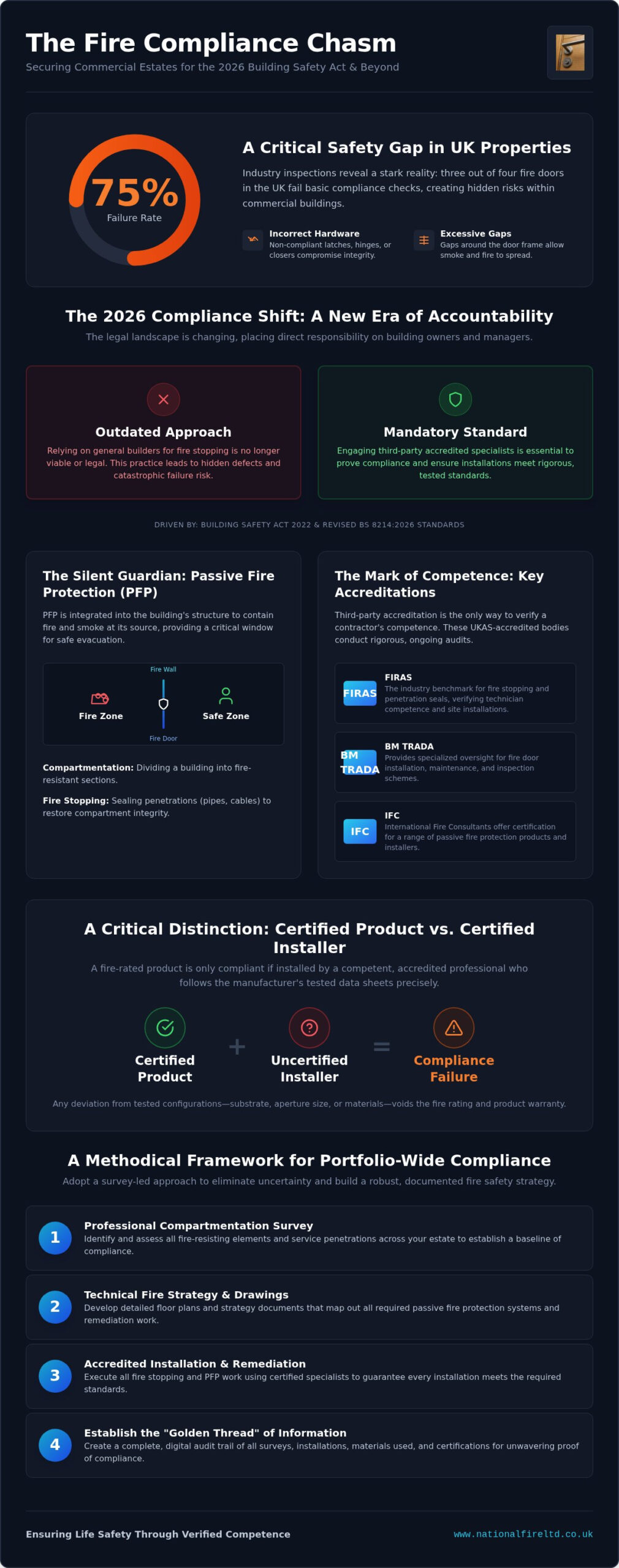
Industry inspections currently suggest that 75% of fire doors in the UK fail basic compliance checks due to incorrect hardware or excessive gaps. You likely recognize the gravity of this statistic, particularly as 2026 introduces more stringent oversight through the Building Safety Act and the revised BS 8214:2026 standards. Securing a commercial estate against hidden defects requires the precision of third-party accredited fire stopping contractors who integrate technical strategy with nationwide execution to ensure life safety.
By adopting a methodical, survey-led approach, you can eliminate the uncertainty surrounding service penetrations and ensure every barrier meets rigorous safety benchmarks. This guide explores how to establish a digital “Golden Thread” of compliance documentation, providing unwavering structural integrity and professional oversight for your entire property portfolio. We’ll examine the technical requirements for 2026, including the transition to BS EN 13501 classifications, and how to maintain a robust fire strategy across complex multi-site environments.
Key Takeaways
- Understand why partnering with third-party accredited fire stopping contractors is essential for meeting the 2026 Building Safety Act requirements and ensuring structural integrity.
- Identify the critical roles of UKAS-accredited bodies such as FIRAS and BM TRADA in verifying contractor competence and installation quality.
- Learn how to integrate technical fire strategy drawings and floor plan generation into your maintenance lifecycle to establish a robust “Golden Thread” of compliance.
- Discover the benefits of specialized solutions like injectable cavity barriers for non-invasive facade remediation across commercial and industrial estates.
- Gain a methodical framework for managing multi-site portfolios through professional compartmentation surveys and systematic oversight of service penetrations.
The Imperative for Third-Party Accredited Fire Stopping Contractors
The traditional approach of allowing general builders to handle fire seals is no longer viable or legal. Under the Building Safety Act 2022 and the updated Regulation 38 requirements for 2026, the burden of proof rests on the Responsible Person to demonstrate that life-safety systems are installed correctly. This shift has elevated third-party accredited fire stopping contractors from a sub-trade to a critical compliance partner. These specialists act as guardians of the building fabric, ensuring that every service penetration and joint maintains the fire resistance of the compartment.
Passive Fire Protection as a Structural Foundation
Passive fire protection (PFP) is not an optional add-on; it’s a fundamental safety feature integrated into the very skeleton of a commercial property. While active systems respond to a fire, PFP works silently to contain it. Effective compartmentation prevents the spread of smoke and flame between floors and rooms, buying time for evacuation and emergency response. Specialist fire stopping is the professional sealing of service breaches to restore the fire-rated integrity of a wall or floor.
The Risks of Non-Accredited Workmanship
Using non-specialist labour for fire stopping often results in hidden defects that only become apparent during a fire or a rigorous audit. A Firestop system that’s poorly installed or uses mismatched materials will fail under thermal stress. This leads to catastrophic compartmentation failure, putting lives at risk and exposing building owners to severe legal and financial liabilities. In a life-safety environment, “near enough” is never acceptable; every seal must be precise and verified.
Professional oversight is the only way to manage these risks effectively. By 2026, the transition from BS 476 to BS EN 13501-1 means that material selection and installation methods are more technical than ever. Engaging third-party accredited fire stopping contractors provides stakeholders with authoritative reassurance. It replaces the anxiety of potential prosecution with the confidence that comes from methodical, verified competence. This disciplined approach ensures that your passive fire protection remains robust, reliable, and fully compliant with the latest UK standards.
Understanding the Accreditations: FIRAS, BM TRADA, and IFC
Accreditation serves as the bridge between theoretical safety and verified performance. In the UK, the United Kingdom Accreditation Service (UKAS) oversees the bodies that audit contractor competence. These bodies, such as FIRAS, BM TRADA, and IFC, don’t just issue certificates; they conduct rigorous, ongoing assessments of both office-based management systems and live site installations. This independent auditing process ensures that third-party accredited fire stopping contractors maintain a consistent standard of quality across every project, regardless of scale or location.
FIRAS is widely recognized as the industry benchmark for fire stopping and penetration seals. It requires contractors to employ competent supervisors and technicians who undergo regular verification. Similarly, BM TRADA and IFC provide specialized oversight, particularly regarding fire door installation and maintenance. These schemes create a transparent record of work, allowing facility managers to trace the lineage of every seal and barrier within their building fabric.
Installer vs. Product Certification
It’s a common misconception that using a certified fire-rated product guarantees a compliant outcome. A sealant or fire batt with a high BS EN 13501-1 rating is only effective if installed in strict accordance with the manufacturer’s tested data sheets. If the substrate, aperture size, or supporting materials deviate from the original lab test, the fire rating is voided. Specialists ensure that the installation mirrors the tested configuration exactly. This meticulous attention to detail maintains the validity of product warranties and prevents catastrophic failure during a fire event.
The Mandatory Filter for Procurement
By 2026, third-party status has transitioned from a “best practice” recommendation to a mandatory filter for commercial procurement. Tenders for high-rise residential, healthcare, and education sectors now almost universally require proof of FIRAS or BM TRADA registration. This requirement protects stakeholders from the legal risks associated with incompetent workmanship. Verifying contractor credentials through official accreditation registers is now a standard step in due diligence. BM TRADA or FIRAS status is the gold standard for specialist contractors because it proves a commitment to technical excellence and life safety. Partnering with a nationwide specialist contractor ensures your entire portfolio benefits from this level of authoritative oversight and documented compliance.
Evaluating the Lifecycle of a Specialist Fire Stopping Project
A specialist project begins long before a single seal is applied. It starts with a comprehensive survey to identify every breach in walls, floors, and ceilings that could compromise life safety. These breaches, often caused by retrofitted cabling or mechanical services, are the primary points of failure during a fire. Third-party accredited fire stopping contractors then develop a technical specification, selecting intumescent materials that expand under heat to block the passage of fire. This selection process is meticulous; materials must match the substrate and the specific service type to maintain the fire rating.
Installation is followed by digital recording, a process that forms the “Golden Thread” of building safety. Every seal is photographed, geo-tagged, and logged into a digital compliance system. This provides an immutable record for Regulation 38 compliance, ensuring that future facility managers have a clear map of all safety assets. Ongoing maintenance is equally vital, as high-traffic commercial environments often see new service installations that can compromise existing barriers. Third-party accredited fire stopping contractors provide the consistent oversight needed to manage these changes throughout the building’s operational life.
Fire Compartmentation and Service Penetrations
Integrating fire compartmentation strategies is the core objective of any remedial project. Specialists restore integrity where pipes and cables breach structural walls using fire-rated mortars, high-density boards, and intumescent wraps. These materials are tested to BS EN 13501-2 standards, ensuring they perform under extreme thermal stress. By sealing these penetrations, we ensure that the building’s internal divisions remain an effective barrier against smoke and flame.
Specialist Fire Door Services
A fire door is a complex life-safety device, not merely a piece of joinery. For industrial and commercial compliance, regular fire door surveys are essential to identify wear, damage, or improper modifications that could lead to failure. Professional maintenance protocols ensure that closers, seals, and hinges operate with absolute reliability. We treat every door as a critical component of the wider fire strategy, ensuring it provides the necessary resistance to protect escape routes and occupants.
Technical Strategy: Integrating Strategy Drawings and Cavity Barriers
Effective fire protection is not merely a matter of reactive installation; it’s a disciplined technical strategy. While physical seals are the visible components of safety, they must be guided by accurate blueprints that define the building’s fire-rated boundaries. This is where third-party accredited fire stopping contractors provide the greatest value. By integrating technical surveying with strategy drawing, we ensure that every installation is purposeful and aligned with the building’s original design intent or updated 2026 safety requirements. This methodical approach eliminates the guesswork that often leads to compliance gaps in complex commercial structures.
Fire Strategy Drawings and Floor Plans
Accurate fire strategy drawings serve as the essential blueprint for building-wide safety compliance. These documents are vital for emergency planning, as they define escape routes, fire-rated partitions, and high-risk zones. We specialize in floor plan generation that maps every fire safety asset, from penetration seals to fire doors. This digital asset mapping supports long-term maintenance by allowing facility managers to identify the location and specification of every barrier. When technical drawings are seamlessly integrated with physical fire stopping assets, the result is a transparent and manageable safety ecosystem that stands up to the most rigorous audits.
Specialised Cavity Barrier Solutions
External wall systems and rainscreens present a unique “hidden” risk in modern commercial architecture. Fire can travel rapidly through the concealed spaces behind a facade if cavity barriers aren’t correctly specified and installed. These barriers are designed to close the gap in the event of a fire, preventing the chimney effect that has historically led to rapid external fire spread. Addressing these risks requires a sophisticated understanding of both material science and structural engineering.
Injectable cavity barriers represent the modern solution for non-invasive facade remediation. This technology allows third-party accredited fire stopping contractors to restore the integrity of an external wall system without the need for extensive deconstruction. It’s an ideal approach for complex commercial buildings where operational continuity is a priority. These solutions are fully compliant with the latest UK standards for external wall systems, providing a robust defense against hidden fire spread while minimizing disruption to the building’s occupants. To ensure your estate meets these technical benchmarks, you should partner with a specialist nationwide contractor who can manage both the technical drawing and physical remediation phases.
Partnering for Nationwide Compliance: The National Fire Ltd Approach
While many firms operate within regional hubs, National Fire Ltd provides a unified approach to passive fire protection across the entire UK. Managing a multi-site portfolio requires a level of consistency in standards and reporting that regional contractors often struggle to deliver. As third-party accredited fire stopping contractors, we serve as a single point of accountability for property managers overseeing diverse assets, from industrial warehouses to high-density office blocks. Our methodology combines rigorous physical installation with advanced technical strategy to ensure every building in your estate meets the same high benchmark of safety.
Guardian Approach to Building Safety
We don’t view our team as a mere service provider; we position ourselves as a long-term guardian of your building’s integrity. This partnership model is essential for navigating the complexities of 2026 regulatory compliance effectively. By acting as a single national partner, we provide property managers with a standardised data set across their entire portfolio. This eliminates the fragmentation often caused by using multiple contractors with varying documentation styles. Our commitment to technical excellence ensures that your fire safety strategy remains a living document that evolves alongside your estate’s operational needs.
Securing Your Property Portfolio
Engaging with our experts begins with a comprehensive technical survey designed to identify current vulnerabilities and document existing assets. We use this data to generate a compliance passport for your building, a digital repository that forms the core of your “Golden Thread” documentation. This process ensures that every service penetration, fire door, and cavity barrier is accounted for and verified against 2026 standards. We specialise in complex remedial works, including injectable cavity barriers and technical floor plan generation, providing a level of oversight that goes beyond simple installation.
Reliability in the fire safety sector isn’t just about technical skill; it’s about constant availability and steadfast support. We understand the high stakes involved in life safety and the legal pressures on “Responsible Persons” to maintain unwavering standards. Our experts stand behind every assessment and technical solution we provide, ensuring your commercial property remains a secure environment for all occupants. Contact our specialist team today to discuss your national fire safety requirements and learn how we can bring authoritative reassurance to your compliance strategy.
Securing Your Estate for the 2026 Regulatory Landscape
The transition to the BS EN 13501 classification system and the heightened requirements of the Building Safety Act demand a disciplined approach to passive fire protection. Managing a multi-site portfolio requires more than just reactive repairs; it necessitates a unified strategy that bridges technical surveying with accredited installation. By partnering with third-party accredited fire stopping contractors, you ensure that every service penetration and fire door meets the highest standards of life safety. We provide the professional oversight needed to establish a digital Golden Thread, protecting both your occupants and your legal standing.
Our expertise in technical fire strategy drawings, floor plan generation, and injectable cavity barrier solutions ensures your estate remains compliant and resilient against hidden risks. We provide nationwide commercial and industrial coverage, offering the stability and reliability your stakeholders expect. You don’t have to navigate these complex safety standards alone. Secure your national property portfolio with National Fire Ltd today and gain the peace of mind that comes from unwavering structural fire integrity.
Frequently Asked Questions
What should I look for when hiring specialist passive fire protection contractors?
You should prioritize contractors who hold UKAS-accredited third-party certifications such as FIRAS, BM TRADA, or IFC. It is essential to verify their registration on official databases to ensure their competence is current. Look for a partner who offers integrated technical surveying and strategy drawing alongside physical installation. This ensures that every barrier installed aligns precisely with your building’s specific fire strategy and the latest 2026 safety standards.
Are fire compartmentation surveys mandatory for UK commercial buildings?
Yes, under the Regulatory Reform (Fire Safety) Order 2005 and the Fire Safety Act 2021, the Responsible Person must ensure the building’s fire safety measures are effective. Regular compartmentation surveys are the only way to verify that walls, floors, and ceilings maintain their required fire resistance. These surveys identify breaches caused by retrofitted services, ensuring the building remains compliant with Regulation 38 and provides a secure environment for all occupants.
How do specialist contractors document their fire stopping work for compliance?
Specialist third-party accredited fire stopping contractors utilize digital quality assurance tools to record every installation in real time. Each seal is photographed, geo-tagged, and logged against a digital floor plan. This creates an immutable “Golden Thread” of information that satisfies Regulation 38 requirements. This documentation provides facility managers with a transparent record of the specific materials used and the fire rating achieved for every penetration across the estate.
Can specialist PFP contractors work in occupied buildings without disruption?
Specialist contractors are experienced in working within live commercial and industrial environments. We use methodical installation techniques and dust-suppression equipment to minimize the impact on daily operations. For facade remediation, we often employ injectable cavity barriers. This allows us to restore fire integrity without deconstructing the external wall system. This non-invasive approach ensures building safety is upgraded while the premises remain fully operational for employees and tenants.
What is the difference between a general builder and a specialist fire stopping contractor?
A specialist contractor possesses deep technical knowledge of intumescent materials and manufacturer data sheets. General builders often lack the specific accreditation required to certify life-safety works. Unlike generalists, third-party accredited fire stopping contractors undergo regular, independent audits. This ensures their installations precisely match laboratory-tested configurations. A general builder’s “near enough” approach can lead to catastrophic compartmentation failure, whereas a specialist ensures every seal is technically verified and legally compliant.
How often should fire door surveys be conducted by a specialist?
The frequency of fire door surveys depends on the building’s risk profile, but a minimum of every six months is standard for most commercial properties. In high-traffic industrial settings, more frequent inspections may be necessary. These surveys ensure that closers, seals, and hinges remain fully functional. Regular inspections are a legal requirement under the Fire Safety (England) Regulations 2022 for certain buildings, and similar diligence is expected across all commercial sectors.
What are injectable cavity barriers and why are they used by specialists?
Injectable cavity barriers are a modern solution for restoring fire integrity within concealed facade spaces. They are used to remediate external wall systems where traditional barriers are missing or have been incorrectly installed. Specialists use this method because it is non-invasive and highly effective at preventing the “chimney effect” fire spread. This technology allows for the precise application of fire-rated material into complex voids, ensuring compliance with the latest UK standards for external wall safety.
Do specialist contractors provide fire strategy drawings for existing buildings?
Yes, specialists provide technical fire strategy drawings and floor plan generation for existing commercial buildings. These drawings act as a blueprint for safety, mapping out fire-rated partitions and escape routes. By documenting the current state of a building’s compartmentation, we help facility managers plan future remedial works and emergency evacuations. This technical oversight is a core component of a professional safety lifecycle, ensuring that physical installations always align with a documented safety strategy.