


In the current regulatory climate, the distinction between a qualified contractor and an accredited specialist is no longer a matter of preference; it’s the definitive line between legal compliance and personal liability. You likely feel the mounting pressure of the Building Safety Act 2022 and the 2026 transition to BS EN 13501 standards. Identifying truly accredited passive fire protection companies UK can feel like an overwhelming task when many firms claim expertise, yet few provide the rigorous documentation your safety files require.
We understand the weight of this responsibility. This guide provides a clear, methodical path to help you identify, verify, and select contractors who possess the technical excellence needed to safeguard your property. You’ll learn how to distinguish between surface-level qualifications and robust third-party accreditation. We’ll also examine the essential role of technical surveys and strategy drawings in maintaining your Golden Thread of information. By the end, you’ll have a reliable framework for choosing partners who offer the documented peace of mind that your fire compartmentation is beyond reproach.
Key Takeaways
- Understand why third-party validation is the only legal safeguard for maintaining the “Golden Thread” of information under the latest building safety regulations.
- Learn the specific protocol for verifying accredited passive fire protection companies UK, moving beyond marketing logos to checking live TPI and ASFP registers.
- Identify the essential industry benchmarks for quality assurance, including BM TRADA certification for fire door installation and maintenance.
- Discover why a comprehensive compartmentation survey and technical fire strategy drawings are the mandatory first steps for any remediation project.
- Follow the “Survey to Certification” model to ensure that every fire stopping measure and cavity barrier installation is fully documented for regulatory compliance.
The Importance of Accredited Passive Fire Protection in 2026
Passive fire protection (PFP) is a fundamental component of structural fire safety. It’s designed to contain fires within their origin and prevent the spread of smoke and heat through fire-resistant walls, floors, and service penetrations. In 2026, the definition of “accredited” PFP has evolved to mean third-party validated safety measures. It’s no longer just about the product itself but about the rigorous validation of the installation process. This ensures that every seal and barrier performs as intended during a fire event, providing the stability required for safe evacuation.
The UK legal framework, primarily the Regulatory Reform (Fire Safety) Order 2005, places the burden of proof on building owners and managers. You must demonstrate that your fire safety measures are adequate and maintained by competent professionals. In 2026, as the UK completes its transition to the BS EN 13501 classification system, the complexity of compliance has increased. For many, partnering with accredited passive fire protection companies UK is the only way to satisfy the requirements of insurers and legal auditors. Accreditation serves as the foundation of the “Golden Thread” of information, providing a verifiable digital record of compliance from the initial survey through to final certification.
Passive vs. Active Fire Protection: The Compliance Difference
While active systems like sprinklers or alarms are visible and easily tested, PFP is often hidden within the building structure. This hidden nature makes it the most scrutinized element during a fire safety audit. If a fire door is poorly installed or a service penetration isn’t correctly fire-stopped, the entire safety strategy fails. Understanding the nuances of these systems is vital for any stakeholder. For a deeper look at these differences, refer to our Passive Fire Protection guide. Choosing accredited firms ensures that critical structural elements like fire stopping and cavity barriers are installed to precise, tested specifications.
The Legal Risks of Non-Accredited PFP Installation
The Building Safety Act 2022 has fundamentally shifted how “Responsible Persons” must approach contractor selection. There’s now a mandatory requirement to provide evidence of competence for any work affecting fire safety. Relying on non-accredited installers creates significant legal exposure. Failure to comply can result in unlimited fines or criminal prosecution if safety standards are breached. In commercial construction, the industry has moved toward a model where documentation is as important as the physical work itself. To mitigate these risks, building managers increasingly rely on accredited passive fire protection companies UK to provide the necessary technical oversight and certification required by the new secondary legislation.
Key Third-Party Accreditations to Look For
Selecting the right partner requires a clear understanding of the hierarchy of credentials. Many firms display trade association logos, but there’s a significant difference between membership and third-party certification. The Association for Specialist Fire Protection (ASFP) serves as the industry’s technical authority, providing the essential guidance that accredited passive fire protection companies UK must follow. Membership in the ASFP indicates a commitment to these standards, but the gold standard for compliance is a Third-Party Installer (TPI) scheme, such as those provided by International Fire Consultants (IFC).
Manufacturer-led training schemes, while valuable for product-specific knowledge, shouldn’t be confused with independent accreditation. For example, a contractor might be “trained” by Quelfire to use their specific sealants, but this doesn’t replace the systemic oversight of a TPI. A certified company undergoes regular, unannounced audits of their workmanship on live sites, ensuring that every installation meets the rigorous criteria outlined in Approved Document B (Fire Safety). This independent layer of scrutiny is what provides the documented evidence needed for building control approval.
Fire Door Certification: Why BM TRADA Matters
Fire doors are complex life-safety devices that require precise installation to function correctly. BM TRADA’s Q-Mark schemes are essential because they certify both the installation and the ongoing maintenance of the door set. When you hire a contractor with this accreditation, you’re ensuring that each door is fitted exactly to its tested specification. This level of detail is critical, as even a minor deviation in the gap or the choice of intumescent strip can compromise the door’s integrity. For a deeper understanding of these requirements, our Fire Door Guide details the specific standards required for commercial properties.
Third-Party Installer Schemes (TPIs)
A common pitfall for building managers is assuming that a “qualified” individual is sufficient. In the eyes of the law, there’s a vital distinction between a company being certified and an individual having attended a training day. TPI schemes certify the entire organization’s quality management systems and technical competence. These schemes require the contractor to maintain a robust record-keeping process, which is the only way to satisfy the “Golden Thread” requirements of the Building Safety Act. If you’re unsure where your current compliance stands, National Fire Ltd can provide a technical review of your existing documentation to ensure it meets these high standards.
Regular audits by TPI bodies ensure that workmanship doesn’t slip over time. These assessments verify that the materials used match the fire strategy drawings and that the installation methods are consistent with the manufacturer’s primary test evidence. For accredited passive fire protection companies UK, this ongoing validation isn’t a burden but a mark of professional integrity. It’s the mechanism that transforms a simple installation into a legally defensible safety measure.
Evaluating PFP Contractors: A Verification Protocol
To move beyond trust and into verification, you must implement a rigorous vetting protocol. It’s not enough for a firm to display a logo on their website; you must demand their specific accreditation number. Legitimate accredited passive fire protection companies UK will provide this without hesitation. Once received, cross-reference this number directly on the relevant TPI or ASFP register. This step confirms the company is currently active and that their specific scope of work, whether it’s fire stopping or door installation, is covered by their certification.
Beyond the paperwork, evaluate their technical output. Request a portfolio of their technical fire strategy drawings and recent compartmentation surveys. This demonstrates their ability to manage complex data and integrate it into the Fire Safety (England) Regulations 2022 framework. You should also check for specialized capabilities. Projects involving facades, for instance, often require injectable cavity barriers. This is a niche solution that demands specific installer competence and specialized equipment that general contractors often lack.
The Role of Technical Surveys and Drawings
An accredited contractor shouldn’t start with an invoice; they must lead with a fire compartmentation survey. This survey identifies existing breaches and provides the technical baseline for all remedial works. Floor plan generation is equally vital, as it allows for the precise mapping of PFP locations, creating a permanent record for building control. It ensures that every fire seal is accounted for in the building’s digital record. For more information on this process, see our Fire Compartmentation Guide.
Case Studies and Proof of Competence
Sector-specific experience is a critical trust marker. A contractor who excels in industrial warehouses may not have the specific oversight required for high-rise commercial offices. Look for “before and after” photographic evidence in their compliance reports. This isn’t just for show; it’s the physical evidence required for the Golden Thread of building safety. Similarly, specialized elements such as fire-rated balconies require accredited passive fire protection companies UK that understand the intersection of structural integrity and fire performance. Demand evidence of similar completed projects to ensure their technical expertise aligns with your building’s specific risks.
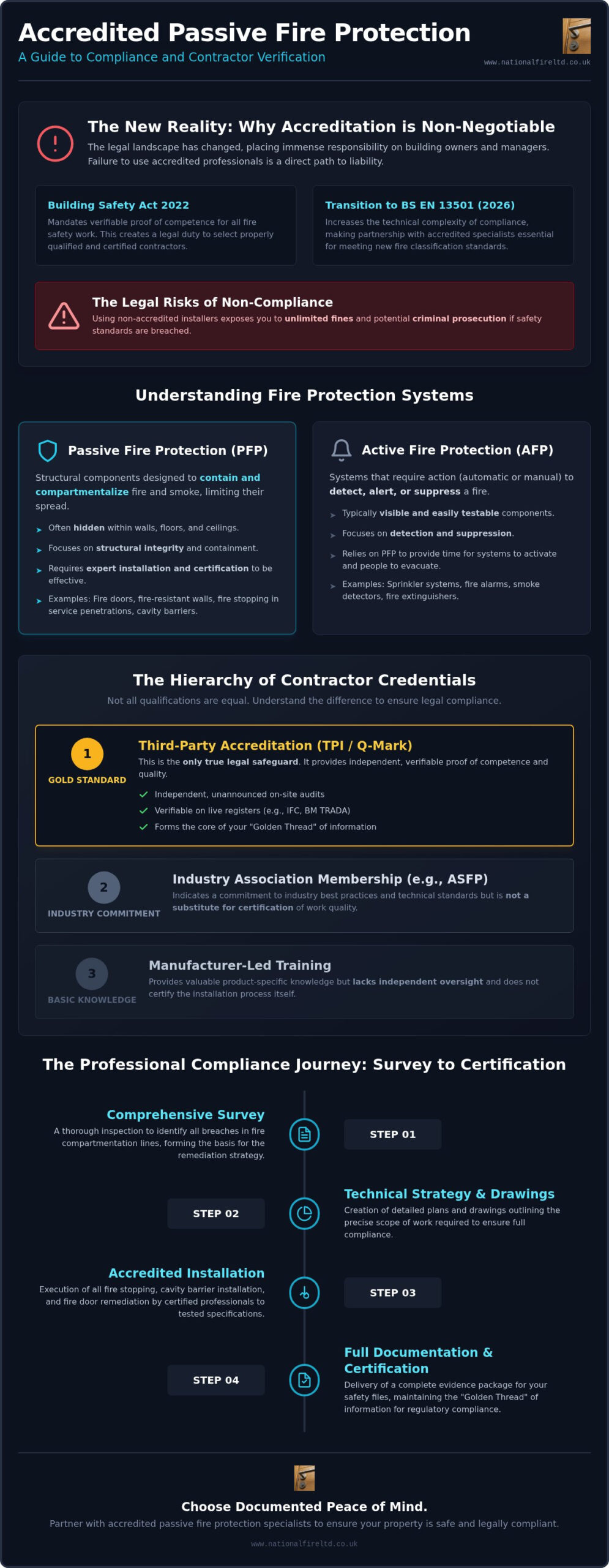
The Professional Compliance Journey: From Survey to Certification
Achieving full regulatory compliance requires a structured, multi-phase approach. It begins with comprehensive Fire Compartmentation Surveys and Fire Door Surveys to identify every breach and non-conformity. This diagnostic stage is critical. Without it, remediation is merely guesswork. Following the survey, accredited passive fire protection companies UK produce technical design documents, including fire strategy drawings. These drawings provide the exact specification for every remedial action. This ensures that the proposed fire stopping measures align with the building’s original fire strategy. This documentation acts as the blueprint for safety.
The installation phase involves the precise application of fire stopping materials, fire door installation, and the fitting of cavity barriers. These works must be carried out by accredited teams who understand the technical requirements of each component. Once the physical works are complete, the final phase is the issuance of certification. This isn’t just a receipt. It’s a detailed data package for the Golden Thread. It includes photographic evidence and material batch numbers. This provides building owners with the documented proof required by the Building Safety Act 2022.
Addressing Hidden Risks with Cavity Barriers
Facade safety remains a primary concern for building managers. Cavity barriers are designed to prevent the spread of fire through hidden voids in the building envelope. For many existing structures, traditional barrier installation is invasive and costly. Accredited specialists now utilize injectable cavity barriers to address these risks without major structural disruption. This specialized technique requires precise oversight to ensure the barrier expands correctly within the void. For detailed technical specifications on these systems, see our Cavity Barriers Guide.
Remedial Works and Ongoing Maintenance
Compliance isn’t a “one-off” event. It’s a continuous obligation. For accredited passive fire protection companies UK, the focus remains on long-term structural integrity rather than temporary fixes. Fire safety components, particularly fire doors, are subject to wear and tear that can compromise their rating over time. Regular fire door maintenance schedules are essential in commercial environments to ensure every component remains functional. Accredited firms manage the entire lifecycle of these assets. They provide the periodic inspections and remedial works necessary to maintain the integrity of the fire compartmentation. If your building requires a professional audit of its current safety measures, you can partner with National Fire Ltd for a comprehensive safety review.
Partnering with National Fire Ltd for UK-Wide Compliance
National Fire Ltd operates as a specialist contractor dedicated to the commercial and industrial sectors. We provide a unified front of experts to resolve the complexities of modern fire safety. As one of the premier accredited passive fire protection companies UK, we prioritize technical excellence from the very first assessment. Our national team understands that building safety isn’t merely a service; it’s a profound responsibility to protect both life and property. We don’t just install products; we engineer safety systems that stand up to the most rigorous legal scrutiny.
Technical Fire Safety Solutions
Our methodology integrates fire compartmentation surveys and fire door surveys directly with the generation of technical fire strategy drawings and floor plans. This seamless transition from identification to technical design eliminates the data gaps that often compromise the Golden Thread. By acting as a single partner for the entire compartmentation process, we ensure that remedial fire stopping and door installations are executed exactly as specified in the design phase. This unified approach reduces administrative burden and ensures that every seal and barrier is fully documented for regulatory audits. We provide specialized facade safety through the installation of fire-rated balconies and the application of injectable cavity barriers designed to stop hidden fire spread.
Securing Your Building’s Future
The legal landscape of 2026 demands meticulous oversight and unwavering standards. We handle the intricacies of the Building Safety Act and its secondary legislation so that building managers can focus on their core operations without the fear of non-compliance. Partnering with accredited passive fire protection companies UK provides the psychological benefit of absolute security. It means knowing that every fire door maintenance schedule and fire stopping installation is backed by industry-standard certifications. Our documentation provides the definitive evidence required to protect the Responsible Person from legal liability and ensure the building remains a safe environment. We invite you to contact our team to secure a professional survey and take the first step toward comprehensive, UK-wide compliance.
Ensuring Structural Integrity and Legal Compliance
Navigating the complex landscape of fire safety requires more than just high-quality materials; it demands a partnership with accredited passive fire protection companies UK that understand the technical depth of the Golden Thread. You’ve seen that true compliance isn’t a single event but a disciplined journey from initial survey to final certification. By prioritizing third-party validation and technical fire strategy drawings, you protect your building from the hidden risks of non-compliance and ensure that every fire door and compartment seal meets the rigorous standards of 2026.
National Fire Ltd stands as a guardian of your property, offering nationwide commercial coverage and specialist expertise. We are BM TRADA certified fire door installers and experts in generating the technical drawings required for complex industrial and commercial sectors. Our methodical approach provides the documented evidence you need to satisfy the Building Safety Act and ensure long-term stability. It’s time to move beyond uncertainty and secure your building’s future with a partner you can trust. Contact National Fire Ltd for an Accredited Fire Compartmentation Survey to begin your compliance journey today. Professional oversight is the most reliable way to achieve lasting peace of mind.
Frequently Asked Questions
What is the difference between an accredited and a non-accredited fire company?
An accredited company has undergone independent, third-party validation of its technical competence and management systems. While a non-accredited firm may claim to be “qualified” based on experience, they lack the systemic oversight provided by bodies like FIRAS or IFC. This validation ensures that the installation methods used by accredited passive fire protection companies UK are consistent with primary fire test evidence. It provides the necessary documentation for legal safety compliance.
How do I check if a passive fire protection company is actually certified?
You should always request a contractor’s unique third-party accreditation number rather than relying on a logo. Once you have this number, visit the official online register of the relevant certification body, such as the ASFP or a Third-Party Installer scheme like BM TRADA. These registers are updated in real-time and will confirm if the company’s certification is current and covers the specific scope of work you require, such as fire stopping.
Is third-party accreditation a legal requirement for fire stopping in the UK?
While the law doesn’t explicitly mandate third-party accreditation for every project, the Building Safety Act 2022 requires “Responsible Persons” to prove they’ve used competent professionals. Using accredited passive fire protection companies UK is the most robust way to demonstrate this competence. In high-risk buildings, failure to provide evidence of third-party validation can lead to building control rejection or personal legal liability for the building manager. It’s a critical legal safeguard.
What specific accreditations should I look for in a fire door installer?
The industry standard for fire door installation and maintenance is the BM TRADA Q-Mark scheme. This accreditation ensures that the installer has been rigorously audited and possesses the technical expertise to fit doors according to the manufacturer’s tested specifications. You should also look for membership in the Association for Specialist Fire Protection (ASFP). This indicates the contractor is fully integrated into the professional and legal framework of the UK safety sector.
Can a general builder install passive fire protection measures?
A general builder may have basic knowledge, but they often lack the specialist technical drawings and primary test evidence required for compliant installation. Passive fire protection is a highly regulated field where even a millimetre of deviation can cause a safety system to fail. Accredited specialists provide the necessary certification and photographic evidence that a general builder cannot, ensuring the building remains legally compliant and safe for its occupants.
What is the Golden Thread and how does an accredited company help maintain it?
The Golden Thread is a digital record of a building’s fire safety information from design through to maintenance, as mandated by the Building Safety Act. An accredited company supports this by providing documented evidence for every installation, including material batch numbers and photographic proof of work. This methodical record-keeping ensures that the building’s safety data is accurate and accessible, allowing building managers to demonstrate compliance throughout the property’s entire lifecycle.
How often should passive fire protection measures be surveyed by an accredited firm?
The frequency of surveys depends on your building’s usage and risk profile. An annual fire compartmentation survey is the standard recommendation for most commercial properties. Fire doors, which are subject to regular mechanical wear, often require more frequent inspections, typically every six months. Regular surveys ensure that any breaches caused by building movement or third-party contractors are identified and remediated before they compromise your building’s overall safety strategy.
Does National Fire Ltd provide accreditation for fire-rated balconies?
National Fire Ltd is an accredited specialist contractor that provides the design and installation of fire-rated balconies. We don’t act as an independent accrediting body; instead, we ensure that our balcony solutions meet all necessary third-party standards. Our experts provide the technical drawings and certification required to prove that these installations are fully compliant with the latest UK fire safety regulations for commercial and high-rise buildings. We focus on structural integrity and compliance.