


The strongest fire-protection specification isn’t necessarily the one with the most familiar brand name. In a promat vs rockwool fire protection comparison, the deciding factor is whether the exact system suits the application, construction detail and required performance. A product’s reputation alone can’t show whether it is appropriate for a service penetration, cavity barrier or joint, or whether its evidence covers the project’s specific conditions.
It’s understandable to ask whether Promat or ROCKWOOL is the better choice. Both manufacturers offer fire-protection materials, but suitability depends on the system and its documented scope, not a blanket brand ranking. This guide explains how to compare solutions by application, review relevant test and classification evidence, and check technical documents against the substrate, dimensions and installation requirements. It also explains when a fire compartmentation survey or specialist fire-stopping input can help identify gaps before they affect compartmentation or compliance. National Fire Ltd connects project assessment with firestopping work, supporting evidence-led decisions from specification through installation.
Key Takeaways
- For promat vs rockwool fire protection, compare systems intended for the same application rather than ranking brands in general.
- Check whether the system evidence matches the project’s construction detail, including the substrate, services and installation requirements.
- Use the fire strategy, drawings, surveys and relevant system documents to establish what needs protection before specifying a solution.
- Follow a clear decision sequence: define the detail, review the evidence, compare suitable systems and record the rationale.
- National Fire Ltd connects compartmentation surveys and fire-related drawings with firestopping work. Its fire-door maintenance service is authorised to offer fully certified maintenance service by the UK’s main Fire door certification body, BM Trada Q-Mark.
Promat vs ROCKWOOL fire protection: why the application matters more than the brand
Promat and ROCKWOOL are manufacturers, not single fire-protection systems. Each brand name covers products intended for different purposes, and a material that suits one detail may not suit another. The useful comparison is between complete systems proposed for the same building application, supported by evidence that relates to that specific use.
Passive fire protection helps a building’s fire-resisting compartments perform as intended. Walls and floors are designed to restrict the spread of fire and smoke; openings and gaps can compromise that separation if they aren’t appropriately protected. Firestopping addresses vulnerable points, such as services passing through a fire-resisting wall or floor. It forms part of the broader Fire protection approach, which includes both passive and active measures.
What does a Promat versus ROCKWOOL comparison actually compare?
Keep four levels distinct. The manufacturer is the company. A product category describes a type of material or component. A system is the tested or assessed arrangement, including relevant materials and installation details. The application is the real building condition the system is intended to address, such as a service passing through a fire-resisting floor.
Comparing two brand names skips the critical questions: are the products intended for the same application, and does each system’s evidence cover the actual construction detail? A material’s general properties don’t, by themselves, establish how a specific installed arrangement performs. The supporting documents and their stated scope matter.
Why can’t one brand be named the universal winner?
The right choice depends on the detail to be protected and the performance required by the project. A linear joint, a cavity and a service penetration have different configurations. Even within one application, the supporting construction, dimensions, service type and installation method can affect whether a system’s evidence is relevant. Read a product claim in context rather than treating it as proof that the product suits every fire-stopping situation.
Before comparing options, establish what is present and what the design requires. Then check whether the system documentation addresses those conditions. This is more reliable than relying on a broad material description or headline performance statement.
- Material properties: describe the material itself.
- System evidence: relates to a defined arrangement and use.
- Installation detail: determines whether the specified arrangement is followed on site.
Project-specific evidence matters more than brand preference because fire protection depends on the performance of the specified system in the actual building detail. Neither Promat nor ROCKWOOL is automatically right for every application. A defensible promat vs rockwool fire protection decision compares like with like and uses evidence that fits the project.
Compare Promat and ROCKWOOL by material, system evidence and application
A useful comparison starts with the building detail, then checks which manufacturer information and system evidence relates to it. Promat’s published technology categories include fire-resistant boards, fire stopping and cavity barriers. ROCKWOOL describes Fire Barrier EN for concealed spaces, with a stated role in mitigating the spread of fire and smoke. These descriptions help identify areas to investigate, but they don’t establish that products from the two manufacturers are direct alternatives.
Keep material properties separate from system performance. A material description tells you about a component; evidence for a system relates to a defined arrangement and its stated conditions of use. Don’t assume that a claim about a material proves the performance of every assembly in which it might be installed.
Compare the same application and its supporting evidence
Use the table as a comparison framework, not as a declaration that a Promat and a ROCKWOOL solution are interchangeable. The relevant documents should identify the precise application and set out the conditions that apply. If the evidence describes different uses or construction details, the comparison isn’t like for like.
| Application | System evidence | Substrate | Services | Installation detail |
|---|---|---|---|---|
| Service penetration through a fire-resisting wall or floor | Check that evidence covers the penetration type and proposed system arrangement. | Match the supporting construction described in the documentation to the project detail. | Compare the service type, configuration and any stated limitations. | Follow the documented preparation, materials and fitting method. |
| Concealed space requiring a fire barrier | For ROCKWOOL Fire Barrier EN, review the manufacturer’s stated concealed-space application and applicable system information. | Check that the construction and cavity conditions align with the evidence. | Identify any services or obstructions that affect the proposed arrangement. | Review positioning and other installation conditions stated for the system. |
| Board-based protection or a joint detail | For Promat, identify the relevant technology and evidence for the intended use, rather than relying on the category name alone. | Check the documented supporting construction and boundaries of use. | Record whether service penetrations form part of the tested or assessed detail. | Confirm the specified assembly and installation method are represented. |
What makes the comparison fair?
For each proposed system, record the application, supporting construction, services, dimensions and installation conditions covered by its documentation. Note exclusions and limitations too. If a key project feature falls outside the stated scope, the evidence may not support the detail as specified. Avoid comparing headline claims from separate product pages as if they establish equivalent performance.
A fair Promat and ROCKWOOL comparison uses current evidence for the same application and checks it against the actual project detail. That is the practical basis for a defensible promat vs rockwool fire protection decision, without declaring a universal winner. Where existing construction or compartment lines need clarification, a fire compartmentation survey can inform the project assessment.
What to check before specifying Promat or ROCKWOOL fire protection
Begin with the fire strategy and the precise building detail that needs protection. The specification should respond to the intended compartmentation and conditions on site, not simply name a familiar manufacturer. A brand name can identify a source of products, but it can’t establish that a particular system suits the construction, opening or services present.
Before comparing options, assemble the information that describes both the design intent and the existing condition. This may include:
- Fire strategy drawings showing compartment lines and the elements intended to provide fire resistance.
- Architectural or construction drawings identifying walls, floors, cavities and relevant dimensions.
- Service layouts showing the type and position of pipes, cables or other penetrations.
- Fire compartmentation survey findings, particularly where the installed construction differs from the available plans.
- Manufacturer system documents, including their stated application, supporting construction and installation conditions.
Which project details affect system selection?
Pinpoint the element and detail first: for example, a service penetration through a wall, a floor opening or a concealed space. Then compare the recorded substrate, construction, configuration and existing compartmentation with the proposed system’s stated scope. If drawings conflict with survey findings, or the substrate and dimensions are uncertain, record the discrepancy for assessment. Don’t fill information gaps with assumptions based on product familiarity.
Requirements and applicable guidance can depend on the building and project. Confirm the relevant fire strategy, performance requirement and guidance for the specific work before selecting a system. This keeps the decision anchored to the project brief and its compliance context.
What evidence should a responsible specification review record?
Keep a clear record of the system documentation reviewed and the application it covers. Check its intended scope against the actual substrate, services, configuration and installation method. Note limitations, exclusions and any conditions that need to be maintained on site. This makes it easier to identify where the design detail aligns with the evidence and where further assessment is needed.
- The exact building location and detail under review.
- The drawing or survey information used to establish existing conditions.
- The relevant system documents and stated application.
- Any differences, assumptions or unresolved information requiring follow-up.
A wider understanding of how compartment lines support building safety can help put this review in context. The fire compartmentation guide explains the role of fire-resisting separation in a building.
For promat vs rockwool fire protection, the practical test is whether the evidence supports the proposed system in the real project detail. A careful review of drawings, surveys and documents gives the specification a clearer basis than brand preference alone.
How to make a defensible Promat vs ROCKWOOL fire-protection decision
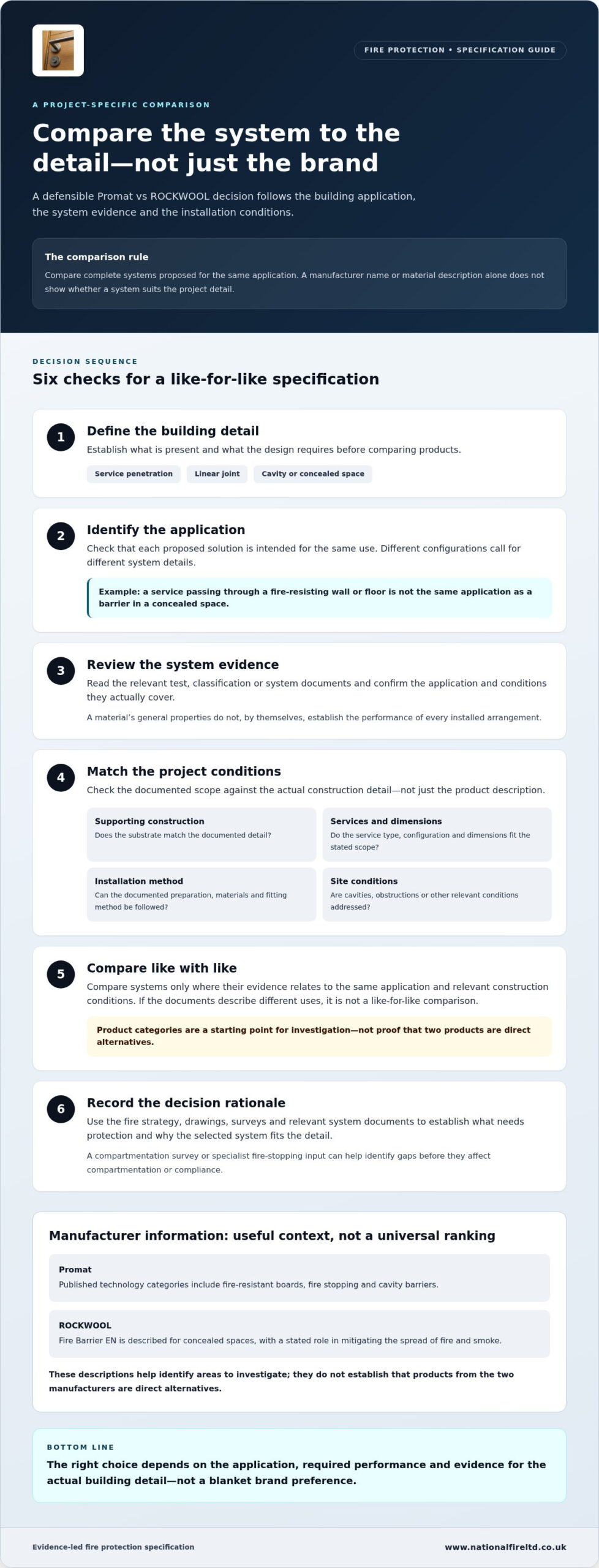
A defensible specification follows a clear trail from the building condition to the selected system. For promat vs rockwool fire protection, the aim isn’t to favour a manufacturer. It’s to select an option whose documented scope fits the detail, then record why it was chosen and how installation must follow that evidence.
A four-step process for comparing systems
Use this sequence to make the decision traceable and expose information gaps before they become assumptions.
- Define the detail. Identify the wall, floor, cavity or other building element, its location and the fire-protection objective. Use the fire strategy and available project information to establish what the detail is meant to achieve.
- Gather relevant evidence. Collect current system documentation for the specific application and configuration. Note the construction, services, dimensions and installation conditions the documents address.
- Compare suitable systems. Consider only options whose documented scope relates to the project detail. If a key feature differs, such as the substrate or service arrangement, record that difference rather than assuming the evidence applies.
- Record the decision. Document the selected system, supporting evidence and rationale. Include assumptions, limitations and unresolved information, along with installation requirements that need to be carried through to the work.
This last step matters. Material selection alone doesn’t describe the completed fire-stopping arrangement. The record should connect the chosen system’s documented scope with the installation detail, so the work can be understood and assessed against the specification.
When can surveys and fire strategy drawings help?
Existing buildings may not match available drawings. A fire compartmentation survey can help establish the observed condition and identify where information about compartment lines or penetrations needs clarification. Fire strategy drawings set out the intended fire-safety approach, while floor plan generation can support clear project records where usable plans are needed.
If survey findings and design information conflict, resolve the discrepancy before treating either system as a straightforward fit. The broader passive fire protection guide provides context on how passive measures contribute to building safety.
National Fire Ltd connects assessment, fire-related drawings and firestopping work, helping project teams carry a clear understanding of the building detail into installation. Its fire compartmentation surveys, drawings and firestopping services support this process.
Where National Fire Ltd fits into a fire-protection specification
Promat and ROCKWOOL manufacture fire-protection products. National Fire Ltd provides passive fire protection services, including firestopping, fire door installation and maintenance. That distinction matters: manufacturer evidence informs the specification, while the contractor’s role is to understand the building detail and carry out the specified work in line with the relevant requirements.
For a promat vs rockwool fire protection decision, National Fire Ltd doesn’t present either manufacturer as the automatic choice. The focus is on matching the project’s fire strategy and site conditions with relevant system evidence, then carrying the agreed detail through to installation. National Fire Ltd is certified by BM Trada Q-Mark and accredited by Safe Contractor and Constructionline Gold.
How National Fire Ltd supports project assessment and delivery
A fire compartmentation survey can help establish conditions in an existing building, including where the observed layout or penetrations need to be considered alongside available records. Findings can inform fire strategy drawings and floor plan generation, helping project teams work from clearer fire-related information when planning firestopping.
This joined-up route connects assessment with practical work without treating product selection as the whole specification. The chosen system’s scope and installation detail remain central. Where the project involves a concealed space, a cavity barriers guide can provide further context on this type of passive fire protection.
What does accredited maintenance contribute after installation?
Fire protection needs appropriate attention after installation too. National Fire Ltd is authorised to offer fully certified maintenance service by the UK’s main Fire door certification body, BM Trada Q-Mark. Its fixed-cost fire door maintenance service supports financial planning and control, helping organisations plan for maintenance as part of property management.
The client portal lets clients view scheduled or completed maintenance visits and generate reports. These records keep information about maintenance activity accessible. They don’t replace the need to follow the project’s fire strategy or retain relevant system documentation.
National Fire Ltd provides passive fire protection support for commercial, education, industrial and leisure properties across the UK, from compartmentation surveys and fire-related drawings to firestopping and maintenance. If your building project needs a clearer assessment of its compartmentation or fire-stopping requirements, discuss your fire-protection project with National Fire Ltd.
Put the specification into action with confidence
A sound fire-protection decision should remain understandable as a project moves from design to work on site. If the building detail changes, or installation conditions differ from those considered during specification, review whether the selected system evidence still applies. Keeping the rationale and relevant documents together gives project teams a clear reference for subsequent work and maintenance.
National Fire Ltd supports passive fire-protection projects with turnkey solutions spanning surveys, fire-related drawings, installation and ongoing maintenance. The company is certified by BM Trada Q-Mark and accredited by Safe Contractor and Constructionline Gold. These credentials support project delivery, while the system choice itself should remain grounded in the project detail and applicable evidence.
For a promat vs rockwool fire protection decision, apply the comparison to your building rather than relying on a general brand preference. Discuss your passive fire-protection project with National Fire Ltd to establish a clearer basis for assessment and delivery.
Frequently Asked Questions
Is Promat or ROCKWOOL better for fire protection?
Neither is automatically better; the right choice depends on the building detail and the evidence for the proposed system. For promat vs rockwool fire protection, compare options intended for the same task, such as protecting a particular opening or concealed space. Then check whether the documented system suits the construction and installation conditions. A brand-level preference can’t establish that an individual solution is suitable for your project.
Can Promat and ROCKWOOL fire-protection products be compared directly?
Yes, if the products or systems address the same application and their supporting information allows a meaningful comparison. A board-based solution and a concealed-space barrier, for example, may serve different purposes, so treating them as alternatives could lead to a misleading conclusion. Compare the scope and conditions in each system’s documentation. If applications differ, assess each option against its own project requirement rather than ranking them side by side.
What should I compare when choosing a fire-protection system?
Compare the proposed system’s intended use, supporting construction, dimensions, service arrangement and installation instructions. Check whether the project includes unusual conditions, such as multiple services passing through one opening, that may affect the documented configuration. Also review any stated exclusions or limits and retain the relevant information with the project record. This gives the design and installation teams a practical reference, rather than leaving them to interpret a product name in isolation.
Does ROCKWOOL fire protection use non-combustible stone wool?
ROCKWOOL describes its stone wool fibres as non-combustible. That property relates to the material, not automatically to the performance of every fire-protection system containing it. For a building specification, look at the documentation for the particular product and complete arrangement, including its intended application and installation conditions. A material description can inform the comparison, but it doesn’t replace evidence relevant to the detail being protected.
Can I mix Promat and ROCKWOOL products in one building?
Different manufacturers’ products may be specified in different parts of a building, provided each proposed system is appropriate for its own application. Don’t assume that combining components from separate systems creates a tested or supported arrangement. Pay particular attention where details meet, such as at a junction between a barrier and a penetration seal. The project specification should identify each system’s scope and how interfaces are to be addressed.
Do Promat or ROCKWOOL products alone guarantee fire compartmentation compliance?
No. A product name or material characteristic alone can’t establish that the building’s compartmentation is adequate. The specified arrangement, its suitability for the building detail, installation and project records all matter. For example, a suitable product used in a configuration outside its documented scope may not provide the evidence needed for that detail. Review the completed work against the design and keep records of relevant system information and installation.
When should a building manager arrange a fire compartmentation survey?
Consider a survey when building records don’t clearly show compartment lines, when refurbishment or new services may have altered them, or when site observations raise questions about existing firestopping. A survey can also help establish conditions before planning remedial work, so decisions respond to the building as it stands. If known damage or openings could affect separation, arrange an appropriate assessment promptly and document the findings for project planning.