


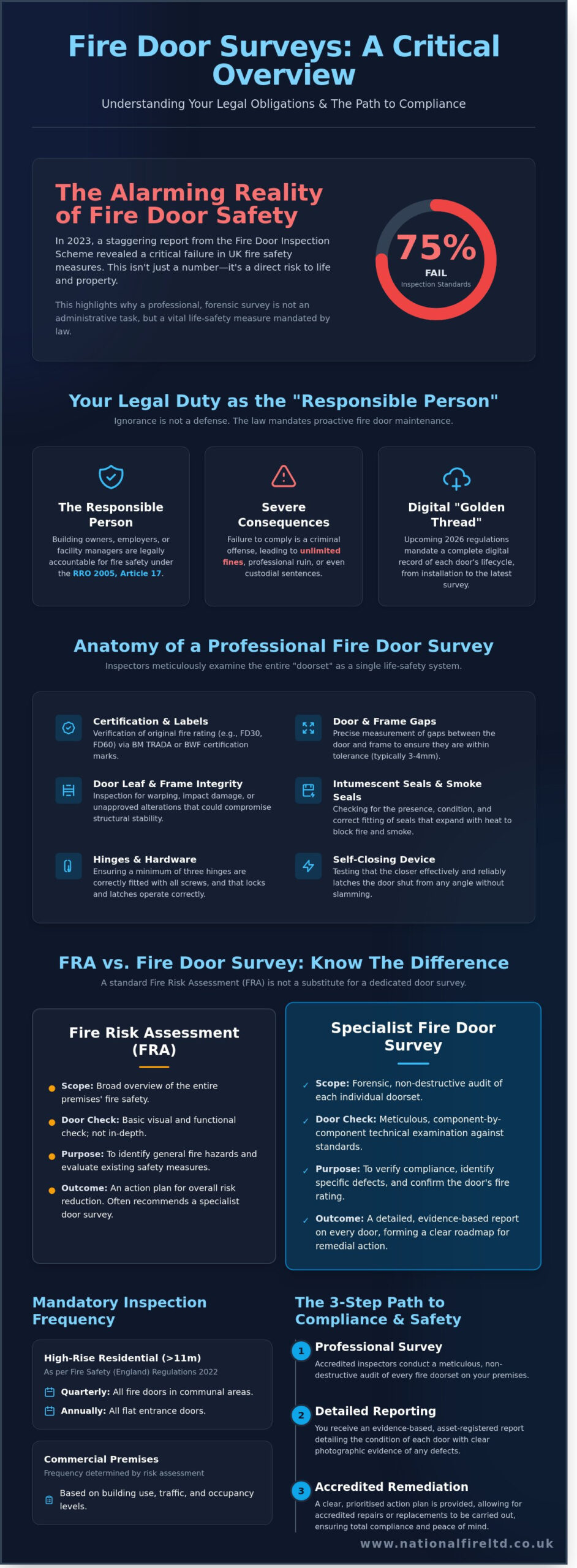
In 2023, the Fire Door Inspection Scheme reported that 75% of fire doors they inspected across the UK failed to meet the necessary safety standards. This statistic underscores the reality that a professional fire door survey is more than an administrative box to tick; it’s a vital life safety measure. You’re likely aware that the legal landscape is shifting, and the pressure to ensure every fire door in your premises is fully compliant with the Regulatory Reform (Fire Safety) Order 2005 has never been greater.
We know it’s challenging to keep pace with the Fire Safety (England) Regulations 2022 while searching for accredited experts you can trust. This article provides the clarity you need to protect your building and its occupants with absolute confidence. We’ll examine the technical depth of a professional inspection, the statutory requirements for different building types, and the structured path toward resolving any identified defects. By the end, you’ll have a clear strategy to mitigate risk, ensure compliance, and achieve the peace of mind that comes from knowing your property is secure.
Key Takeaways
- Discover why a professional fire door survey is a statutory requirement under the Regulatory Reform (Fire Safety) Order 2005 and how it defines your legal obligations as a Responsible Person.
- Learn the critical differences between a standard Fire Risk Assessment and a forensic doorset audit to ensure no hidden vulnerabilities compromise your building’s safety.
- Understand the “doorset” inspection methodology, which meticulously examines the leaf, frame, and hardware as a single unit to verify original fire ratings.
- Identify the mandatory inspection frequencies required by Regulation 10 for high-rise residential buildings to maintain continuous compliance.
- Gain clarity on the remedial pathways available to transform survey data into accredited repairs, ensuring total peace of mind for property managers and owners.
Understanding the Fire Door Survey: Legal Necessity and Statutory Duty
A professional fire door survey is a comprehensive, non-destructive forensic audit of a doorset. It goes far beyond a simple visual check. It evaluates the structural integrity and functional performance of the entire unit to ensure it will perform as intended during a fire. Under the Regulatory Reform (Fire Safety) Order 2005, every commercial and multi-occupied residential building must maintain these life-saving assets. The survey identifies defects in Fire Door Components, such as intumescent seals, hinges, and leaf gaps, that could allow smoke or flames to bypass the barrier. We focus on providing a clear roadmap to compliance through meticulous technical assessment.
The legal landscape has changed significantly following the Fire Safety Act 2021 and the Fire Safety (England) Regulations 2022. These updates have tightened inspection mandates, making it a criminal offence to neglect the maintenance of fire-resisting doorsets. For building owners and managers, a fire door survey isn’t just a recommendation; it’s a fundamental requirement to mitigate risk and protect occupants. Failing to act can lead to unlimited fines, professional ruin, or custodial sentences if life is lost due to faulty equipment.
The Role of the Responsible Person
The law identifies a “Responsible Person” (RP) for every premises. This is usually the employer, building owner, or facilities manager. The RP holds the legal accountability for fire safety. Under Article 17 of the 2005 Order, you’ve got a statutory duty to ensure fire doors are subject to a suitable system of maintenance. If a fire occurs and the doors fail, “ignorance of condition” isn’t a valid legal defence. Prosecutors look for evidence of proactive management. We help RPs meet their obligations by delivering accredited, evidence-based reports that demonstrate due diligence.
Evolving Legislation in 2026
The regulatory environment is shifting toward even greater transparency. Since 23 January 2023, building managers of residential buildings over 11 metres must conduct quarterly checks on fire doors in communal areas. Looking ahead, the UK Fire Door Regulations updates for 2026 emphasise the “Golden Thread” of information. This requires a digital record of every door’s history, from installation to the latest fire door survey. This shift ensures that safety data is accessible, accurate, and up to date for the entire lifecycle of the building.
- High-rise requirements: Mandatory annual checks on flat entrance doors and quarterly communal checks.
- Commercial premises: Risk-based frequency determined by building use and occupancy levels.
- Digital Compliance: Transitioning from paper logs to secure, cloud-based asset registers.
Maintaining these standards ensures your organisation remains on the right side of the law. It provides the peace of mind that comes from knowing your fire safety strategy is robust, compliant, and managed by experts who understand the gravity of the task.
The Anatomy of a Professional Survey: What Inspectors Meticulously Examine
A professional fire door survey adopts the “doorset” approach, viewing the frame, leaf, and hardware as a single, integrated safety unit. This methodology ensures that every component works in harmony to provide the necessary fire resistance. During an inspection, our experts locate and verify certification marks, such as those from BM TRADA or the BWF. These labels provide the definitive evidence required to confirm the original fire rating, whether it’s FD30 or FD60. Without these markers, a door’s performance in a fire is speculative at best, which is why we prioritise the verification of original manufacturing standards.
The integrity of the door leaf remains a primary focus. We inspect for warping, impact damage, or any unapproved alterations that could compromise the core’s stability. A critical phase of the process involves testing the self-closing mechanism. A fire door is only effective if it’s closed; therefore, the closer must reliably latch the door from any angle of opening. We verify that the closing force is sufficient to overcome the resistance of the latches and seals without being so heavy that it creates an accessibility barrier for building occupants.
Critical Hardware and Seals
Intumescent strips and cold smoke seals are the first line of defence against the spread of fire and toxic fumes. We check for continuity, ensuring these seals aren’t damaged, missing, or rendered ineffective by layers of paint. All hardware, including hinges, locks, and latches, must be CE marked and appropriately fire-rated. Compliance with the Fire Safety (England) Regulations 2022 also requires specific statutory signage, such as “Fire Door Keep Shut” or “Fire Door Keep Locked,” to be clearly displayed. These small details are essential for maintaining the legal status of the installation and ensuring the safety of everyone on-site.
The 3mm Rule: Precision Gaps and Tolerances
Precision is not optional in fire safety. The gaps between the leaf and the frame must typically be maintained between 2mm and 4mm to ensure the intumescent strips can expand effectively during a fire. A 3mm gap is the benchmark for excellence. At the threshold, the gap must meet specific smoke control requirements, which often limit the space to 10mm or less. Even a slight deviation of 1mm or 2mm can lead to a “Category A” failure in a professional report. This level of failure indicates a significant risk that requires immediate attention to restore protection. To help you manage these risks, we offer comprehensive safety assessments that provide clear, actionable pathways to compliance and peace of mind.
Fire Risk Assessment vs. Fire Door Survey: Why Your FRA Isn’t Enough
Many building owners assume a standard Fire Risk Assessment (FRA) satisfies their legal obligations for doorsets. It doesn’t. A standard FRA is a high-level, visual inspection designed to identify obvious hazards. It lacks the forensic depth required to guarantee a doorset will perform as designed during a fire event. While an FRA might note a missing closer, a professional fire door survey investigates the structural integrity and technical precision of the entire installation.
General risk assessors often lack the specialized toolkits required for a compliant audit. They rarely carry calibrated gap gauges or digital callipers to measure tolerances to the nearest 0.1mm. If the gap between the door leaf and the frame exceeds 4mm, the intumescent seal may fail to bridge the void. This allows lethal smoke to bypass the barrier. A specialist survey uncovers these hidden failures, ensuring your building’s fire compartmentation remains robust and effective.
Forensic vs. Visual Inspections
Our specialists employ non-destructive testing methods to evaluate every component, including hinges, intumescent strips, and glazing beads. We don’t just look at the door; we verify its certification against its current condition. Each unit receives a unique ID tag, creating a digital asset register that simplifies future maintenance. Since the 2023 updates to the Fire Safety (England) Regulations, insurance providers have become more stringent. They increasingly demand dedicated survey reports over general FRAs to validate coverage and mitigate risk.
Integration with Passive Fire Protection
Fire doors are unique because they’re the only moving parts within your passive fire protection system. A wall remains static, but a door must operate perfectly thousands of times while maintaining its fire-stopping capability. Our surveyors examine the critical interface between the door frame and the surrounding wall. We check that the fire-stopping materials behind the architrave are correctly installed and haven’t degraded. This methodical approach ensures the doorset functions as a seamless extension of the building’s life-safety infrastructure, providing the peace of mind you require.
Survey Frequency and Reporting: A Methodical Approach to Compliance
Determining the frequency of a fire door survey depends entirely on the building’s risk profile and usage patterns. Statutory requirements vary significantly between residential and commercial sectors. Under the Fire Safety (England) Regulations 2022, which became law on 23 January 2023, specific mandates apply to multi-occupied residential buildings over 11 metres in height. For these structures, Regulation 10 dictates that responsible persons must perform quarterly checks on all fire doors in common parts and make best endeavours to inspect flat entrance doors annually.
Commercial environments typically follow a baseline of an annual professional survey. However, high-traffic settings such as hospitals, schools, or busy retail hubs often require six-monthly or even quarterly inspections to mitigate the accelerated wear and tear on door hardware. A methodical approach ensures that your safety programme remains both cost-effective and legally robust.
Establishing an Inspection Routine
A bespoke inspection schedule balances your statutory obligations with the practical realities of building management. While a professional fire door survey provides a comprehensive technical assessment, it’s supplemented by in-house monthly visual checks. These internal reviews focus on obvious damage, such as blocked exits or broken self-closing devices. Documenting every check is vital; a clear audit trail demonstrates to the Fire and Rescue Service that you’re managing risks proactively. We recommend using a standardised checklist to ensure consistency across all inspections, ensuring no component is overlooked during the process.
Interpreting the Survey Report
A professional report from National Fire Ltd serves as a technical roadmap for your safety strategy. We utilise a traffic-light risk rating system to categorise findings clearly. Category A findings represent an immediate risk to life safety, requiring urgent intervention. Category B findings indicate that remedial work is necessary to maintain the door’s integrity over the medium term. Each entry includes photographic evidence of the defect, providing absolute clarity for facilities managers. This detailed documentation is essential for planning fire door maintenance, allowing you to allocate budgets where the risk is highest. Digital reporting further simplifies compliance for multi-site organisations, offering a centralised view of fire safety status across an entire estate.
Ensure your building meets the latest statutory standards and secure long-term peace of mind. Contact National Fire Ltd today to book your professional survey.
From Survey to Safety: Remedial Pathways with National Fire Ltd
Identifying a fault during a fire door survey is only the start of the compliance journey. The value of the data lies in how it’s translated into actionable, certified improvements. National Fire Ltd bridges this gap by providing a seamless transition from initial inspection to final certification. We don’t just identify risks; we mitigate them through disciplined engineering. Choosing an accredited surveyor provides the total peace of mind that every defect is categorised by its severity, allowing for a prioritised remedial programme that aligns with your budget and safety obligations.
National Fire Ltd operates with an unwavering commitment to meticulous standards. Our transition from survey data to professional fire door repair or replacement is governed by BAFE-accredited methodologies. This ensures that every remedial action doesn’t just “fix” a door, but restores the integrity of the entire fire-stopping system. We provide a comprehensive digital trail for every asset, ensuring that the Responsible Person can demonstrate statutory compliance to the Fire and Rescue Service at any moment.
The Importance of Third-Party Accreditation
Third-party certification through bodies like BM TRADA or BAFE isn’t a luxury. It’s a statutory safeguard. When we undertake a fire door installation, every component must align with the original test evidence of the doorset. Using an unaccredited installer risks voiding the fire rating, leaving the Building Safety Act 2022 requirements unfulfilled. Our “survey-to-solution” model provides several key benefits for building managers:
- Consistency: The technicians performing repairs use the exact data points captured during the initial survey.
- Compliance: All works are certified to maintain the original fire rating (FD30s or FD60s).
- Accountability: A single point of contact for both the diagnostic and the cure.
Securing Your Building’s Future
Reactive maintenance costs are typically 2.5 times higher than scheduled upkeep. By moving to a proactive culture, building managers protect their long-term capital expenditure. A regular fire door survey cycle helps identify minor wear, such as drop-down seal failures or hinge degradation, before they necessitate a full doorset replacement. Under Regulation 10 of the Fire Safety (England) Regulations 2022, buildings over 11 metres now require specific quarterly and annual checks. Adhering to these schedules isn’t just about avoiding fines; it’s about the preservation of life. A structured approach to fire door maintenance aligned with the 2026 statutory compliance requirements ensures your programme remains both legally defensible and operationally effective.
The final step in any safety strategy is professional diligence. National Fire Ltd stands as a guardian of your property, ensuring that every door remains a reliable barrier against smoke and flame. Protecting your occupants requires more than a checklist. It requires a partnership with experts who view fire safety as a non-negotiable standard. When selecting certified fire door installers for your remedial works, ensure they meet the 2026 commercial compliance standards to maintain your building’s integrity. Contact us today to secure your building’s compliance and ensure your fire doors perform exactly when they’re needed most.
Securing Your Statutory Compliance and Property Safety
The Regulatory Reform (Fire Safety) Order 2005 mandates that responsible persons maintain fire safety provisions in an efficient state. Relying solely on a general Fire Risk Assessment often leaves critical gaps in your protection strategy. A professional fire door survey provides the technical depth required to identify specific structural failures that a visual inspection might miss. By implementing a methodical reporting system, you establish a robust audit trail that satisfies statutory requirements and protects building occupants.
National Fire Ltd operates as BAFE accredited specialists, providing nationwide coverage across the UK’s commercial sectors. Our team delivers meticulous digital reporting that aligns with ISO 9001 standards, ensuring every asset is documented for your compliance records. We’ve supported hundreds of organisations in transitioning from identified risks to certified safety. It’s vital to address these requirements before an incident occurs. Our experts are ready to guide you through every step of the remedial process.
Book a Comprehensive Fire Door Survey for Your Property to ensure your building remains a safe, compliant environment for everyone.
Frequently Asked Questions
Is a fire door survey a legal requirement for my building?
Yes, it’s a statutory requirement under the Regulatory Reform (Fire Safety) Order 2005. For residential buildings in England over 11 metres in height, the Fire Safety (England) Regulations 2022 mandate that Responsible Persons must conduct annual checks on flat entrance doors and quarterly checks on communal fire doors. A professional fire door survey ensures these passive fire protection measures remain functional and compliant with current British Standards.
How often should fire doors be surveyed in a commercial property?
Commercial properties should have fire doors inspected at least every six months to comply with BS 9999:2017. In high-traffic environments like hospitals or schools, where doors sustain damage more frequently, we recommend monthly inspections to maintain safety. Regular assessments identify wear and tear on components like overhead closers and intumescent seals before they compromise the door’s integrity during a fire event.
What is the “3mm gap rule” in fire door inspections?
The 3mm gap rule refers to the essential clearance required between the fire door leaf and its frame. According to BS 8214:2016, the gap should consistently measure between 2mm and 4mm along the top and sides. If the gap exceeds 4mm, smoke and flames can bypass the intumescent seals, rendering the door ineffective. Our surveyors use calibrated gap gauges to ensure every millimetre meets these strict statutory tolerances.
Can I carry out my own fire door survey?
A competent person can legally perform checks, but a professional fire door survey provides the technical depth required for full legal indemnity. National Fire Ltd surveyors hold third-party accreditations, such as BAFE or BRE certification, which ensures every component is assessed against the original manufacturer’s data sheet. It’s risky to rely on uncertified staff, as this often leads to overlooked defects and potential prosecution under Article 17 of the Fire Safety Order.
What happens if a fire door fails its professional survey?
If a door fails, we issue a detailed non-compliance report categorising defects by risk level. Minor issues like missing smoke seals require remedial work. Major structural failures might necessitate a full door set replacement. Under the Fire Safety Act 2021, the Responsible Person must address these failures promptly to mitigate risk. We provide a clear roadmap for repairs, ensuring your building returns to a state of total statutory compliance.
What is the difference between an FD30 and an FD60 fire door survey?
The primary difference lies in the integrity duration; FD30 doors provide 30 minutes of fire resistance, while FD60 doors provide 60 minutes. During a survey, we verify that the intumescent strips and glazing types match the specific rating required for that location. For instance, an FD60 door typically requires a 20mm intumescent strip, whereas an FD30 might only require 15mm to meet British Standard 476-22 requirements.
Does a fire door survey include the frame and hardware?
Yes, a comprehensive survey evaluates the entire door set, including the frame, hinges, locks, and self-closing devices. We examine the frame’s bedding to the wall and ensure all hardware is UKCA marked and compatible with the door’s fire rating. National Fire Ltd experts check that hinges are free from oil leakage and that the door closer successfully latches the door from any angle, as required by EN 1154 standards.
How long does a professional fire door survey typically take?
A thorough inspection of a single fire door set usually takes between 15 and 30 minutes. This timeframe allows our accredited surveyors to check over 25 individual points of compliance, including intumescent seals, leaf alignment, and signage. For a standard office block with 50 doors, it’s best to allocate two full working days for a complete, non-disruptive assessment. This methodical approach ensures we capture every detail for your final safety documentation.