

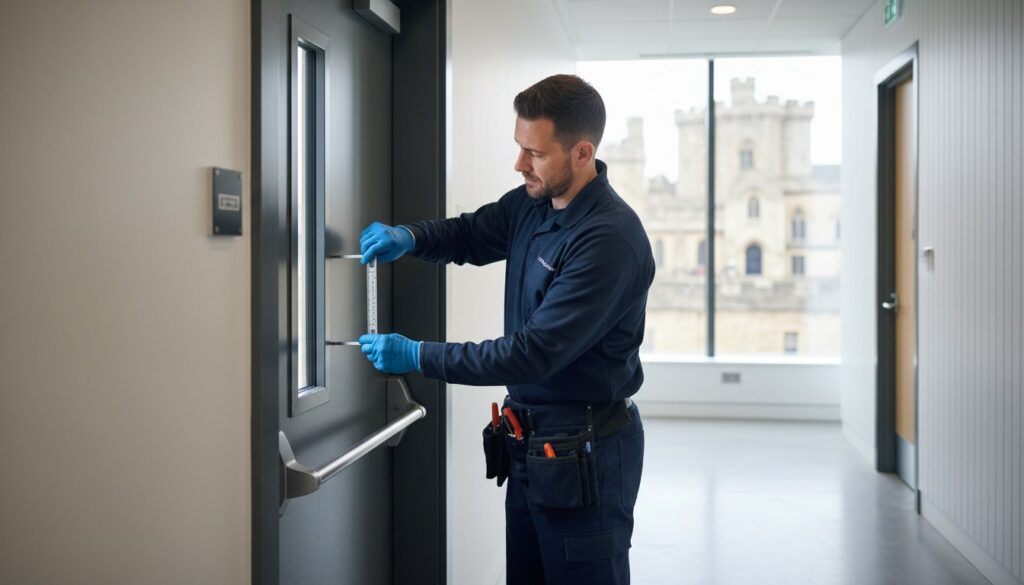
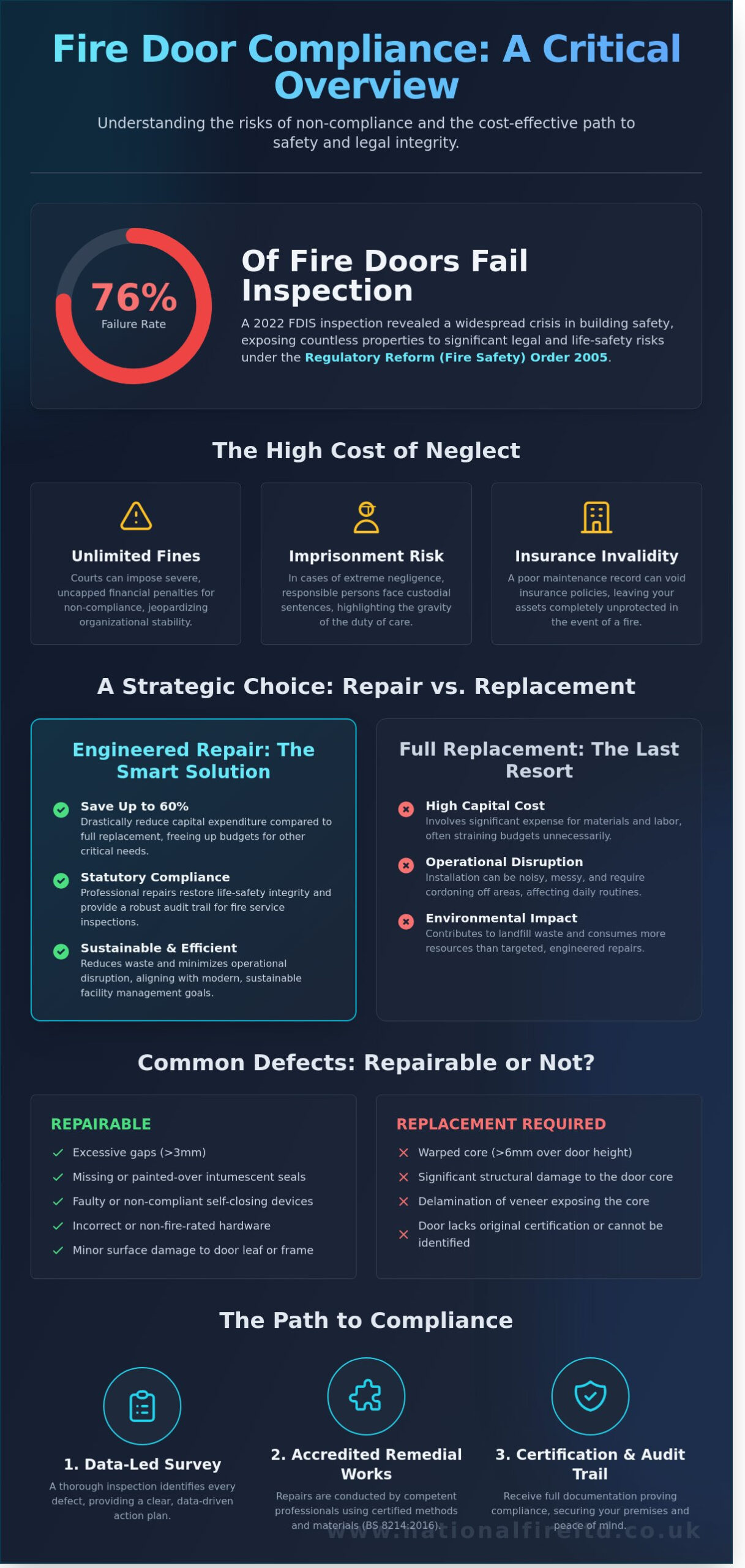
Did you know that 76% of fire doors inspected by the Fire Door Inspection Scheme in 2022 failed to meet required safety standards? For many building managers, this statistic represents a significant legal risk under the Regulatory Reform (Fire Safety) Order 2005. It’s understandable that you might feel overwhelmed by the potential for heavy fines or the daunting cost of a full building-wide replacement. However, professional fire door repair often provides a more efficient, compliant solution that many overlook.
We agree that maintaining a safe environment shouldn’t necessitate the immediate disposal of existing assets or the disruption of your daily operations. This guide will demonstrate how accredited remedial works restore life-safety integrity and provide a robust audit trail for your records. You’ll discover how choosing expert repair over replacement can save your organisation up to 60% in capital expenditure while ensuring absolute statutory compliance. We’ll examine the technical standards required for certification and the methodical approach we take to secure your premises and your peace of mind.
Key Takeaways
- Understand your statutory obligations under the Regulatory Reform (Fire Safety) Order 2005 and the critical role of maintaining FD30 and FD60 fire-resistance ratings.
- Learn to distinguish between minor wear and structural failures to determine when professional fire door repair offers a compliant, cost-effective alternative to full replacement.
- Discover the significant environmental and financial advantages of an “engineered repair” approach for modern, sustainable facility management.
- Explore the step-by-step remedial process, from conducting data-led surveys to implementing bespoke schedules that restore life-safety integrity.
- Realise the benefits of a nationwide safety partnership that integrates fire door maintenance with comprehensive fire stopping and strategy drawings.
The Critical Role of Fire Door Repair in Building Compliance
Fire door repair is the meticulous restorative process of ensuring a door-set maintains its original fire-resistance rating, such as FD30 or FD60. These ratings indicate the number of minutes a door can withstand heat and smoke, providing a vital window for evacuation. When a door is damaged or poorly maintained, it ceases to function as a reliable passive fire protection system, which compromises the safety of every occupant in the building. Professional remediation focuses on returning the assembly to its tested state, ensuring that every component, from the hinges to the intumescent seals, works in unison during an emergency.
The legal framework governing these standards is the Regulatory Reform (Fire Safety) Order 2005. This legislation places a statutory obligation on the “Responsible Person” to ensure that all fire safety equipment is maintained in an efficient state, in efficient working order, and in good repair. Following the commencement of Section 156 of the Building Safety Act 2023, these obligations have become even more stringent. Understanding the evolving landscape of UK fire door regulations and compliance requirements is essential for building managers navigating these complex statutory obligations. National Fire Ltd provides the expertise required to meet these standards, moving beyond superficial patches to deliver accredited remedial works that offer genuine peace of mind. We ensure that every fire door repair is carried out by competent professionals who understand the nuances of life-safety equipment.
Technical excellence in this field is guided by BS 8214:2016, which is the code of practice for the specification, installation, and maintenance of timber-based fire doors. This standard outlines how repairs should be executed without voiding the door’s certification. Adhering to these guidelines ensures that the fire door repair process is documented and compliant, maintaining the integrity of the building’s fire strategy. Our approach focuses on long-term reliability, ensuring that every door we service remains a steadfast barrier against the spread of fire.
Legal Consequences of Neglecting Fire Door Maintenance
Failure to maintain fire doors carries severe risks that extend far beyond simple administrative errors. Since the 2023 legislative updates, courts can impose unlimited fines for non-compliance; in cases of extreme negligence, responsible parties face potential imprisonment. A single failed fire door can compromise the entire compartmentation strategy of a building, allowing fire to leap between floors or corridors. We help clients maintain a robust audit trail of all repairs, which is essential for fire service inspections and insurance validity. This documentation proves that the building owner has exercised due diligence in protecting lives and property.
When is a Repair Mandatory?
Identifying “red flag” issues early is the most effective way to mitigate risk. Mandatory repairs are required when there is visible damage to the door leaf, missing or painted-over intumescent seals, or when self-closing devices fail to shut the door firmly into the rebate. The 3mm rule dictates that the gap between the door leaf and the frame must not exceed 3mm to ensure the door effectively contains smoke and flames during a fire. Regular fire door surveys identify these technical failures before they become life-threatening. By addressing these issues through professional remedial works, building managers ensure their premises remain safe, compliant, and fully operational 24/7.
Common Defects: What Can and Cannot Be Repaired?
Many building managers assume any competent joiner can fix a fire door. This is a dangerous misconception. Under the Regulatory Reform (Fire Safety) Order 2005, the Responsible Person must ensure that all maintenance is conducted by competent persons. A general joiner often lacks the specific knowledge of fire-rating compatibility. Using non-fire-rated wood filler or standard steel hinges instead of grade 13 stainless steel alternatives can invalidate the door’s certification. Data from the Fire Door Inspection Scheme (FDIS) reveals that 76% of doors inspected in 2023 failed due to incorrect installation or maintenance by non-specialists. When repairs are no longer viable, it’s essential to work with certified fire door installers who meet 2026 commercial compliance standards to ensure proper replacement.
Compliance isn’t just about functionality; it’s about evidence. Every material used in a fire door repair must match the original door-set specification. If the original test evidence requires a specific brand of intumescent paste or a particular thickness of hardwood lipping, substitutions aren’t permitted. Specifying BM TRADA fire doors with Q-Mark third-party certification provides the documented evidence that components meet the rigorous testing standards required for full statutory compliance. For complex remedial works, our team provides the accredited expertise required to maintain your building’s safety standards while ensuring full legal compliance.
Restoring Intumescent Seals and Smoke Strips
Intumescent strips are critical components that expand up to 10 times their original size when temperatures exceed 200°C. This expansion seals the gap between the door and frame, preventing the spread of fire. If seals are missing, damaged, or heavily painted over, they must be replaced immediately. We ensure new seals match the original manufacturer’s specification, whether they are standard 10mm or 15mm strips. Brush-type smoke seals provide an additional layer of protection by blocking cool smoke before the heat-activated intumescent strip engages. Replacing these requires precision to ensure the seal doesn’t impede the door’s ability to close and latch.
Ironmongery and Self-Closing Devices
Hardware is the mechanical heart of fire safety. Every hinge, lock, and closer must carry a CE or UKCA mark to prove it has passed rigorous fire testing. Overhead closers often lose tension or leak oil, preventing the door from latching correctly. We re-calibrate these devices to ensure the door closes reliably against the latch from any angle. If a door is “hinge bound” and rubbing against the frame, it creates a friction point that can prevent full closure during an emergency. Professional remediation involves adjusting the alignment using intumescent hinge pads to maintain the 3mm gap required by BS 8214:2016. Using non-fire-rated screws or plates in these areas is a common but high-risk error that we rectify through bespoke component matching.
Fire Door Repair vs. Replacement: A Strategic Analysis
Facility managers often face a complex dilemma when a professional survey identifies non-compliance within their building. Replacing every faulty unit is a common reflex, yet it’s frequently an unnecessary expenditure. A strategic fire door repair programme restores the integrity of the fire compartment while protecting the bottom line. National Fire Ltd conducts detailed assessments to ensure that remedial work meets the stringent requirements of BS 8214:2016, providing the same level of safety as a new installation without the associated upheaval.
Cost Implications for Commercial Facilities
A new FD60 door-set installation typically costs between £800 and £1,200 depending on the specification and ironmongery. This figure excludes the “hidden costs” that quickly escalate a project budget. You must factor in structural remedial work to the opening, skip hire for disposal, and the subsequent redecoration of the surrounding area. Professional repair can often save up to 60% of the cost of replacement. This allows facility budgets to be allocated more effectively across a larger estate, ensuring more units are brought up to standard simultaneously.
Professional surveys determine the “economic limit” of a project by calculating the cumulative cost of parts and labour against the price of a total replacement. We typically apply a threshold where if the repair exceeds 70% of the replacement value, a new installation becomes the logical choice. For most issues like excessive gaps, faulty closers, or damaged intumescent strips, the cost remains well below this limit. It’s a pragmatic approach to statutory compliance.
Sustainability and the Circular Economy
Repairing fire doors aligns directly with modern corporate “Net Zero” targets and the principles of the circular economy. Discarding a high-quality timber door-set because of a minor defect is an environmental failure. In a 2023 review of facility waste, it was noted that extending the lifecycle of existing fire assets can reduce the carbon footprint of a building’s maintenance by over 45%. National Fire Ltd advocates for the most responsible safety-first solution, particularly in heritage buildings where original architectural features are irreplaceable and must be preserved under planning laws.
Operational disruption is another critical factor in the strategic analysis. A repair technician can often complete their tasks in 90 minutes without the noise, dust, and access issues associated with removing a frame. This is vital for hospitals or schools where 24/7 access is a statutory requirement and “down-time” is not an option. We prioritise on-site remedial works to maintain the building’s operational flow while securing the premises.
National Fire Ltd remains committed to the principle that safety shouldn’t be synonymous with waste. Our accredited technicians use certified components to ensure every fire door repair is fully documented and compliant with the Regulatory Reform (Fire Safety) Order 2005. We provide a comprehensive report for your fire gold box, giving you total peace of mind that your assets are both safe and cost-effective. Choosing to repair rather than replace is often the most disciplined choice a building owner can make.
The Professional Remedial Process: From Survey to Certification
Achieving statutory compliance isn’t a matter of guesswork; it requires a disciplined, four-stage methodology that guarantees every fire door repair meets the highest safety standards. At National Fire Ltd, we follow a rigorous workflow designed to eliminate risk and provide property managers with total peace of mind. We don’t leave safety to chance. Our process is built on the foundation of the Regulatory Reform (Fire Safety) Order 2005, ensuring every action is documented and legally defensible.
- Step 1: Comprehensive Survey. We deploy industry-leading digital data collection tools to scrutinise every leaf, frame, and hardware component. This isn’t a visual walkthrough; it’s a technical audit that captures photographic evidence and precise measurements of gaps and tolerances.
- Step 2: Bespoke Remedial Schedule. Based on the survey findings and your specific fire strategy, we develop a tailored programme of works. This schedule prioritises high-risk areas, ensuring that the most critical life-safety issues are addressed first.
- Step 3: Accredited Execution. Our technicians use only fire-rated components that match the original manufacturer’s specifications. Every fire door repair is carried out with surgical precision, maintaining the integrity of the fire-stopping capabilities without compromising the door’s functionality.
- Step 4: Final Inspection and Certification. Once works are complete, a final inspection verifies that the repairs meet the required standards. We then issue a compliance certification for your building’s safety manual, creating a robust “Golden Thread” of information.
The Importance of the Initial Survey
A professional fire door survey is the only way to guarantee the legality of any subsequent repair. National Fire Ltd uses technical surveys to categorise doors as “Pass,” “Nominal,” or “Fail.” A “Nominal” rating often applies to older doors that lack original certification but can be brought to a safe standard through specific upgrades. By integrating these surveys with our wider fire compartmentation and floor plan generation services, we provide a holistic view of your building’s defensive posture. Data from the Fire Door Inspection Scheme (FDIS) in 2022 showed that 75% of fire doors failed their initial inspections, highlighting why this diagnostic stage is vital. Implementing a structured fire door maintenance programme aligned with 2026 statutory compliance requirements ensures that issues identified during surveys are addressed within a legally defensible framework.
Accredited Workmanship: BM TRADA and BAFE
Third-party accreditation is the hallmark of a competent installer. National Fire Ltd holds certifications from BM TRADA and BAFE, which means our processes are externally audited for quality and consistency. We rely on “Global Assessments” to validate repair methods for specific door blanks, ensuring that the techniques used are backed by rigorous fire testing data. This level of detail is essential for maintaining the validity of the door’s fire rating. Every repair we perform is logged and traceable; this creates a permanent record for future safety audits and ensures that your organisation remains on the right side of the law. We don’t just fix doors; we preserve their life-saving potential through technical excellence.
Protect your building and its occupants by choosing a partner that prioritises accredited standards and meticulous documentation. Contact our team today to schedule your professional fire door remedial services and secure your compliance certification.
Partnering with National Fire Ltd for National Safety
National Fire Ltd serves as a critical guardian for UK infrastructure and life safety. We maintain a robust presence through our strategic hubs in London, Warwick, and Great Yarmouth. This geographical spread ensures we can deploy accredited technicians to any site with speed and precision. We provide a single point of contact for all passive fire safety needs, which eliminates the friction of managing multiple vendors. Our methodology integrates fire door repair with technical strategy drawings and fire stopping measures. This creates a seamless safety net for your property. We focus on authoritative reassurance, giving duty holders the confidence that their assets are fully compliant with the latest British Standards and the Fire Safety Act 2021.
Our commitment to excellence is reflected in our disciplined approach to every project. We don’t just treat symptoms; we diagnose the root cause of failures to prevent recurrence. This methodical strategy is essential for maintaining the “Golden Thread” of information required in modern building management. By partnering with us, you gain access to a team that understands the high stakes of fire safety. We offer a calm, stable presence in an industry where precision is the only acceptable standard. Our specialists are trained to handle the complexities of statutory regulations, ensuring your building remains a safe environment for all occupants.
- Nationwide Reach: Rapid deployment from London, Warwick, and Great Yarmouth offices.
- Integrated Solutions: Seamless coordination between fire doors, fire stopping, and strategy drawings.
- Expert Guidance: A single point of contact for all passive fire protection requirements.
- Statutory Compliance: Full alignment with the Regulatory Reform (Fire Safety) Order 2005.
Comprehensive Passive Fire Protection
Passive fire protection isn’t a series of independent tasks; it’s a unified system. We combine our fire door expertise with advanced solutions like injectable cavity barriers and comprehensive compartmentation surveys. Using a single specialist contractor for all remedial works ensures that no gaps are left in a building’s fire-resisting walls or floors. In 2023, industry data suggested that up to 61% of fire doors in commercial settings had at least one fault. We address these issues through a disciplined, 24/7 service model designed for long-term commercial partnerships. Our work ensures that every fire door repair aligns with the overall fire strategy of the building, maintaining the integrity of fire compartments for the full duration specified in the design.
Request Your Fire Door Compliance Review
Securing a building’s future requires a proactive stance on regulation. Our Warwick and London offices provide preliminary consultations tailored to the unique demands of the commercial, industrial, and high-rise sectors. We’ve seen a 40% increase in demand for detailed compliance reviews following recent legislative shifts. Our surveyors are experts in navigating the complexities of high-rise residential requirements, particularly for buildings exceeding 11 metres in height. Don’t wait for an enforcement notice to act. You can book a comprehensive fire door survey with National Fire Ltd to establish a clear roadmap for your statutory obligations. Our team delivers the meticulous documentation needed to prove compliance during any official inspection, providing you with total peace of mind.
Securing Your Statutory Compliance Through Expert Remediation
Ensuring your premises remain compliant with the Regulatory Reform (Fire Safety) Order 2005 requires a methodical approach to fire door repair that restores every component to its original certified standard. Professional remediation isn’t just a cost-effective alternative to replacement; it’s a vital discipline that maintains the integrity of your building’s fire compartmentation. National Fire Ltd brings authoritative expertise to every project, operating as BAFE and BM TRADA accredited specialists across London, the Midlands, and East Anglia. We focus on complex commercial and industrial environments where precision is paramount. Our surveyors provide the technical clarity needed to mitigate risks and ensure your safety records are beyond reproach. It’s our responsibility to provide the stability and peace of mind that comes from unwavering professional standards. When repairs are no longer viable, our team can seamlessly transition to professional fire door installation services that meet the same exacting standards. By choosing an accredited partner, you’re investing in a long-term safety strategy that protects both life and property. For ongoing compliance beyond repairs, implementing a comprehensive fire door maintenance programme in London ensures your building remains protected through regular inspections and preventive care. We’re here to guide you through every statutory requirement with meticulous care.
Contact our expert team for an accredited fire door survey and repair quote
Frequently Asked Questions
Who is legally allowed to repair a fire door in a commercial building?
Under the Regulatory Reform (Fire Safety) Order 2005, a fire door repair must be carried out by a competent person with sufficient training and experience. We recommend using technicians who hold third-party accreditation, such as BAFE SP205, to ensure compliance with statutory safety requirements. Choosing an accredited professional guarantees that the door’s integrity remains intact; this provides peace of mind that the installation meets the rigorous standards set by UK building regulations.
How often should commercial fire doors be inspected for repair issues?
Commercial fire doors require a formal inspection at least every 6 months to comply with BS 9999 and BS 8214 standards. In high-traffic environments like hospitals or schools, where doors might be cycled over 100 times daily, monthly checks are essential to identify wear and tear. Regular monitoring helps mitigate risks before they escalate into costly failures, ensuring your building remains a safe environment for all occupants throughout the 365 days of the year.
Can I use standard wood filler to repair a hole in a fire door?
You can’t use standard wood filler to repair a hole in a fire door because it lacks the necessary fire-resistance properties. Any repair must involve fire-rated timber plugs or specialised intumescent pastes that have been tested to BS 476-22 or EN 1634-1 standards. Using non-compliant materials compromises the door’s ability to hold back flames for the rated 30 or 60 minutes. This directly violates fire safety legislation and puts lives at risk.
What is the maximum allowable gap between a fire door and its frame?
The maximum allowable gap between the leaf and the frame of a fire door is 3mm, with a tolerance of plus or minus 1mm. For the threshold gap at the bottom of the door, the limit is typically 10mm for fire protection, though this reduces to 3mm if smoke control is required. Maintaining these precise dimensions is critical for a successful fire door repair, as excessive gaps allow smoke and heat to bypass the fire barrier during an emergency.
Does a repaired fire door need a new certification label?
A repaired fire door doesn’t always require a new certification label, but the work must be documented in the building’s fire safety logbook. If the original certification plug or label is damaged or removed during the process, a certified inspector must re-validate the door to ensure it still meets BS 8214 criteria. Our technicians provide a comprehensive report for every fire door repair, ensuring your statutory compliance records are accurate and up to date for future audits.
What happens if a fire door cannot be repaired to BS 8214 standards?
If a fire door cannot be repaired to meet BS 8214 standards, it must be replaced immediately to maintain the building’s fire compartmentation. Continuing to use a non-compliant door is a breach of the Regulatory Reform (Fire Safety) Order 2005 and can lead to prosecution or heavy fines. We provide bespoke replacement solutions for doors that have suffered structural failure or significant warping, ensuring your site returns to full safety compliance without delay.
Are intumescent strips required on all four sides of a fire door?
Intumescent strips are typically required on the top and both vertical sides of the door leaf or frame. While the bottom edge doesn’t always require a heat-activated strip, a smoke seal is often necessary there to comply with Approved Document B of the Building Regulations. We assess each door individually to determine if a 10mm or 15mm strip is required, ensuring the seal configuration provides the full 30 or 60 minutes of protection specified.
How long does a typical fire door repair take to complete?
A typical repair for minor issues like hinge replacement or seal fitting takes between 1 and 3 hours to complete. More complex tasks, such as re-hanging a leaf or repairing damaged timber sections, may require a full half-day on-site. Our team works efficiently to minimise disruption to your business operations. We ensure your fire safety measures are fully restored to professional standards with minimal downtime for your staff and visitors.