


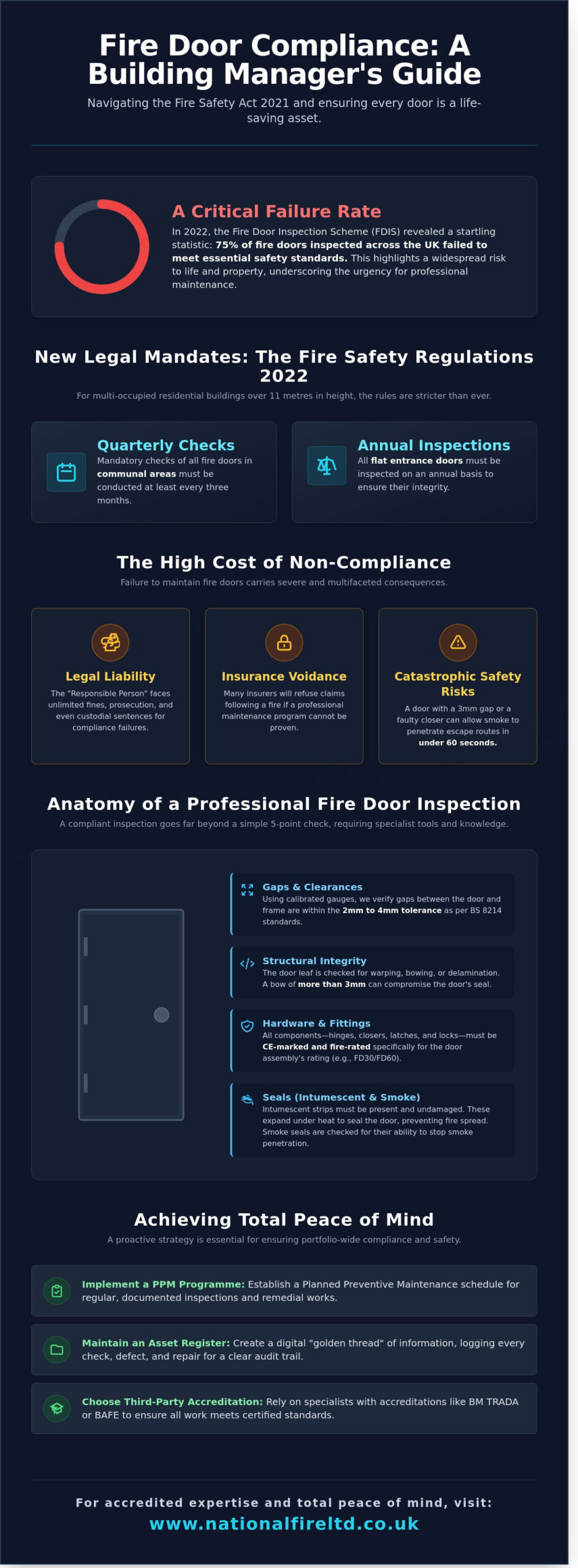
In 2022, the Fire Door Inspection Scheme (FDIS) revealed that 75% of fire doors inspected across the UK failed to meet essential safety standards. For building managers, this statistic is a sobering reminder of the legal risks introduced by the Fire Safety Act 2021. You’re likely focused on the immense responsibility of keeping occupants safe while avoiding the severe penalties of non-compliance. Securing professional fire door maintenance is a critical step in fulfilling your statutory duties, ensuring that every asset in your portfolio functions exactly as intended during a crisis.
We recognise the complexity of managing large-scale safety audits and the desire to avoid the high costs of unnecessary replacements. This guide provides the authoritative clarity you need to navigate current regulations and implement professional remedial strategies. We’ll outline how to build a robust audit trail, extend the operational life of your doors, and maintain the highest levels of protection. Our methodical approach ensures you achieve total peace of mind, knowing your building is fully compliant and your occupants are shielded by accredited safety standards.
Key Takeaways
- Understand how the Fire Safety Act 2021 and 2022 Regulations have intensified statutory inspection frequencies for commercial building managers across the UK.
- Learn why professional fire door maintenance london requires specialised remedial techniques that go beyond general joinery to maintain valid fire-integrity certification.
- Discover the essential components of a comprehensive professional survey, moving beyond basic checks to evaluate warping, structural damage, and hardware compliance.
- Establish a structured Planned Preventive Maintenance (PPM) programme and asset register to ensure your property portfolio remains compliant and safe at all times.
- Recognise the critical importance of third-party accreditations like BM TRADA or BAFE in providing authoritative expertise and total peace of mind for your fire safety strategy.
Statutory Requirements for Fire Door Maintenance in 2026
The legal framework governing fire safety in the United Kingdom has undergone significant transformation, making professional fire door maintenance london a non-negotiable priority for property owners in 2026. Compliance isn’t just a recommendation; it’s a statutory mandate enforced by the Fire and Rescue Services. Under the Regulatory Reform (Fire Safety) Order 2005, fire doors are classified as essential life-safety equipment. Their failure during a fire incident often leads to catastrophic outcomes, which is why the law demands they remain in efficient working order through a rigorous inspection regime.
The Regulatory Reform (Fire Safety) Order 2005
Article 17 of the Regulatory Reform (Fire Safety) Order 2005 stipulates that the Responsible Person must ensure all fire safety assets are subject to a suitable system of maintenance. Because fire doors are complex assemblies, their effectiveness depends on precise fire door construction and ratings, including the integrity of intumescent seals, hinges, and self-closing devices. The law requires that all commercial fire doors are maintained in an efficient state, in efficient working order, and in good repair to ensure they function as intended during an emergency. Our accredited engineers provide the technical expertise required to verify these components against national standards, ensuring that every door provides the necessary compartmentation to protect escape routes.
Recent Legislative Updates and Regulation 10
The Fire Safety (England) Regulations 2022, which came into force on 23rd January 2023, introduced stringent requirements for multi-occupied residential buildings. For properties exceeding 11 metres in height, Regulation 10 mandates quarterly checks of all fire doors in communal areas and annual inspections of flat entrance doors. These updates are designed to mitigate risks by identifying defects before they compromise the building’s integrity. Maintaining a digital “golden thread” of safety information ensures that every inspection and repair is logged, providing a transparent audit trail for regulators and insurers alike. This proactive approach to fire door maintenance helps property managers avoid the severe consequences of non-compliance.
- Legal Liability: Failure to comply can lead to prosecution, unlimited fines, or custodial sentences for the Responsible Person.
- Insurance Voidance: Many insurers now require proof of a professional maintenance programme before they’ll honour a claim following a fire.
- Safety Risks: A door with a 3mm gap or a faulty closer can allow smoke to penetrate escape routes in under 60 seconds.
National Fire Ltd acts as your dedicated partner in safety, providing the authoritative guidance needed to navigate these complex statutory duties. We replace uncertainty with methodical, accredited inspections that offer genuine peace of mind. By choosing a structured maintenance schedule, you aren’t just ticking a box; you’re actively guarding the lives of everyone who enters your building.
The Anatomy of a Professional Fire Door Inspection
While the Fire Door Inspection Scheme (FDIS) often promotes a basic 5-point check for general awareness, a professional survey for fire door maintenance london requires a more rigorous, technical methodology. We examine the structural integrity of the door leaf to identify warping, bowing, or delamination that could compromise its fire-resistance rating. A door leaf that is bowed by more than 3mm along its vertical edge may fail to sit flush within the rebate, creating a path for fire to bypass the primary barrier. The relationship between the leaf and the frame is critical; a fire-rated door is only as effective as the frame supporting it. We verify that all hardware, from hinges to locks, is CE-marked and specifically fire-rated for the assembly. Using non-compliant ironmongery leads to premature failure during a thermal event, as standard screws or low-grade metals may melt or shear under intense heat.
Seals and Clearances: The Precision of Safety
Precision is the hallmark of fire safety compliance. Our technicians use calibrated gap gauges to ensure the clearance between the door leaf and the frame remains between 2mm and 4mm. The 3mm rule is the industry benchmark for BS 8214 standards, and any deviation can render the door non-compliant. Gaps exceeding this limit prevent intumescent seals from expanding sufficiently to bridge the void during a fire. We meticulously inspect intumescent strips and smoke seals for signs of physical wear, tear, or over-painting, which can neutralise their chemical properties. Property managers should consult the London Fire Brigade fire door safety advice to understand the statutory obligations regarding these components. Threshold gaps are equally vital; they must typically be restricted to 10mm or less to prevent the passage of cool smoke before the intumescent material activates.
Self-Closing Devices and Operational Testing
A fire door is effectively useless if it remains open during an emergency. We test self-closing devices to ensure the door latches securely from any angle of opening, overcoming the resistance of both the latch bolt and the seals. Common failures often reside in overhead closers or floor springs that have leaked hydraulic fluid or lost spring tension over time. These mechanical defects are frequently the underlying reason doors are found wedged open, a dangerous practice that creates a significant breach in a building’s compartmentation. Our maintenance identifies these mechanical failures early, providing bespoke repair solutions that ensure your property remains compliant with the Regulatory Reform (Fire Safety) Order 2005. Regular testing mitigates the risk of mechanical fatigue, ensuring the door performs its life-saving function when it is needed most.
Remedial Works vs. General Repairs: Maintaining Fire Integrity
General joinery techniques often invalidate fire door certifications because they fail to account for the specific thermal properties required to withstand intense heat. A standard carpenter might plane a door edge to resolve a sticking issue; however, if they remove more than the permitted 3mm from a fire door’s lipping, the entire certification is voided. All remedial actions must utilise fire-rated materials that match the original manufacturer’s global assessment. National Fire Ltd technicians focus on correcting alignment issues without breaching the door’s core integrity, ensuring every adjustment adheres to the statutory fire door guidance provided by the Home Office.
Maintaining fire integrity involves more than just fixing a latch. Timber restoration is strictly limited. If a door leaf has delaminated or the core has been compromised by moisture, it can no longer provide the 30 or 60 minutes of protection it was designed for. Our approach to fire door maintenance london prioritises the preservation of the door’s fire-stopping capabilities over mere aesthetics. We ensure that every repair is documented to provide a clear audit trail for building owners and responsible persons.
Specialist Fire Door Repair Techniques
Precision is vital when re-hanging doors. We use fire-rated shims for minor hinge adjustments to ensure the gaps between the door and the frame remain between 2mm and 4mm. We replace the entire hinge set if the leaf has dropped significantly or if the hardware shows signs of fatigue. Replacing intumescent strips requires meticulous care to avoid damaging the rebate; any gaps in the seal allow smoke to bypass the door. For glazing repairs, we verify that fire-rated glass and specialist intumescent beads are installed correctly, as standard glass fails under high temperatures.
When Maintenance Becomes Replacement
We condemn a fire door set when the structural integrity is lost. Criteria for replacement include holes larger than 10mm that cannot be plugged with fire-rated dowels, or when the door leaf is warped beyond 8mm over its height. The cost-benefit analysis often favours a new fire door installation if multiple components, such as the closer, hinges, and seals, all require replacement simultaneously. New installations must perfectly match the existing fire compartmentation strategy to ensure the building remains a safe environment for all occupants. This disciplined approach to fire door maintenance london provides long-term peace of mind and statutory compliance.
Implementing a Planned Preventive Maintenance (PPM) Strategy
Reactive repairs often lead to sudden, unbudgeted costs and dangerous lapses in safety. Transitioning to a structured PPM strategy ensures your fire doors remain compliant throughout their entire lifecycle. It’s a proactive shift. This methodology is particularly vital for fire door maintenance london, where high-occupancy buildings face intense scrutiny from the London Fire Brigade and must adhere to the Fire Safety (England) Regulations 2022. By moving away from “fix-on-fail” models, you maintain the integrity of your building’s compartmentation without the stress of emergency call-out fees.
Every building manager should maintain a comprehensive asset register. This document tracks the location, fire rating, and hardware specifications of every door in your portfolio. It allows for precise budgeting. Instead of facing a £3,000 bill for a full door replacement, you can allocate smaller sums for minor adjustments. Regular maintenance prevents the mechanical wear that leads to total component failure. It keeps your capital expenditure predictable and your occupants safe.
The principle of using specialized tools to extend the life of professional equipment is common across many sectors; for example, those in the grooming industry often rely on high-performance air duster solutions from BarberNation to maintain their precision instruments and prevent mechanical wear.
Establishing the Maintenance Cycle
Creating a reliable cycle requires a methodical approach to risk. We follow a disciplined three-step process to ensure no door is overlooked:
- Step 1: Conduct an initial professional fire door survey to establish a baseline of your current compliance status.
- Step 2: Risk-rate doors based on traffic volume. A main entrance door that opens 500 times a day requires more frequent oversight than a plant room door that’s opened once a month.
- Step 3: Define inspection frequencies. While the law requires specific checks for buildings over 11 metres, we often recommend monthly or quarterly inspections for high-risk London environments to ensure total peace of mind.
Documentation and the Audit Trail
In the event of a fire, your documentation is your primary legal defence. It proves you’ve exercised due diligence. Modern facilities management relies on digital reporting to provide an undeniable audit trail. These records capture the exact date, time, and nature of every check performed. Professional fire door repair logs provide clear evidence that faults were rectified by competent persons. This level of detail protects building managers from personal liability and ensures the property remains within the statutory requirements of the Regulatory Reform (Fire Safety) Order 2005.
Our team provides the technical excellence required to manage these complex schedules. We don’t just find faults; we provide the accredited solutions to fix them. A robust PPM strategy is the only way to guarantee that a fire door will perform its life-saving function when it matters most.
Secure your property’s safety today by requesting a bespoke fire door maintenance quote from our expert advisors.
Expert Passive Fire Protection and National Compliance Services
National Fire Ltd delivers a disciplined approach to life safety. We don’t just tick boxes; we ensure every component of your building’s safety infrastructure meets statutory requirements. For property managers seeking professional fire door maintenance london, our expertise provides the necessary assurance that assets are fully compliant with the Regulatory Reform (Fire Safety) Order 2005. We operate with a sense of responsibility that extends beyond simple repairs, positioning ourselves as the guardians of your property and the people within it.
This dedication to property protection is shared by other specialized service providers; for example, Key Qualities offers expert locksmith and property maintenance services that help maintain the integrity and security of commercial assets, ensuring all hardware is professionally managed.
Third-party accreditation isn’t an optional extra in this industry. It’s the benchmark of professional competence. We maintain rigorous standards through BM TRADA and BAFE certifications. These credentials verify that our surveyors and technicians possess the technical skills required to mitigate risks effectively. By integrating maintenance with broader passive fire protection strategies, we create a unified barrier against smoke and flame. Our nationwide service delivery ensures that commercial and industrial sectors across the UK receive the same meticulous level of care, regardless of location. Specifying BM TRADA fire doors is the gold standard approach for commercial compliance, providing the Q-Mark third-party certification that gives building managers documented assurance of both product quality and installation integrity.
Our Commitment to Professional Excellence
Our methodology begins with a detailed fire door survey of every individual door set. We follow this with precise remedial works that restore integrity without compromising the building’s functionality. We provide comprehensive compliance reporting that offers total transparency for your health and safety records, creating a clear audit trail for inspectors. In high-stakes commercial environments, our teams remain available 24/7. This ensures that critical repairs happen immediately, maintaining the safety of your occupants at all hours of the day and night.
Partnering for Long-Term Safety
Managing a complex national property portfolio requires more than reactive repairs. We develop bespoke maintenance programmes tailored to the specific usage patterns and risk profiles of your buildings. Our team utilises technical fire strategy drawings to ensure every maintenance action aligns with the original design intent of the property. This structured approach reduces long-term costs while significantly enhancing overall safety. When selecting contractors for new installations or major refurbishments, it’s essential to work with certified fire door installers who understand the complex regulatory requirements and can deliver compliant solutions that integrate seamlessly with your existing maintenance programme.
If you require a reliable partner for your fire door maintenance london or have a nationwide requirement, request a professional consultation with our expert team today. We’ll help you navigate the complexities of compliance with a calm, methodical approach that delivers absolute peace of mind. We stand ready to secure your portfolio and provide the steadfast protection your organisation deserves.
Future-Proof Your Building’s Fire Safety Strategy
Adhering to the updated statutory requirements for 2026 is no longer optional for commercial property owners. Effective fire safety relies on a transition from ad-hoc repairs to a disciplined Planned Preventive Maintenance (PPM) strategy. By prioritising remedial works that uphold the original fire integrity of the assembly, you mitigate risk and ensure long-term stability. Our BM TRADA Certified Installers provide the technical excellence required to navigate these complex legal frameworks, delivering comprehensive statutory compliance reporting that stands up to the most rigorous audits.
Whether you require expert fire door maintenance london or nationwide commercial coverage across the UK, our team acts as your trusted guardian of life and property. We provide the meticulous oversight needed to maintain passive fire protection standards without compromise. It’s about more than just checking a box; it’s about creating a verifiable trail of safety and professional accountability. For a complete framework covering mandatory inspection intervals and technical compliance checklists, our fire door maintenance statutory compliance guide provides the authoritative reference you need. Secure your building’s safety with a professional fire door maintenance programme from National Fire Ltd. Taking these proactive steps today ensures your premises remain protected and fully compliant for years to come.
Frequently Asked Questions
How often should fire doors be inspected in a commercial building?
Fire doors in commercial buildings require a formal inspection at least every 6 months to comply with BS 9999 standards. High-traffic areas, such as main corridors or stairwells, often necessitate more frequent checks, sometimes monthly or quarterly. We ensure your fire door maintenance London schedule aligns with the Regulatory Reform (Fire Safety) Order 2005 to maintain statutory compliance and protect occupants.
Can a general handyman carry out fire door maintenance and repairs?
A general handyman lacks the specific accreditation required to certify fire door safety. Under the Fire Safety (England) Regulations 2022, maintenance must be performed by a competent person with technical expertise. Our BAFE-accredited technicians possess the specialist knowledge to identify subtle defects that an untrained eye might miss. This ensures every repair meets the original manufacturer’s fire test evidence.
What are the most common reasons for a fire door to fail an inspection?
Excessive gaps around the door frame account for approximately 60% of inspection failures. Gaps must remain between 2mm and 4mm to prevent smoke leakage. Other frequent issues include damaged intumescent seals, non-functional self-closing devices, and the use of non-fire-rated hardware. These faults compromise the door’s ability to hold back flames for the required duration during a fire event.
Is it legal to repair a fire door, or must it always be replaced?
It’s legal to repair a fire door provided the work restores the unit to its original fire-tested specification. Minor issues like replacing intumescent strips or adjusting closers are standard maintenance tasks. However, if the door leaf is warped or the core is breached, a full replacement becomes mandatory. We provide detailed assessments to determine the most cost-effective, compliant route for your fire door maintenance London requirements.
What evidence of fire door maintenance must a Responsible Person retain?
The Responsible Person must retain a comprehensive fire safety logbook containing dated records of all inspections and repairs. This documentation should include the inspector’s name, their qualifications, specific faults identified, and the remedial actions taken. Article 17 of the Fire Safety Order mandates these records be available for inspection by local Fire and Rescue Authorities during a safety audit.
What is the difference between an FD30 and an FD60 fire door during maintenance?
The primary difference lies in the integrity period; FD30 doors provide 30 minutes of fire resistance, while FD60 units offer 60 minutes. During maintenance, FD60 doors often require more robust intumescent seals and specific heavy-duty hardware to withstand prolonged heat exposure. Our technicians verify that all components match the specific rating required by your building’s fire strategy and compartmentation plan.
How much does fire door maintenance typically cost for a commercial property?
Costs for fire door maintenance vary based on the volume of doors and the complexity of the building’s layout. Industry data suggests that a professional inspection for a single door typically starts from £50 to £90, with rates decreasing for larger estates. Repairs are billed based on the specific components required, such as £20 for a set of intumescent seals or £150 for a high-specification overhead closer.
What happens if a fire door is found to be non-compliant during a survey?
If a survey identifies non-compliance, you’ll receive a detailed report outlining the necessary remedial actions to restore safety. Ignoring these findings puts you at risk of prosecution, with fines reaching over £400,000 for serious breaches in some UK cases. We provide a prioritised schedule of works to mitigate these risks immediately, ensuring your property remains a safe environment for all residents and employees.