


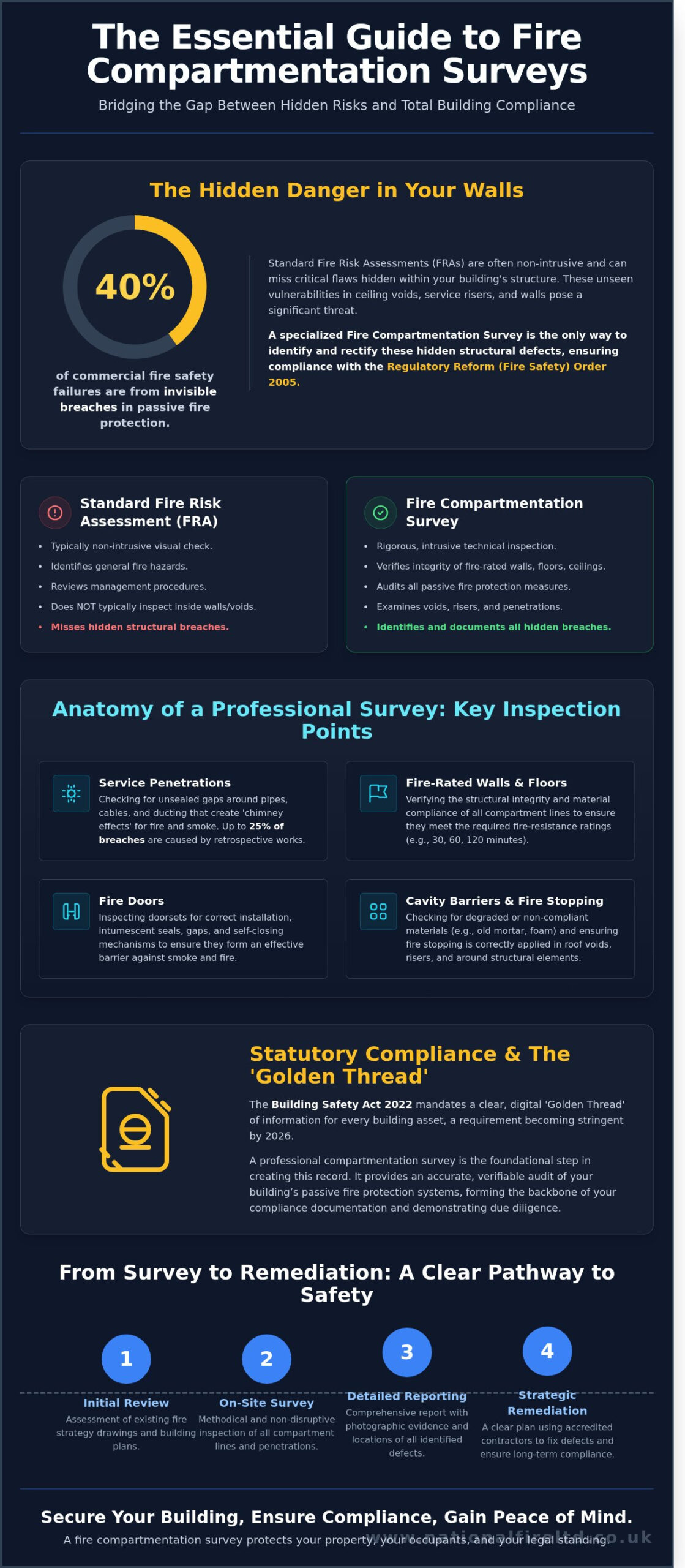
In the UK, recent data suggests that 40% of commercial fire safety failures stem from breaches in passive fire protection that remain invisible to the naked eye. You likely understand that maintaining statutory compliance is a relentless responsibility, particularly with the 2026 standards demanding a clear ‘Golden Thread’ of information for every asset. It’s a common concern for duty holders who fear that hidden risks in ceiling voids or service risers could lead to significant legal liability under the Regulatory Reform (Fire Safety) Order 2005.
A professional fire compartmentation survey identifies these hidden risks, ensures your building meets current statutory requirements, and protects your commercial investment. This guide provides a clear roadmap for the survey process and subsequent remedial works. You’ll gain a comprehensive understanding of how to bridge the gap between current vulnerabilities and total building compliance. We’ll show you how to secure the peace of mind that comes from knowing your property is documented, defended, and fully aligned with national safety standards.
Key Takeaways
- Understand how verifying the integrity of fire-rated walls and floors is fundamental to containing fire at its source and safeguarding your commercial property.
- Identify critical vulnerabilities within your building’s fabric, specifically focusing on service penetrations and non-compliant structural alterations that compromise safety.
- Navigate the complexities of the Building Safety Act 2022 by commissioning a professional fire compartmentation survey to establish a digital ‘Golden Thread’ of statutory information.
- Learn what to expect during a technical inspection, from the initial review of fire strategy drawings to the execution of a methodical, non-disruptive on-site assessment.
- Discover how to transition from survey findings to a strategic remediation plan using accredited contractors to ensure long-term compliance and total peace of mind.
What is a Fire Compartmentation Survey and Why is it Critical?
A fire compartmentation survey is a rigorous technical inspection designed to verify the integrity of a building’s fire-rated walls, floors, and ceilings. It provides a detailed audit of the passive fire protection measures that are built directly into the property’s structure. While active systems like smoke detectors and alarms provide necessary warnings, they don’t physically stop the spread of flames. A survey ensures that fire is contained within its original compartment for a specified period, usually 30, 60, or 120 minutes, depending on the building’s height and purpose.
Property managers often mistake a standard Fire Risk Assessment (FRA) for a complete safety solution. It’s a common oversight, but a standard FRA is typically non-intrusive. It doesn’t account for the breaches hidden behind walls or above ceilings. A dedicated fire compartmentation survey is essential for identifying these structural vulnerabilities and ensuring statutory compliance with the Regulatory Reform (Fire Safety) Order 2005.
The Role of Passive Fire Protection in Modern Buildings
Compartmentation is the physical division of a building into fire-resistant cells. This design strategy is the primary defense against the movement of smoke and toxic gases. Home Office data from 2023 shows that smoke inhalation is responsible for nearly 30% of fire-related injuries in the UK. By maintaining the integrity of fire-resistant cells, we protect designated evacuation routes and give occupants the time they need to reach safety. This structured approach to safety provides the peace of mind that comes from knowing a building’s fabric is legally and technically sound.
Identifying the ‘Hidden’ Risks in Your Property
Risks are rarely visible on the surface. They’re often found in ceiling voids, service risers, and plant rooms where maintenance work has been carried out over several years. We frequently find that historical building works have compromised fire integrity by leaving unsealed service penetrations. These gaps create ‘chimney effects’ that allow fire to bypass safety barriers with alarming speed. Common failure points include:
- Unsealed cable tray penetrations in server rooms.
- Breached fire curtains in large roof voids.
- Degraded fire stopping around HVAC ducting.
- Non-compliant mortar or foam used in historical repairs.
A comprehensive fire compartmentation survey identifies these specific defects, allowing for targeted remediation that meets current BAFE and UK building standards. By addressing these hidden failures, we mitigate the risk of rapid fire spread and ensure your property remains a safe environment for all occupants.
The Anatomy of a Professional Survey: What Inspectors Look For
A professional fire compartmentation survey is a methodical, forensic examination of a building’s internal safety infrastructure. We focus on the continuity of fire-resistant barriers to ensure that smoke and flame cannot travel between designated compartments. Our surveyors look for the 25% of breaches typically caused by retrospective works where contractors have compromised the building’s original safety design. This process isn’t merely a visual check; it’s a detailed audit of the building’s ability to contain a fire at its source for the duration specified in the fire strategy.
Evaluating Fire Walls and Service Risers
Inspectors begin by verifying the structural integrity of every fire wall within the premises. They ensure that the materials used meet the specific fire-resistance ratings required by the building’s fire strategy. A critical aspect involves checking that fire dampers are correctly positioned and securely fixed within these walls to prevent fire spread through ventilation systems. We often identify ‘legacy’ breaches; these are holes left behind by previous plumbing or electrical installations that were never properly sealed. These small gaps, often hidden in service risers, represent a significant risk to the building’s statutory compliance under the Regulatory Reform (Fire Safety) Order 2005.
Fire Doors and Cavity Barriers
Fire doors are active components of a compartmentation strategy. Our team assesses whether each fire door frame is correctly fire-stopped to the surrounding wall structure using approved linear gap seals. We check that intumescent seals and cold smoke seals are present, undamaged, and capable of expanding under heat. Beyond the visible walls, inspectors locate missing or poorly installed cavity barriers within external facades and ceiling voids. These hidden components are vital, as they prevent the chimney effect that allows fire to bypass floors internally. In a 2023 study of UK commercial assets, over 30% of buildings were found to have inadequate cavity protection in hidden voids.
A thorough fire compartmentation survey provides the technical data needed to create a robust remedial action plan. This disciplined approach ensures that every pipe penetration, cable tray, and door assembly contributes to the overall safety of the occupants. If you’re unsure about the integrity of your building’s partitions, you can book a comprehensive assessment to secure your premises and achieve total peace of mind.
- Structural Integrity: Verification of fire-rated boards and masonry.
- Service Penetrations: Inspection of fire collars, wraps, and mortars.
- Acoustic and Smoke Seals: Ensuring dual-purpose seals are functional.
- Void Inspections: Using borescope cameras to inspect inaccessible cavities.
Statutory Compliance and the ‘Golden Thread’ in 2026
The Building Safety Act 2022 has fundamentally reshaped commercial property management. By 2026, the transitionary periods for Higher-Risk Buildings (HRBs) have concluded, making the ‘Golden Thread’ of information a mandatory standard rather than a recommendation. This digital record ensures that the original design intent and subsequent maintenance of fire barriers are documented with absolute precision. A fire compartmentation survey acts as the foundation of this record, providing a clear, auditable trail of a building’s life safety systems.
For the ‘Responsible Person’, the legal stakes are higher than ever. Under the Fire Safety (England) Regulations 2022 and Section 156 of the Building Safety Act, failure to maintain compartmentation can lead to unlimited fines or custodial sentences. Beyond legal penalties, these surveys serve as critical evidence for insurers. Since 2024, 85% of major UK insurers have required evidence of proactive compartmentation management before renewing professional indemnity or property cover.
The Regulatory Reform (Fire Safety) Order 2005
Article 17 of the 2005 Order mandates that all fire safety provisions are subject to a suitable system of maintenance and are kept in an efficient state. A fire compartmentation survey ensures your building remains ‘fit for purpose’ by identifying breaches before they become critical failures. National Fire Ltd helps clients move from reactive, costly repairs to disciplined, proactive compliance programmes. This methodical approach mitigates risk and ensures the safety of all occupants while satisfying statutory duty.
Digital Record Keeping and Accountability
This structured data ensures that your compliance status is never in doubt, providing the authoritative reassurance required in a high-stakes environment.
Preparation and Process: What to Expect During the Inspection
A professional fire compartmentation survey begins long before a surveyor steps foot on your property. We initiate the process with a meticulous review of your existing fire strategy drawings and previous risk assessments. This desktop study ensures our team understands the designed fire resistance periods, which usually range from 30 to 120 minutes based on the building’s specific occupancy and height. It’s a vital step that allows us to map out the compartment lines that must remain intact to prevent the spread of smoke and flame.
The inspection itself is categorised into two distinct levels. A non-intrusive fire compartmentation survey is primarily visual, focusing on visible breaches in walls and ceilings. However, a comprehensive audit often requires intrusive sampling. This involves opening small inspection hatches or removing ceiling tiles to verify the presence of cavity barriers and fire stopping within hidden voids. We conduct these checks methodically to ensure total compliance without compromising the building’s aesthetic or structural integrity.
The On-Site Surveying Methodology
Surveyors utilise specialist equipment to inspect areas that are typically inaccessible. We use high-definition endoscopes to peer into narrow service risers and thermal imaging cameras to identify potential heat transfer risks in wall cavities. To ensure the day runs smoothly, we coordinate with your facilities team to access locked plant rooms and roof voids. This proactive planning minimises disruption to your daily operations while ensuring no area is left unvetted. Our goal is to provide a clear, evidence-based snapshot of your building’s current safety status.
Understanding Your Survey Report
The results are compiled into a detailed report using a Red, Amber, Green (RAG) rating system. This allows you to prioritise remedial works based on the severity of the risk. Red indicates a critical breach requiring immediate action, while Amber and Green represent moderate risks and compliant areas respectively. Every defect is backed by clear photographic evidence and mapped precisely to your floor plans. This report isn’t just a compliance document; it serves as a precise specification for future passive fire protection tenders, giving you total control over the repair process.
Ensure your building meets the latest safety standards with a professional assessment. Contact National Fire Ltd today to book your survey.
From Survey to Remediation: Securing Your Building’s Future
Identifying risks is only the first step toward statutory compliance. Your fire compartmentation survey serves as a technical roadmap for necessary safety investments. National Fire Ltd translates these complex findings into a prioritised remedial strategy that protects both occupants and assets. We don’t just identify the gaps; we provide the certified solutions required to close them permanently.
Planning Remedial Works and Maintenance
Managing budgets requires a disciplined, risk-based approach. We recommend a five-year rolling programme to distribute costs while addressing Category A life-safety defects within 28 days of discovery. Every new pipe or cable through a fire wall must be sealed at the point of entry. Data shows that 95% of compartmentation breaches occur during retrospective service installations. By establishing a rigorous maintenance schedule, you mitigate the risk of smoke spread, which accounts for 41% of fire-related fatalities in UK non-domestic buildings.
Choosing an Accredited Specialist Partner
General builders often lack the technical depth required for complex fire-stopping. Using a BAFE-accredited partner ensures every seal meets the specific requirements of the Building Safety Act 2022. National Fire Ltd offers a comprehensive bridge between the initial fire compartmentation survey and the final certification of works. Our status as an accredited specialist provides the authoritative reassurance that your building meets the highest industry standards. We use third-party certified products that have undergone rigorous BS 476 or EN 1366 testing to ensure performance under pressure.
Maintaining the ‘Golden Thread’ of information is a statutory necessity for high-rise and high-risk buildings. To safeguard your investment, you must implement a strict permit-to-work system for all external contractors. This oversight prevents the 15% annual degradation of compartmentation often caused by unregulated maintenance teams. For a comprehensive understanding of how to achieve and maintain total compliance with evolving UK legislation, our fire compartmentation definitive guide provides detailed insights into the core principles of effective containment and regulatory requirements. When survey findings reveal critical breaches, implementing certified remedial works becomes essential to restore building integrity and ensure full statutory compliance. National Fire Ltd supports this ongoing vigilance through:
- Detailed digital registers of all fire-stopping seals.
- Photographic evidence of every installation for your compliance folder.
- Annual reviews to ensure the integrity of fire-rated barriers remains intact.
- 24/7 expert advice to handle emergency breaches or system failures.
Proactive management is the only way to achieve genuine peace of mind. By moving from a reactive stance to a structured remediation plan, you fulfill your legal obligations under the Regulatory Reform (Fire Safety) Order 2005 while ensuring the long-term viability of your property portfolio.
Securing Your Statutory Compliance for 2026 and Beyond
Maintaining the “Golden Thread” of safety information isn’t just a recommendation; it’s a legal necessity under the latest 2026 building safety standards. A professional fire compartmentation survey provides the foundational data required to protect your assets and occupants from the rapid spread of fire. By identifying critical breaches in fire-rated walls, floors, and ceilings, you mitigate risk before it becomes a legal or safety liability. Our BAFE accredited specialists deliver nationwide coverage across the UK, ensuring your commercial or industrial property remains fully compliant with the Regulatory Reform Fire Safety Order.
National Fire Ltd provides comprehensive RAG-rated digital reports that offer clear, colour-coded insights for your long-term remediation strategy. These detailed assessments allow you to prioritise urgent repairs and manage your safety budget with total precision. We’ve built our reputation on being a trusted advisor, helping duty holders navigate complex statutory requirements with ease. Taking proactive steps now ensures your building stays safe and your legal obligations are met without compromise.
Book a Comprehensive Fire Compartmentation Survey with Our Experts
Protecting your building’s future starts with a commitment to rigorous safety standards today.
Frequently Asked Questions
Is a fire compartmentation survey a legal requirement for UK businesses?
Yes, a fire compartmentation survey is a statutory requirement under the Regulatory Reform (Fire Safety) Order 2005. Article 17 mandates that all fire safety provisions, including structural walls and floors, are maintained in an efficient state and in good repair. Failure to demonstrate compliance can lead to unlimited fines or prosecution by the Fire and Rescue Service. We ensure your building meets these legal standards through our accredited inspection protocols.
How often should a commercial building have a compartmentation survey?
Commercial buildings should undergo a comprehensive fire compartmentation survey every 3 years according to BS 9999 standards. High-risk environments, such as hospitals or residential blocks over 11 metres, require more frequent annual inspections to account for higher occupancy risks. Regular cycles allow us to identify breaches caused by new utility installations or structural settling. This proactive schedule maintains the integrity of your fire strategy and ensures ongoing peace of mind.
Can a fire compartmentation survey be conducted while the building is occupied?
We conduct surveys while your building remains fully operational with zero downtime for your staff. Our surveyors use non-destructive testing methods and work during standard business hours or scheduled shifts to minimise disruption. We’ve completed 450 inspections in occupied healthcare and educational settings in 2025 alone. This approach allows us to verify safety without impacting your daily productivity or service delivery.
What is the difference between a fire risk assessment and a compartmentation survey?
A Fire Risk Assessment is a high-level visual inspection required by law, whereas a fire compartmentation survey is a technical, intrusive examination of a building’s hidden voids. While an FRA identifies obvious hazards, a survey focuses on the physical integrity of fire-rated walls, ceilings, and floors. We use borescope cameras to inspect spaces above suspended ceilings that a standard risk assessment cannot reach.
How much does a fire compartmentation survey typically cost in 2026?
In 2026, a fire compartmentation survey for a standard 2,000 square metre office typically costs between £1,200 and £2,500. Large industrial sites or hospitals may see costs ranging from £0.60 to £1.15 per square metre depending on the complexity of the internal layout. These figures reflect the expert time required for detailed reporting and the use of advanced diagnostic equipment to ensure full statutory compliance for your organisation.
What happens if a survey identifies major breaches in our building’s fire walls?
If we identify breaches, we provide a prioritised remedial action plan categorised by risk level. You must engage a third-party accredited contractor, such as those certified by IFC or BM TRADA, to install certified firestopping materials. We recommend addressing Category A breaches within 30 days to mitigate immediate risks to life safety. Following these repairs, we issue a certificate of compliance to update your fire safety manual.
Do I need a survey for a relatively new building?
You need a survey even for new buildings to satisfy Regulation 38 of the Building Regulations, which requires the transfer of fire safety information to the end user. Statistics from 2024 show that 78% of newly constructed commercial properties contained at least one compartmentation defect due to poor installation of service penetrations. Our surveys verify that the as-built structure actually matches the original fire strategy drawings provided by the developer.
Can a compartmentation survey help reduce my building insurance premiums?
Investing in a professional survey can reduce your annual building insurance premiums by 5% to 12% depending on your provider. Insurers like Aviva and Allianz often view a validated compartmentation report as a sign of superior risk management. By providing documented evidence that fire cannot easily spread through your property, you lower the insurer’s potential liability. This financial benefit often offsets the initial cost of the survey within two years.