


A fire risk assessment identifies the danger, but it is the professional execution of certified remedial works that actually saves lives and fulfils your statutory obligations under the Regulatory Reform (Fire Safety) Order 2005. You likely feel the weight of responsibility when a survey highlights critical breaches in fire compartmentation, yet finding accredited contractors who provide full certification remains a persistent challenge. It’s frustrating to face strict compliance deadlines while struggling to distinguish between technical fire stopping requirements and standard building repairs.
We provide the authoritative clarity you need to move from a list of defects to a fully protected premises. You’ll discover how to identify, prioritise, and execute essential remedial works to restore building integrity and ensure total peace of mind. We will outline the methodical steps required to maintain the Golden Thread of information, ensuring your building remains demonstrably safe and legally compliant for every occupant through 2026.
Key Takeaways
- Understand the critical legal obligations under the Regulatory Reform (Fire Safety) Order 2005 and the Building Safety Act 2022 to ensure continuous statutory compliance.
- Learn how to identify and execute essential remedial works to address breached compartmentation and failing fire doors, restoring your building’s defensive integrity.
- Discover the methodical process of transitioning from a comprehensive fire compartmentation survey to the final, accredited certification of corrective actions.
- Master the strategy of prioritising fire safety repairs based on risk levels and building occupancy to mitigate hazards with maximum efficiency.
- Gain the peace of mind that comes from implementing technically excellent solutions that safeguard both life and property against fire risks.
Understanding Remedial Works in the Context of Passive Fire Protection
Remedial works represent the critical corrective actions required to restore a building’s fire safety systems to their original, intended performance levels. In the current regulatory climate of 2026, these works aren’t merely suggestions; they’re essential statutory requirements. When a professional survey identifies a breach in compartmentation or a failure in a fire door, remedial works act as the necessary bridge between a non-compliant state and a certified, safe environment.
Effective remediation relies on the implementation of “like-for-like” or upgraded tested solutions. This means every material used must have documented evidence of its performance in a specific configuration. We ensure that every intervention aligns with the original fire strategy of the building, providing landlords and facility managers with the peace of mind that their assets are fully protected. These fire safety measures form the backbone of a robust risk management strategy, ensuring that life safety is never compromised by substandard repairs.
Remedial Work vs. General Maintenance
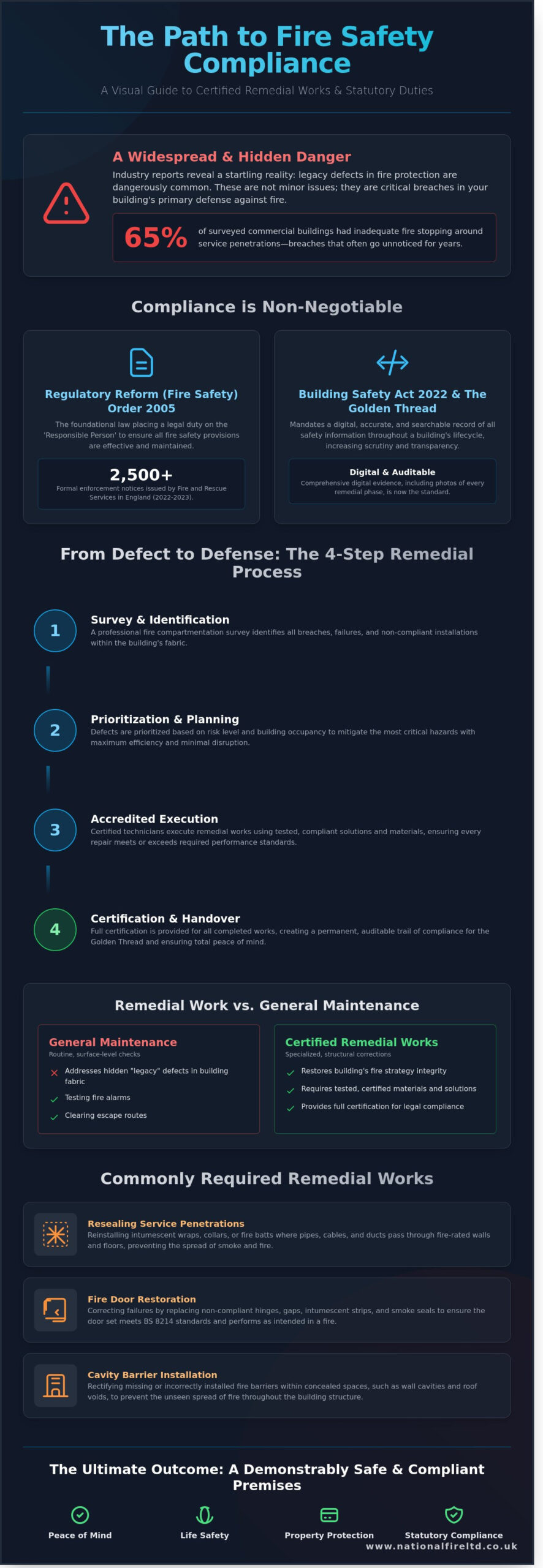
General maintenance typically involves routine checks such as testing alarms or clearing escape routes. While vital, these tasks often overlook hidden breaches within the building’s fabric. Remedial work is a specialised discipline designed to address “legacy” defects often left behind during the original construction phase. For instance, a 2024 industry report indicated that 65% of surveyed commercial buildings had inadequate fire stopping around service penetrations that had gone unnoticed for years.
- Resealing service penetrations: Reinstalling intumescent wraps or fire batts where pipes pass through compartment walls.
- Fire door restoration: Replacing non-compliant hinges or intumescent strips to ensure the door meets BS 8214 standards.
- Cavity barrier installation: Rectifying missing or incorrectly installed barriers in external cladding systems.
The Scope of Remedial Fire Safety in 2026
The standard for remedial excellence in the UK commercial sector has evolved rapidly since the full implementation of the Golden Thread of information. Contractors now provide comprehensive digital evidence, including photographic proof of every remedial works phase. This transparency is vital for complex, older structures where standard off-the-shelf products won’t suffice. Bespoke solutions are frequently required to mitigate risks in buildings constructed before modern 2010 Building Regulations were established. Every action we take is recorded in a digital log, ensuring a permanent, auditable trail of compliance that stands up to the scrutiny of the Fire and Rescue Service.
The Statutory Drivers: Why Remedial Fire Safety is Non-Negotiable
Fire safety compliance isn’t a matter of choice; it’s a statutory mandate. The Regulatory Reform (Fire Safety) Order 2005 remains the bedrock of UK fire legislation, placing a legal duty on the Responsible Person to ensure all fire safety provisions are kept in an efficient state. When a Fire Risk Assessment identifies deficiencies, these are recorded as significant findings. These findings aren’t merely suggestions. They represent a legal requirement for remedial works to mitigate risk to life and property effectively.
The Regulatory Reform (Fire Safety) Order
The local Fire and Rescue Service acts as the primary enforcement body. They have the power to audit your premises and review your progress on addressing FRA actions at any time. Between April 2022 and March 2023, Fire and Rescue Services in England issued over 2,500 formal enforcement notices to businesses failing to meet their obligations. Following Remedial Works and Rectification Guidance helps ensure that every action taken is proportionate, effective, and compliant with national standards. Failure to act on these notices can lead to unlimited fines or even prosecution, underscoring the gravity of maintaining a rigorous maintenance schedule.
The Building Safety Act and the Golden Thread
The Building Safety Act 2022 has introduced a higher level of scrutiny, particularly regarding the Golden Thread of information. This requirement ensures that safety data is digital, searchable, and accurate throughout the building’s entire lifecycle. When remedial works are executed, the documentation must be meticulous. It must specify who authorised the work, who performed it, and what certifications were achieved. At National Fire Ltd, we support this transparency through detailed fire strategy drawings, which provide a clear visual record for the Golden Thread. This level of accountability provides the peace of mind that your building is not only safe but legally robust.
Insurance providers are also driving the demand for immediate compliance. It’s now standard practice for insurers to request evidence of completed remedial actions before they’ll renew a commercial policy. Without documented proof that you’ve addressed high-priority risks identified in your latest assessment, your organisation could face significantly higher premiums or a total loss of cover. Protecting your assets requires a disciplined approach to safety. You can consult our team of experts to ensure your remedial programme meets these stringent legal and insurance standards before your next renewal date.
Identifying Common Remedial Requirements in Commercial Buildings
Identifying deficiencies in a building’s fire protection strategy requires a meticulous, expert eye. Most commercial properties in the UK undergo frequent alterations, from IT upgrades to HVAC maintenance, which often compromise the building’s original safety design. Under the Building Safety Act 2022, property managers face strict legal obligations to address these failures. Failure to comply can lead to enforcement actions, as detailed in the UK government guidance on remediation orders.
These requirements usually fall into four critical categories:
- Breached fire compartmentation: Often caused by new service installations like data cables, pipes, or ductwork that pierce through protective barriers.
- Fire door degradation: Degraded or incorrectly installed fire doors that no longer meet the required fire rating due to wear or poor maintenance.
- Cavity barrier failures: Damaged or missing cavity barriers within building facades or ceiling voids, which can lead to rapid, unseen fire spread.
- Structural movement: Inadequate fire stopping around structural elements that have shifted or settled over several years, creating new gaps.
Fire Door Remediation: Beyond Simple Repairs
Addressing fire door defects involves more than just fixing a sticking hinge. We focus on critical failures such as gaps exceeding 4mm, damaged intumescent strips, and non-compliant ironmongery that compromises the door’s integrity. While minor repairs are often possible, a full fire door installation becomes necessary when the core of the leaf is damaged or the frame is warped beyond recovery. It’s essential to secure BM TRADA or equivalent certification for all door remedial works to ensure they remain legally compliant and fit for purpose.
Restoring Fire Compartmentation and Stopping
Unmanaged service penetrations are the most frequent cause of compartmentation failure in UK offices. When new data cables or pipes are pulled through fire walls, they leave gaps that allow smoke and flame to bypass safety barriers. Our remedial works focus on sealing these breaches using high-performance intumescent batt, mastic, and specialised collars. We restore the integrity to the exact 30, 60, or 120-minute standards as per the original fire strategy. This methodical approach ensures that every penetration is accounted for and documented for the building’s safety records.
Managing the Remedial Process: From Survey to Certification
Achieving full compliance is a structured journey that transforms a list of identified defects into a certified safety record. This process must be methodical to ensure no detail is overlooked. It starts with a comprehensive fire compartmentation survey. This survey acts as the master blueprint for all subsequent actions, identifying every breach in fire-resisting walls, floors, and ceilings. By mapping these defects with precision, we eliminate the guesswork that often leads to budget overruns or missed risks.
Prioritisation and Risk Management
Effective management requires categorising remedial works into high, medium, and low priority. High-priority items include defects in protected escape routes or high-occupancy areas where the risk to life is greatest. These require immediate intervention to maintain life safety standards. Medium and low-priority tasks are scheduled based on building usage and annual budget cycles. We often implement temporary fire stopping during large-scale programmes to maintain a baseline of safety while permanent fixes are phased. This approach ensures that the building remains as safe as possible during the transition period, balancing urgent safety needs with operational requirements.
The Importance of Third-Party Accreditation
The technical nature of fire safety means you cannot rely on general builders for these tasks. Using non-specialist contractors for remedial works risks improper installation, which can lead to catastrophic failure during a fire event. It is essential to verify that your contractor holds BAFE, IFC, or BM TRADA accreditation. These certifications confirm that the technicians possess the specific expertise required for passive fire protection. For stakeholders and insurers, this accreditation is the primary source of peace of mind. It demonstrates a disciplined commitment to the highest safety standards and significantly mitigates legal liability.
Execution of the works involves real-time digital logging. Every penetration seal is tagged and photographed, providing an immutable record of the materials used and the quality of the workmanship. This level of transparency supports the “Golden Thread” of information required by the Building Safety Act and modern UK regulations. The process concludes with a final inspection and the issuing of a Certificate of Conformity. This document serves as statutory evidence that your building is compliant, your occupants are protected, and your legal obligations are fulfilled.
Ensure your building meets every statutory requirement with our accredited team. Contact National Fire Ltd today to secure your Certificate of Conformity.
National Fire Ltd: Your Partner for Compliant Remedial Solutions
National Fire Ltd delivers a disciplined, methodical approach to fire safety. We prioritise technical excellence to ensure every building meets the rigorous standards required by the Building Safety Act 2022. Our team specialises in remedial works that address critical vulnerabilities identified during professional inspections. We provide fire stopping, comprehensive fire door maintenance, and the installation of specialised cavity barriers. These measures are essential for maintaining compartmentation and protecting the lives of occupants in any high-risk environment.
We utilise advanced technology to support the Golden Thread of information. Our surveyors generate precise digital floor plans and asset logs for every project. This provides property managers with a transparent, permanent record of their compliance status that is accessible at all times. We operate across the UK, maintaining the highest safety standards while ensuring minimal disruption to your daily operations. Our goal is to provide a seamless transition from identified risk to certified safety through a process that is both thorough and transparent.
Why Choose Our Accredited Remedial Services?
Our surveyors and installers possess deep expertise in complex commercial and industrial environments. We don’t just fix immediate issues; we build long-term safety partnerships focused on durability and reliability. Every action we undertake comes with full certification, ensuring your statutory compliance is documented and verifiable for insurers and local authorities. By choosing an accredited partner, you mitigate legal risks and secure peace of mind for your stakeholders. We maintain a constant state of readiness, ensuring our technical knowledge reflects the latest updates to British Standards and the Regulatory Reform (Fire Safety) Order 2005.
Contact Us for a Remedial Consultation
Moving from a failed Fire Risk Assessment to full compliance requires a structured, professional strategy. We help you bridge that gap by designing a bespoke remedial works programme tailored to your specific property portfolio. Whether you manage a single commercial site or a national industrial estate, our team provides the technical clarity needed to resolve safety breaches efficiently. We understand the responsibility you carry as a duty holder. Take the final step toward total building safety and regulatory alignment. Ensure your building is compliant with National Fire Ltd by requesting a consultation with our expert team today.
Securing Your Statutory Compliance for 2026 and Beyond
The landscape of UK fire safety continues to evolve, making the diligent management of remedial works a critical priority for every building owner and facility manager. Adhering to the Regulatory Reform (Fire Safety) Order 2005 isn’t just about avoiding legal penalties; it’s about the fundamental protection of life and property. We’ve established that effective passive fire protection relies on a structured, logical progression from the initial survey through to final certification. By partnering with BAFE and BM TRADA accredited specialists, you ensure that every installation meets the most rigorous technical standards. National Fire Ltd provides comprehensive digital audit trails for every project, offering a transparent and permanent record of safety across your entire commercial or industrial estate. Our national coverage across the UK ensures that expert guidance is available wherever your assets are located. We’re here to act as your trusted advisor, providing the discipline and technical excellence required to navigate complex safety regulations. Secure your building’s integrity with our expert remedial services and gain the peace of mind that comes from knowing your property is in professional hands. We look forward to helping you maintain a safe and compliant environment.
Frequently Asked Questions
What is the difference between remedial work and reactive maintenance?
Remedial work refers to planned actions taken to rectify a specific non-compliance identified during a Fire Risk Assessment (FRA). Unlike reactive maintenance, which involves fixing a component after it has failed, remedial work is a proactive requirement under the Regulatory Reform (Fire Safety) Order 2005. It ensures the building returns to a statutory level of safety. National Fire Ltd specialises in these targeted improvements to mitigate risk before an incident occurs.
How long do I have to complete remedial works after a fire risk assessment?
Completion timelines don’t follow a single rule because they depend on the risk level assigned to each finding in your assessment. High-priority items typically require action within 24 hours to 28 days, while lower-risk issues may have a window of 6 to 12 months. Failure to adhere to these specific timeframes can invalidate your insurance and lead to enforcement action from the Fire and Rescue Service. We provide a clear schedule to help you manage these deadlines effectively.
Do I need a new fire compartmentation survey before starting remedial work?
It’s vital to commission a detailed fire compartmentation survey if your initial assessment identifies general breaches without specifying the exact location or required material. While an FRA identifies that a problem exists, a compartmentation survey provides the technical roadmap for remedial works. This ensures every penetration in fire-rated walls is sealed using BAFE-accredited methods. It prevents wasted expenditure on incorrect materials that do not meet BS 476 or EN 1366 standards.
Can any builder carry out fire stopping remedial works?
Only contractors with third-party accreditation should carry out fire stopping because they must provide a Certificate of Conformity upon completion. While any builder can apply sealant, the Building Safety Act 2022 mandates that work must be performed by a competent person to ensure legal compliance. National Fire Ltd uses IFC or BM TRADA certified installers to guarantee that every seal maintains the structural integrity of the building for the required 30 or 60-minute duration.
What documentation should I receive after remedial works are completed?
You must receive a comprehensive handover pack that includes a Certificate of Conformity and a detailed photographic log of the completed work. This documentation serves as your statutory evidence of compliance under the Fire Safety (England) Regulations 2022. It should feature technical data sheets for all materials used and a marked-up floor plan. This digital audit trail is vital for your Golden Thread of information and provides total peace of mind during future inspections.
Is it possible to remediate a fire door rather than replacing it?
Remediation is often a viable alternative to replacement if the door leaf and frame remain structurally sound. Statistics from the Fire Door Inspection Scheme suggest that up to 75% of fire doors can be repaired by replacing intumescent strips, upgrading hinges, or adjusting door closers. Our accredited technicians assess each door against BS 8214 standards to determine if a bespoke repair can restore its fire-resisting capabilities. This approach is often more cost-effective than a full installation.
How do remedial works affect my building insurance premiums?
Completing remedial works demonstrates to insurers that you’re actively mitigating risk, which can prevent premium hikes or the withdrawal of cover. Most commercial policies require strict adherence to the Regulatory Reform (Fire Safety) Order 2005 as a condition of the contract. By providing evidence of completed works and professional certification, you reduce the likelihood of a claim being rejected. Many insurers now view a clear, documented history of fire safety maintenance as a key factor in their risk profiling.
What happens if I ignore the remedial actions suggested in my fire survey?
Ignoring remedial actions leaves you liable for unlimited fines or a prison sentence of up to 2 years under the Regulatory Reform (Fire Safety) Order 2005. The Fire and Rescue Service has the power to issue Enforcement or Prohibition Notices, which can effectively shut down your business until the risks are managed. Beyond the legal peril, you’re knowingly placing lives at risk. Professional remedial action is the only way to ensure your building remains a safe environment for all occupants.