


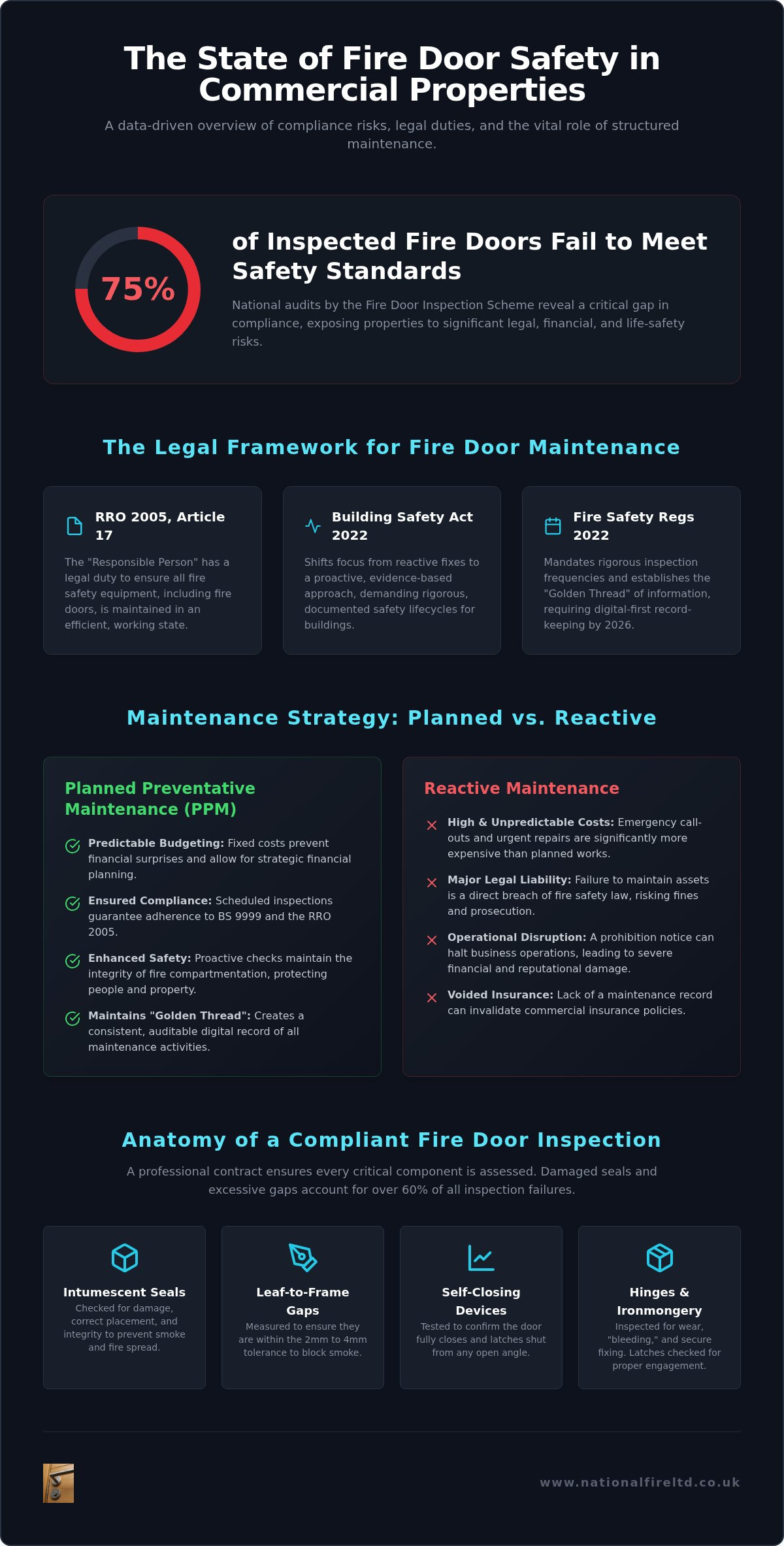
A staggering 75% of fire doors inspected by the Fire Door Inspection Scheme failed to meet required safety standards in recent national audits. For any property professional, this statistic represents more than just a technical failure; it’s a significant legal and safety risk that could lead to unlimited fines or even prosecution. We understand that managing these critical assets across a commercial portfolio is often complex, especially when you’re balancing quarterly inspection requirements against the need for predictable budgeting. Confusion over British Standards and the fear of unexpected repair costs can make fire safety feel like a moving target.
Securing a structured commercial fire door maintenance contract transforms this uncertainty into a methodical, compliant lifecycle. By reading this guide, you’ll discover how a professional maintenance framework ensures your building adheres to the Regulatory Reform (Fire Safety) Order 2005 and the latest 2026 record-keeping standards. We’ll outline the essential components of a robust contract, from technical fire strategy drawings to accredited remedial works. This article provides the clarity you need to maintain the Golden Thread of safety information while protecting your property, your people, and your professional reputation.
Key Takeaways
- Identify the specific legal mandates under the Regulatory Reform (Fire Safety) Order 2005 that dictate your maintenance and record-keeping responsibilities.
- Learn how a commercial fire door maintenance contract provides a predictable framework for budgeting while eliminating the high costs of reactive repairs.
- Discover the technical requirements for compliant inspections, including the role of technical fire strategy drawings in maintaining the Golden Thread of safety.
- Understand how to verify the credentials of an accredited national partner to ensure all remedial works meet rigorous safety standards and mitigate professional liability.
The Legal Mandate for Commercial Fire Door Maintenance
The Regulatory Reform (Fire Safety) Order 2005 remains the cornerstone of fire safety legislation in England and Wales. Under Article 17 of this Order, the “Responsible Person” must ensure that fire safety equipment is subject to a suitable system of maintenance and kept in an efficient state. This legal obligation extends specifically to fire doors, which are critical components of a building’s passive fire protection. Despite this, national audits by the Fire Door Inspection Scheme reveal that 75% of fire doors fail to meet required standards. This high failure rate often stems from a lack of a structured commercial fire door maintenance contract, leading to neglected fire door components and function, such as damaged intumescent seals or faulty self-closing devices.
The Building Safety Act 2022 has further intensified these requirements, particularly for high-rise and complex commercial assets. It shifts the focus from reactive fixes to a proactive, evidence-based approach. Fire doors are frequently the most failed element in fire risk assessments because they are high-traffic items prone to constant wear and tear. Without a formalised maintenance agreement, these assets quickly degrade, leaving the building owner or facilities manager legally liable for any resulting life-safety failures. We view maintenance not as a standalone task, but as a vital part of a building’s total fire compartmentation strategy.
Regulation 10 and the Golden Thread of Information
The Fire Safety (England) Regulations 2022, specifically Regulation 10, mandate more rigorous inspection frequencies for multi-occupied buildings. By 2026, the industry has transitioned toward a mandatory digital-first approach for record-keeping, making paper logs largely obsolete. A commercial fire door maintenance contract provides the essential framework for this “Golden Thread,” ensuring that every inspection, repair, and certification is logged in a digitised, accessible format. The Golden Thread is the permanent digital record of a building’s safety lifecycle that ensures critical information is accurate, accessible, and up to date for all stakeholders. This structured data management is essential for maintaining the integrity of technical fire strategy drawings.
Consequences of Non-Compliance in 2026
Failure to maintain fire doors carries severe penalties. In 2026, the legal landscape allows for unlimited fines and custodial sentences for those found in breach of fire safety duties. Beyond the courtroom, the insurance implications are equally damaging. Most commercial insurers now require documented proof of a proactive maintenance schedule. Unmaintained fire doors can effectively void a commercial policy, leaving a business financially exposed after an incident. There is also the irreparable reputational damage that follows a safety failure. For multi-site commercial portfolios, the risk of a prohibition notice can halt operations entirely, making professional, accredited maintenance a fundamental business necessity.
Essential Components of a Professional Maintenance Contract
A professional commercial fire door maintenance contract serves as a technical blueprint for sustained building safety. It moves beyond simple visual checks to ensure every component of the door set functions exactly as intended under fire conditions. British Standard BS 9999 recommends professional inspections every six months for most commercial properties; however, high-traffic environments or high-risk facilities often require monthly assessments to remain compliant with UK fire door regulations. By formalising these intervals, property managers replace guesswork with a disciplined safety schedule.
The contract must prioritise comprehensive ironmongery assessments. Our technicians examine overhead door closers to ensure they effectively overcome air pressure and latch the door from any angle. Hinges are checked for metal-to-metal friction or “bleeding,” which indicates imminent failure. We also verify that latching mechanisms engage securely without requiring manual force. These mechanical elements are the first line of defence in maintaining compartmentation during a fire event. Damaged intumescent seals and excessive gaps between the door and frame account for over 60% of inspection failures. A robust maintenance plan includes precise leaf-to-frame gap measurements, typically between 2mm and 4mm, and threshold tolerances to prevent smoke bypass. If you’re managing multiple sites, securing national fire door maintenance services ensures these standards are applied consistently across your entire portfolio.
Standardised Defect Classification
Effective maintenance relies on clear communication of risk. We use a standardised defect classification system to categorise issues as either critical safety failures or minor functional wear. This allows building safety managers to prioritise urgent remedial works that impact life safety. Initial fire door surveys establish the necessary baseline for this classification, ensuring that every subsequent maintenance visit is measured against a known standard. This methodical approach prevents minor issues from escalating into expensive, non-compliant failures.
Digital Reporting and Evidence of Compliance
By 2026, the industry has fully embraced a digital-first approach to safety records. A modern commercial fire door maintenance contract includes asset tagging each door with unique QR or RFID codes for individual traceability. This technology allows for the generation of comprehensive compliance reports, complete with photographic evidence of every inspection and repair. These digital logs are essential for fire service audits and provide the irrefutable evidence of due diligence required by the Building Safety Regulator and insurance providers.
PPM vs. Reactive Maintenance: Strategic Cost Management
Planned Preventative Maintenance (PPM) is a disciplined approach to passive fire safety that replaces the inefficiency of reactive repairs with a scheduled audit of every door set. Relying on “emergency” fixes is a high-risk strategy that often results in inflated labour costs and temporary solutions that don’t satisfy legal scrutiny. Implementing a commercial fire door maintenance contract shifts this dynamic, allowing property managers to transition from unpredictable capital expenditure to stable operational expenditure. By identifying minor misalignments or worn components early, we prevent the accelerated degradation of expensive assets.
Regular adjustments to hinges and overhead closers significantly extend the operational lifecycle of FD30 and FD60 doors. These assets are subject to constant mechanical stress in high-traffic commercial environments. Without a structured agreement, a door that merely required a hinge adjustment can quickly become a warped leaf requiring a full replacement. This proactive oversight is a fundamental requirement for staying aligned with Fire door safety regulations, which demand that safety equipment remains in efficient working order at all times.
Repair vs. Replacement Thresholds
Technical criteria must guide the decision to repair or replace a door set. We consider a door beyond economic repair if the timber core is compromised, or if previous non-compliant modifications have invalidated its original certification. In these instances, we recommend professional fire door installation to restore the building’s safety integrity. Our maintenance framework provides the data necessary to manage this transition, ensuring replacements are planned and budgeted for well before a safety failure occurs during a fire risk assessment.
Minimising Operational Disruption
We understand that commercial operations cannot grind to a halt for safety works. To maximise efficiency, we often bundle door maintenance with comprehensive fire compartmentation surveys. This holistic approach ensures that all passive fire protection elements are reviewed in a single, coordinated visit. For multi-site portfolios, our national coordination team schedules works during off-peak hours, ensuring that compliance is achieved without compromising the daily productivity of your business or tenants.
How to Procure a Compliant Maintenance Partner
Selecting a partner for a commercial fire door maintenance contract requires a rigorous vetting process that transcends simple price comparison. The high-stakes nature of life safety demands that contractors demonstrate third-party accreditation from recognised bodies such as BM TRADA or FIRAS. These certifications provide independent verification that the company’s management systems and technical skills meet national standards. We recommend assessing a contractor’s ability to integrate door maintenance with broader technical documentation, such as fire strategy drawings. A partner who understands the relationship between a single door and the building’s total compartmentation strategy offers a superior level of risk mitigation.
For multi-site commercial portfolios, national reach is a critical factor. You should evaluate whether a contractor employs a consistent, in-house team of experts or relies heavily on a fragmented network of sub-contractors. Reliance on sub-contractors often leads to inconsistent reporting and variable quality in remedial works. During the quotation phase, ask for evidence of their digital record-keeping capabilities and their process for managing the Golden Thread of information. If a contractor can’t provide a clear, photographic audit trail for every asset, they can’t support your compliance obligations in 2026.
The Role of Competency in Passive Fire Protection
General builders often fail fire door maintenance audits because they don’t have the specialised knowledge required for complex fire-rated assemblies. Effective passive fire protection is a technical discipline, not a general trade. It’s essential that technicians are trained specifically in BS 8214 standards, which govern the installation and maintenance of timber-based fire doors. We ensure our teams are fully integrated into these professional frameworks, providing the meticulous oversight required to protect both property and life.
Drafting the Service Level Agreement (SLA)
A robust SLA is the foundation of a successful commercial fire door maintenance contract. It must define clear emergency response times for critical failures, such as a door that fails to latch or a damaged leaf in a high-risk area. Your agreement should also provide clarity on parts inclusion, specifically addressing ironmongery, intumescent seals, and fire-rated glazing. We suggest including performance indicators related to compliance percentages and termination clauses that trigger if safety standards aren’t consistently met. To secure your building’s safety with a proven national partner, request a technical consultation with our experts.
National Fire Ltd: National Compliance Specialists
National Fire Ltd operates as a unified front of experts dedicated to the protection of life and property across the United Kingdom. Our approach to a commercial fire door maintenance contract is built on technical excellence and a deep understanding of the professional and legal frameworks of the national safety sector. We provide comprehensive oversight for industrial and commercial portfolios, ensuring that every asset is managed with the same level of meticulous detail. By maintaining a national presence, we offer multi-site organisations a consistent standard of safety that local, fragmented contractors cannot match. Our teams are seasoned professionals who are always prepared, reflecting the disciplined nature of the safety industry.
Our commitment to the Golden Thread of building safety is absolute. We employ advanced digital reporting systems that offer building safety managers total transparency into their compliance status. Every survey and remedial action is logged with precision, creating an exhaustive audit trail that stands up to the most rigorous inspections. This methodical approach ensures that your safety records are always accurate, accessible, and up to date, providing the psychological benefit of security for both owners and occupants. We don’t just complete a task; we provide an accredited method for addressing safety risks that instils a deep sense of security and confidence.
Beyond the Door: A Holistic Safety Perspective
A fire door is only as effective as the wall that contains it. We distinguish ourselves by integrating door maintenance with a total fire compartmentation strategy. Our specialists use technical fire strategy drawings to inform maintenance priorities, identifying how individual doors support the wider building’s safety integrity. This holistic perspective allows us to provide a single point of accountability for passive fire compliance, incorporating specialised solutions like cavity barriers and remedial fire stopping. We ensure that no hidden fire spread path is left unaddressed, maintaining the stability of your building’s safety framework.
Partnering for Long-Term Compliance
We view our clients as long-term partners in safety. Every commercial fire door maintenance contract we design is tailored to the specific risk profile and occupancy of the building in question. Our team projects an image of seasoned professionalism, delivering authoritative reassurance through disciplined project management and constant availability. We aren’t just a service provider; we position ourselves as a guardian of life and property. This steadfast approach ensures that your commercial assets remain compliant with all national standards and legislative requirements. Contact National Fire Ltd today to discuss your requirements and secure a compliant, robust safety framework for your commercial assets.
Securing Your Commercial Assets Through Strategic Compliance
Transitioning from reactive repairs to a structured maintenance framework is essential for meeting the 2026 Building Safety Act requirements. A professional maintenance approach ensures that every component of a door set, from intumescent seals to technical fire strategy drawings, remains verified and compliant. Implementing a commercial fire door maintenance contract provides the digital evidence needed to maintain the Golden Thread and protect your legal liability. It also transforms unpredictable capital expenditure into manageable operational costs, extending the functional lifecycle of your passive fire protection assets.
National Fire Ltd offers UK national coverage for commercial portfolios, backed by BM TRADA certified installers and specialised expertise in technical fire strategy drawings. Our methodical approach instils the security and confidence required to manage complex property requirements effectively. We’re committed to acting as a guardian of your life and property, ensuring that your compliance is never in doubt. To secure your building’s safety and regulatory future, Request a Professional Fire Door Maintenance Quote. Taking proactive steps today ensures a safer environment for your occupants and a more predictable future for your property management budget.
Frequently Asked Questions
Is a fire door maintenance contract a legal requirement in the UK?
Maintenance is a legal requirement under Article 17 of the Regulatory Reform (Fire Safety) Order 2005. While the law doesn’t explicitly mandate a “contract,” it requires a suitable system of maintenance to ensure safety equipment is kept in an efficient state. A commercial fire door maintenance contract is the most reliable method to demonstrate due diligence to the Fire and Rescue Service. It ensures inspections are never missed, providing a robust audit trail that protects the Responsible Person.
How often should commercial fire doors be inspected under a contract?
Standard commercial properties should receive professional inspections every six months as recommended by British Standard BS 9999. However, the Fire Safety (England) Regulations 2022 mandate quarterly checks for fire doors in common parts of residential buildings over 11 metres. High-traffic commercial environments, such as hospitals or major retail hubs, often require monthly assessments. Your contract should be tailored to your building’s specific risk profile and occupancy levels to ensure continuous compliance and life safety.
What is the difference between a fire door survey and a maintenance check?
A fire door survey is a comprehensive technical audit used to establish an initial baseline of your building’s assets. It identifies existing defects and verifies the original certification of each door set. In contrast, a maintenance check is a recurring visit performed as part of a commercial fire door maintenance contract. These visits focus on the ongoing functionality of components like seals and closers, ensuring the doors remain in efficient working order between major technical surveys.
Can my internal maintenance team carry out fire door repairs?
Internal teams may only perform repairs if they meet the legal definition of a “competent person” with specific training in fire door assemblies. General maintenance staff often lack the technical certification required to ensure that remedial works don’t invalidate a door’s fire rating. We recommend using third-party accredited technicians for all repairs. This ensures every component used is compatible and that the work adheres to the rigorous standards required by building safety regulators and insurers.
What happens if a fire door fails an inspection during a contract?
If an inspection identifies a failure, the technician will categorise the defect based on its impact on life safety. Critical failures, such as a door that fails to self-close or latch, require immediate remedial action to restore the building’s fire compartmentation. Minor functional wear is logged for scheduled repair. A structured contract ensures these issues are addressed systematically, with all remedial works documented digitally to maintain the Golden Thread of safety information for your records.
Does a maintenance contract cover both FD30 and FD60 fire doors?
A professional maintenance framework covers all fire-rated door sets, including FD30 and FD60 variants. While the fire resistance duration differs, the mechanical requirements for compliance remain consistent across all types. Technicians must verify that intumescent seals, smoke seals, and ironmongery function correctly regardless of the door’s specific rating. Our national teams are trained to maintain the technical requirements of both timber and metal door sets to ensure complete portfolio safety and regulatory adherence.
How much does a commercial fire door maintenance contract typically cost?
The cost of a maintenance agreement depends on several factors, including the total number of doors, the building’s height, and the required inspection frequency. High-traffic sites requiring monthly checks will have different cost structures than smaller offices with biannual requirements. We provide tailored quotations based on a technical assessment of your portfolio. This approach ensures you receive a predictable budgeting framework that covers essential inspections and prevents the high costs associated with reactive, emergency repairs.
What documentation should I receive after a fire door maintenance visit?
Following every maintenance visit, you should receive a detailed digital report for each asset inspected. This documentation must include photographic evidence of the door’s condition and a clear record of any remedial works performed. These reports are essential for satisfying fire service audits and maintaining your building’s safety case under the Building Safety Act. We provide accessible, digitised logs that ensure your safety information is accurate and available whenever a regulator or insurer requests it.