


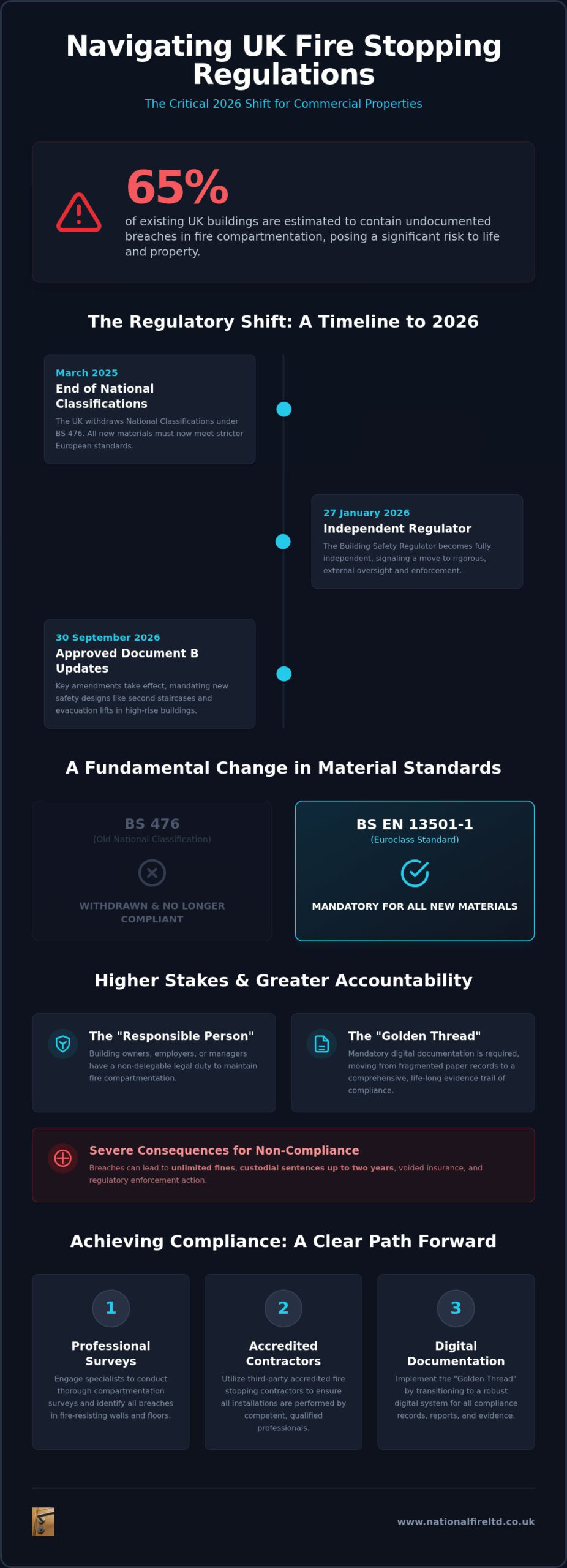
Did you know that approximately 65% of existing UK buildings are estimated to contain undocumented breaches in fire compartmentation? This statistic represents a significant risk to life and property, especially as the Building Safety Regulator becomes fully independent on 27 January 2026. It’s understandable that many commercial property owners feel overwhelmed by the current fire stopping regulations UK. The transition from BS 476 to the stricter BS EN 13501-1 Euroclass standard, alongside the 30 September 2026 amendments to Approved Document B, has created a complex legal environment where traditional methods no longer guarantee safety.
We recognize the weight of responsibility you carry as a building owner or manager. This guide provides the technical clarity you need to master these evolving standards and ensure your property remains a secure, compliant environment. You’ll gain a clear roadmap to meeting your safety obligations with confidence. We’ll examine the mandatory “Golden Thread” of digital documentation, the critical role of technical fire strategy drawings, and how to verify contractor competency in an era of heightened accountability and rigorous enforcement.
Key Takeaways
- Understand how the 2026 updates to Approved Document B and the Building Safety Act redefine passive fire protection standards for commercial properties.
- Identify your legal obligations as a “Responsible Person” to maintain compartmentation integrity under the latest fire stopping regulations UK.
- Learn why service penetrations and joints require specialized sealing to ensure the fire resistance of walls and floors is never compromised.
- Discover how to implement the mandatory “Golden Thread” by transitioning from fragmented paper records to comprehensive digital compliance evidence.
- Recognize why third-party accredited contractors and professional compartmentation surveys are essential for meeting stringent 2026 safety benchmarks.
The 2026 Regulatory Landscape: Approved Document B and the Building Safety Act
Fire stopping is the disciplined practice of sealing openings to prevent the spread of fire, smoke, and heat between building compartments. Within the broader context of passive fire protection, it’s the primary method for maintaining the structural integrity of fire-rated walls and floors when they are breached by services. The technical specifications for these installations are detailed within the UK Building Regulations, specifically Approved Document B. Adhering to the fire stopping regulations UK is a legal necessity that protects both the structural assets and the lives of those inside.
The regulatory environment is shifting toward a model of higher accountability. On 27 January 2026, the Building Safety Regulator becomes a fully independent body, separate from the Health and Safety Executive. This change signals a move away from traditional self-regulation toward a system of rigorous, external oversight for all commercial and high-risk structures. For building owners, this means that compliance is no longer a periodic check but a continuous obligation to maintain safety standards.
Key Legislative Pillars for UK Building Owners
Three core pieces of legislation form the foundation of modern fire safety. The Fire Safety Act 2021 clarified that the structure, external walls, and flat entrance doors are within the legal scope of the Fire Safety Order. This was followed by the Building Safety Act 2022, which introduced a rigorous Gateway process for high-risk buildings (HRBs). These are typically defined as buildings at least 18 metres tall or having seven storeys. This Act also established the role of the Accountable Person, who holds criminal liability for safety failures.
Finally, the Construction Products Regulations ensure that all materials used in fire stopping carry appropriate markings and performance data. Since March 2025, the UK has withdrawn National Classifications under BS 476. All new fire-resistant materials must now comply with the stricter BS EN 13501-1 Euroclass standard. This transition ensures that products are tested under more realistic, high-performance conditions.
Approved Document B: Changes Effective in 2026
The 30 September 2026 amendments to Approved Document B introduce significant design shifts for the built environment. Most notably, they mandate second staircases in new residential blocks of flats 18 metres and above to improve evacuation resilience. New provisions for evacuation lifts also become a standard requirement for these structures. These changes reflect an engineering-led approach to safety where passive systems must support complex evacuation strategies.
In the commercial sector, the shift to Euroclass standards for fire stopping materials is now absolute. Insurers and the Building Safety Regulator view these updated standards as mandatory benchmarks for compliance rather than optional guidance. Failure to use materials that meet the BS EN 13501-1 standard can result in a building being deemed non-compliant, potentially voiding insurance policies and triggering enforcement action from the regulator.
The Legal Duties of the “Responsible Person” Under the Fire Safety Order
The Regulatory Reform (Fire Safety) Order 2005 identifies the “Responsible Person” (RP) as the individual or entity legally accountable for fire safety. In a commercial context, this is usually the employer, the building owner, or a managing agent with control over the premises. The RP holds a non-delegable duty to maintain the building’s fire compartmentation. This means you’re responsible for ensuring that fire-resisting walls and floors aren’t compromised by unsealed service penetrations or poor maintenance. Adhering to the fire stopping regulations UK isn’t merely a technical requirement; it’s a primary legal obligation to protect occupants from the spread of smoke and flame.
Legislation requires the RP to appoint “competent persons” to assist in undertaking protective measures. Competency is defined by a combination of formal training, documented experience, and technical knowledge. Attempting to manage fire stopping through unqualified internal staff or general contractors often leads to non-compliance. Serious breaches can result in unlimited fines and custodial sentences of up to two years. The Building Safety Regulator’s independent status in 2026 ensures these penalties are applied with greater frequency and transparency.
Mandatory Fire Risk Assessments and Remediation
A Fire Risk Assessment (FRA) is only valid if it accurately reflects the state of a building’s passive fire protection. Research from the Fire Protection Association shows that 80% of buildings contain hidden breaches that standard assessments often overlook. Consequently, remedial fire stopping is the most common requirement identified during a professional audit. RPs must move beyond one-off fixes and establish a structured maintenance schedule. This ensures that any new cabling or pipework installations are immediately sealed in accordance with Approved Document B (Fire Safety), maintaining the building’s integrity over time.
Liability and the Cost of Failure
The financial risks of negligence extend far beyond statutory fines. Most commercial insurance providers require proof of compliance with all national safety standards. If a fire occurs and investigation reveals that fire stopping was deficient, insurers often void the policy, leaving the business liable for all damages. The Fire Safety (England) Regulations 2022 have further tightened these rules for multi-occupied buildings, mandating quarterly inspections of fire doors and evacuation routes.
There’s also a significant shift toward personal liability. Directors and building managers can no longer rely on corporate structures to shield them from the consequences of safety failures. If a breach is traced back to individual neglect, the legal and reputational fallout is severe. To verify your building’s current safety status, commissioning a professional fire compartmentation survey is the most reliable way to identify and mitigate these risks before they escalate.
Technical Requirements for Service Penetrations and Joints
Service penetrations represent the most common points of failure in a building’s passive fire protection strategy. These penetrations include any pipes, ducts, or electrical cables that pass through fire-resisting walls or floors. According to the fire stopping regulations UK, the fire resistance of a compartment must not be compromised by these openings. Restoring this integrity requires a methodical application of tested systems rather than simply filling a gap with a single product. It’s a legal necessity to ensure that the fire-stopping measure provides the same level of resistance as the original structure.
Professional installers utilize a range of specialized materials to achieve this, including intumescent batts, sealants, pipe collars, and wraps. It’s essential to use a unified “system” from a single manufacturer. Mixing components from different sources is a high-risk practice because combined products lack the necessary certification for collective performance under heat. Every installation must align with the specific test data provided by the manufacturer to remain compliant with Approved Document B.
Maintaining Compartment Integrity
Intumescent materials operate through a chemical reaction triggered by high temperatures. They expand significantly to seal gaps as plastic pipes melt or cables char, creating a pressure seal that blocks flame and toxic gases. This process is vital at joints and junctions where different construction materials meet. Ensuring robust fire compartmentation is the primary method for containing smoke. This is a critical safety factor, as smoke inhalation accounts for 41% of fire-related fatalities in the UK.
Specific Solutions for Complex Penetrations
Large openings and cable trays often require high-density fire boards to maintain a structural barrier. In hidden voids, we utilize cavity barriers to prevent the unseen spread of flame through wall cavities and floor voids. It’s a critical point of compliance that standard expandable foam is rarely suitable for commercial use. Despite its commonality, approximately 15% of site audits uncover the misuse of standard pink PU foam as a fire-rated solution. In professional environments, only tested, system-based sealants meet the rigorous requirements of 2026 safety standards.
The Golden Thread: Mandatory Documentation and Evidence of Compliance
The Building Safety Act 2022 mandates the creation of a “Golden Thread” of information. This is a digital record of a building’s fire safety information that must be maintained throughout its entire lifecycle. Under the fire stopping regulations UK, this requirement ensures that safety data is accurate, accessible, and up to date. It’s no longer acceptable to rely on fragmented paper records or verbal assurances. Digital transparency is now the primary benchmark for legal compliance.
The transition to digital platforms allows for real-time tracking of safety assets. Essential documentation includes technical data sheets, installation logs, and manufacturer’s test evidence. These records prove that every seal installed meets the specific performance requirements of the building’s design. Regulation 38 reinforces this by placing a clear responsibility on contractors to provide detailed handover documentation that covers the location, performance, and maintenance requirements of every passive fire protection system.
Photographic evidence is a non-negotiable part of this process. Since fire stopping is frequently concealed by subsequent construction, photos are the only way to verify that a seal was installed correctly. A compliant digital record must include high-resolution images of the penetration before work starts, the internal components of the seal, and the finished application. This level of detail provides the necessary assurance to the Building Safety Regulator that the compartmentation remains intact.
Digital Record Keeping and Asset Tagging
Asset tagging represents the modern standard for safety management. We use unique QR codes and digital tags to track the history of every fire stop. When scanned, these tags provide instant access to the installation data and the credentials of the competent person who performed the work. This creates a robust “as-built” record that matches the original fire strategy. Building managers must demand these digital handover packs to ensure they meet their ongoing obligations for high-rise and commercial structures.
The Role of Fire Strategy Drawings
Fire strategy drawings are the foundational blueprint for all passive fire protection installations. These drawings dictate the exact location and fire rating of every compartment wall and floor. Without accurate strategy drawings, it’s impossible to guarantee that fire stopping seals will perform as intended during an incident. Professional floor plan generation is required to map these lines with precision. If your current documentation is incomplete, our experts can produce the technical fire strategy drawings needed to secure your compliance roadmap.
Achieving Compliance with Professional Fire Stopping Contractors
Professionalism in the passive fire protection sector is defined by third-party accreditation. Independent bodies such as FIRAS, IFC, and BM TRADA provide the necessary oversight to ensure that installers possess the technical proficiency required by fire stopping regulations UK. Relying on unaccredited contractors introduces significant risk, as they lack the rigorous external audits that verify their adherence to manufacturer-tested systems. Accreditation is the only reliable indicator that a contractor can provide the certified evidence of compliance required by the Building Safety Regulator.
A comprehensive fire compartmentation survey is the essential first step toward achieving a compliant status. This technical audit identifies hidden breaches in walls and floors that standard fire risk assessments often overlook. By utilizing a single-source contractor for both surveying and remedial installations, building managers ensure a seamless transition from risk identification to resolution. This approach allows for the integration of specialized solutions, such as injectable cavity barriers and fire-rated balconies, into a unified safety strategy where every seal is documented and verified.
Vetting Your Passive Fire Protection Partner
Building managers must evaluate potential partners based on their technical drawing capabilities and insurance coverage. A competent contractor doesn’t just install materials; they provide the technical fire strategy drawings required for long-term asset management. These drawings serve as the permanent record for the “Golden Thread” of information. When vetting a partner, ensure they provide full Operation and Maintenance (O&M) documentation. This pack should include digital installation logs and high-resolution photographic evidence for every fire stop, ensuring the work remains transparent for future inspections.
National Fire Ltd: Your Partner in Compliance
National Fire Ltd operates as a dedicated guardian of life and property across the UK. We specialize exclusively in the commercial and industrial sectors, providing the meticulous standards required to meet 2026 safety benchmarks. Our expertise in floor plan generation and technical drawings ensures that your building’s safety infrastructure is fully documented and legally robust. We ensure that your fire doors and fire stopping measures work in unison to provide total compartmentation. This holistic approach creates a secure environment that stands up to the most rigorous professional audits.
Securing Your Property’s Future Under 2026 Standards
Mastering the fire stopping regulations UK requires a disciplined approach to both physical installation and digital record-keeping. The 2026 safety landscape demands absolute transparency through the mandatory Golden Thread and strict adherence to BS EN 13501-1 Euroclass standards. Building owners must prioritize professional compartmentation surveys to identify hidden breaches before they become significant legal liabilities. Relying on accredited expertise is the only way to ensure that your passive fire protection remains robust under the scrutiny of the independent Building Safety Regulator.
National Fire Ltd serves as a specialist commercial fire stopping contractor with national UK coverage. We provide the comprehensive fire strategy drawing services and floor plan generation necessary to anchor your compliance framework in technical excellence. Our expert surveyors are prepared to help you meet these meticulous standards and maintain a secure environment for all occupants. Proactive remediation ensures that your property remains a safe asset for years to come.
Ensure your building is compliant; book a professional fire compartmentation survey today.
Achieving a secure, compliant environment is a significant responsibility, but it’s one you can meet with confidence through methodical planning and professional partnership.
Frequently Asked Questions
Is fire stopping a legal requirement in the UK?
Yes, fire stopping is a mandatory legal requirement under the Regulatory Reform (Fire Safety) Order 2005 and Approved Document B of the Building Regulations. These laws mandate that buildings are divided into fire-resisting compartments to inhibit the spread of flame and smoke. Failure to maintain these barriers through proper fire stopping regulations UK is a breach of statutory duty. It’s essential that all service penetrations are sealed using tested systems to ensure compliance.
What is the difference between fire stopping and fire protection?
Fire protection is an umbrella term encompassing both active systems, like sprinklers, and passive measures. Fire stopping is a specific discipline within passive fire protection that focuses on sealing openings in fire-rated walls and floors. While fire protection refers to the overall strategy for life safety, fire stopping specifically restores the integrity of compartmentation where it’s been breached by pipes, cables, or ducts. Both are necessary for a comprehensive safety strategy.
Who is responsible for fire stopping in a commercial building?
The “Responsible Person” (RP) holds the legal accountability for fire stopping in commercial premises. This individual is typically the employer, building owner, or managing agent. The RP must ensure that fire compartmentation is maintained and that any remedial works are performed by a competent person. In high-rise residential buildings, the Building Safety Act 2022 also introduces the role of the “Accountable Person” who shares specific duties regarding structural and fire safety risks.
What are the penalties for non-compliant fire stopping?
Non-compliance with fire safety legislation carries severe legal and financial consequences. Courts can impose unlimited fines on organizations and custodial sentences of up to two years for individuals found negligent. Beyond statutory penalties, failing to meet fire stopping regulations UK often voids building insurance policies. This leaves the business liable for all damages and civil claims following an incident. The Building Safety Regulator’s independent status in 2026 ensures more rigorous enforcement of these standards.
Do I need a fire compartmentation survey every year?
While the specific frequency of a survey isn’t fixed for all commercial buildings, the Fire Safety (England) Regulations 2022 mandate quarterly inspections for fire doors in multi-occupied buildings. For high-rise residential blocks over 18 metres, Fire Risk Assessments must be reviewed annually. We recommend a full compartmentation survey whenever significant building work occurs or when an audit reveals concerns. Statistics show that 65% of existing buildings contain undocumented breaches in their fire barriers.
What is the Golden Thread in fire safety?
The Golden Thread is a digital record of a building’s fire safety information required by the Building Safety Act 2022. It ensures that accurate data regarding the building’s design, construction, and maintenance is available throughout its lifecycle. For fire stopping, this includes installation logs, photographic evidence, and technical data sheets for every seal. This digital transparency allows building managers to demonstrate compliance and provides the Building Safety Regulator with a clear, verified audit trail.
Can I use standard expanding foam for fire stopping?
Standard PU expanding foam is not a compliant fire stopping solution for commercial or industrial applications. Research indicates that 15% of site audits reveal the misuse of “pink” foam as a fire-rated material, which often fails to stop smoke or flame spread. Compliance requires the use of tested intumescent systems, such as batts, sealants, or collars. These materials are specifically engineered to react to heat and maintain the integrity of fire-rated compartments during an incident.
How long does fire stopping material last?
Most fire stopping materials are designed to be durable for the life of the building if they remain undisturbed. However, their performance depends on environmental conditions and the quality of the initial installation. Manufacturers provide specific service life data, but regular inspections are required to identify degradation or new breaches. If service penetrations are modified or new cables are installed, the fire stopping must be updated immediately to maintain the building’s technical compliance and long-term safety.