


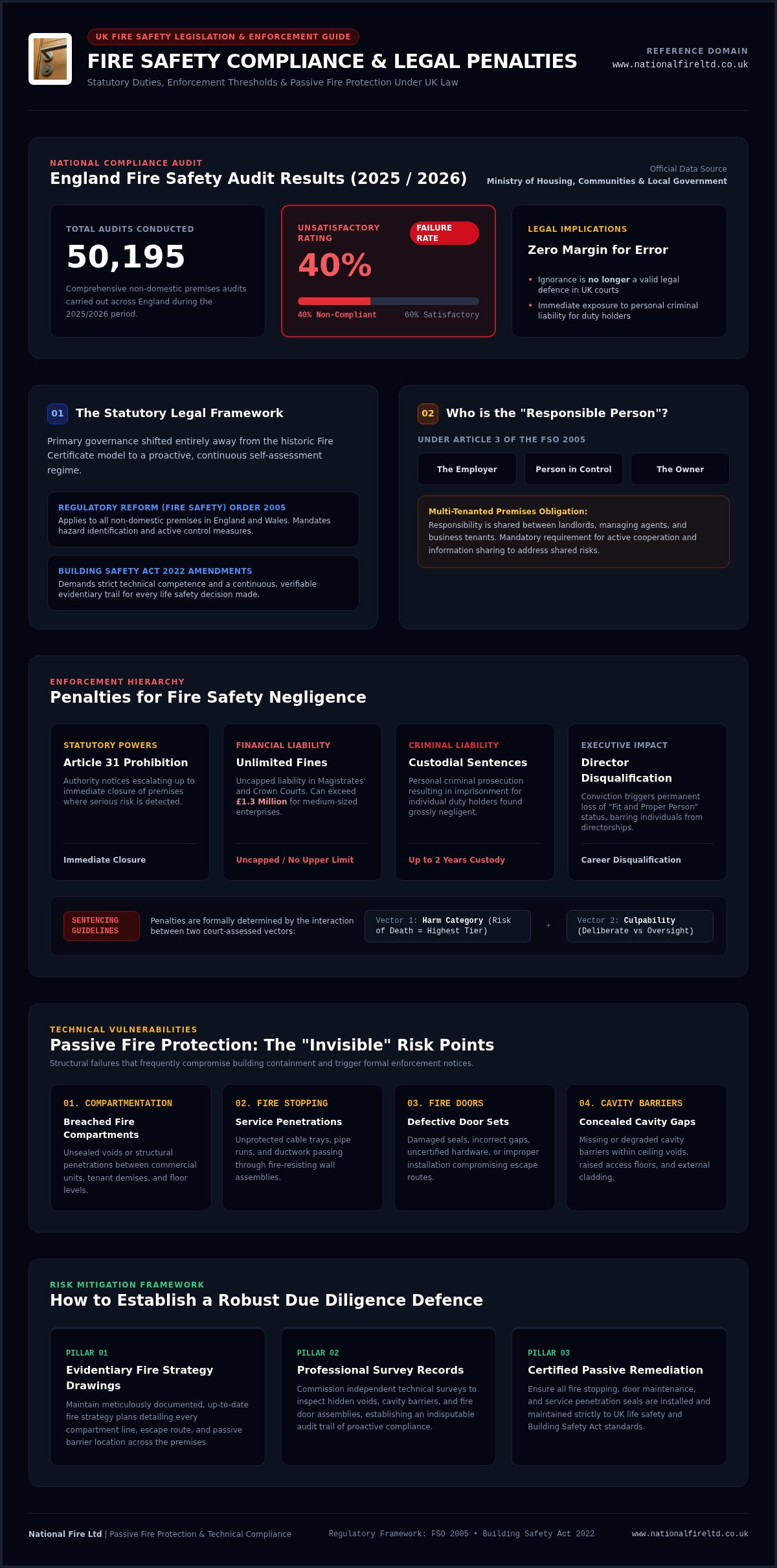
Did you know that 40% of the 50,195 fire safety audits conducted across England in 2025/2026 resulted in an unsatisfactory rating? This data from the Ministry of Housing, Communities and Local Government highlights a systemic failure in compliance that leaves many managers exposed to severe legal penalties for fire safety negligence. Under the Regulatory Reform (Fire Safety) Order 2005, the margin for error has vanished, replaced by a landscape where ignorance is no longer a valid legal defence. If you’re feeling the weight of personal criminal liability or find the latest Building Safety Act amendments confusing, your concerns are entirely justified.
We understand that overseeing a commercial property involves managing complex, often invisible risks like poor fire stopping or compromised compartmentation. This guide provides a definitive framework to help you understand the potential for unlimited fines and custodial sentences of up to two years. You’ll learn how to demonstrate rigorous due diligence and exactly how to rectify passive fire safety gaps. We’ll explore the technical solutions that move your organisation beyond basic compliance, ensuring you’re fully prepared for any professional inspection or audit.
Key Takeaways
- Understand your statutory obligations as a ‘Responsible Person’ under the Regulatory Reform (Fire Safety) Order 2005 and the recent amendments mandated by the Building Safety Act.
- Identify the severe financial and criminal consequences of non-compliance, including the potential for unlimited fines and custodial sentences that constitute the primary legal penalties for fire safety negligence.
- Recognise the “invisible” risks within your building’s structure, such as breached compartmentation and defective fire doors, which frequently trigger formal enforcement notices.
- Establish a robust due diligence defence by maintaining accurate fire strategy drawings and professional survey records to prove your commitment to life safety standards.
- Learn how to mitigate liability through proactive passive fire protection measures, ensuring all service penetrations and cavity barriers meet rigorous UK compliance requirements.
The Regulatory Reform (Fire Safety) Order 2005: Your Legal Foundation
The Regulatory Reform (Fire Safety) Order 2005, commonly known as the FSO, serves as the primary legislative framework governing fire safety for all non-domestic premises in England and Wales. It represents a fundamental shift in responsibility, moving the legal burden away from the local fire authority and placing it squarely on the shoulders of those who manage or own buildings. This self-assessment regime requires a proactive approach to risk management. It’s no longer enough to wait for an external inspection; you must actively identify hazards and implement control measures to protect both occupants and property.
Current standards in 2026 reflect a significant evolution in building safety. With the full implementation of the Building Safety Act 2022 amendments, the expectations for documentation and technical competence have never been higher. Authorities now demand a clear evidentiary trail for every safety decision made. Courts consistently rule that ignorance of these statutory requirements isn’t a valid defence. If a building manager fails to record a fire risk assessment or overlooks structural defects, they become vulnerable to the full weight of legal penalties for fire safety negligence.
Who is the “Responsible Person” Under the Law?
Identifying the “Responsible Person” is the first step in establishing a legal safety framework. Under Article 3 of the FSO, the Responsible Person is defined as the employer, the person who has control of the premises, or the owner. This role carries an uncompromising duty of care to ensure the safety of everyone on-site. In multi-tenanted commercial buildings, this responsibility is often shared between landlords, managing agents, and business owners. This creates a mandatory requirement for cooperation and information sharing to ensure that “invisible” risks, like breached compartmentation between units, are addressed collectively. If a failure occurs, the legal system looks at who had the power to rectify the risk and failed to act.
The Scope of Commercial Fire Safety Compliance
The FSO applies to nearly every type of non-domestic premise, including offices, warehouses, industrial units, and retail spaces. Compliance isn’t limited to visible features like extinguishers. It mandates robust passive fire protection, which includes fire stopping, fire door installation, and the maintenance of cavity barriers. The modern regime has moved far beyond the outdated Fire Certificate system. It’s now a continuous process of risk assessment where the Responsible Person must demonstrate they’ve taken all reasonable precautions. Failing to maintain these structural safeguards is a common trigger for prosecution, as these defects directly impact the building’s ability to contain a fire and protect escape routes.
The Financial and Criminal Penalties for Fire Safety Negligence
The UK legal system treats fire safety breaches with extreme gravity. Authorities use a tiered enforcement approach, starting with informal advice and escalating to Article 31 Prohibition Notices that can close a building immediately. When cases reach the courts, the legal penalties for fire safety negligence are determined by the Sentencing Council’s definitive guidelines. These guidelines assess fines based on the “harm category,” where the risk of death is the highest tier, and the “culpability” of the Responsible Person. A deliberate breach for financial gain attracts significantly higher penalties than a technical oversight.
Beyond the immediate judicial outcome, the reputational fallout can be terminal for a business. Conviction for fire safety offences often leads to a loss of “Fit and Proper Person” status for directors. This disqualification can prevent individuals from holding similar positions in the future, effectively ending a professional career. The courts aim to set fines at a level that provides a genuine deterrent, ensuring that safety is never sacrificed for the sake of profit margins.
Unlimited Fines and Financial Liability
Financial consequences extend far beyond the courtroom. Fines for fire safety offences are now unlimited in both Magistrates’ and Crown Courts. This uncapped liability means a medium-sized enterprise could face fines exceeding £1.3 million for serious failures. Beyond the fine itself, non-compliance frequently invalidates commercial property insurance. If a fire occurs and investigators find unsealed service penetrations, your insurer may refuse to cover the damage. This leaves the business with total financial ruin. You must also consider the “Fee for Intervention” model, where you’re charged for the time inspectors spend investigating your breaches. Engaging in a professional fire compartmentation survey is the most effective way to identify these hidden liabilities before they trigger an enforcement action.
Custodial Sentences and Corporate Manslaughter
Individual directors and managers aren’t shielded by the corporate veil. Under Article 32(8) of the FSO, if an offence is committed with your “consent, connivance, or neglect,” you face personal criminal liability. The GOV.UK workplace fire safety penalties and enforcement guide clarifies that custodial sentences are a real possibility for those who ignore their duties. For the most severe cases involving fatalities, the Corporate Manslaughter and Corporate Homicide Act 2007 allows for the prosecution of the entire organisation. Under current UK law, fire safety negligence can result in a custodial sentence of up to two years for individuals found personally liable.
Passive Fire Protection: The “Invisible” Risk of Negligence
While fire alarms and extinguishers are highly visible, the structural integrity of a building often dictates the severity of legal penalties for fire safety negligence. Passive fire protection (PFP) is designed to contain fire and smoke within a specific area, providing vital time for evacuation and emergency response. However, because these systems are often hidden behind ceilings or within wall cavities, they’re frequently overlooked during routine maintenance. This oversight doesn’t exempt a Responsible Person from liability; the law expects a comprehensive understanding of the building’s structural fire resistance.
A primary area of failure involves service penetrations. When electricians or plumbers install new cables and pipes, they often breach fire-rated walls without correctly resealing the openings with accredited fire-stopping materials. These small gaps allow fire to bypass containment zones, rendering expensive safety measures useless. Relying on basic visual inspections is insufficient for legal compliance because they cannot identify breaches deep within the building’s fabric. To fully understand your obligations, consult the definitive guide to passive fire protection to ensure your structural safeguards meet modern standards.
The Legal Consequences of Non-Compliant Fire Doors
Fire doors are critical life-safety components, yet they’re among the most common points of failure in commercial audits. A fire door that’s wedged open, has excessive gaps, or lacks functioning intumescent seals is a direct violation of the statutory text of the Fire Safety Order. Courts view poorly maintained doors as a high-priority breach because they represent a clear failure in the duty of care. Demonstrating due diligence requires regular inspections by competent persons and detailed maintenance records. We recommend reviewing our commercial fire door guides to understand the technical requirements for BM TRADA-certified installations and ongoing maintenance programmes.
Compartmentation Failures and Rapid Fire Spread
Compartmentation is the practice of dividing a building into “cells” using fire-resistant materials to prevent the rapid spread of flames and toxic smoke. When these compartments fail, the risk to life increases exponentially, often leading to immediate prosecution following an incident. A significant part of this containment involves cavity barriers, which are essential for preventing “chimney effect” fire spread within hidden voids and building facades. Failures here are often considered a result of wilful neglect if professional surveys haven’t been conducted. For detailed technical insights on securing these voids, refer to our cavity barrier guidance to protect your premises and your legal standing.
How to Demonstrate Due Diligence and Mitigate Legal Risk
Under Article 33 of the Fire Safety Order, a defence of due diligence exists if you can prove you took all reasonable precautions and exercised all due diligence to avoid a breach. This is your primary shield against legal penalties for fire safety negligence. A ‘suitable and sufficient’ Fire Risk Assessment (FRA) serves as the foundation of this defence, but it’s rarely the finish line for complex commercial buildings. While a standard FRA identifies obvious hazards, it often lacks the technical depth to uncover structural failures. You must move toward specialised investigations to truly mitigate risk and protect your standing in court.
Technical fire strategy drawings play a pivotal role in this process. They provide a definitive record of how a building was designed to contain fire and smoke. When these drawings are paired with professional compartmentation surveys, they create a clear evidentiary trail. This proactive approach demonstrates that you aren’t just reacting to visible issues but are actively managing the building’s life safety systems. Authorities look for this level of technical oversight when determining whether a manager has met their statutory duty of care.
The Audit Trail: Documentation as a Legal Shield
Establishing a robust audit trail is essential for modern compliance. Every remedial action, from fire stopping to fire door maintenance, must be meticulously logged. This documentation forms the ‘Golden Thread’ of information required by the Building Safety Act amendments. Using contractors with third-party accreditation isn’t just a preference; it’s evidence of competence that courts scrutinise during a prosecution. Floor plan generation and updated strategy drawings support this thread, providing visual proof that safety systems remain functional. Without these records, proving that you’ve fulfilled your legal obligations becomes nearly impossible during a formal audit.
Regular Maintenance vs. Remedial Backlogs
A significant legal risk arises when a Responsible Person knows about a structural fault but fails to act. Delaying repairs creates a remedial backlog that authorities often interpret as wilful neglect rather than accidental oversight. You should prioritise high-risk breaches, such as failed cavity barriers or unsealed service penetrations, to ensure the building remains safe for occupation. For a detailed framework on managing these technical requirements, review our fire compartmentation survey details. Proactive oversight is the only way to avoid the personal liability and uncapped fines discussed in previous sections. To ensure your documentation meets the highest standards of due diligence, contact our technical team for a comprehensive safety audit.
Securing Your Premises with National Fire Ltd
National Fire Ltd stands as a disciplined partner in high-stakes risk mitigation. We provide the technical evidence necessary to protect your organisation from the severe legal penalties for fire safety negligence. While general risk assessments identify surface-level issues, our team focuses on the structural integrity of the building, ensuring every compartmentation line and fire door meets statutory requirements. Our national coverage ensures that whether you manage a single industrial unit or a nationwide portfolio of commercial warehouses, you receive the same meticulous oversight. We operate as a guardian of life and property, offering a seamless journey from the initial survey to the final remedial installation.
We understand that compliance isn’t a one-time event but a continuous commitment to excellence. By positioning ourselves as a long-term advisor, we help managers maintain the ‘Golden Thread’ of safety information. Our methodical approach ensures that your building remains a secure environment, regardless of its size or complexity. We provide the stability you need in the face of evolving regulatory demands.
Specialist Surveys and Technical Drawings
Our compartmentation surveys go beyond the reach of standard inspections. We use technical expertise to identify hidden breaches in fire stopping and cavity barriers that could otherwise lead to rapid fire spread. To support these findings, we provide precise floor plan generation and fire strategy drawings. These documents are essential for effective emergency planning and provide the Responsible Person with the auditable records needed to satisfy Article 18 of the FSO. We ensure that every structural safeguard is mapped and verified, leaving no room for ambiguity during a professional audit or incident investigation.
Expert Remedial Works and Maintenance
Identifying a safety gap is only the first step; closing it requires accredited technical skill. National Fire Ltd specialises in professional fire stopping for service penetrations and structural gaps, ensuring that fire-rated walls retain their integrity. We also provide comprehensive fire door installation and maintenance services, ensuring every closer, seal, and hinge functions correctly according to manufacturer specifications. Our use of injectable cavity barriers provides a non-invasive solution for complex facades, keeping your building compliant with the latest 2026 UK standards. This disciplined approach is designed to mitigate the risk of legal penalties for fire safety negligence by providing a clear, accredited trail of remedial excellence that stands up to judicial scrutiny.
Protecting Your Organisation and Your Professional Future
The regulatory landscape in 2026 demands more than just a passing awareness of safety protocols; it requires a meticulous, documented approach to every structural element of your building. We’ve established that the legal penalties for fire safety negligence now include uncapped financial liabilities and the risk of personal criminal prosecution for directors and managers. Relying on superficial inspections is no longer a viable strategy for the modern Responsible Person. You must ensure that every fire door, service penetration, and cavity barrier is verified by competent, expert hands.
National Fire Ltd serves as a steadfast guardian for your commercial property. As accredited passive fire protection specialists with national UK coverage, we deliver the technical surveys and comprehensive audit trail documentation required to demonstrate due diligence in a court of law. Our methodical approach identifies and rectifies the hidden structural breaches that often trigger formal enforcement action. Don’t leave your compliance to chance. Ensure your building is compliant-book a professional fire compartmentation survey today. Securing your premises is a vital investment in both life safety and your long-term professional standing.
Frequently Asked Questions
What is the maximum fine for a fire safety breach in the UK?
The maximum financial penalty for a fire safety breach in the UK is now unlimited in both the Magistrates’ and Crown Courts. Under the Regulatory Reform (Fire Safety) Order 2005, courts have the authority to impose uncapped fines that are proportionate to the turnover of the organisation and the level of risk created. These legal penalties for fire safety negligence are designed to act as a serious deterrent, ensuring that safety is never compromised for commercial gain.
Can a business owner go to prison for fire safety negligence?
Yes, individual company directors, managers, or owners can face custodial sentences for serious fire safety breaches. If an offence occurs with your “consent, connivance, or neglect,” you face personal criminal liability under Article 32(8) of the Fire Safety Order. Conviction at the Crown Court can lead to a prison sentence of up to two years. This demonstrates the high level of personal accountability expected from those designated as the Responsible Person for a commercial building.
What happens if I don’t have a valid Fire Risk Assessment?
Failing to maintain a valid Fire Risk Assessment (FRA) is a direct breach of statutory duty, particularly following the Building Safety Act 2022 amendments. Since October 2023, all businesses must record their FRA in full regardless of size. Without this document, you cannot demonstrate due diligence. Enforcing authorities may issue an Enforcement Notice or initiate prosecution, as the absence of a professional assessment suggests a fundamental failure in your safety management system.
Who is legally responsible for fire safety in a commercial building?
Legal responsibility lies with the “Responsible Person,” as defined in Article 3 of the Fire Safety Order. This is typically the employer, the building owner, or the person who has control over the premises. In multi-occupied commercial buildings, responsibility is often shared between the landlord and individual tenants. Every party must cooperate to ensure that structural safety features, such as fire stopping and compartmentation, remain effective across the entire building fabric.
What is an Enforcement Notice and how should I respond?
An Enforcement Notice is a formal order issued under Article 30 of the Fire Safety Order when an inspector identifies significant legal breaches. It details the specific failures and sets a mandatory deadline for rectification. You should respond by immediately engaging accredited specialists to address the defects. Failure to comply with the notice within the specified timeframe is a criminal offence that often leads to prosecution and severe legal penalties for fire safety negligence.
Does insurance cover fines for fire safety negligence?
Insurance policies do not cover criminal fines imposed by the courts for fire safety negligence. Financial penalties are intended to punish the offender and cannot be transferred to an insurer. Additionally, a conviction for non-compliance often invalidates your commercial property and business interruption insurance. This leaves the organisation fully liable for all costs associated with fire damage, legal fees, and civil claims, creating a state of total financial exposure.
How often must fire doors be inspected to remain legally compliant?
Fire doors must be inspected regularly to remain compliant, with the specific frequency determined by your building’s risk assessment. For most commercial environments, a professional inspection every six months is the industry standard. However, high-traffic areas may require more frequent checks. These inspections must verify that all components, including intumescent seals and self-closing devices, remain functional. Detailed maintenance logs are essential for proving due diligence during a formal fire authority audit.
What is “wilful neglect” in the context of fire safety law?
Wilful neglect refers to a deliberate or reckless failure to perform a legal duty. In fire safety law, this occurs when a Responsible Person is aware of a significant risk, such as a breached compartment wall or a defective fire door, but chooses not to act. It represents a blatant disregard for life safety. Courts distinguish this from accidental oversight; proven wilful neglect almost always results in the highest tier of financial and custodial penalties.