

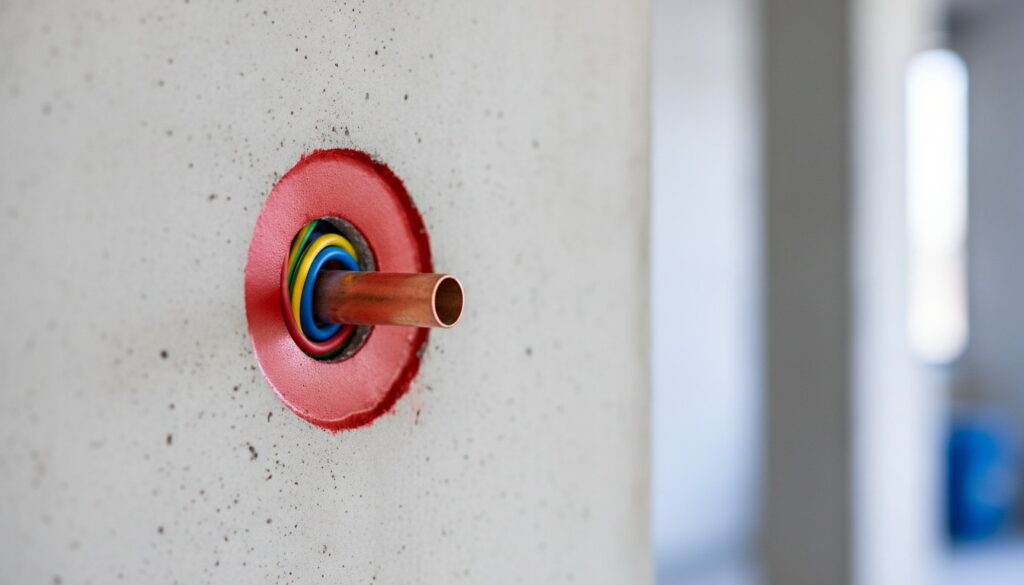
A single breach in your building’s compartmentation, no larger than a small coin, can render a 120-minute fire-rated wall completely useless in seconds. It is a sobering reality that many commercial property managers face, especially when trying to distinguish between compliant installations and aging, ineffective materials. We understand the pressure of meeting strict insurance mandates and the confusion that often arises from varying fire ratings. Ensuring every fire seal in your facility is correctly specified and installed isn’t just a legal checkbox; it’s a fundamental responsibility to protect life and property.
This guide provides the technical clarity required to navigate the high-stakes world of passive fire protection. You will master the specific material types and regulatory standards, including the critical ISO 10295-1:2026 testing methods, to ensure your building remains a secure environment. We will examine how to specify the correct solutions for different service penetrations and identify non-compliant seals before they become a liability. By the end of this article, you’ll have a clear, methodical framework for maintaining a legally compliant and safe commercial property.
Key Takeaways
- Understand how a correctly specified fire seal maintains the integrity of compartmentation by preventing the passage of toxic gases and flames.
- Identify the appropriate materials for specific service penetrations, from fire-rated silicone mastics for linear joints to intumescent pillows for temporary cable runs.
- Differentiate between Integrity (E) and Insulation (I) ratings to ensure firestopping solutions meet both physical and thermal protection standards.
- Avoid common compliance failures, such as mixing manufacturers or improper gap sizing, which can void fire ratings and compromise building safety.
- Learn how professional compartmentation surveys use thermal imaging and borescopes to identify hidden breaches in passive fire protection systems.
What is a Fire Seal and Why is it Critical for Passive Fire Protection?
A fire seal is a specialized component engineered to maintain the fire resistance of a wall or floor at the point where services, such as electrical cables or plumbing, pass through a compartment boundary. Without these seals, a fire-rated wall is merely a cosmetic partition. The primary role of a fire seal is to prevent the passage of flames, hot gases, and lethal smoke between building sections. To understand the foundational principles of What is a Firestop?, we must view these materials as the final line of defense in a building’s physical structure.
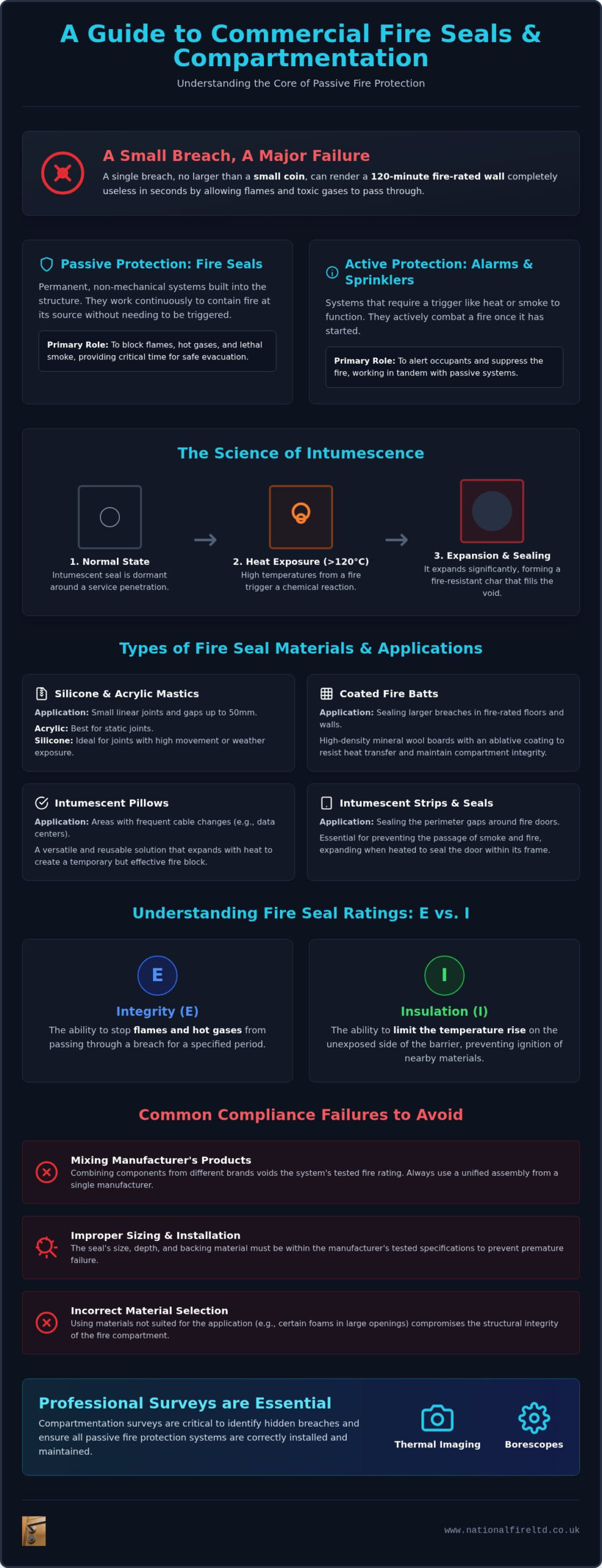
It’s vital to distinguish these passive measures from active fire protection systems. While sprinklers and alarms require a trigger to function, a fire seal is a permanent, non-mechanical installation. This distinction is the cornerstone of compartmentation, a strategy that divides a building into high-integrity “cells” to contain a fire at its source. By restricting the movement of toxic gases, which account for the majority of fire-related fatalities, these seals provide the necessary time for safe evacuation and emergency service intervention. We view these installations not as isolated products, but as essential guardians of life safety within the commercial environment.
The Science of Intumescence in Fire Sealing
Many modern seals rely on intumescent technology. When these materials are exposed to temperatures typically exceeding 120°C, they undergo a chemical reaction that causes them to expand significantly. This expansion creates a robust, fire-resistant char layer that fills the voids left by melting service pipes or combustible cable insulation. The expansion ratio is a critical technical specification. It must be precisely matched to the service type to ensure the gap is closed before the integrity of the compartment is compromised. A high-expansion material is often required for plastic pipes, where the seal must crush the softening pipe to prevent fire from jumping the barrier.
Fire Seals vs. Fire Stopping: Understanding the Terminology
In professional practice, a fire seal is often a single element within a comprehensive fire stopping system. Effective protection requires these seals to work in tandem with other components like mineral wool batts, steel collars, or intumescent wraps. We emphasize the use of tested systems over mixed components. Combining products from different manufacturers, even if they’re individually rated, can lead to unpredictable performance during a fire. Reliability is only guaranteed when the entire assembly has been tested as a unified solution to meet specific national standards.
Types of Fire Seal Materials and Their Commercial Applications
Selecting the correct fire seal material is a technical requirement that depends entirely on the substrate, the aperture size, and the specific services passing through the boundary. For small linear joints and gaps up to 50mm, fire-rated silicone and acrylic mastics are the industry standard. While acrylic mastics are typically used for static joints, silicone variants offer the necessary flexibility for joints subject to high movement or external weathering. For larger breaches in fire-rated floors and walls, we utilize coated fire batts. These high-density mineral wool boards are pre-treated with an ablative coating, providing a robust barrier that resists thermal transfer and maintains the integrity of the compartment.
In environments where cable configurations change frequently, such as data centers or server rooms, intumescent fire pillows offer a versatile, reusable solution. These pillows are packed tightly into the opening and expand rapidly when exposed to heat to block the passage of fire. Conversely, while fire-rated foams are available, their application in commercial compartmentation is often limited. Many foams lack the structural integrity required for large openings or joints with significant movement, making them unsuitable for many high-stakes Passive Fire Protection strategies. Relying on professional Fire Stopping installations ensures that the chosen material is fit for its specific purpose.
Sealing Fire Doors: Intumescent Strips and Cold Smoke Seals
A critical application of sealing technology is found in the maintenance of fire door integrity. Intumescent strips are fitted into the door leaf or frame, remaining dormant until they reach a specific temperature. At this point, they expand to seal the gap between the door and the frame, preventing the spread of fire. However, these strips alone don’t stop smoke at ambient temperatures. Cold smoke seals, often featuring brushes or fins, are essential for life safety. They prevent smoke inhalation during the early stages of a fire, providing occupants with clear escape routes.
Sealing Service Penetrations: Pipes, Cables, and Ductwork
Service penetrations require specialized hardware tailored to the pipe material. Non-combustible pipes, such as copper or steel, primarily need a fire seal to prevent smoke passage and heat transfer. Plastic pipes, however, soften and collapse under heat. This requires the installation of fire collars or wraps containing high-pressure intumescent material that crushes the pipe to close the void completely. For cable trays, seals must also account for heat conduction through the metal components. Every penetration must be treated as a unique engineering challenge to ensure total compliance.
Understanding Fire Seal Ratings: Integrity (E) vs. Insulation (I)
Technical specifications for a fire seal are defined by two primary performance criteria: Integrity and Insulation. Integrity, denoted by the letter (E), measures the duration a seal can physically prevent the passage of flames and hot gases. It’s the baseline requirement for any compartmentation barrier. However, stopping the flame is only half of the safety equation. Insulation, denoted by (I), measures the seal’s ability to restrict the transfer of heat to the unexposed side of the barrier. A failure in insulation means the temperature on the “safe” side could rise high enough to spontaneously ignite nearby combustible materials, even if no flame has breached the seal.
It’s common to see a disparity between these two ratings. A fire seal might carry an E120 rating but only an I30 rating. This means while the seal remains structurally intact against flames for two hours, it only prevents hazardous temperature transfer for thirty minutes. For building owners, these nuances are critical. Failure to specify the correct EI rating can lead to non-compliance with building insurance policies and life safety certifications. We ensure every installation aligns with the specific fire strategy of the building to mitigate these risks effectively.
UK Standards and Testing: BS EN 1366-3
All penetration seals must undergo rigorous testing under BS EN 1366-3 to prove their efficacy. This standard subjects the seal to high-pressure furnace conditions that simulate a fully developed fire. A critical aspect of this testing is the “field of application”. A seal is only compliant if it’s installed in the exact configuration, substrate, and orientation in which it was tested. We rely on third-party certification bodies, such as BM TRADA, to verify that the products we install meet these exacting performance standards. This provides an audited trail of safety that is essential for legal compliance.
Specifying the Correct Duration: 30, 60, or 120 Minutes?
The required duration for a fire seal is never a guess. It’s dictated by the building’s fire strategy drawings, which assign specific fire resistance periods to every wall and floor. A 60-minute fire-rated wall requires a seal that provides at least 60 minutes of protection. Matching the seal’s rating to the substrate is fundamental. Over-specifying can lead to unnecessary costs, while under-specifying creates a weak point that invalidates the entire compartment. Precision in specification is the only way to guarantee that the building’s passive fire protection remains robust under pressure.
Common Failure Points and the Importance of Remedial Work
Identifying a failed fire seal requires more than a visual check; it demands an understanding of the tested system’s specific parameters. One of the most common errors is improper gap sizing. While “too little” mastic is an obvious risk, “too much” can be equally dangerous. Excessive mastic without proper backing material can lead to slumping or cracking during the curing process, which compromises the seal’s integrity during a fire. Similarly, mixing manufacturers, such as using a Brand A mastic with a Brand B fire batt, is a critical failure. Fire stopping systems are tested as unified assemblies. Using mismatched components voids the fire rating and leaves the building legally exposed.
Poor substrate adhesion is another frequent oversight. If surfaces aren’t thoroughly cleaned of dust, grease, and construction debris, the fire seal will fail to bond correctly. This lack of adhesion creates microscopic paths for cold smoke to bypass the barrier long before the heat-activated intumescent properties can engage. We also frequently find unsealed “hidden” penetrations during our surveys. These are often located above suspended ceilings or beneath raised floors, where contractors have installed services without restoring the compartmentation, effectively leaving a hole in the building’s safety shell.
The Risk of Non-Compliant Service Penetrations
Every time a new data cable is pulled or a plumbing repair is made, the original fire seal is at risk. If these penetrations aren’t professionally reinstated, they create a “chimney effect,” where fire and smoke are drawn through the building’s cavities at high velocity. This is particularly dangerous in building facades, where unsealed voids allow fire to leap between floors. For these hidden risks, the installation of cavity barriers is essential to prevent rapid, unseen fire spread through the building’s structural voids.
Executing Professional Remedial Works
Professional remedial work involves more than just patching holes. It requires the methodical removal of non-compliant materials and the installation of a verified, tested system. This process is a vital part of maintaining the “Golden Thread” of information, a mandatory requirement for high-rise residential and complex commercial buildings. Every repair must be documented with photographic evidence and technical data sheets to prove compliance. “Handyman” repairs almost always fail professional audits because they lack the necessary certification and technical precision. To ensure your building meets these rigorous standards, consider our specialist Fire Stopping services.
Ensuring Compliance: Fire Compartmentation Surveys and Maintenance
Legal compliance under the Regulatory Reform (Fire Safety) Order 2005 is a continuous obligation rather than a one-time event. We prioritize the fire compartmentation survey as the primary diagnostic tool for identifying compromised fire seal installations. These surveys go beyond superficial checks. Our specialists utilize advanced diagnostic equipment, including thermal imaging to detect heat leaks and borescope inspections to view penetrations within internal wall cavities. This methodical approach ensures that every breach, whether visible or hidden, is cataloged for remedial action.
Maintaining the integrity of a building’s compartmentation requires an accurate technical baseline. Fire strategy drawings serve as this essential reference point, detailing the exact location and rating of every fire-resistant boundary. Without these drawings, it’s impossible to verify if a fire seal has been correctly reinstated after maintenance work. We use these blueprints to audit the building against its original safety design, ensuring that the cumulative effect of minor repairs hasn’t undermined the overall fire safety architecture.
The Frequency of Fire Seal Inspections
For high-occupancy commercial buildings, annual inspections are the established industry standard for maintaining safety. However, specific events should trigger an immediate review of your fire seals. Any post-renovation work, utility upgrade, or installation of new data cabling can inadvertently breach existing barriers. We recommend maintaining a robust maintenance log that records every inspection and remedial action. This documentation provides an essential audit trail for insurance purposes and demonstrates a proactive approach to life safety management.
Choosing a Specialist Contractor for National Coverage
Managing fire safety across multiple sites requires a partner with national scale to ensure consistent standards and reporting. At National Fire Ltd, we provide a unified front of expertise, offering specialized solutions ranging from fire stopping to complex injectable cavity barriers. Our technical proficiency ensures that your building remains a secure environment, fully integrated into the legal framework of national safety sectors. Ensure your building remains a safe environment; contact National Fire Ltd for a comprehensive audit.
Securing Your Building’s Future Through Technical Compliance
Maintaining a compliant fire seal strategy is a fundamental pillar of commercial property management. We’ve explored how precise material selection and a deep understanding of Integrity (E) and Insulation (I) ratings are non-negotiable for life safety. Neglecting hidden penetrations or relying on non-compliant remedial patches creates significant legal and physical risks. As a specialized national contractor, we provide the technical oversight required to protect your assets and occupants.
We are certified BM TRADA Fire Door Installers and specialists in complex injectable cavity barriers. Our team offers national UK coverage for the commercial and industrial sectors, ensuring your safety standards are consistent across every site. It’s time to move beyond guesswork and establish a robust, documented safety framework. Secure your building with professional fire compartmentation surveys from National Fire Ltd. We are ready to help you maintain a secure and fully compliant environment.
Frequently Asked Questions
What is the difference between a fire seal and an acoustic seal?
A fire seal is engineered to prevent the passage of flames and smoke, whereas an acoustic seal is designed specifically for sound attenuation. While some intumescent seals offer acoustic properties, a standard acoustic seal lacks the specialized chemicals required to expand and block fire. Using an acoustic seal in a compartmentation boundary is a critical compliance failure that leaves the building unprotected during a fire event.
Can I use regular silicone to seal a fire-rated wall?
No, regular silicone must never be used to seal a fire-rated wall because it lacks the chemical properties to withstand extreme temperatures. Standard silicone will melt or burn away rapidly in a fire, leaving a significant breach in the compartment. Only certified fire-rated silicone or acrylic mastics, tested to BS EN 1366-3, are acceptable for maintaining the integrity of a fire-resistant barrier in commercial properties.
How long do intumescent fire seals last before they need replacing?
Most intumescent fire seals are designed to last for the lifetime of the building partition, provided they remain undisturbed and are not subjected to environmental degradation. However, mechanical damage, excessive moisture, or chemical exposure can compromise their efficacy over time. We recommend annual inspections to identify physical wear, loss of adhesion, or accidental damage, ensuring every fire seal remains ready to activate in an emergency.
What happens if a fire seal is painted over?
Painting over a fire seal can severely compromise its performance by preventing the intumescent material from expanding correctly when exposed to heat. The paint layer creates a rigid shell that can restrict the chemical reaction required to close gaps around service penetrations. If a seal has been painted, it must be inspected by a specialist to determine if the coating has rendered it non-compliant and if replacement is necessary.
Do fire seals prevent the spread of cold smoke?
Standard intumescent fire seals do not prevent cold smoke spread as they only activate at high temperatures; separate smoke seals are required for ambient protection. To address cold smoke, we install specialized seals with brushes or fins that provide a physical barrier at room temperature. Effective life safety strategies require a combination of both fire-resistant and smoke-blocking components to protect escape routes during the early stages of a fire.
Are fire seals required for small cable penetrations?
Yes, every penetration, regardless of its diameter, must be sealed to maintain the fire resistance of a compartment boundary. Even a small gap around a single data cable can allow lethal toxic gases to bypass a fire wall. Small penetrations are typically managed with fire-rated mastics or intumescent putties, ensuring the technical integrity of the partition is not compromised by minor utility upgrades.
Who is legally responsible for the maintenance of fire seals in a commercial building?
Under the Regulatory Reform (Fire Safety) Order 2005, the “Responsible Person” is legally accountable for the maintenance of fire seals. This individual, typically the building owner, employer, or facilities manager, must ensure that all passive fire protection measures are kept in efficient working order. Failure to maintain these systems can lead to legal prosecution, significant fines, or the total invalidation of building insurance policies.
How do I know if my existing fire seals are compliant with current UK regulations?
The only reliable method to verify the compliance of existing fire seals is through a professional fire compartmentation survey. Our experts audit your facility against original fire strategy drawings and current UK standards to identify non-compliant materials or improper installations. This detailed assessment uncovers hidden breaches above ceilings and under floors, providing the documented evidence required for long-term legal security and life safety compliance.