


A fire outage costs more than the sales lost while a site is closed. Calculating the cost of downtime from a fire incident means estimating lost contribution margin, then adding costs such as idle staff, ongoing overheads, emergency repairs and recovery work. The total depends on which parts of the business are affected and how quickly normal operations resume.
The impact may last beyond the hours a site is closed: reduced output and catch-up work can extend disruption. A business that can defer orders may face different losses from one reliant on continuous production or immediate transactions. This guide explains how to estimate hourly losses, account for reduced productivity and assess your business’s dependence on uptime. It also covers how fire compartmentation and fire door condition fit into efforts to limit disruption, while keeping a financial estimate separate from a site-specific assessment.
Key Takeaways
- Separate lost contribution margin from continuing costs such as idle labour, overheads and recovery work to build a more complete outage estimate.
- Choose a revenue-based or productivity-based calculation according to how the incident affects sales, output and staff capacity.
- Estimate the productivity drop by identifying which teams, processes and work remain affected after operations resume.
- Assess how quickly customers can transact and how much work can be deferred to understand your business’s reliance on uptime.
What are downtime costs?
Build a fire outage estimate from lost contribution, continuing expenses and recovery costs. For calculating the cost of downtime from a fire incident, separate recurring hourly losses from one-off expenses and consider how the interruption affects operations.
-
Identify Revenue, Recovery, and Productivity Costs
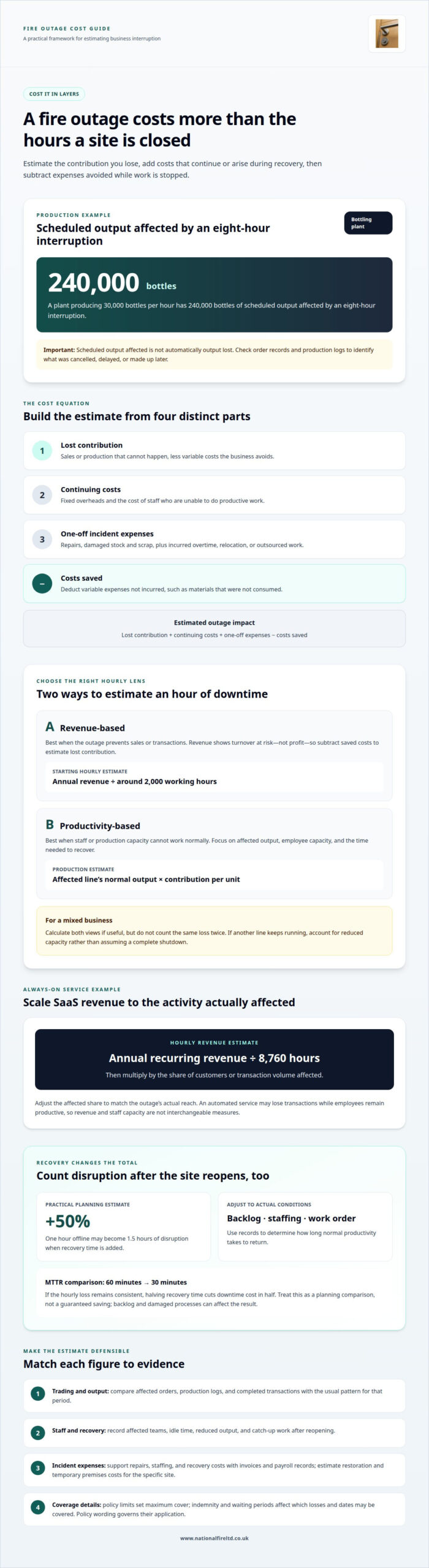
Estimate sales or production that cannot happen during the outage, then distinguish lost revenue from work merely delayed. Include idle employees, reduced output and the time needed to clear backlogs after reopening. A beverage bottling plant producing 30,000 bottles per hour would have 240,000 bottles of scheduled output affected by an eight-hour interruption. Use order records and production logs to establish what was actually lost.
-
Include Repairs, Scrap, and Extra Expenses
Record repairs, damaged stock and scrap as separate one-off costs. Add extra expenses such as overtime, relocation or outsourced work when they are incurred, using invoices and payroll records to support each amount. UK restoration and temporary premises costs depend on damage, reinstatement work, location and the time required to resume operations, so estimate them from the specific premises rather than applying a generic figure.
-
Account for Saved Variable Costs
Deduct variable costs the business avoids when production or sales stop, such as materials not consumed, but include continuing fixed overheads. This gives a clearer estimate of business interruption losses than gross lost revenue alone. A sound calculation also keeps avoided expenses separate from costs incurred to restore output.
-
Document Costs and Review Insurance Limits
Keep dated records of closure, reduced output, repairs, staffing and recovery milestones. Policy limits set the maximum cover, while the indemnity period and waiting period affect which losses and dates may be covered; policy wording governs their application. For property inspection and emergency mitigation planning, consulting specialists like Fox Claims Consultants can help ensure physical damage assessments and restoration requirements are documented thoroughly. To project costs annually, multiply a weekly estimate by 52 or a monthly estimate by 12. Keep recurring costs separate from one-off incident expenses.
What does an hour of downtime actually cost you?
Choose a method that reflects how a fire outage disrupts your operation. Compare lost sales with lost productive capacity, then use the measure that best represents the actual impact.
- Choose a revenue-based or productivity-based estimate. Use revenue when the outage prevents transactions or sales, and productivity when employees or production capacity cannot work normally. Revenue shows turnover at risk, not profit: subtract costs saved during the outage to estimate lost contribution. A productivity estimate focuses on affected output, staff capacity and recovery time. For a mixed business, calculate both, but do not count the same loss twice.
- Estimate lost production revenue and profit per hour. Divide annual revenue by around 2,000 working hours for a starting estimate of average hourly revenue. For production, use the affected line’s normal output and contribution per unit. If another line continues working, account for the reduced capacity rather than assuming a complete shutdown.
- Measure the outage against actual trading patterns. Use the hours when sales or production would normally take place, not simply the time between closure and reopening. Compare affected orders, output records and completed transactions with the usual pattern for that period. Include delayed work only when it creates a real loss, such as cancelled orders or output that cannot be made up. This distinguishes losses from deferred revenue.
- Calculate SaaS revenue loss using affected activity. Divide annual recurring revenue by 8,760 hours, then multiply by the share of customers or transaction volume affected. This gives an hourly estimate for an always-on service; adjust the affected share to match the outage’s actual reach. An automated service may lose transactions while employees remain productive, so don’t treat revenue and staff capacity as interchangeable measures. For fire-related downtime planning, consider your building’s fire protection needs alongside the financial estimate.
Estimating the productivity drop during an outage
Estimate business interruption losses by combining lost output, idle labour and recovery work, then subtracting costs saved. After a fire, measure which teams and processes remain affected, not just how long the site is closed.
-
Calculate Employee Costs and Financial Impact
Start with employees unable to do productive work, their hourly cost and the affected hours. Add this to lost contribution or output, taking care not to count the same loss twice. Separate fully idle staff from employees who can continue working through another process, site or software. The result estimates direct financial impact, not every operational consequence.
-
Estimate Recovery and Catch-Up Time
Record how long normal productivity takes to return after access or equipment is restored. Teams may need to process delayed orders, recreate lost information and respond to customers. A practical estimate can add 50% to outage time for recovery: one hour offline becomes 1.5 hours of disruption. Adjust the figure to reflect actual backlog, staffing and the order of work. A scheduling program or software logs can help distinguish work completed during the outage from catch-up activity afterwards.
Use mean time to recovery (MTTR) to assess potential savings. If recovery falls from 60 minutes to 30 minutes, downtime cost is cut in half when the hourly loss remains consistent. Multiply the reduction in disruption time by the affected hourly cost to estimate the financial benefit. Treat this as a comparison for planning, not as a guaranteed saving: productivity may also depend on damaged processes, backlog and the time required to resume normal output.
Business model and reliance on uptime
Assess how a fire-related failure affects sales, customer access and essential operations. Business interruption insurance in the UK may cover financial losses from an interruption, subject to the policy’s insured events, limits and indemnity period.
- Map uptime dependence to your business model. Identify which activities stop when a site, production area or service becomes unavailable. A retailer may lose transactions immediately, while a business with a backlog may defer some work but still incur catch-up costs. Record the customers, orders and processes directly affected, then distinguish lost activity from delayed activity. This makes the estimate reflect how the business actually earns revenue.
- Translate uptime targets into permitted downtime. Use this formula: period length multiplied by the proportion of time the service may be unavailable. For a year, 99.9% uptime allows roughly 8.7 hours of downtime; 99.99% allows 52 minutes and 36 seconds. At 99.999%, the allowance is roughly 5 minutes and 15 seconds annually. These figures show how a small change in target can materially alter the permitted outage window.
- Review SLA terms and possible penalties. Record the measurement period, definition of downtime, exclusions and remedy for missing a target. A service-level agreement may specify service credits or other contractual remedies, but its wording determines how a failure is measured. Compare the target with actual operational dependencies: a contractual allowance may not match how long your business can tolerate being unavailable.
- Use the result to prioritise continuity planning. Compare direct losses per minute with the time needed to restore critical operations. Include customer access, production capacity and contractual penalties in the assessment, without counting the same loss twice. For example, an online ordering failure can affect transactions even if staff remain productive. Review your building’s passive fire protection as part of planning for safer, more resilient operations.
National Fire
National Fire Ltd helps businesses address passive fire protection measures that support safer, more resilient buildings. When assessing the possible operational impact of a fire, consider whether fire stopping, cavity barriers and fire doors form part of the building’s protection strategy. National Fire Ltd provides fire stopping, injectable cavity barriers, fire door installation and fire door maintenance. These services address building elements relevant to considering how fire could affect operations, alongside your business interruption estimate.
Turn to National Fire Ltd when you need work on these passive fire protection measures as part of your building planning or maintenance. The appropriate service depends on the building and the work required. To discuss your requirements, contact National Fire Ltd.
Turn your estimate into a practical readiness plan
Treat the estimate as a planning tool, not a prediction. Use it to identify operational dependencies that deserve attention in your continuity planning, and bring property and finance teams into the discussion. A clear view of business priorities can inform decisions without confusing a financial scenario with a technical assessment.
Calculating the cost of downtime from a fire incident can prompt a closer review of a building’s passive fire protection. National Fire provides fire stopping, fire door installation and injectable cavity barriers. Consider these services where your building review identifies relevant work, with priorities based on the property and its requirements.
When you’re ready to discuss how building fire protection fits your readiness planning, contact National Fire. A considered next step helps keep decisions focused on your operational needs and the safety of people and property.
Frequently Asked Questions
How do you estimate lost revenue and gross profit during a fire shutdown?
Estimate the sales that would have occurred during the shutdown, then subtract sales completed later rather than treating every delayed order as lost. To estimate gross profit loss, deduct variable costs avoided because sales or production did not happen. Use comparable trading periods and adjust for known seasonal demand or order changes. Keep cancelled orders separate from deferred orders to avoid counting the same loss twice.
How can a business estimate the duration of downtime after a fire?
Map the dependencies for restarting operations, from safe access and damage assessment to cleaning, repairs, equipment testing and staff readiness. Ask each operational lead which task must finish before the next can begin, then identify tasks that can happen in parallel. In specialised facilities such as commercial kitchens, coordinating with mechanical contractors like Air Flow M&E Pte Ltd for exhaust system alterations and repairs helps establish reliable timeframes for restoring ventilation. Use contractor schedules and equipment lead times to build a realistic range. Update the estimate as conditions change rather than treating the first version as fixed.
What indirect and long-term costs can follow a fire-related business interruption?
Consider effects that continue after the site reopens, including lost repeat business, delayed renewals, supplier disruption and extra administration. A backlog may also increase errors or delay new work, affecting future income beyond the closure. Record these separately from immediate repair and lost-output costs, linking each item to evidence such as customer cancellations, amended orders or additional processing records.
What UK insurance policy limits, indemnity periods and waiting periods affect fire downtime claims?
Policy limits set the maximum cover, while the indemnity and waiting periods affect which losses and dates may be covered. The policy wording governs how these terms apply.