

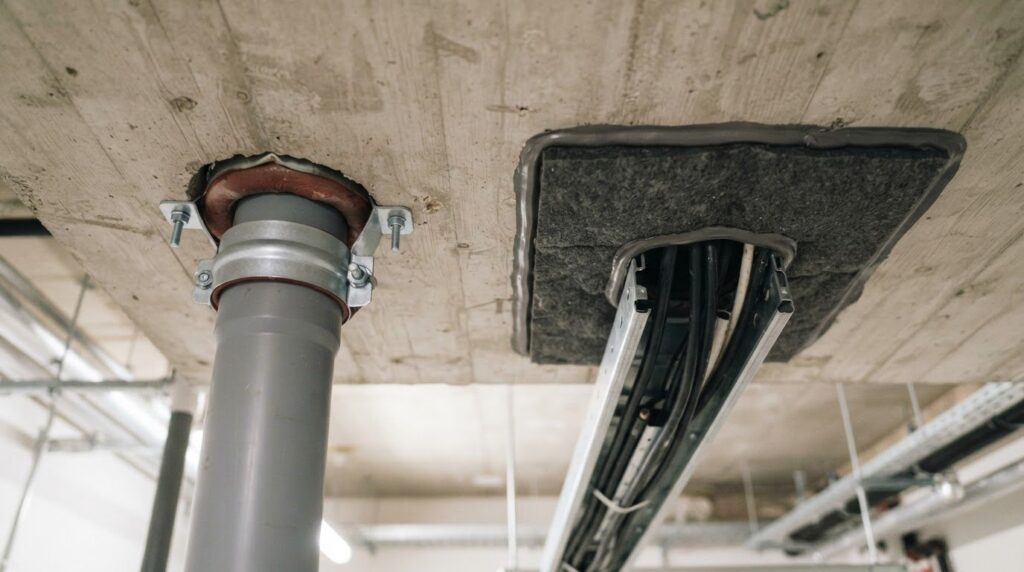
The most suitable firestopping product isn’t determined by brand name alone. There’s no universal winner in a Fireus vs Quelfire products comparison: the right choice depends on whether the tested and certified system matches the building element, service penetration and installation details. A product that suits one arrangement may not be appropriate for another.
It’s understandable to focus on the manufacturer when comparing options, but performance evidence and intended application matter just as much. This article explains how to assess Fireus and Quelfire products by their testing, certification and typical uses in buildings and infrastructure. It also sets out what to check when matching a system to a project, so the decision is based on the proposed construction rather than brand familiarity.
Key Takeaways
- Compare firestopping systems by their tested and certified applications, not by brand name alone.
- Identify the building element and service penetration before narrowing down suitable product types.
- Use the product-range comparison to understand where Fireus and Quelfire may suit different project requirements.
- Consider how installation details affect whether a firestopping system is appropriate for the intended application.
Testing standards and certification
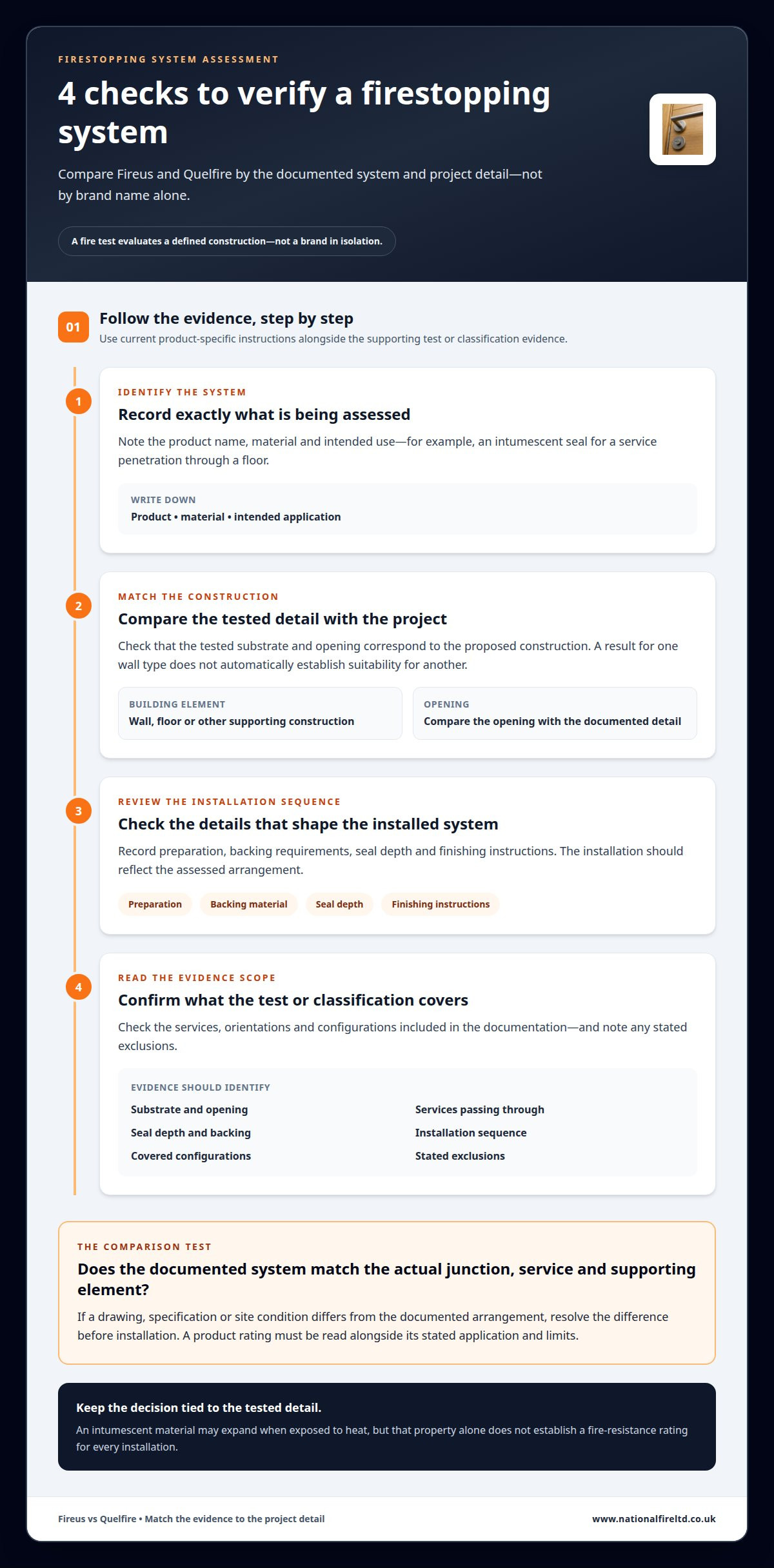
For Fireus and Quelfire products, compare the installation guidance and technical documentation with the exact product and proposed arrangement. Look for instructions and evidence covering the substrate, opening, service type, seal depth, backing material and installation sequence. For example, guidance for intumescent acrylic around a cable penetration is not evidence for a different sealant or opening configuration.
A fire test evaluates a defined construction, not a brand name in isolation. Its result relates to the tested materials and installation details, including the supporting wall or floor, opening size and services passing through it. Changing a detail can take the installation beyond the evidence for that system. That is why a product rating must be read alongside its stated application and limits.
When comparing documentation, follow these steps:
- Identify the system. Record the product name, material and intended use, such as an intumescent seal for a service penetration through a floor.
- Match the construction. Compare the tested substrate and opening with the project detail. A result for one wall type does not automatically establish suitability for another.
- Review the installation sequence. Note preparation, backing requirements, seal depth and finishing instructions. Each detail affects whether the installed arrangement reflects the assessed system.
- Read the evidence scope. Check what services, orientations and configurations the test or classification documentation covers, and note any stated exclusions.
These steps make a Fireus versus Quelfire comparison more useful than comparing product names or headline ratings. The key question is whether the documented system matches the actual junction, service and supporting element. An intumescent material may expand when exposed to heat, but that property alone does not establish a fire-resistance rating for every installation.
Use the current product-specific instructions and supporting evidence together. If a drawing, specification or site condition differs from the documented arrangement, resolve the difference before installation. This keeps passive fire protection decisions tied to the tested detail, rather than assumptions based on a similar-looking acrylic sealant or product category.
Fireus and Quelfire product documentation includes installation instructions and supporting test or classification evidence. It should identify the assessed substrate, opening, services, seal depth, backing material, installation sequence, covered configurations and any exclusions.
What fire protection products does Quelfire offer in the UK?
For a useful comparison of the Quelfire range, group products by the building detail they are intended to protect. A service penetration through a wall raises a different specification question from a joint between building elements. Product names alone don’t establish that either arrangement is covered: the relevant application and supporting technical information matter.
Start with the project detail, then identify the product category intended for it. For example, a drawing showing pipes through a compartment wall calls for a different assessment from a gap at a floor edge. This application-first approach helps distinguish products for penetrations from those intended for joints or other construction details, without treating them as interchangeable.
For each Quelfire product under consideration, organise the information under these points:
- Purpose: Record the stated use, such as sealing a service opening or treating a junction.
- Building element: Note whether the documentation refers to a wall, floor or another construction detail.
- Services and materials: Capture the pipes, cables or other components named in the application.
- Installation detail: Record preparation, placement and any material combination shown in the instructions.
This method makes the UK product range easier to navigate while keeping selection tied to the project. If a specification includes a cable bundle, for example, don’t assume documentation for a pipe arrangement also applies. The product’s stated scope and installation instructions are the useful comparison points.
Use the same categories when comparing Fireus and Quelfire. This separates range breadth from suitability: a manufacturer may offer products for several applications, but the project still needs a documented match for its specific detail. For work involving several openings or junctions, a clear schedule can link each location to its intended system and installation information.
For project-specific firestopping work, fire stopping support can help connect building details with installation requirements.
Quelfire’s UK range includes products intended for service penetrations and openings, joints between building elements, and other construction details. Applications may involve pipes or cables, but each product’s stated scope and installation instructions determine whether it suits a particular project detail.
How do Fireus and Quelfire compare on fire stopping product ranges?
Compare Fireus and Quelfire by application category, rather than treating either brand as a single solution. A project may include service penetrations, linear joints and gaps around building elements. These are different details, so separate them before comparing individual products.
Build a side-by-side schedule using the same headings for both manufacturers. Record the product category, intended building element, service type, installation method and supporting technical evidence. For example, a cable opening through a wall is not the same application as a pipe passing through a floor. Keeping these examples separate makes differences easier to identify.
- Penetrations: Group details such as cables or pipes passing through a wall or floor.
- Joints: Separate linear gaps between building elements from service openings.
- Materials: Note whether the specified detail involves sealant, backing material or another component.
- Documentation: Record the stated application and installation information for each listed option.
This comparison shows whether Fireus or Quelfire has a documented option matching each project detail. It also prevents a misleading count of product types from determining the selection. A longer catalogue does not, by itself, show that a particular product suits a cable bundle, pipe or floor junction.
Use the project schedule to identify gaps between the required details and the products documented for them. For instance, if a drawing contains both a pipe penetration and a linear joint, assess them as separate applications. Then compare the relevant product information for each, rather than assuming one system covers both.
The practical outcome is a comparison based on coverage, not brand preference. Assess Fireus and Quelfire against the same project details and documentation criteria. This gives designers and installers a clearer basis for specifying firestopping products and coordinating the required systems across the building.
Which Fireus and Quelfire products are suitable for sealing service penetrations?
For a Fireus or Quelfire service penetration, start with the service and the construction it passes through. A cable bundle through a wall differs from a pipe through a floor. The product must be documented for the actual arrangement, not simply described as firestopping material. The Fireus vs Quelfire products comparison is most useful when tied to a specific penetration detail.
Classify the opening before comparing product types. Record whether it contains cables, metallic pipes, plastic pipes or a combination. Note the supporting element, such as a wall or floor, and the opening configuration. These details help identify the relevant product categories and installation instructions.
Common categories to investigate in each manufacturer’s documentation include:
- Sealants: Consider these for specified gaps around services, subject to the documented substrate and installation detail.
- Collars or wraps: Check whether the documentation covers the pipe material and arrangement in question.
- Compound or mortar systems: Review whether the stated use covers the opening and services shown in the project detail.
- Mixed-service systems: Look for evidence covering the specific combination of cables and pipes, rather than assuming separate applications transfer.
Compare Fireus and Quelfire options using the same project information. For example, a system intended for a plastic pipe should not automatically be selected for a cable bundle. In a Fireus vs Quelfire products assessment, installation details matter too: backing, seal depth, product placement and supporting construction must align with the applicable instructions.
A clear schedule can link each penetration to its service type, building element, selected system and installation documentation. This gives design and site teams a practical reference when coordinating multiple openings. If a detail changes, such as the pipe material or wall construction, reassess the match against the revised arrangement.
For installation of project firestopping, arrange fire stopping support for the relevant building details.
National Fire Ltd
National Fire Ltd can turn a product comparison into coordinated passive fire protection work for a building. Its fire stopping service addresses practical installation, while fire compartmentation details can be considered alongside fire door installation and maintenance. Injectable cavity barriers can also support projects where cavity protection forms part of the design.
Turn to National Fire Ltd when product selection needs to align with site conditions, building details or wider compartmentation work. The approach depends on the project and protection required, keeping decisions focused on the building’s firestopping needs rather than brand names alone.
For a project involving fire stopping, fire doors or cavity barriers, contact National Fire Ltd to discuss the work.
Carry the specification into the next project step
A product decision is useful when reflected consistently in the project drawings, installation plan and site records. Treat the chosen system as part of the building’s wider passive fire protection strategy, not an isolated product selection. This helps keep the design intent clear as work moves from specification to installation.
A comparison of Fireus and Quelfire products should support a practical decision: which documented system aligns with the project’s construction details and planned work? If the next step involves installation or related compartmentation work, National Fire Ltd provides fire stopping, fire door installation and injectable cavity barriers. These services help connect product decisions with the building work they relate to.
Share the project requirements and relevant details with National Fire Ltd to discuss a suitable next step. Contact National Fire Ltd about your project and move forward with a clear, considered approach to building firestopping.