

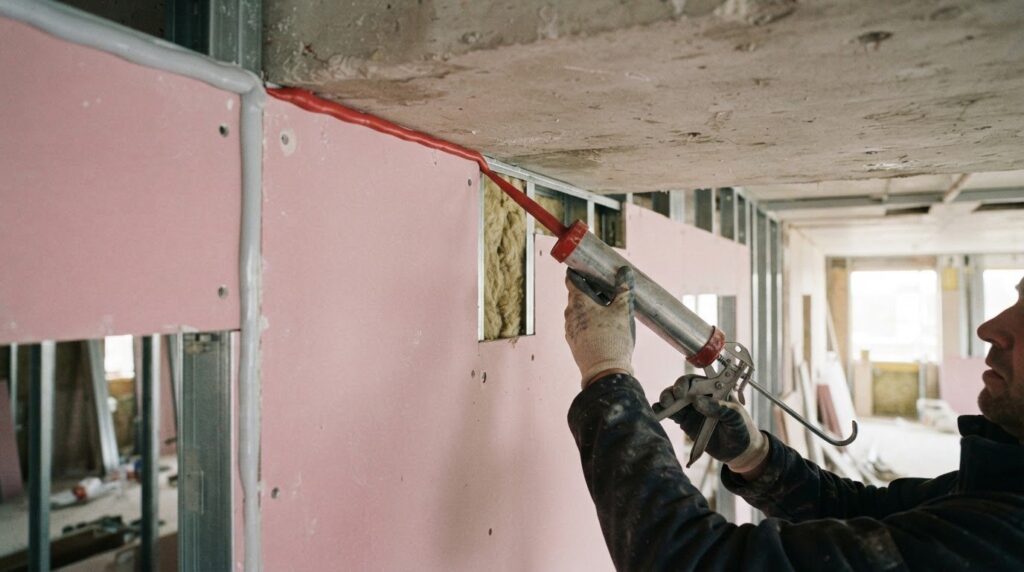
A Sika vs Hilti fire sealant comparison should focus on the application, not the brand name alone. For interior firestopping, the sealant must suit the opening or joint and the tested arrangement it is intended to protect.
It’s reasonable to compare products by name, but performance depends on how a seal works in its specific location. The British Standards Institution identifies EN 1366-4 as the test standard for linear joint seals, while EN 13501-2 classifies the fire resistance of building elements, including linear seals and penetrations.
This guide explains how to assess Sika and Hilti sealants for interior locations, exposed areas and openings where fire and smoke could spread. It also explains why the tested system and installation details matter, helping you compare evidence against the actual building condition rather than choosing by brand alone.
Key Takeaways
- Identify whether the opening is a linear joint or a penetration before comparing sealants; the tested application should match the building detail.
- Separate reaction-to-fire classification from fire-resistance performance to understand what each standard assesses.
- Use the exposed area and interior or exterior location to narrow the relevant requirements, particularly for rail applications.
- Where openings need firestopping, National Fire Ltd can help address passive fire protection needs through its Fire Stopping service.
Fire and smoke spread through penetrations and joints
A wall or floor can form part of a building’s fire compartment, but openings interrupt that separation. A cable or pipe passing through a wall creates a penetration; a gap where building elements meet forms a joint. Flames, heat and toxic smoke can pass through these routes into adjoining areas if they are not suitably protected. The opening’s location and purpose therefore matter when assessing firestopping.
Passive fire protection is intended to contain fire within defined compartments and limit its spread through a building. It can also give people in other areas time to evacuate safely. This differs from active systems such as sprinklers, which can extinguish fires. Fire sealant is part of a passive system, so its suitability depends on the specific joint or penetration, not simply its brand.
Classification terms describe different aspects of fire performance. In Europe, reaction to fire is classified according to EN 13501-1, as stated by the British Standards Institution. For a firestopping decision, that classification should not be confused with evidence about how a sealed joint or penetration performs in a fire. The relevant evidence needs to match the building detail being protected.
Consider a service opening through a compartment wall and a linear gap between adjoining building elements. Both may allow fire and smoke to spread, but they are different building details. A sealant suitable for one tested arrangement should not automatically be considered suitable for the other. The substrate, opening geometry and service passing through it all affect which tested system applies.
Start by identifying whether the gap is a penetration or a linear joint, then record its location and surrounding materials. Note whether pipes, cables or other services pass through it. These details provide a practical basis for comparing Sika and Hilti sealants with the application evidence. The aim is to choose a firestopping solution that suits the actual opening and supports compartmentation, not one selected on brand recognition alone.
A separate assessment addresses surface flame spread: ECE R118 Annex 8 uses ISO 5658-2 to assess spread of flame. This does not replace evidence for a specific firestopping joint or penetration.
Fire-rated interior sealants
For an interior joint or penetration, compare the evidence for the exact product and installation detail. A brand name alone doesn’t show that a sealant suits the opening.
Test Evidence and Certification
The British Standards Institution identifies EN 1366-4 as the test standard for linear joint seals. For a wall-floor joint, compare evidence that covers the joint arrangement and installation being considered. For a service penetration, look for evidence specifically addressing that type of opening, including BS EN 1366-3 documentation where applicable. Third-party certification should also cover the product and configuration in question. These details matter more than a general claim that a sealant is fire-rated.
Movement, Curing Time, and Paintability
There’s no reliable brand-wide ranking for movement capability, curing time or paintability. These properties depend on the specific Sika or Hilti sealant and its stated application. Compare the technical information for each product, including movement limits, curing conditions and whether the cured surface can be painted. For a moving joint, movement capability is central; in a finished interior, curing and paint compatibility may affect the work sequence.
Installation Steps and Backing Materials
Installation must follow the tested system for the product and opening. First, identify the joint or penetration and its dimensions. Then use the product instructions to establish the required preparation, backing material, sealant depth and application method. Backing materials aren’t interchangeable by default: follow the specification for the tested arrangement. Complete the application and finishing steps as directed, then allow the stated curing conditions before decoration or disturbance.
For a practical Sika-versus-Hilti assessment, compare like with like: the same opening type, substrate and installation conditions. This avoids treating movement, curing or finish claims as universal product properties. The suitable choice is the sealant whose test evidence and installation requirements match the specific interior detail.

Sealant selection by exposed area and location
Selection starts with the building detail, not the sealant brand. Record whether the joint is inside or outside, what materials form its sides, and the gap’s width and depth. Then match those conditions to the tested application for the specific Sika or Hilti product. Evidence for one joint size or substrate doesn’t establish suitability for another.
There isn’t one approved joint width, depth or substrate that applies to every Sika or Hilti fire sealant. Those limits depend on the product and tested system. Compare the product documentation with the actual opening, including its dimensions, supporting construction and any backing material. If the substrate differs, the tested result may no longer represent the installed arrangement.
Exposed area and location also appear in rail-vehicle requirements, which should not be confused with building firestopping classifications. For rail vehicles, an exposed area greater than 0,20 m2 in an interior location has requirement set R1; an exposed area less than 0,20 m2 in an interior location has requirement set R22. In an exterior location, an exposed area greater than 0,20 m2 has requirement set R7, while an exposed area ≤ 0,20 m2 has requirement set R23.
These rail categories show why location and exposed area matter in that context. They don’t, by themselves, identify a suitable sealant for a building joint. For an interior wall or floor opening, prioritise evidence for that construction and configuration rather than applying rail-vehicle requirement sets.
Using a sealant outside its tested configuration can leave the installed joint without supporting performance evidence for its actual dimensions or materials. An incompatible substrate can also affect adhesion and the integrity of the seal. In either case, the completed installation may not perform as intended in fire conditions.
Use this sequence to compare options:
- Record the location, substrate, joint dimensions and exposed area.
- Match those details to the product’s tested configuration.
- Keep rail-vehicle requirements separate from building firestopping decisions.
How do Sika and Hilti fire sealants compare for tested wall and floor joints?
Neither brand can be ranked for every wall and floor joint by name alone. The relevant comparison is between evidence for the specific Sika and Hilti products and the installed detail. The British Standards Institution identifies EN 1366-4 as the test standard for linear joint seals. Compare tested joint arrangements, supporting construction and installation conditions, rather than treating a general product description as proof of suitability.
A wall joint and a floor joint may involve different orientations and supporting constructions. Even two wall joints can differ in substrate, gap dimensions, sealant depth or backing material. For each option, establish whether the evidence covers the joint’s position and configuration. A test result for one arrangement doesn’t automatically apply to another. The brand is only one identifier; the exact product and documented system matter.
Use a like-for-like comparison. First, define the joint: wall or floor, its dimensions and the materials on each side. Next, compare the Sika and Hilti evidence against those same details. Then consider the classification and any stated installation conditions. This makes differences clear without assuming one manufacturer’s sealant performs better across all applications.
- Joint type: confirm the evidence relates to a linear joint, not a service penetration.
- Construction: compare the supporting elements and substrate with the actual wall or floor.
- Configuration: match dimensions, orientation, backing and sealant arrangement.
- Documentation: keep the product identification and relevant system evidence together.
These steps help distinguish an application-specific match from a broad brand comparison. A floor plan showing compartment boundaries and openings can also help organise the joint locations for review. For a project requiring that drawing work, contact National Fire Ltd to support a clear review of the building layout and firestopping details.
Penetrations and joints in walls and floors can provide a passage for flames, heat and toxic smoke to adjoining areas, so the review should account for the route they may create between spaces. According to EAD 350141-00-1106, linear joint seals tested without movement can accommodate a maximum of 7.5% movement. This limit is relevant when checking whether the documented test basis matches the movement expected at the joint.
National Fire
National Fire can help translate firestopping decisions into practical building work when openings or joints need attention. Its Fire Stopping service addresses passive fire protection needs, while the appropriate approach depends on the building detail and the intended compartmentation.
Where a project involves more than sealant selection, National Fire also provides Fire Door Installation, Injectable Cavity Barriers and Fire Door Maintenance. These services can be relevant when reviewing how different passive fire protection elements contribute to a building’s overall fire separation. Describe the location and nature of the issue to discuss the work in context.
For support with firestopping or related passive fire protection work, contact National Fire.
Make the next firestopping decision a coordinated one
A Sika vs Hilti fire sealant comparison can help clarify a project’s next step, but the choice also needs to fit the building’s wider passive fire protection plan. Consider how the opening relates to surrounding compartments, doors and façade cavities so each detail contributes to a coordinated approach.
National Fire Ltd provides Fire Stopping, Fire Door Installation and Injectable Cavity Barriers. These services support projects where sealant selection is part of broader compartmentation work. Discuss your Sika vs Hilti fire sealant decision alongside the building areas requiring attention.
For guidance on practical next steps, contact National Fire Ltd. A considered discussion can help move the project towards a coherent approach to protecting the building.