

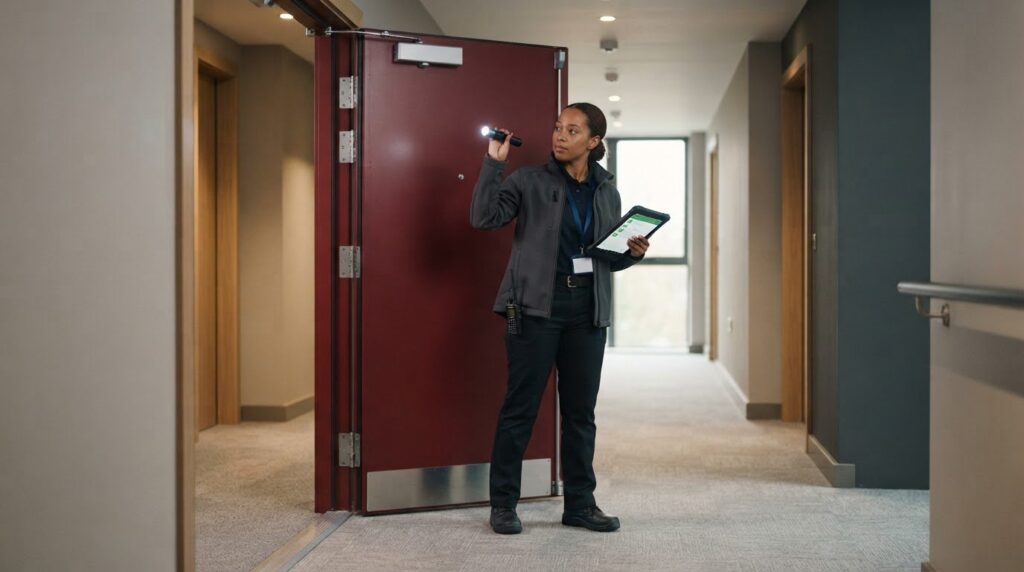
What if the right fire door inspection schedule depends less on a single calendar interval and more on your building, its condition and the law that applies where it stands? That distinction is central to fire door maintenance regulations uk. It can be difficult to separate statutory duties from guidance, routine checks and specialist maintenance, and requirements vary across the UK. A process that suits one building may not meet another building’s compliance needs.
It’s reasonable to want a clear schedule and reliable evidence that defects are being dealt with. This guide explains how to identify the duties that apply to your building, including additional checks for certain residential buildings in England, and how to organise proportionate, documented maintenance. It distinguishes routine observations from formal inspections and repairs, explains what to consider when assessing a contractor’s competence, and outlines records that can help show how findings and remedial actions were managed. A specialist fire door survey can help establish door condition and prioritise work, while responsibility for overall fire safety arrangements remains with the responsible person.
Key Takeaways
- Check your building’s use, occupancy and UK jurisdiction to identify which fire safety duties apply.
- Use a risk-led process to identify doors, assess their role and condition, and plan proportionate checks.
- Assign each task to someone with the appropriate knowledge, training and experience, from routine observations to specialist repairs.
- Keep clear records of responsibilities, inspection findings and remedial actions to help demonstrate how issues were managed.
- Understanding fire door maintenance regulations uk can help you decide when a specialist survey or maintenance support may be useful.
What do UK fire door maintenance regulations require from a responsible person?
The core duty is to keep relevant fire safety measures properly maintained. Under Article 17 of the Regulatory Reform (Fire Safety) Order 2005, where it applies, the responsible person must ensure that relevant fire safety equipment and devices are maintained in an efficient state, in efficient working order and in good repair. Fire doors are part of this life-safety provision: the door leaf, frame, seals and hardware work together to help resist fire and smoke. A general overview of a fire door can explain its role, but it doesn’t replace legislation or technical assessment.
In short: identify the duties that apply to the premises, maintain relevant fire doors so they remain effective, and keep evidence of how their condition and any defects are managed. Fire door maintenance regulations uk do not provide one identical checklist for every building. Legal requirements depend on the premises, their use and their location.
Which fire safety laws apply across the UK?
In England and Wales, the Regulatory Reform (Fire Safety) Order 2005 establishes the main fire safety framework for relevant non-domestic premises, including applicable workplaces and shared areas. Scotland has its own framework under the Fire (Scotland) Act 2005 and associated regulations. In Northern Ireland, the principal framework includes the Fire and Rescue Services (Northern Ireland) Order 2006 and the Fire Safety Regulations (Northern Ireland) 2010. Check current legislation and official guidance for the relevant nation and premises before applying a requirement.
Legislation creates legal duties. Official guidance helps responsible persons understand how to comply, while British Standards and other recommended practices can inform technical methods and maintenance planning. These sources are not interchangeable: a standard may support good practice, but it doesn’t automatically create a legal duty. Following general guidance also doesn’t remove the need to assess the building’s specific risks.
What do the Fire Safety (England) Regulations add?
In England, the Fire Safety (England) Regulations 2022 add specific fire door checking duties for certain multi-occupied residential buildings. For residential buildings over 11 metres, responsible persons must arrange quarterly checks of fire doors in common parts and annual checks of flat entrance doors. These duties apply in England to the building categories set out in the Regulations. They do not establish one inspection interval for every fire door in every commercial building.
A commercial building’s maintenance plan should reflect its applicable legal duties and the role, use and condition of its doors, rather than simply adopting the residential intervals that apply in England. Confirm the rules for the building’s jurisdiction, then document the maintenance arrangements that support compliance.
How should a compliant fire door maintenance process work?
A reliable process turns fire door responsibilities into repeatable actions, from identifying each door to confirming that defects have been resolved. Fire door maintenance regulations uk do not set one inspection interval for every door in every building. Plan checks around applicable legal duties, the fire risk assessment, building use and door condition. For duties under the Fire Safety (England) Regulations 2022, consult the official government guidance to confirm which requirements apply.
- 1. Identify the doors. Create a register showing each door’s location and a clear identifier. Record its role, such as protecting an escape route or separating areas, and include relevant information about its design where known.
- 2. Assess risk and plan checks. Consider occupancy, building use, how often each door is used, its importance to compartmentation and any previous defects. Use these factors, the risk assessment and applicable guidance to set a suitable inspection plan instead of applying an unsupported blanket interval.
- 3. Check condition. Assign routine visual observations to appropriately instructed staff. Arrange a more detailed inspection if a defect, repeated damage or uncertainty requires specialist assessment. Maintenance and repairs should be completed by someone competent for the work.
- 4. Record and prioritise findings. Log each defect against the individual door, assess its significance, and assign an action owner and a target for review or completion.
- 5. Close and verify actions. Record the work completed, then follow up to confirm that the issue has been resolved and the door operates as intended. Keep unresolved findings visible and escalate them through the building’s fire safety arrangements.
What should a fire door check cover?
Record the condition of the door leaf and frame, hinges, closer, latch, glazing and seals where fitted. Note visible damage, missing or loose components, alterations, and anything that stops the door from closing properly. A routine visual check can identify concerns, but it should not replace specialist assessment when performance is uncertain or a defect needs diagnosis.
How should defects and maintenance actions be tracked?
For each finding, record the door’s location and identifier, its condition, the issue observed, the action owner and the completion status. Dated notes and photographs can clarify the audit trail, particularly if a defect changes over time. After remedial work, document the follow-up check and its outcome, not just the contractor’s attendance.
If a door is damaged, has missing components or fails to close correctly, report and escalate it promptly under your site procedure. A specialist fire door survey can help establish its condition and prioritise remedial work when the next step isn’t clear.
Who is competent to inspect, maintain or repair fire doors?
Competence depends on the task. Anyone carrying out the work should have the knowledge, training, experience and practical ability to do it safely and to a suitable standard. Someone who can spot visible damage during a routine check may not be qualified to assess an uncertain doorset specification, diagnose a recurring fault or complete remedial work.
There isn’t one mandatory qualification that proves competence for every fire door task. The responsible person should assess whether an individual’s experience and evidence match the work assigned. The National Fire Chiefs Council provides practical information on the England-specific regulations. Confirm the legal requirements that apply to your building and jurisdiction separately.
Before appointing a specialist, check their relevant fire door experience, the exact scope of the proposed work, evidence of training, and how they quality-check and report findings. Third-party certification can provide useful assurance where relevant, but check which activities and scope it covers. A certificate alone doesn’t establish that someone is competent for every inspection, maintenance or repair task.
When can staff carry out routine checks?
In-house staff can complete assigned visual observations if they have been instructed in a clear procedure and know what to record. They might look for visible damage, missing components or a door that doesn’t close properly. Set out how to report concerns and who decides what happens next. Routine checks do not, by themselves, qualify staff to alter, maintain or repair a fire door.
When should a specialist be appointed?
Use a specialist if the door’s specification or condition is uncertain, damage is significant, faults recur, or the required repair is outside in-house competence. Compare the person’s relevant experience with the specific task, not just their general fire safety credentials. Ask what they will inspect or change, what findings they will document, and how completed work will be checked.
Fire door maintenance regulations uk set duties for the responsible person, but appointing a contractor doesn’t transfer those duties. The responsible person should define the work, review the findings and make sure identified actions are addressed. For a wider technical overview, consult the article’s commercial fire door guide alongside the applicable official guidance.

How can responsible persons prove fire door maintenance competence?
Good records connect the person assigned to a task with the work they were asked to do, the findings they reported and the actions taken afterwards. They help the responsible person oversee maintenance and demonstrate that arrangements are being managed. Records alone don’t prove that every door is compliant, so they must reflect the building’s actual condition and be kept up to date.
A useful fire door maintenance audit trail is a dated record linking each door and inspection finding to the person responsible, the work completed and evidence that any remedial action was reviewed. This helps trace decisions, identify overdue actions and confirm that the work matched the individual’s competence. It also supports consistent management of fire door maintenance regulations uk without treating paperwork as a substitute for effective maintenance.
What evidence should the fire safety file contain?
Organise records so a reviewer can follow an individual door’s history from inspection through to remedial close-out. The relevant fire safety file or record system should include:
- A current door register showing identifiers and locations, linked to relevant inspection and survey records.
- Inspection findings describing the door’s condition, the date of the check and who completed it.
- Competence and appointment evidence, such as relevant training or experience records, assigned responsibilities and the contractor’s agreed scope of work.
- Defect and action records showing the issue, its action owner, completion date and verification or follow-up evidence where applicable.
- Relevant technical information, including available door specifications, survey findings and details of maintenance or repairs.
Keep evidence proportionate and meaningful. A record that says only “checked” or “repaired” may not explain what was examined, what was found or whether the original concern was resolved. If photographs help clarify a defect or completed work, store them with the dated record and door identifier.
How should records support the fire risk assessment?
Use inspection and survey findings to inform reviews of fire risks and maintenance priorities. A damaged door on a key escape route, for example, may need a different response from a minor issue on a less critical door. Record why actions are prioritised and make sure unresolved defects remain visible to the people managing fire safety.
If a defect can’t be corrected immediately, document how it was escalated and any interim risk controls considered or put in place. Review those controls and the outstanding action until the issue is closed. A fire compartmentation survey may help clarify how doors relate to the building’s wider compartmentation. A specialist can support this process, but the responsible person remains accountable for overseeing the arrangements.
How can specialist fire door maintenance support ongoing compliance?
A specialist survey can help when door specifications are unclear, defects recur or the scale of remedial work is uncertain. Planned fire door maintenance can then address identified needs and provide a structured basis for continued oversight. This support is part of the responsible person’s wider arrangements. Appointing a contractor doesn’t transfer responsibility: the responsible person still needs to review findings, agree priorities and make sure actions are tracked to completion.
A clear brief helps the appointed specialist understand the building and provide useful, traceable findings. Before commissioning work, prepare the door register, known defects, relevant fire risk assessment information, access arrangements and the required scope. Specify whether you need a survey, maintenance or both, and what records should be provided.
What should a fire door survey or maintenance brief include?
Set out the building’s use and relevant context, known door locations, observed faults, and any available specifications or previous survey findings. Ask for findings linked to individual doors, remedial recommendations prioritised by risk, and records identifying completed work and outstanding issues. Agree how access will be arranged and how changes to the scope will be approved and documented.
Fire doors also form part of a wider passive fire protection strategy. For broader context on how building elements work together, see Passive Fire Protection: The Definitive Guide to Building Safety and Compliance.
What are the next steps for a responsible person?
Use a defined sequence to turn survey results into ongoing management:
- Confirm the applicable UK jurisdiction, premises scope and current fire risk assessment.
- Assign inspection and maintenance tasks to people competent for the work, and agree a proportionate schedule informed by risk and relevant guidance.
- Maintain an action register linking each finding to an owner, required work, status and follow-up review.
- Review contractor records and verify that completed remedial actions address the recorded defects.
These steps help make fire door maintenance regulations uk relevant to the building’s actual duties and condition, rather than relying on a generic checklist. National Fire Ltd provides fire door surveys and maintenance for commercial and industrial clients across the UK. If you need help establishing door condition or planning remedial priorities, contact National Fire Ltd to discuss your building’s requirements.
Put a clear fire door maintenance plan in place
Effective compliance starts with confirming which legal duties apply to your premises and UK jurisdiction. Fire door maintenance regulations uk do not create one universal inspection schedule for every building, so base your arrangements on applicable requirements, risk and door condition. Assign each inspection, maintenance or repair task to someone with competence appropriate to that work.
Keep clear records of findings, decisions, action owners and completed remedial work. Review unresolved defects and confirm that repairs address the issues identified. These records support oversight, but the responsible person remains accountable for the building’s wider fire safety arrangements.
For commercial and industrial buildings, a specialist survey can help clarify door condition and prioritise remedial work. National Fire Ltd provides fire door surveys and maintenance, as well as fire door installation and fire compartmentation surveys. To discuss what may support your building’s arrangements, discuss fire door surveys and maintenance with National Fire Ltd.
A consistent, well-documented process helps you manage responsibilities with greater confidence and maintain safer premises.
Frequently Asked Questions
What are the fire door maintenance regulations in the UK?
The applicable duties depend on the building’s location, use and legal scope. In England and Wales, the Regulatory Reform (Fire Safety) Order 2005 requires relevant fire safety measures to be maintained. Scotland and Northern Ireland have separate fire safety frameworks. Fire door maintenance regulations uk therefore do not form one identical checklist for every premises. Confirm the jurisdiction and applicable legislation, then use official guidance to plan and document appropriate maintenance.
How often should fire doors be inspected in commercial buildings?
There isn’t one inspection interval that applies to every commercial fire door across the UK. Plan checks according to applicable legal duties, the fire risk assessment, the door’s role, building use, occupancy and condition. Specific intervals apply to certain residential buildings in England, but they shouldn’t automatically be applied to all commercial premises. Set a proportionate schedule, record the rationale and review it if use, condition or risk changes.
Who is responsible for maintaining fire doors in a commercial building?
The responsible person under the relevant fire safety legislation must ensure applicable fire safety measures are maintained. Depending on the premises, this may be an employer, building owner, occupier or another person with control. More than one party may have responsibilities. A contractor can carry out agreed surveys or maintenance, but appointing one doesn’t transfer the responsible person’s legal duties. Confirm who holds responsibility and how work and findings will be overseen.
Can an in-house facilities team inspect fire doors?
Yes. Appropriately instructed facilities staff can carry out routine visual checks under a defined procedure and within their assigned responsibilities. They should know what to observe, how to record concerns and who to notify. A visual check doesn’t qualify staff to alter or repair a fire door, or necessarily to diagnose more complex defects. Refer significant damage, recurring faults or uncertainty about specification or performance to someone competent for that assessment or work.
What records should be kept for fire door maintenance?
Keep an up-to-date door register with locations and identifiers, dated inspection findings, and records of who completed each task and its scope. Document defects, assigned action owners, completion dates and follow-up checks. Retain relevant specifications, survey findings, repair details and evidence of competence for the work undertaken. These records help responsible persons track decisions and outstanding actions. Organise them so findings can be traced from identification through to review and close-out.
Does a fire door survey prove that a building is compliant?
No. A survey records the condition of doors within its agreed scope and can identify concerns and remedial priorities. It’s a useful part of managing fire safety, but it doesn’t by itself prove that every door or the wider building complies with all applicable duties. The responsible person should review the findings, arrange appropriate action, track unresolved defects and consider how the results affect the building’s wider fire safety arrangements.
Are British Standards for fire doors legally mandatory?
Not automatically. British Standards generally provide technical specifications or recommended practice; they aren’t legislation simply because they apply to fire doors. However, a standard may be relevant to a legal duty, a project specification or other contractual requirements. Responsible persons should identify the applicable legislation and use relevant standards where appropriate to inform competent work. Check the current edition and its scope rather than assuming a standard replaces legal requirements or official guidance.