


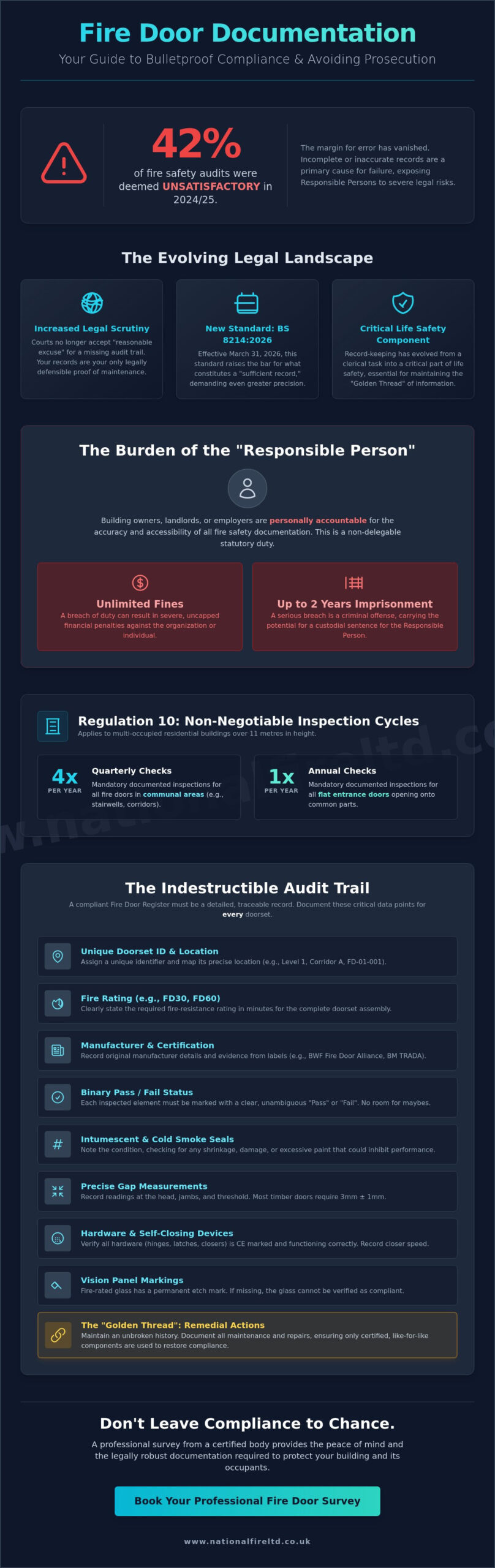
With 42% of fire safety audits deemed unsatisfactory in 2024/25, the margin for error in your documentation has effectively vanished. It’s no longer enough to simply perform a check; you must prove it happened with surgical precision. For many responsible persons, the fear of prosecution stems not from a lack of care, but from the complexity of modern fire door inspection records requirements. The introduction of BS 8214:2026 on March 31, 2026, has only raised the stakes, transforming record keeping from a clerical task into a critical component of life safety.
We understand the weight of this responsibility and the confusion surrounding digital versus paper validity. This guide provides a definitive roadmap to mastering your legal obligations, offering you the confidence to meet Regulation 10 requirements without hesitation. We’ll outline the specific data points required for a compliant audit trail, explain the “Golden Thread” of information, and provide a clear template to ensure your building stands up to the most rigorous scrutiny from Fire and Rescue Authorities.
Key Takeaways
- Navigate the evolving legal landscape and understand how the Fire Safety (England) Regulations 2022 dictate your documentation responsibilities.
- Identify the critical data points necessary to meet fire door inspection records requirements, including unique doorset identification and precise location mapping.
- Transition from fragmented inspection sheets to a centralized Fire Door Register to establish an indestructible audit trail for your building.
- Maintain the “Golden Thread” of safety by accurately recording all remedial maintenance and ensuring the use of certified, like-for-like components.
- Understand why professional Fire Door Surveys are required to provide the authoritative, legally defensible records that internal checks often lack.
The Legal Mandate for Fire Door Record Keeping in the UK
Passive fire protection relies on a foundation of documented evidence. The Regulatory Reform (Fire Safety) Order 2005 remains the primary legal framework, requiring that fire safety provisions are subject to a suitable system of maintenance. However, the introduction of the Fire Safety (England) Regulations 2022 on January 23, 2023, significantly tightened the fire door inspection records requirements for multi-occupied residential buildings. Understanding What is a Fire Door? and its role as a critical system is the first step toward achieving absolute regulatory compliance.
Compliance isn’t a suggestion; it’s a statutory obligation that demands meticulous attention to detail. When the Fire and Rescue Authority conducts an audit, they don’t just look at the physical condition of the doors. They scrutinize the audit trail. If records are missing or incomplete, the “reasonable excuse” defense often fails in court. You cannot prove that maintenance has occurred without a robust logbook. This lack of evidence leaves the building and its occupants at risk and exposes the organization to severe legal repercussions.
The Fire and Rescue Authority has the power to issue enforcement notices or even prohibition notices if they find your records lacking. These notices can restrict building use or demand immediate remedial action within a set timeframe. In the wake of recent legislative updates, including the publication of BS 8214:2026 on March 20, 2026, the standard for what constitutes a “sufficient record” has evolved. It’s no longer acceptable to have vague entries; your documentation must reflect a methodical approach to safety.
The Duties of the Responsible Person
The “Responsible Person” carries the legal weight for every doorset within their remit. This individual, whether a building owner, landlord, or employer, is personally accountable for the accuracy and accessibility of all safety documentation. Failure to maintain a transparent fire safety logbook isn’t just a clerical error; it’s a breach of duty that can lead to unlimited fines or imprisonment of up to two years. In residential settings, the Responsible Person must also ensure that specific safety information is shared with residents. This ensures that those living in the building understand the importance of fire door integrity and the measures taken to protect them.
Regulation 10 and Multi-Occupied Residential Buildings
For residential buildings exceeding 11 metres in height, Regulation 10 introduces specific, non-negotiable documentation cycles. You must document quarterly checks on all fire doors in communal areas, such as stairwells and corridors. These fire door inspection records requirements also mandate annual checks for flat entrance doors that open onto common parts. Documenting these inspections provides a clear history of the building’s safety status. It ensures that the most vulnerable points in a building’s compartmentation are monitored with consistent, documented frequency, providing peace of mind for both management and residents alike.
The record must also clearly state the fire rating of the assembly, such as FD30 or FD60, and identify the original manufacturer. Following the standards set out in The Fire Safety (England) Regulations 2022, these details form the baseline for all subsequent assessments. A binary “Pass” or “Fail” status is required for each inspected element, so there’s no room for ambiguity regarding the door’s safety. If a door fails, the record should immediately trigger a remedial workflow to restore protection.
Technical Data Points for Every Doorset
Precision is vital when documenting technical findings. Inspectors must record the condition of intumescent seals and cold smoke seals, noting any shrinkage or damage. Gap measurements are equally critical; documentation should include specific readings at the head, jambs, and threshold. Most timber fire doors require a gap of 3mm plus or minus 1mm along the sides and top. Additionally, the functionality of self-closing devices must be verified. This includes recording the closing speed to ensure the door latches firmly without posing a risk to occupants.
Identifying Fire Ratings and Certifications
A compliant record captures the evidence found on certification labels, such as those from the BWF Fire Door Alliance or BM TRADA. These labels provide a traceable history of the doorset’s performance. Inspectors must also document the markings on vision panels. Fire-rated glass features a permanent etch indicating its rating and manufacturer. If these markings are missing, the glass cannot be verified as compliant. Similarly, the hardware must be checked for compatibility. Recording that hinges, locks, and closers are suitably marked and compatible with the specific FD rating is a core part of the process. For those seeking to establish a robust baseline for their documentation, commissioning a professional Fire Door Survey ensures that every technical detail is captured with absolute accuracy.
The Fire Door Register: Building a Robust Audit Trail
A fire door register serves as a living compliance document, acting as the definitive source of truth for every doorset within a facility. Unlike fragmented inspection sheets that are easily misplaced or misinterpreted, a centralized register provides a comprehensive overview of building integrity. This structured approach is essential for meeting the Regulatory Reform (Fire Safety) Order 2005, which mandates that fire safety measures are maintained in efficient working order and in good repair. Without a unified register, tracking the lifecycle of multiple doors becomes a logistical impossibility, leaving the Responsible Person vulnerable during a formal audit.
By consolidating data into a single register, you create a transparent audit trail that is immediately accessible to maintenance teams, site managers, and emergency services. This document should be intrinsically linked to your Fire strategy drawings to ensure that every door’s location and purpose are clearly understood within the broader context of the building’s compartmentation. This synergy between spatial data and inspection history is what defines modern fire door inspection records requirements. It allows for a methodical progression from identifying a safety risk to implementing an accredited method for addressing it.
Digital Record Management vs. Traditional Logbooks
Cloud-based asset management systems offer significant advantages over traditional paper logbooks. Digital platforms provide real-time updates, ensuring that compliance status is never out of date. These systems must be tamper-proof, utilizing automated date and time stamps to provide an immutable record of when an inspection occurred and who performed it. Transitioning to a digital approach moves your organization away from reactive filing toward proactive safety management. It ensures that data is not just stored, but is functional and searchable, which is a core requirement of the Building Safety Act’s “Golden Thread” of information.
Retention Periods and Data Accessibility
Legal and insurance frameworks generally require that fire safety records are held for a minimum of seven years, though best practice in 2026 suggests maintaining records for the entire lifecycle of the building. When a door is replaced, the historical data shouldn’t be discarded. Instead, it must be archived to prove a continuous history of diligent maintenance. Records must be “readily available” at all times. If a fire service inspector arrives for an unannounced visit, you’re expected to produce a complete, accurate register within minutes. This level of preparedness demonstrates a meticulous commitment to standards and ensures your fire door inspection records requirements are met with absolute reliability.
Documenting Remedial Works and Maintenance Actions
Identifying a defect is only the first stage of a professional safety workflow. To satisfy modern fire door inspection records requirements, especially as 75% of fire doors inspected by the FDIS in 2023 failed to meet required standards, you must document the entire lifecycle of a repair from the initial failure to the final sign-off. This process forms the “Golden Thread” of information required by the Building Safety Act. It ensures that every identified risk is met with an accredited solution that preserves the integrity of the fire compartment. When a component fails, the record must capture the exact specification of the replacement part. Using like-for-like certified components is non-negotiable; replacing a specific intumescent seal with an unverified alternative can invalidate the entire doorset’s certification.
Documenting who performed the work is just as critical as the repair itself. You must record the qualifications and competence of the operative to prove the remedial action meets rigorous industry standards. Once the repair is finished, the loop must be closed with a formal post-repair verification check. This step is often overlooked, yet it’s the only way to confirm the door has returned to a compliant state. This second inspection provides a legally defensible conclusion to the maintenance event and ensures the audit trail remains unbroken, protecting the Responsible Person from claims of negligence.
Tracking Repairs from Identification to Completion
Effective record keeping involves assigning clear priority levels to every defect identified during a survey. This allows maintenance teams to address high-risk issues, such as failed self-closers or excessive gaps, with the necessary urgency. Each entry in your log should include the date of repair and a detailed list of the specific materials utilized. Attaching manufacturer data sheets for new components, such as fire-rated glazing or specialized locks, to the master record ensures that the building’s safety manual remains a comprehensive technical resource. This level of detail is essential, given that GOV.UK figures for 2024/25 showed 42% of fire safety audits were deemed unsatisfactory, often due to poor documentation of remedial actions.
Integrating Maintenance into the Master Record
Ongoing fire door maintenance shouldn’t exist in isolation. Regular logs documenting minor adjustments, such as tightening hinges, cleaning seals, or recalibrating closing speeds, provide vital support for your annual survey findings. These minor interventions are essential for preventing small issues from escalating into significant safety breaches or costly full-door replacements. By linking these records to your overall safety budget, you gain a clearer picture of long-term asset performance and lifecycle costs. This data-driven approach allows for better financial planning and more predictable safety outcomes. If your current documentation doesn’t bridge the gap between inspection and repair, our experts can provide a compliant Fire Door Maintenance strategy tailored to your building’s specific needs.
Professional Surveys: Ensuring Accuracy in Your Compliance Records
Relying on internal staff for complex safety assessments introduces unmanaged risk into your organization. While building managers can identify obvious physical damage, they often lack the technical training required to evaluate threshold gaps, hardware compatibility, or intumescent performance against the rigorous BS 8214:2026 standard. A professional survey provides a legally defensible baseline, ensuring that your fire door inspection records requirements are met with technical precision rather than guesswork. This authoritative approach transforms your documentation from a simple list into a robust shield against legal scrutiny and regulatory intervention.
Fire doors function as critical components within a building’s broader safety architecture, and it’s a mistake to view them in isolation. By integrating door data into a wider fire compartmentation survey, you ensure that every potential breach in a fire-rated wall is accounted for and managed. This holistic oversight is further strengthened by utilizing technical fire strategy drawings. These drawings act as a master map, allowing maintenance teams and inspectors to locate every doorset instantly and understand its specific role in preventing the spread of fire and smoke throughout the premises.
The Value of Third-Party Certified Surveys
Accreditations like BM TRADA signify that a surveyor possesses the specialized knowledge to distinguish between a functional door and a compliant one. A basic visual check might miss a non-compatible hinge or a slight warp in the door leaf, but a comprehensive compliance survey leaves no technical detail unexamined. These professional reports simplify the Responsible Person’s duties during an audit by providing clear, accredited evidence that all safety systems are being managed with meticulous care. This disciplined approach reduces the likelihood of enforcement notices and provides a clear pathway for ongoing maintenance.
How National Fire Ltd Supports Building Compliance
We provide a unified front of experts dedicated to securing your environment and protecting life. Our approach involves detailed record generation and asset tagging for every doorset, creating a digital footprint that’s easy to track, update, and retrieve. We offer a seamless transition from the initial survey to remedial Fire Door Maintenance, Fire Door Installation, or Fire Stopping, ensuring that defects aren’t just recorded but resolved by competent professionals. This methodical progression ensures your records are audit-ready 365 days a year, providing the psychological benefit of safety and the practical certainty of absolute compliance.
Securing Your Path to Absolute Compliance
Meeting the strict fire door inspection records requirements is a fundamental duty for every Responsible Person. As the 2026 standards demonstrate, compliance isn’t defined by the inspection itself, but by the indestructible audit trail that follows. You must maintain a centralized register that bridges the gap between defect identification and certified resolution. This methodical approach ensures that your building remains a secure environment while protecting you from the severe legal consequences of documented negligence.
We stand ready to act as your guardian of life and property. As specialist passive fire protection contractors, we provide national coverage for the commercial and industrial sectors, delivering the technical excellence your facility demands. Ensure your building is compliant with a professional Fire Door Survey from National Fire Ltd. Our comprehensive fire door survey and maintenance solutions provide the stability and oversight needed to navigate complex regulatory frameworks with total confidence. Taking these disciplined steps today secures your building for the long term.
Frequently Asked Questions
Are fire door inspection records a legal requirement?
Yes, maintaining accurate documentation is a statutory obligation under the Regulatory Reform (Fire Safety) Order 2005 and the Fire Safety (England) Regulations 2022. These laws mandate that fire safety equipment, including doorsets, is subject to a suitable system of maintenance. Without records, you cannot demonstrate that you have fulfilled your legal duty to ensure the safety of the building’s occupants and the integrity of its compartmentation.
How long must I retain fire door inspection records in the UK?
You should retain fire door inspection records for a minimum of seven years to satisfy standard legal and insurance requirements. However, industry best practice in 2026 suggests maintaining a “Golden Thread” of information for the entire lifecycle of the building. This provides a complete historical audit trail that remains valid even if the building ownership or management changes, ensuring continuous safety oversight.
Can I keep fire door records in a digital format?
Digital records are not only permitted but are now considered the industry standard for meeting fire door inspection records requirements. Cloud-based asset management systems provide real-time updates and tamper-proof time stamps that traditional paper logbooks cannot match. These systems ensure that safety data is readily accessible to both maintenance teams and Fire and Rescue Authorities during unannounced inspections or formal audits.
What happens if my fire door inspection records are missing during an audit?
Missing records during an audit can lead to serious legal consequences, including unlimited fines and potential imprisonment for the Responsible Person. Fire and Rescue Authorities may issue enforcement notices requiring immediate remedial action or prohibition notices that restrict building access. In the absence of documentation, you lose the “reasonable excuse” defense, as you cannot prove that required safety checks were ever performed.
Do I need a separate record for every single fire door in my building?
Yes, every individual doorset must have its own unique identification code and a dedicated entry in your fire door register. This level of granularity is essential for tracking the specific maintenance history, fire rating, and component specifications of each door. Treating doors as individual assets prevents confusion and ensures that defects are correctly attributed and resolved by your maintenance team without administrative error.
What specific information must be included in an inspection report?
A compliant report must include the unique door ID, its precise location, the fire rating, and the manufacturer’s details. It should document the technical condition of the leaf, frame, hinges, self-closers, and intumescent seals. Each component requires a clear “Pass” or “Fail” status, supported by specific gap measurements at the head, jambs, and threshold to ensure technical accuracy and regulatory compliance.
How often do fire door inspection records need to be updated?
Records must be updated every time an inspection or maintenance action occurs. For residential buildings over 11 metres, the fire door inspection records requirements mandate quarterly updates for communal doors and annual updates for flat entrance doors. In non-domestic settings, updates typically follow a six-monthly cycle as recommended by BS 9999, or more frequently if the doors are located in high-traffic areas.
Who is authorized to sign off on a fire door inspection record?
A competent person with the necessary training, skills, and experience must sign off on the records. While building managers can perform basic visual checks, formal compliance surveys should be conducted by third-party certified professionals, such as those with BM TRADA accreditation. This ensures that the sign-off is technically accurate and provides a legally defensible baseline that internal, untrained staff aren’t qualified to provide.