

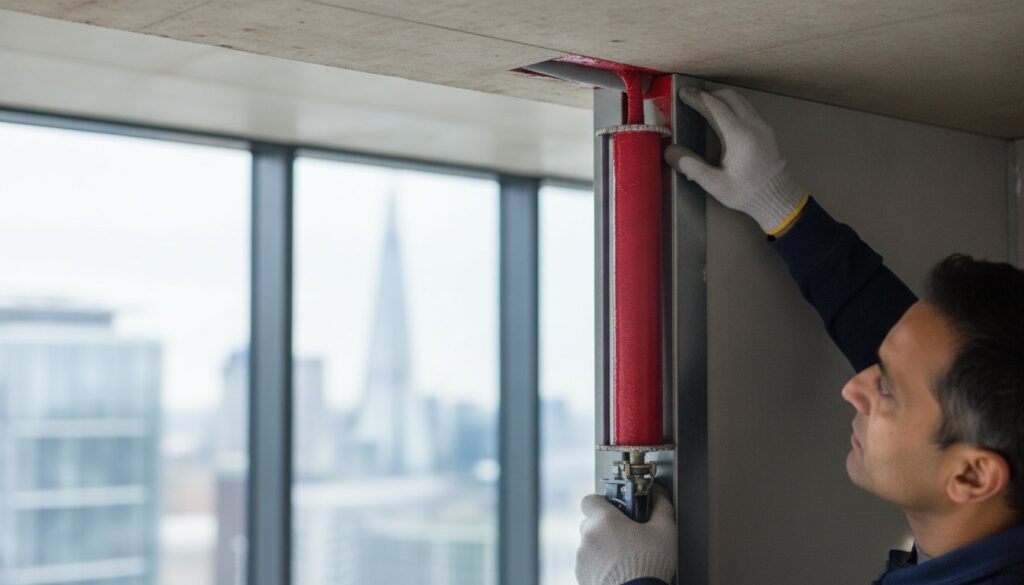
An acoustic leak in a commercial partition is often the first warning sign of a compromised fire barrier. For contractors and specifiers, the challenge isn’t just blocking sound; it’s ensuring that every linear joint maintains the building’s structural integrity during a blaze. Selecting the correct fire rated acoustic sealant is no longer a matter of preference but a critical requirement under the 2026 amendments to Approved Document B. As the UK completes its transition to BS EN 13501 standards, the margin for error in material specification has effectively vanished.
We understand that navigating the technical overlap between sound insulation and fire stopping can feel like a regulatory minefield. It’s difficult to balance decibel reduction with the rigid demands of fire compartmentation. This guide provides the professional clarity you need to specify and install sealants that satisfy both building control inspections and long-term safety obligations. We’ll examine the latest BS EN 1366-3 testing nuances, the mandatory shift away from legacy BS 476 standards, and the precise methods for documenting installations to maintain the digital “Golden Thread” required for modern compliance.
Key Takeaways
- Navigate the 2026 updates to Approved Documents B and E to ensure your commercial project meets the dual requirements for fire safety and sound insulation.
- Select the appropriate fire rated acoustic sealant by comparing the performance characteristics of acrylic intumescent materials and high-moisture silicone variants.
- Master professional installation techniques, including the critical use of backer rods, to prevent three-sided adhesion and maintain the integrity of linear joints.
- Understand how comprehensive fire compartmentation surveys identify degraded seals and form the basis for necessary remedial fire stopping works.
- Align your project documentation with the “Golden Thread” of information by adhering to the latest BS EN 13501 testing and accreditation standards.
What is Fire Rated Acoustic Sealant and Why is it Critical?
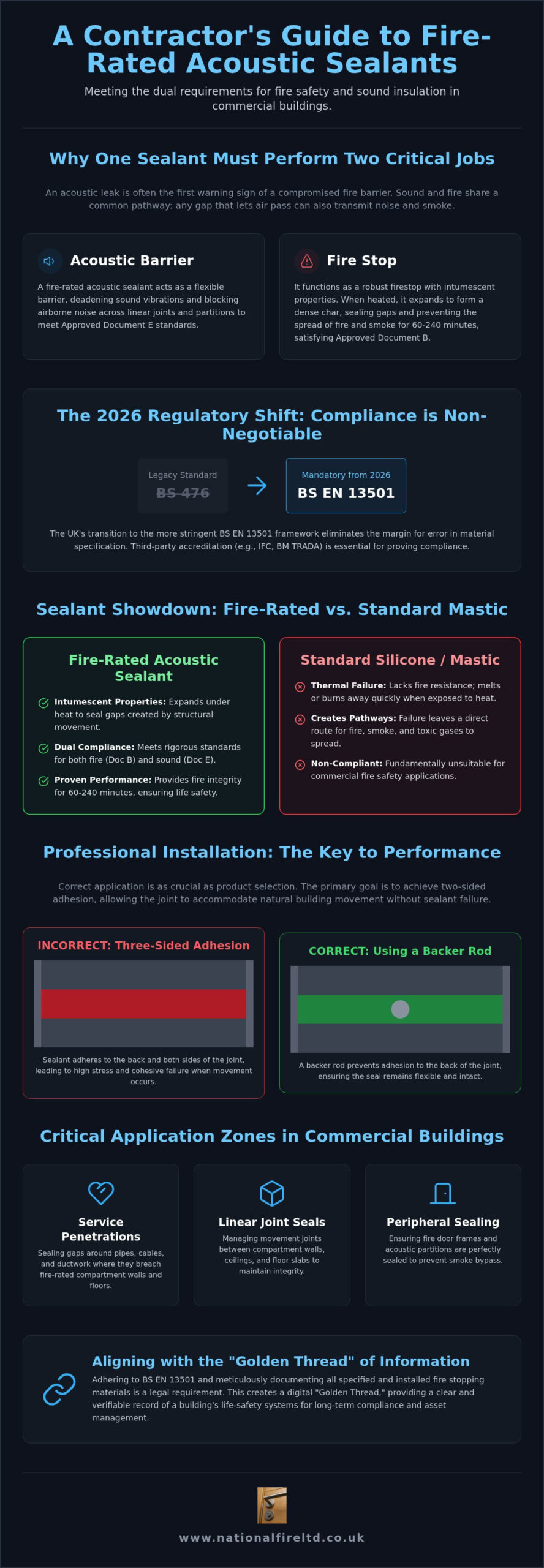
A fire rated acoustic sealant is a sophisticated hybrid material designed to meet the rigorous demands of modern passive fire protection. While standard mastics focus on aesthetic finishes or basic weatherproofing, these professional-grade products are engineered to perform two critical roles simultaneously. They act as a flexible acoustic barrier that deadens sound vibrations across linear joints while functioning as a robust firestop within a building’s compartmentation strategy. Understanding What is Firestopping? is fundamental to this process, as it involves the methodical sealing of openings to prevent the spread of fire, smoke, and heat through walls and floors.
Standard silicone or mastic is fundamentally insufficient for commercial fire safety. These materials lack the chemical composition to withstand extreme thermal stress; they often melt or burn away quickly, leaving a direct path for fire to bypass rated barriers. In contrast, a certified fire rated acoustic sealant contains intumescent properties that react to heat. When temperatures rise during a blaze, the sealant undergoes a chemical expansion to seal gaps that might otherwise open as building materials warp or move. This ensures that the integrity of the fire compartment is maintained for a verified duration, typically between 60 and 240 minutes.
The Intersection of Fire and Sound
Sound and fire share a common trait: they both exploit the smallest gaps in a building’s construction. If air can pass through a joint, sound and smoke can too. We’ve observed that acoustic leaks are often the primary indicator of a breach in a fire-rated barrier. Sealing hidden voids in floor and wall junctions is not just about noise reduction; it’s a life-safety requirement. Fire-rated sealants expand under heat to create a dense char that blocks the passage of smoke and flames through these voids. By addressing these gaps, we ensure that the building meets the requirements of both fire safety and acoustic regulations.
Common Application Areas in Commercial Buildings
Effective fire stopping relies on the precise application of sealants in several high-risk zones. Our teams focus on these critical areas during remedial works and new installations:
- Service Penetrations: Sealing the gaps around pipes, cables, and ductwork where they breach compartment walls.
- Linear Joint Seals: Managing the movement joints between compartment walls and ceilings or floor slabs.
- Peripheral Sealing: Ensuring fire door frames and acoustic partitions are sealed to prevent smoke bypass.
Correct specification in these areas is vital for maintaining the “Golden Thread” of safety information and ensuring long-term compliance across the property’s lifecycle.
Navigating UK Regulations: Approved Documents B and E
Compliance in the UK’s high-stakes construction sector requires a dual-layered approach to safety and habitability. Approved Document B dictates the mandatory standards for fire spread and compartmentation, ensuring that buildings are divided into fire-resistant zones. Simultaneously, Approved Document E establishes the requirements for resistance to the passage of sound. These regulations aren’t just guidelines; they’re legal benchmarks that determine whether a building is fit for occupation. Failing to meet either standard during building control inspections can lead to costly remedial works and significant project delays.
Specifying a high-quality fire rated acoustic sealant allows developers to satisfy both regulatory requirements within a single installation. This is particularly important as the industry transitions from legacy BS 476 standards to the more stringent BS EN 13501 framework in 2026. Efficiency in specification reduces material costs and installation time while ensuring that no compromises are made on life safety. However, compliance is only guaranteed when materials carry third-party accreditation from bodies such as IFC or BM TRADA. These certifications provide the necessary evidence that the sealant will perform under extreme thermal stress. If you’re concerned about the status of your current assets, our team at National Fire Ltd provides comprehensive fire compartmentation surveys to identify and rectify non-compliant joints.
Understanding Fire Resistance Ratings (EI)
Fire resistance is categorised by Integrity (E) and Insulation (I). Integrity refers to the material’s ability to stop the passage of flames and hot gases. Insulation measures its capacity to limit temperature rise on the non-fire side of the joint. In commercial environments, 30, 60, and 120-minute ratings are the industry standard. Interpreting these “minutes of protection” correctly is vital; a sealant must match or exceed the rating of the substrate it’s applied to. Using a 30-minute sealant in a 60-minute wall creates a weak point that invalidates the entire fire barrier and compromises the safety of the occupants.
Acoustic Performance Standards (dB)
Acoustic performance is quantified using the Weighted Sound Reduction Index (Rw), measured in decibels (dB). Professional sealants are tested to determine how effectively they block airborne sound across various frequencies. Gap size significantly impacts this performance. Even a 1mm breach in a 10mm joint can lead to a disproportionate drop in sound insulation. Effective fire compartmentation relies on these technical specifications to ensure that sound and fire are contained within their designated zones. High-specification sealants can achieve an Rw of up to 52dB in a single joint, providing significant protection against noise pollution in commercial settings.
Comparing Sealant Types: Acrylic, Silicone, and Intumescent
Selecting the correct material for fire stopping requires a clear understanding of the environmental conditions and structural demands of the joint. Specialist firms such as MESCH Isolierung & Brandschutz GmbH focus on providing high-quality insulation and fire protection solutions that meet these rigorous technical requirements. Acrylic intumescent sealants serve as the primary solution for internal fire stopping. These water-based products are preferred for their ease of application and their ability to adhere to common substrates like masonry, concrete, and plasterboard. They are particularly effective in internal partitions where they can be painted to match the surrounding finish. However, these materials are generally limited to internal environments where moisture levels are strictly controlled.
For external joints or areas prone to high humidity, such as plant rooms or basements, we specify fire-rated silicone. Unlike acrylics, silicone variants offer superior weather resistance and maintain their integrity under UV exposure. The critical distinction often lies in movement capability. Modern structures are designed to flex and settle. A high-performance fire rated acoustic sealant must accommodate between 25% and 30% movement without losing adhesion. If a sealant is too rigid, structural shifts will create micro-gaps that allow sound to leak and, more dangerously, provide a path for smoke during the initial stages of a fire.
Intumescent vs. Neutral Cure Sealants
Intumescent materials provide a reactive defense. When temperatures rise, they expand to several times their original volume, forming a carbonaceous char that seals the void. Standard neutral cure acoustic mastics lack this reactive chemistry. While they might deaden sound effectively, they will fail building control inspections because they cannot maintain compartmentation during a thermal event. Professional applications must be verified against BS EN 1366-3 testing standards to ensure the material performs as intended under extreme heat. Water-based acrylics are the standard for internal compartmentation, but their performance is entirely dependent on correct substrate preparation.
Selecting Based on Joint Width and Depth
Correct dimensioning is as vital as the material choice itself. We follow strict 1:1 or 1:2 depth-to-width ratio rules to ensure the sealant performs its dual role. For instance, a 20mm wide joint typically requires a 10mm depth of sealant to maintain its fire and acoustic rating. Most linear gap seals have maximum opening limits, often capped at 50mm, beyond which alternative fire stopping systems must be used. Over-sealing a joint is as dangerous as under-sealing because excessive material can prevent the necessary expansion or movement, leading to premature failure of the seal during a fire.
Professional Installation and Best Practices
The efficacy of a fire rated acoustic sealant is entirely dependent on the quality of its installation. Even the highest-specification materials will fail to provide the necessary protection if the substrate isn’t meticulously prepared. Before application, all surfaces must be free from dust, grease, and loose debris. Contaminants prevent the sealant from forming a molecular bond with the substrate, leading to delamination under thermal stress or acoustic leakage. We ensure that every joint is cleaned and, where necessary, primed to guarantee maximum adhesion.
A critical component of professional installation is the use of non-combustible backer rods. These rods serve two essential purposes. First, they allow the installer to control the exact depth of the sealant, ensuring the technical ratios required for compliance are maintained. Second, they prevent three-sided adhesion. Sealant must only bond to the two parallel sides of a joint; if it bonds to the back of the void, the material cannot flex as the building moves. This restriction leads to tearing and premature failure. Once the rod is set, the sealant should be applied in a continuous bead and tooled to a smooth finish to ensure a smoke-tight seal.
Common Installation Failures to Avoid
In our compartmentation surveys, we frequently identify recurring errors that compromise building safety. These include:
- Insufficient Depth: Applying a thin cosmetic layer that lacks the mass to expand effectively during a fire.
- Incompatible Backers: Using standard polyethylene foam rods instead of mineral wool or fire-rated variants, which can melt and undermine the seal.
- Complex Penetrations: Leaving gaps behind cable trays or within multi-service bundles, creating chimney effects for smoke travel.
The Importance of Accredited Contractors
Relying on non-specialist labor for passive fire protection is a significant risk to commercial liability. DIY or general maintenance sealing often fails to meet the rigorous standards required for building control sign-off. Professional installers provide the necessary digital records to maintain the Golden Thread of information, as mandated by the Building Safety Act. This documentation includes photographic evidence of the seal at every stage, ensuring that the installation is fully traceable and compliant with 2026 standards. To ensure your building meets these stringent requirements, contact us for professional fire stopping installation across your commercial estate.
Ensuring Long-Term Compliance with National Fire Ltd
Maintaining the fire integrity of a commercial building is an ongoing responsibility that extends far beyond the initial construction phase. While the correct application of a fire rated acoustic sealant provides a vital baseline of safety, environmental factors and structural shifts can compromise these barriers over time. Facilities managers must recognize that any new service penetration, such as the addition of data cables or HVAC adjustments, represents a potential breach in compartmentation. Our specialist surveys identify these vulnerabilities before they become a liability, ensuring that every linear joint and service opening remains compliant with current safety standards.
Remedial works are often the only way to restore a building’s safety profile after years of unrecorded maintenance or minor structural changes. We integrate sealant application into a comprehensive fire compartmentation strategy that addresses both sound insulation and fire spread. This methodical approach ensures that your property’s safety file is always up to date, providing a deep sense of security for both building owners and occupants. By addressing missing or degraded seals, we help you avoid the significant legal risks associated with non-compliance during fire risk assessments.
Comprehensive Fire Stopping Surveys
Our survey methodology involves both non-destructive visual inspections and targeted destructive testing to verify seal integrity and depth. We generate precise technical drawings for building safety files, which are essential for proving compliance under the 2026 regulations. These surveys don’t just look at surface seals; they inform the wider cavity barrier and fire stopping strategy to prevent hidden fire spread within the building’s fabric. This creates a digital record that satisfies the “Golden Thread” of information required by modern safety legislation.
Your Partner in Passive Fire Protection
National Fire Ltd acts as a dedicated guardian of your property’s safety. We’re committed to technical excellence and provide the authoritative reassurance needed in high-stakes commercial environments. Our teams are experienced in managing large-scale remedial projects with minimal disruption to your daily operations. We ensure that every fire rated acoustic sealant application is documented and accredited, protecting your commercial liability. Whether you require a single-site survey or a nationwide fire safety assessment, our experts are prepared to deliver accredited solutions that stand up to the most rigorous professional audits.
Securing Building Integrity through Professional Compliance
The 2026 regulatory landscape leaves no room for ambiguity in passive fire protection. Achieving compliance requires more than just purchasing a high-specification fire rated acoustic sealant. It demands a methodical approach to substrate preparation, material selection, and rigorous documentation. By aligning your installation practices with the latest BS EN standards and maintaining a digital record of every seal, you protect both the building’s occupants and your legal liability.
We’ve explored how the intersection of fire safety and acoustic performance defines modern compartmentation. Whether you’re managing service penetrations or linear joints, the integrity of these barriers is the foundation of structural security. As specialist passive fire protection contractors with nationwide UK coverage, we provide the technical expertise necessary to bridge the gap between initial construction and long-term safety.
Ensure your building is compliant. Contact National Fire Ltd for a Fire Stopping Survey. Our team conducts expert fire compartmentation surveys to identify vulnerabilities and implement accredited remedial solutions. We’re here to help you navigate these complex requirements with confidence.
Frequently Asked Questions
Can I paint over fire rated acoustic sealant once it has cured?
You can paint over most water-based acrylic fire rated acoustic sealant products once they’ve fully cured. This is a common requirement for internal partitions where aesthetics are important. However, you should avoid painting over silicone-based variants, as paint won’t adhere to the surface. Always consult the manufacturer’s technical data sheet to ensure the specific paint type doesn’t compromise the sealant’s intumescent properties or its ability to flex during structural movement.
What is the difference between fire rated sealant and standard intumescent mastic?
The primary difference lies in the dual-testing of the fire rated acoustic sealant. While standard intumescent mastics focus solely on preventing the spread of fire and smoke, acoustic variants are also tested for their sound-deadening capabilities. These products are rated for their Weighted Sound Reduction Index (Rw), ensuring they meet Approved Document E requirements. This makes them the superior choice for sealing joints in sound-sensitive commercial environments like offices or hospitals.
How long does fire rated acoustic sealant last before it needs replacing?
Most high-quality sealants are designed to last the lifetime of the building, often cited as 20 to 25 years. However, their actual longevity depends on environmental factors and structural settling. We recommend checking the integrity of these seals during annual fire compartmentation surveys. If you notice signs of cracking, shrinkage, or delamination from the substrate, the sealant has reached the end of its service life and requires immediate remedial replacement to maintain safety.
Is fire rated sealant required for every cable penetration in a commercial building?
Every penetration through a fire-rated compartment wall or floor must be sealed, regardless of size. While a single cable might seem insignificant, it provides a direct path for cold smoke and toxic gases to bypass fire barriers. For small, individual cable penetrations, a fire rated acoustic sealant is the most efficient solution. Larger cable bundles or trays usually require a combination of fire batts and sealant to ensure the entire opening is smoke-tight.
What happens if I use an acoustic sealant that is not fire rated in a fire wall?
Using a non-fire-rated acoustic sealant in a fire-rated wall creates a critical failure point in your building’s safety strategy. Standard mastics lack the intumescent chemicals needed to expand and char under heat; they’ll simply melt or burn away within minutes of a fire starting. This allows flames and smoke to breach the compartment, invalidating your fire risk assessment and potentially leading to significant legal liability or loss of life during an emergency.
Do I need a special applicator gun for intumescent fire sealants?
Standard cartridges typically fit into a heavy-duty professional mastic gun. You don’t need a specialised “fire gun,” but the quality of the tool affects the consistency of the bead. If you’re using 600ml foil packs, which are often more cost-effective for large commercial projects, you’ll need a specific barrel or “sausage” gun. The focus should always be on achieving a smooth, continuous seal that adheres perfectly to the cleaned substrate for maximum performance.
Can fire rated acoustic sealant be used on external building facades?
Standard water-based acrylic sealants aren’t suitable for external facades as they’ll degrade when exposed to moisture and UV light. If you’re sealing external joints, you must specify a fire-rated silicone or a hybrid polymer sealant designed for weather resistance. These products maintain their fire and acoustic properties while resisting the elements. For complex facade requirements, we often recommend injectable cavity barriers to ensure hidden voids are protected against fire spread across the building’s exterior.
What certifications should I look for on a fire rated sealant cartridge?
You should look for clear references to BS EN 1366-3 or BS EN 1366-4 testing standards on the cartridge label. These indicate the product has passed rigorous European fire resistance tests. Additionally, search for the CE or UKCA mark and third-party accreditation logos from bodies such as IFC or BM TRADA. These certifications provide the necessary evidence for your “Golden Thread” of safety documentation, proving the material is fit for its intended commercial application.