


In the year ending March 2025, 42% of fire safety audits conducted by Fire and Rescue Services in England resulted in an unsatisfactory rating. For commercial building owners and managers, this data confirms that the era of passive compliance is over. It’s a significant challenge to manage the technical demands of the Building Safety Act 2022 while maintaining operational continuity. Professional fire compartmentation remediation services are now the only reliable method to bridge the gap between identified risks and full regulatory alignment.
This guide offers a methodical approach to identifying deficiencies and implementing accredited repairs that stand up to the most rigorous inspections. We’ll explain how to restore your building’s fire strategy, maintain a clear digital audit trail, and ensure your property meets the BS EN 13501 standards. As a dedicated partner in safety, we provide the technical oversight necessary to navigate these high-stakes requirements. By following this professional framework, you’ll secure your assets, protect occupants, and fulfill your legal obligations with total confidence.
Key Takeaways
- Understand how mandatory Fire Risk Assessments and compartmentation surveys serve as the legal triggers for essential remedial programmes.
- Learn how professional fire compartmentation remediation services systematically restore building integrity by sealing service penetrations and remediating fire door sets.
- Discover non-invasive solutions for complex facade deficiencies, including the use of injectable cavity barriers and the installation of fire-rated balconies.
- Master the remedial works lifecycle, transitioning from technical surveys to risk-based prioritisation to ensure a robust digital audit trail for compliance.
- Identify critical benchmarks for selecting specialist contractors, prioritising 3rd party accreditations such as FIRAS or BM TRADA to mitigate commercial liability.
What are Fire Safety Remedial Works?
Professional fire safety remedial works represent the systematic restoration of a building’s technical fire strategy. These are not optional upgrades; they are corrective actions triggered by legal findings in a Fire Risk Assessment (FRA) or a specialist compartmentation survey. When a building fails to meet its safety obligations, fire compartmentation remediation services provide the accredited path back to compliance. The objective is to move from a state of liability to a verified “Pass” status, securing both building insurance and the safety of occupants. In an era of heightened scrutiny, remediation is the bridge between a dangerous deficiency and a secure, compliant environment.
The Legal Framework for Remediation in 2026
The Regulatory Reform (Fire Safety) Order 2005 remains the foundation of UK fire law, placing a statutory duty on the “Responsible Person” to maintain fire safety systems. However, the Building Safety Act 2022 has significantly tightened these requirements. By 2026, the “Accountable Person” for high-rise residential buildings faces personal criminal liability for non-compliance. This includes potential for unlimited fines and up to two years’ imprisonment. Data from the Ministry of Housing, Communities & Local Government in 2025 showed that 42% of fire safety audits resulted in an unsatisfactory rating. This high failure rate has led to a 79% increase in fire safety prosecutions. Addressing remedial notices isn’t just about safety; it’s about mitigating severe legal and financial risks.
Remediation vs. General Building Maintenance
It’s a common mistake to treat fire safety repairs as general building maintenance. General contractors often lack the specific 3rd party certifications required for high-stakes Passive fire protection. Remediation is a precise technical discipline that relies on tested material configurations. If a service penetration is sealed with the wrong mastic or an uncertified board, the entire fire compartmentation strategy fails.
Professional remediation goes beyond aesthetic repairs to ensure functional performance. For example, while a general builder might fix a sticking door, a specialist will restore a fire door set to its original FD30 or FD60 performance standard. This process restores the “Golden Thread” of building information. By using fire compartmentation remediation services, you create a digital audit trail that documents every repair, the specific materials used, and the accreditation of the installer. This transparency is essential for modern building safety management and insurance validity.
Core Components of a Remedial Works Programme
A successful remedial works programme requires a systematic approach to restoring a building’s fire strategy. It is not enough to address visible defects; true compliance involves a comprehensive audit of all service penetrations, door sets, and hidden cavities. When managing fire compartmentation remediation services, we prioritise the restoration of the building’s integrity through the use of tested, certified material configurations that match the specific substrate of the property.
Fire Stopping and Penetration Sealing
Breaches often occur when new mechanical and electrical (M&E) services are installed without proper oversight. These openings allow smoke and flame to bypass fire-rated walls and floors. Remediation involves the technical application of intumescent mastics, high-density fire batts, and fire-rated mortars to restore the barrier. Fire stopping is the critical seal for maintaining compartment integrity. All works must align with the Building Regulations fire safety guidance to ensure the chosen solution provides the necessary period of fire resistance. It is essential that materials are compatible; using a mortar where a flexible sealant is required can lead to premature failure during a fire event.
Fire Door Remediation and Compliance
Fire doors are active components that suffer from operational wear. In many commercial settings, targeted remediation is a cost-effective alternative to a full fire door installation. This approach is viable if the door leaf and frame remain structurally sound. Standard remedial tasks include:
- Replacing damaged intumescent strips and smoke seals.
- Installing or adjusting overhead door closers to ensure correct latching.
- Upgrading non-compliant ironmongery to meet BS EN standards.
- Repairing minor damage to the door leaf using fire-rated materials.
Every component must maintain hardware compliance with British and European standards. Professional assessment ensures these elements function as a single, accredited system. Addressing breaches in hidden cavities and the building envelope is equally vital, often requiring specialised techniques to reach voids behind ceilings or within floor structures. By deploying fire compartmentation remediation services, building managers can restore the Golden Thread of safety information while protecting occupants. If you are unsure of the current condition of your building’s barriers, requesting a technical compartmentation survey is the first step toward a compliant remediation plan.
Addressing Complex Deficiencies: Specialised Remediation
Complex building environments, such as high-load industrial warehouses and manufacturing plants, require more than basic fire stopping. These facilities often feature expansive footprints where smoke spread can be catastrophic if not contained. Addressing these deficiencies requires a technical restoration of the original fire strategy rather than superficial fixes. By utilising specialised fire compartmentation remediation services, we address structural vulnerabilities that standard repairs might overlook, ensuring that large-scale commercial assets remain fully compliant and insurable. This methodical approach ensures that even the most demanding industrial environments meet modern safety benchmarks.
Injectable Cavity Barriers for Facade Safety
Specialised remediation often extends to the building’s external envelope. Traditional methods for fixing missing cavity barriers frequently involve the costly and disruptive removal of cladding panels. However, injectable cavity barriers offer a non-invasive alternative for facade remediation. This technical process involves injecting fire-rated material into hidden voids to create a continuous fire break. It’s an ideal solution for high-rise commercial buildings where maintaining the external aesthetic and operational continuity is a priority. While UK regulations drive these works, we align our technical applications with global best practices, including NFPA codes and standards, to ensure the highest level of protection.
Similarly, external structures like balconies in commercial blocks have come under intense scrutiny following recent regulatory updates. Remediation in 2026 often includes upgrading these to fire-rated balconies to prevent vertical fire spread. This ensures the entire building envelope functions as a unified safety system rather than a collection of isolated components. By integrating these external upgrades into a wider remediation programme, building managers can mitigate the risk of external fire spread effectively.
Technical Fire Strategy Drawings and Floor Plans
Before any physical work begins on a complex site, floor plan generation is a mandatory prerequisite. We use technical fire strategy drawings to map every compartmentation breach across the property. These drawings serve as a precise guide for our contractors, highlighting critical areas that require immediate intervention. It’s impossible to guarantee a building’s integrity without this visual data, as it allows for the risk-based prioritisation of works.
Once the fire compartmentation remediation services are complete, we update these fire strategy documents to reflect the restored state of the building. This provides the “Accountable Person” with an accurate, current record of compliance, fulfilling the documentation requirements of the Building Safety Act 2022. Having these records readily available ensures that the Golden Thread of information remains intact for future audits and insurance renewals.
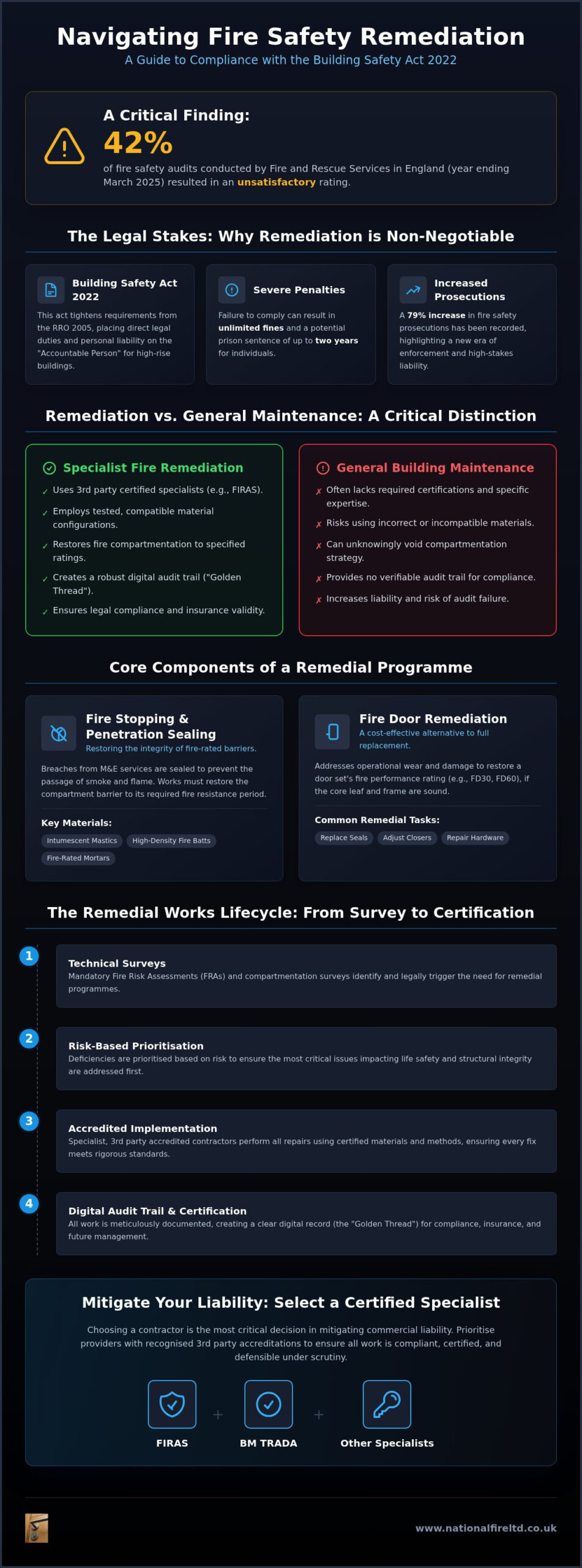
The Remedial Works Lifecycle: From Survey to Certification
Remediation shouldn’t be a reactive series of patches. It’s a disciplined lifecycle that ensures every repair is technically sound and legally defensible. By engaging professional fire compartmentation remediation services, building managers move through a logical sequence that transforms raw survey data into a certified safety status. This systematic journey is the only way to guarantee that a building’s fire strategy is restored to its intended performance level.
The process follows five distinct stages:
- Stage 1: Survey. A qualified professional conducts a comprehensive fire compartmentation survey to identify and map every technical defect.
- Stage 2: Specification. We develop a technical specification that details the exact materials and methods required, alongside a risk-based prioritisation list.
- Stage 3: Execution. Accredited passive fire protection contractors carry out the works using tested material configurations.
- Stage 4: Documentation. Every seal and repair is digitally logged with high-resolution photographic evidence of the internal and external work.
- Stage 5: Certification. A final inspection is performed to verify the works, followed by the issuance of a Certificate of Conformity.
Risk-Based Prioritisation of Defects
Not every defect carries the same weight in a safety audit. We categorise findings into immediate life safety risks, such as breaches in primary escape routes, and secondary compliance issues. This hierarchy allows property managers to manage remedial budgets effectively across large-scale commercial portfolios. It’s about allocating resources where the impact on life safety is greatest. We also plan these works to minimise operational disruption, ensuring that commercial activities continue while occupied spaces are being remediated.
Digital Evidence and the Golden Thread
The Building Safety Act 2022 demands a “Golden Thread” of information that is accessible and accurate. Digital platforms are the primary tool for achieving this. We capture “before and after” data for every penetration seal, which is vital because many fire stopping works are hidden behind walls or ceilings once the project is finished. This photographic evidence is essential for future audits and insurance renewals. Once the project concludes, these certified remedial records are integrated into the building’s O&M manual. This transparency provides the Accountable Person with a clear audit trail to verify compliance to the Building Safety Regulator.
If you need a systematic approach to restoring your building’s integrity, book a fire compartmentation survey to begin the lifecycle of professional remediation.
Choosing a Specialist Contractor for National Remediation
Selecting a contractor for remedial works is a high-stakes decision that directly impacts your legal standing. In the current regulatory environment, mere experience isn’t enough; you must verify that your partner holds valid 3rd party accreditations such as BM TRADA, IFC, or FIRAS. These certifications aren’t just badges. They represent a commitment to independent audits and technical rigor. For organisations managing national property portfolios, the requirement for national coverage and consistent quality across multiple sites is paramount. Fire compartmentation remediation services must be delivered with the same level of precision in every facility to ensure a unified safety standard.
A specialist contractor should offer more than physical labour. They must provide the technical oversight necessary to generate fire strategy drawings and updated floor plans. This dual capability ensures that the remediation isn’t just a series of repairs, but a documented restoration of the building’s original safety design. By choosing a partner who understands the intersection of construction and compliance, you secure a robust digital audit trail that stands up to scrutiny from the Building Safety Regulator.
The Risk of Generalist Contractors
General builders often lack the specific knowledge of intumescent chemistry and substrate compatibility required for high-performance fire stopping. Using uncertified labour for tasks like fire door maintenance or penetration sealing creates significant liability risks. If a repair fails during a fire event because the wrong material configuration was used, the legal consequences for the Accountable Person can be severe. National Fire Ltd maintains a pure focus on the commercial and industrial sectors, ensuring our experts are always up to date with the latest legislative frameworks. We don’t dilute our expertise with general construction; we act as dedicated guardians of passive fire protection standards.
Proactive Compliance Management
The transition from reactive remediation to proactive compliance management is a hallmark of a mature safety strategy. Rather than waiting for a failed audit, we encourage building managers to move toward scheduled fire door maintenance programmes. This long-term partnership approach allows for the early detection of defects, reducing the cost and scale of future remedial projects. Ongoing compartmentation surveys ensure that any new M&E works are immediately audited, preventing the degradation of your building’s integrity. By positioning National Fire Ltd as a steadfast advisor, you ensure your building’s fire strategy remains current, compliant, and dependable regardless of the circumstances.
Securing Your Building’s Future through Technical Excellence
Achieving total compliance in 2026 requires a shift from reactive repairs to a disciplined, technical restoration of your building’s fire strategy. By following a structured lifecycle from survey to certification, you ensure that every fire door and service penetration meets the highest standards of performance. Professional fire compartmentation remediation services provide the accredited oversight necessary to protect both life and property while maintaining the digital audit trail required by the Building Safety Regulator.
National Fire Ltd stands as a specialist guardian of your assets, offering national UK coverage for the commercial and industrial sectors. Our experts provide specialised solutions, including injectable cavity barriers and fire-rated balconies, alongside technical fire strategy drawings to ensure complete transparency. This methodical approach transforms legal liability into verified safety. We invite you to Request a Technical Remedial Works Quote from National Fire Ltd to begin restoring your property’s integrity. Taking these proactive steps today ensures a secure and compliant environment for the years ahead.
Frequently Asked Questions
What triggers the legal requirement for fire safety remedial works?
Remedial works are legally triggered when a Fire Risk Assessment (FRA) or a specialist compartmentation survey identifies breaches that compromise the building’s fire strategy. Under the Regulatory Reform (Fire Safety) Order 2005, the Responsible Person must address these deficiencies to ensure occupant safety. Failure to act on these findings can lead to enforcement notices from Fire and Rescue Services, which often mandate specific fire compartmentation remediation services to restore compliance.
How long do remedial fire stopping works typically take to complete?
The duration of remedial fire stopping works depends entirely on the volume of service penetrations and the complexity of the building’s layout. A small commercial unit might be completed within a few days, whereas a large-scale manufacturing plant or high-rise complex could require several weeks of phased work. We provide a detailed programme of works following the initial survey, allowing building managers to plan for operational continuity while we systematically restore integrity.
Can commercial buildings remain occupied during fire remedial works?
Commercial buildings can generally remain occupied while remedial works are carried out, provided a robust safety plan is in place. We specialise in phased execution, working in specific zones to minimise disruption to daily operations. In high-traffic areas, we may schedule works during out-of-hours periods to ensure safety and efficiency. Our teams maintain clean work environments and use non-invasive techniques, such as injectable cavity barriers, to reduce the impact on occupants.
What is the difference between fire door repair and full replacement?
Fire door remediation involves repairing existing door sets by replacing intumescent strips, smoke seals, or non-compliant ironmongery to restore their FD30 or FD60 rating. This is a cost-effective solution if the door leaf and frame remain structurally sound. Full replacement is only necessary when the door’s core is compromised or the frame is warped beyond technical repair. We assess each door individually to determine the most compliant and economical route for your facility.
Are fire safety remedial works mandatory under the Building Safety Act?
Yes, remedial works are mandatory for any building falling under the scope of the Building Safety Act 2022 where safety risks are identified. The Act introduces a statutory duty for the Accountable Person to manage building safety risks, including the integrity of fire compartments. Neglecting identified defects is a breach of legal duty that can result in criminal prosecution. Professional fire compartmentation remediation services are essential for maintaining the digital Golden Thread required by the regulator.
How much do fire safety remedial works cost in 2026?
Costs for remedial works are determined by the specific scope of deficiencies identified during the technical survey. Factors influencing the total investment include the number of penetrations requiring seals, the condition of fire door sets, and the accessibility of hidden cavities. Because every commercial building has a unique fire strategy, we provide bespoke quotations based on a risk-based prioritisation list. This ensures your budget is allocated effectively to address the most critical life safety risks first.
What documentation should I receive once remedial works are finished?
Upon completion, you should receive a comprehensive documentation package that includes a Certificate of Conformity for the works. This package should feature a digital audit trail with “before and after” photographic evidence of every repair. Additionally, we provide updated fire strategy drawings and floor plans that reflect the restored state of the building. These records are vital for your O&M manual and provide the necessary evidence for insurance renewals and regulatory inspections.
Do I need a new Fire Risk Assessment after completing remedial works?
It’s a professional best practice to review and update your Fire Risk Assessment (FRA) once significant remedial works are finalised. While a full new assessment may not always be mandatory, the FRA must reflect the current, remediated state of the building to remain valid. Documenting the completion of fire compartmentation remediation services within your FRA demonstrates proactive compliance management. This provides the Fire and Rescue Services with clear evidence of your fulfilled duties.