


A digital archive that sits gathering dust on a server isn’t a golden thread; it’s a liability waiting for a Building Safety Regulator audit. As the 2026 regulatory landscape matures, many duty holders still struggle to define exactly what is a golden thread of information for buildings and how it functions as a live compliance ecosystem. Under the Building Safety Act 2022, this record must bridge the gap between design intent and physical fire protection for all higher-risk buildings over 18 metres or seven storeys. Failure to maintain this single source of truth is now a criminal offence that can result in unlimited fines or custodial sentences. We recognise that coordinating fragmented data between designers and contractors often feels like an insurmountable administrative burden.
This guide provides the methodical clarity you need to move from confusion to a state of total regulatory readiness. You’ll gain a clear understanding of the mandatory digital requirements and the practical steps needed to build a robust information trail. We’ll also outline the specific technical data, from fire compartmentation surveys to strategy drawings, required to ensure your building remains a secure environment that meets every national standard. By establishing a disciplined approach to data management, you can protect both your residents and your professional standing.
Key Takeaways
- Discover the regulatory origins of the golden thread and why it is now a mandatory legal requirement for all higher-risk buildings in England.
- Gain a clear understanding of what is a golden thread of information for buildings by exploring the “Single Source of Truth” principle and digital management standards.
- Learn how to manage safety information across the entire building lifecycle, ensuring design intent is accurately reflected in final construction records.
- Identify the essential technical data required for compliance, such as fire compartmentation surveys and digitised fire door maintenance logs.
- Understand the importance of partnering with third-party accredited contractors to generate the verified data needed for Building Safety Regulator audits.
Defining the Golden Thread: A Post-Hackitt Regulatory Standard
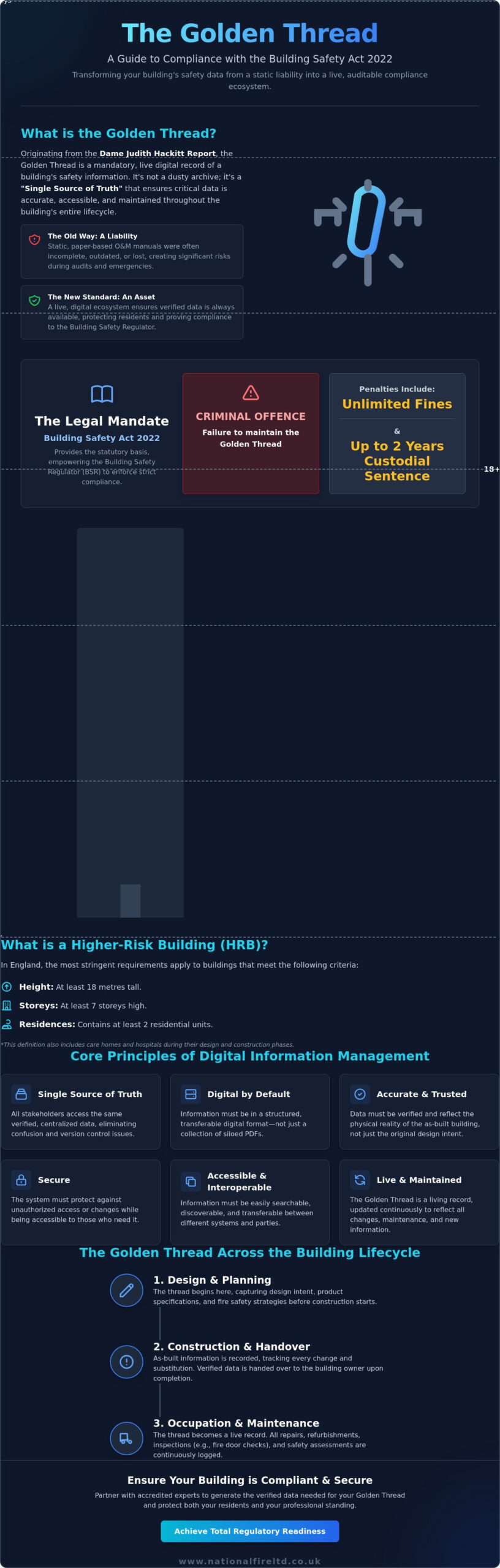
The golden thread is a fundamental shift in how we approach structural and fire safety data. It originated from the independent review of building regulations and fire safety led by Dame Judith Hackitt. Her report, “Building a Safer Future,” identified that a lack of clear, accessible information was a primary failure in the industry. This lack of transparency often led to critical safety details being lost during handovers between designers, contractors, and building owners. To address this, the government established a mandatory framework that ensures safety information is handled with the same discipline as financial records.
Legally, the golden thread is a live, digital record of a building’s safety information. It isn’t just a collection of PDFs stored on a hard drive. It’s a structured system that ensures the right people have the right information at the right time. When asking what is a golden thread of information for buildings, one must view it as a continuous loop of data that starts at design and stays active through the building’s entire occupation. We’re seeing the end of the traditional paper-based O&M manual. These static documents were often lost, outdated, or incomplete. The new standard requires digital-first management where data is searchable, secure, and transferable, creating a reliable “single source of truth.”
The Legal Framework: Building Safety Act 2022
The Building Safety Act 2022 provides the statutory basis for these requirements. It empowers the Building Safety Regulator (BSR) to oversee compliance and enforce strict standards across the industry. Under this framework, the Accountable Person (AP) or Principal Accountable Person (PAP) holds the legal responsibility for maintaining the thread. This individual must ensure that all fire safety data is accurate and available for inspection at any time. If you can’t produce a coherent, up-to-date record during an audit, the consequences are severe. Penalties for non-compliance include unlimited fines and, in cases of criminal negligence, custodial sentences of up to two years.
What Qualifies as a Higher-Risk Building (HRB)?
The most stringent requirements apply to Higher-Risk Buildings. In England, a building is classified as an HRB if it’s at least 18 metres tall or has at least seven storeys and contains at least two residential units. This definition also encompasses care homes and hospitals during their design and construction phases. While the law mandates these digital records for high-rise structures, many asset managers of smaller buildings are adopting these principles as a matter of best practice. They recognize that a structured data trail reduces long-term liability and improves the overall safety of the built environment. Establishing this thread early ensures that every fire stopping installation or fire door survey is recorded with precision, providing peace of mind for both owners and residents.
The Mandatory Principles of Digital Information Management
The transition to a digital-first environment isn’t just a suggestion; it’s a statutory mandate. Understanding what is a golden thread of information for buildings requires a focus on how data is stored, secured, and shared. According to the government’s Golden Thread Factsheet, information must be held in a digital format that’s easily transferable between parties throughout the building’s lifecycle. This creates a “Single Source of Truth,” ensuring every stakeholder, from the principal designer to the facility manager, accesses the same verified data.
Security is paramount. The system must protect against unauthorised access while remaining fully “discoverable” for those with legitimate needs. This means information isn’t just stored; it’s indexed so that a specific fire door certification or a compartmentation detail can be found in seconds. We ensure that all data reflects the physical reality of the building, providing a reliable foundation for risk assessments and safety case reports.
Live vs. Static Documentation
Traditional Operation and Maintenance (O&M) manuals often fail because they’re static. They capture a moment in time that quickly becomes obsolete as repairs and modifications occur. The golden thread demands a live record. Every time our teams perform fire door maintenance, the record must be updated with a timestamp and clear version control. This real-time approach ensures that remedial works are documented as they happen, preventing the dangerous information gaps that contributed to past tragedies. A live record acts as an active guardian of the building’s integrity.
Accessibility and Interoperability
Data must survive the software that created it. By using open data standards, building owners ensure their safety information remains accessible even if a specific software provider goes out of business or a platform is upgraded. This interoperability is critical for the Fire and Rescue Service. In an emergency, they need instant access to floor plans and fire strategy drawings to make life-saving decisions.
Simplicity is also a requirement. While the data is technical, it must be presented in a way that residents can understand. Providing clear, non-technical summaries of building safety risks and mitigation measures helps build trust and ensures compliance with the 2023 management regulations. This methodical approach to digital management doesn’t just satisfy the regulator; it creates a disciplined culture of safety that protects lives and property for the long term.
Managing the Information Thread Across the Building Lifecycle
The golden thread is not a retrospective administrative task; it’s a continuous chain of accountability that begins at the earliest design stage. For a building to remain compliant, every decision made during the design and construction phases must be recorded and passed forward. This ensures that the original design intent, particularly regarding fire safety, is never compromised by later modifications. To truly grasp what is a golden thread of information for buildings, one must view it as a living record that evolves alongside the physical structure.
According to the Golden Thread Definition and Principles, this information management must be maintained throughout the building’s lifecycle. During the design phase, we establish the fire strategy and floor plans that define how a building will protect its occupants. As construction begins, the focus shifts to capturing as-built data, ensuring that every deviation from the initial design is documented, justified, and approved. This methodical approach prevents the loss of critical safety information during the transition from construction to occupation.
Navigating the Three Gateways
The Building Safety Regulator enforces compliance through a rigorous three-gateway process. Gateway 1 occurs at the planning stage, requiring a detailed fire statement that outlines initial safety considerations. Gateway 2 acts as a “stop/go” point before construction begins; the BSR must approve the full technical design to ensure it meets all safety standards. Finally, Gateway 3 takes place at the completion stage. A building cannot be occupied until the BSR is satisfied that the as-built information is accurate and the golden thread is complete. This sequential oversight ensures that safety is designed in, not bolted on.
The Importance of As-Built Accuracy
Relying on “as-designed” drawings is a common but dangerous mistake. The golden thread demands as-built accuracy, which reflects what was actually installed on-site. This includes capturing photographic evidence of hidden fire stopping and injectable cavity barriers before they’re closed up by walls or ceilings. We verify that every installed component matches the fire strategy specifications exactly. Once the building is occupied, the responsibility transitions from the Principal Contractor to the Accountable Person. The thread remains active through ongoing passive fire protection inspections. This disciplined handover ensures those responsible for long-term management have the technical data required to maintain a secure environment.
The Critical Role of Fire Surveys and Technical Strategy Drawings
A digital framework is only as robust as the data it contains. When building managers ask what is a golden thread of information for buildings in a practical sense, the answer lies in the technical evidence produced by on-site assessments. A fire compartmentation survey serves as the foundational baseline for this record. It provides a methodical audit of the building’s physical barriers, identifying every wall, floor, and ceiling designed to inhibit the spread of smoke and flame. Without this verified baseline, the golden thread remains an empty shell, lacking the physical context required for true safety management.
Digitising fire door data is another essential component of a compliant thread. We assign unique identification codes to every door set, linking them to a digital log that tracks installation certification, maintenance history, and inspection results. This level of granularity ensures that the Accountable Person can prove the compliance of every safety asset at the touch of a button. It transforms a scattered pile of paper certificates into a searchable, live database that’s always ready for a regulator’s inspection.
Populating the Thread with Survey Data
Our experts map service penetrations and fire stopping measures directly into the digital thread. This process identifies compliance gaps that might otherwise remain hidden within the building’s structure. Using accredited surveying services is vital; it ensures the data is legally defensible and meets the rigorous standards of the Building Safety Regulator. These findings aren’t just static reports. They’re actionable data points that drive remedial priorities and ensure that the building’s passive fire protection remains intact. Accurate survey data prevents the information decay that often leads to safety failures.
Visualising Safety: Fire Strategy Drawings
Technical strategy drawings and floor plan generation provide the visual backbone of the golden thread. They translate complex fire engineering principles into clear, understandable maps of the building’s safety features. These drawings must be updated after any major refurbishment or remedial work to maintain the “single source of truth” required by law. In an active incident, accurate floor plans are indispensable for emergency services. They allow first responders to navigate the building with confidence, knowing exactly where compartmentation lines and exit routes are located. Visual clarity is just as important as data accuracy when lives are on the line.
Ensure your building’s data is accurate and compliant by scheduling a professional assessment with the experts at National Fire Ltd.
Maintaining Compliance Through Accredited Passive Fire Protection
Compliance with the Building Safety Act 2022 is not a one-time achievement; it’s a continuous commitment to accuracy and technical excellence. While the digital framework provides the structure, the quality of the data depends entirely on the competence of the contractors involved. When considering what is a golden thread of information for buildings, it’s essential to recognise that the thread is only as strong as the physical installations it records. Using third-party accredited contractors is a mandatory step for duty holders who wish to provide the Building Safety Regulator with legally defensible evidence of safety.
Accredited experts ensure that every fire stopping seal and every fire door installation is completed to a certified standard. This methodical approach provides the Accountable Person with the reassurance that the building’s passive fire protection is functional and fully documented. We provide the technical traceability required to bridge the gap between physical works and digital records, ensuring that your safety case report is built on a foundation of verified facts rather than assumptions.
The National Fire Ltd Approach to the Golden Thread
Our organization functions as a technical partner in your compliance journey. We generate high-accuracy fire strategy drawings and floor plans that serve as the visual core of your digital record. These aren’t generic diagrams; they’re precise technical documents that reflect the unique fire compartmentation requirements of your specific building. By providing comprehensive fire door surveys and fire stopping assessments that meet modern digital standards, we ensure your data is ready for immediate integration into your management systems. Every remedial action we perform is documented with full technical traceability, including photographic evidence and material specifications, to keep your golden thread alive and accurate.
Securing Your Building’s Future
A robust and transparent safety record provides a significant psychological benefit to residents and stakeholders. It demonstrates a disciplined approach to risk management and a genuine commitment to the protection of life. Beyond the immediate safety benefits, meticulous information management reduces long-term liability for building owners and managers. As regulations evolve toward 2026 and beyond, having a “single source of truth” allows you to adapt to new requirements without the need for costly, retrospective surveys. We stand ready to help you navigate these complexities with unwavering professionalism. Contact our specialists today at National Fire Ltd to begin building a compliant golden thread that protects your property and its occupants for years to come.
Securing Your Building’s Legacy Through Digital Readiness
Establishing a compliant safety record is no longer an optional administrative task; it’s a fundamental legal obligation. We have explored the transition from static manuals to a live digital ecosystem and the critical importance of the three-gateway process. Gaining a clear understanding of what is a golden thread of information for buildings allows duty holders to move beyond simple data storage and toward active, life-saving asset management. By integrating high-accuracy fire strategy drawings with verified survey data, you create a transparent safety culture that satisfies the Building Safety Regulator and protects every resident.
National Fire Ltd operates as a specialist partner in passive fire protection and complex compliance. Our team provides comprehensive fire compartmentation and fire door surveys, alongside technical floor plan generation designed for the rigorous standards of 2026. Contact National Fire Ltd for expert fire strategy drawings and surveys to secure your Golden Thread. Taking these methodical steps now ensures your building remains a secure environment, providing long-term stability and peace of mind for all stakeholders.
Frequently Asked Questions
Is the golden thread of information a legal requirement for all buildings?
No, the golden thread is currently a mandatory legal requirement only for Higher-Risk Buildings (HRBs) in England. These are defined as buildings at least 18 metres tall or with at least seven storeys that contain two or more residential units. While not compulsory for lower-rise structures, the Building Safety Regulator recommends adopting these principles as best practice to ensure robust fire and structural safety management across all assets.
Who is responsible for creating and maintaining the golden thread?
Responsibility for the thread shifts as a building moves through its lifecycle. During the design and construction phases, the Principal Designer and Principal Contractor must establish and record the necessary safety data. Once the building is occupied, the legal duty passes to the Accountable Person (AP) or Principal Accountable Person (PAP). These individuals are responsible for ensuring the information remains accurate, digital, and available for inspection.
What specific information must be included in the golden thread?
The record must contain all technical data required to manage fire and structural safety risks effectively. This includes original fire strategy drawings, as-built floor plans, and detailed records of fire stopping installations. It also encompasses maintenance logs for fire doors, results from compartmentation surveys, and any safety case reports submitted to the regulator. The aim is to provide a comprehensive, evidence-based justification for the building’s safety.
Does the golden thread have to be stored in a specific software or platform?
The government doesn’t mandate a specific brand of software, but the data must be stored in a secure, digital format. The chosen system must allow for easy information transfer between parties and remain accessible throughout the building’s life. Using open data standards is essential to ensure that your understanding of what is a golden thread of information for buildings isn’t compromised by software updates or vendor changes.
How does the golden thread differ from a standard O&M manual?
A standard O&M manual is typically a static document that’s often incomplete or outdated shortly after handover. The golden thread is a live record that requires constant updates whenever maintenance or remedial works occur. It prioritises fire and structural safety data over general building information. This disciplined approach ensures that the digital record always reflects the physical reality of the building, rather than just its original design intent.
What are the consequences of not maintaining a golden thread for a higher-risk building?
Failure to maintain a compliant golden thread is a criminal offence under the Building Safety Act 2022. The Building Safety Regulator has the authority to issue compliance notices or stop notices that can halt building work. In serious cases, the Accountable Person can face unlimited fines or imprisonment for up to two years. Neglecting your digital records is treated with the same legal severity as a physical safety failure.
Can the golden thread be shared with residents and emergency services?
Yes, the legislation requires that specific parts of the golden thread are shared with those who need them. Residents are entitled to receive a summary of safety risks and the measures taken to mitigate them. Emergency services require immediate access to technical floor plans and fire strategy drawings to assist in incident response. Providing this information ensures a transparent safety culture and assists first responders in making life-saving decisions.
How often should the golden thread of information be updated?
Updates must happen in real-time or as soon as practically possible after any change to the building’s safety features. This includes recording fire door maintenance, updates to fire stopping, or major structural refurbishments. A static annual review is insufficient to meet the regulator’s standards. Keeping the thread updated ensures that the “single source of truth” remains reliable for risk assessments and ongoing safety management.