

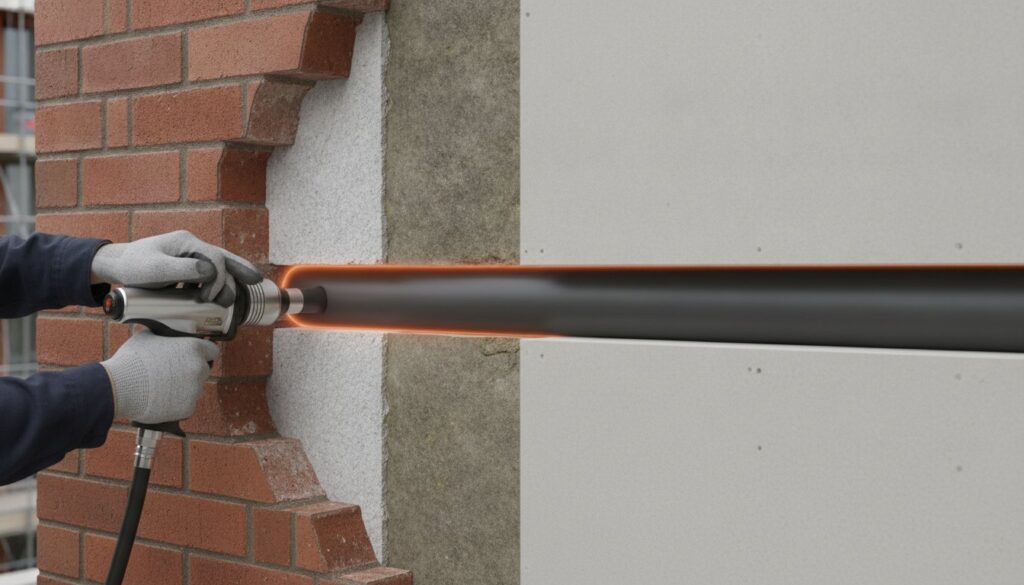
Did you know that an industry review found up to 40% of fire safety defects in new builds are linked to incorrectly installed cavity barriers? For many property managers, discovering such a defect feels like a forced choice between astronomical remedial costs or failing to meet the rigorous standards set by the Building Safety Regulator. The injectable cavity barrier installation process provides a surgical, non-destructive alternative to the traditional upheaval of removing a building’s entire facade. We understand that your priority is the protection of life and property, especially as the 2026 amendments to Approved Document B introduce stricter requirements for continuous horizontal barriers at every floor level.
This guide offers the technical clarity needed to navigate these high-stakes compliance challenges with confidence. You’ll discover how specialized intumescent materials are precisely deployed to seal hidden voids while minimizing disruption to building occupants. We’ll walk through the methodical steps required to achieve the mandatory 30 minutes of fire integrity in accordance with BS 9991:2024. By following this accredited approach, you’ll learn how to secure your building’s safety while maintaining the digital “Golden Thread” of evidence required by current legislation.
Key Takeaways
- Learn how intumescent graphite materials create a retrospective fire seal within existing voids to contain smoke and flame spread effectively.
- Understand the precise injectable cavity barrier installation process, from drilling strategic ports to installing patented reinforcing mesh for structural integrity.
- Discover why invasive borescope inspections are vital for mapping internal obstructions and ensuring the barrier’s continuity throughout the building.
- See how real-time digital logging and third-party accreditation satisfy Building Safety Regulator requirements and maintain the Golden Thread of information.
- Gain criteria for selecting specialist contractors who possess the technical credentials and experience necessary for complex remedial fire safety projects.
Understanding Injectable Cavity Barriers in Remedial Fire Safety
An injectable cavity barrier is a specialized retrospective fire stopping system designed to reinstate fire-resistant performance within existing wall voids. This technology allows for the installation of a compliant fire break without the need for extensive, destructive works. It’s a critical tool for building owners who must address safety defects identified in fire compartmentation surveys. By injecting a high-performance intumescent material directly into the cavity, we can create a continuous seal that prevents the “chimney effect,” where fire spreads rapidly through unseen spaces. Understanding the fundamentals of firestops and passive fire protection is essential for recognizing how these barriers integrate into a building’s broader safety strategy.
The injectable cavity barrier installation process is specifically engineered to meet the stringent requirements of BS EN 1366-4. This standard ensures that the remedial solution provides the necessary fire integrity and insulation to protect life and property. As the 2026 amendments to Approved Document B approach, the industry is shifting toward these surgical solutions. They offer a reliable way to achieve compliance while maintaining the structural integrity of the building’s facade.
The Science of Intumescent Graphite
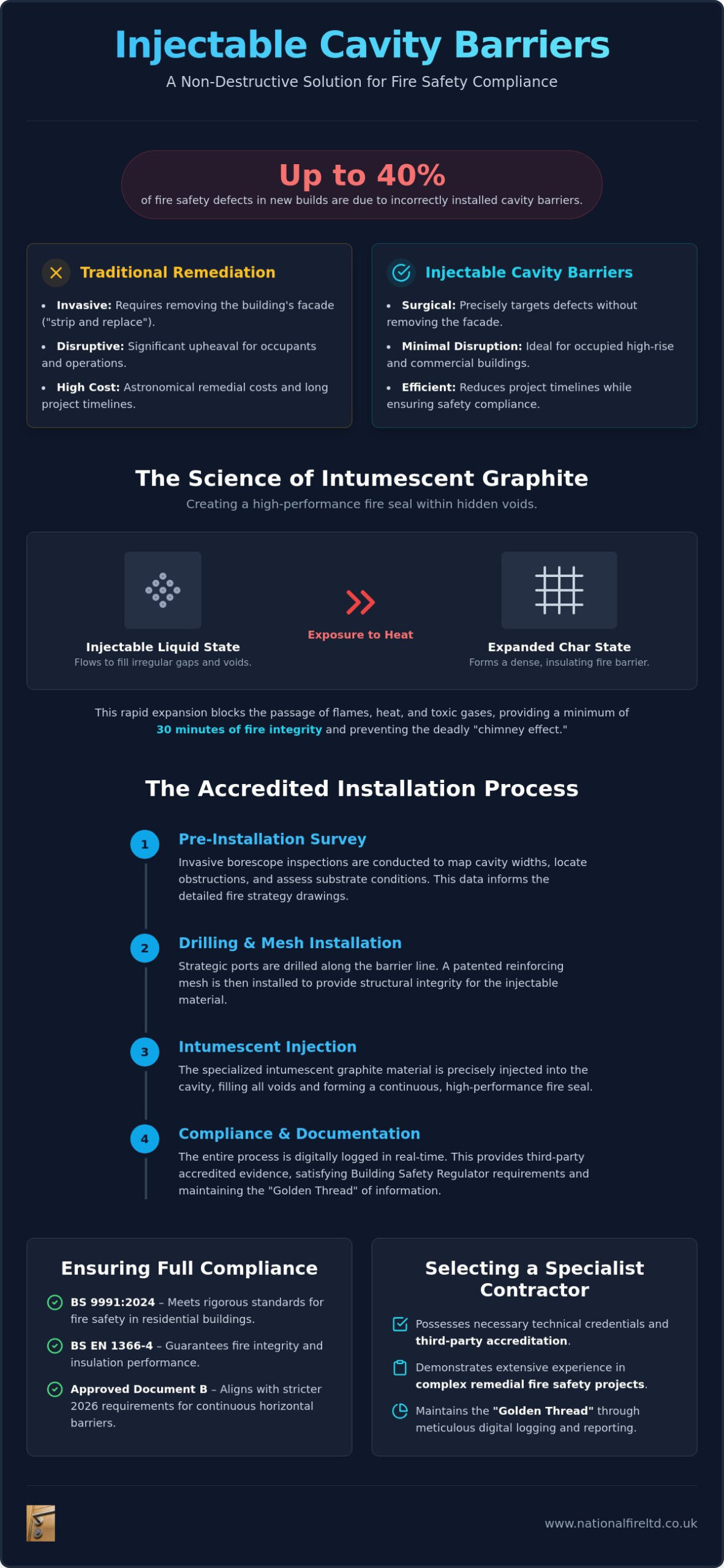
The effectiveness of this system depends on the unique properties of intumescent graphite. When this material is exposed to temperatures typically associated with a building fire, it undergoes a rapid physical transformation. It expands to many times its original volume, forming a dense, carbonaceous char. This char acts as an insulating shield, blocking the transfer of heat and preventing the passage of toxic gases and flames. Because the material is injected as a fluid before curing, it fills irregular gaps and settles around obstructions that would hinder traditional mineral wool installations. This pressure-forming capability ensures a tight, high-performance seal even in complex masonry or cladding systems. These materials are tested for long-term stability, ensuring they remain dormant but ready for the duration of a building’s functional life.
When to Choose Injection Over Traditional Remediation
Traditional fire safety remediation often involves the “strip and replace” method. This requires removing large sections of the building’s external skin to install physical barriers, which leads to high costs and significant disruption. For high-rise residential blocks or occupied commercial offices, this level of upheaval is rarely ideal. The injectable method serves as a sophisticated alternative. It is the preferred choice when surveys reveal missing or incorrectly installed barriers in cavities that are otherwise difficult to access. We recommend this approach when the goal is to reduce project timelines without compromising on safety standards. It allows for a targeted, non-destructive intervention that preserves the building’s aesthetic while bringing it into full alignment with the latest Building Safety Regulator guidelines.
The Essential Pre-Installation Survey and Site Preparation
Success in fire safety remediation depends on precise data. It’s impossible to guarantee a building’s safety without an exhaustive understanding of its hidden architecture. Before the injectable cavity barrier installation process begins, a comprehensive pre-installation survey is mandatory to identify exactly where the existing fire protection has failed. We don’t rely on original building plans, which are often inaccurate. Instead, we verify the current state of the building. This stage involves invasive inspections to map cavity widths, locate hidden obstructions, and assess the condition of the substrate. If the substrate is compromised or incompatible with the graphite sealant, the barrier’s integrity could be at risk.
During this phase, technical teams develop detailed fire strategy drawings. These documents serve as the definitive blueprint for the remedial work, ensuring every proposed barrier line aligns with the requirements of UK Building Regulations for Fire Safety. A professional fire compartmentation survey is often the critical first step in this journey, providing the evidence base needed to justify the injection strategy to stakeholders and regulators alike.
Mapping the Cavity Void
We utilize borescope cameras to peer into the voids, verifying the location of existing insulation and identifying any service penetrations that might compromise the seal. It’s vital to determine the horizontal and vertical barrier requirements based on floor slabs and party walls. Most injectable systems are tested for voids up to 200mm. If the gap exceeds this, the fire integrity may not meet the 30-minute requirement mandated by law. Identifying these discrepancies early prevents non-compliance and ensures the remedial solution is fit for purpose. Maintaining this rigorous standard throughout the injectable cavity barrier installation process ensures that no gap is left unsealed.
Establishing the “Golden Thread” Early
The Building Safety Act 2022 mandates a “Golden Thread” of information for higher-risk buildings. This digital record must start before the first injection port is drilled. We establish a digital record-keeping system to log every detail, from pre-installation photography to datum point marking. This provides the Building Safety Regulator with an immutable trail of evidence. By coordinating with regulators and maintaining high-resolution logs, we ensure that every step of the installation is transparent and fully auditable. This methodical preparation transforms a complex safety risk into a controlled, compliant asset.
Step-by-Step: The Injectable Cavity Barrier Installation Process
The injectable cavity barrier installation process begins with the precise drilling of injection ports. These access points are spaced at intervals determined by the technical survey and the manufacturer’s tested parameters. Once the ports are prepared, we insert a patented reinforcing mesh and secure it with holding pin supports. This mesh is a critical component; it provides the structural skeleton that allows the intumescent graphite to expand and hold its integrity during a fire event. Without this reinforcement, the material could slump or fail to maintain the necessary pressure against the substrate, compromising the seal. Every port location is logged digitally to ensure the installation aligns perfectly with the fire strategy drawings.
Following the preparation of the ports and mesh, the intumescent material is pumped into the cavity under strictly controlled pressure. Technicians monitor the flow rate and pressure gauges continuously to ensure the void is filled without exerting excessive force on the external cladding or internal linings. Once the material reaches the next port in the sequence, the team knows the section is fully charged. Finally, the injection ports are sealed with color-matched plugs or specialized mortar to match the existing facade finish, leaving the building’s aesthetic unchanged while its safety is significantly enhanced.
Horizontal and Vertical Barrier Placement
Achieving effective compartmentation requires perfect alignment of the barrier lines. We install horizontal barriers along floor slabs to prevent vertical fire spread between levels, effectively neutralizing the “chimney effect” in the cavity. Vertical barriers are then positioned at party wall junctions to stop lateral fire movement. Managing the transitions between these sections is a high-precision task. Our teams ensure that the horizontal and vertical lines meet seamlessly, leaving no gaps for smoke or flame to bypass the protection system. This creates a complete, continuous grid of fire resistance across the entire elevation.
“Picture Framing” Around Openings
Windows and doors are often the most vulnerable points in a building’s fire strategy. We use a specialized technique called “picture framing” to seal these areas. This involves the injectable cavity barrier installation process being applied around the entire perimeter of the window or door unit. Unlike traditional remedial methods, this doesn’t require the removal of the glazing or frames. We create a continuous seal that integrates with existing cavity closers, ensuring fire cannot bypass the opening and enter the internal living spaces or spread further into the cavity.
Working with Existing Insulation
Many modern buildings utilize PIR (Polyisocyanurate) or mineral wool insulation within their cavities. The injection system is specifically tested to work alongside these various insulation types. The graphite material is injected to fill the specific void between the insulation and the rear of the facade. This ensures that while we achieve the mandatory 30 minutes of fire integrity, we don’t compromise the building’s thermal performance or create cold bridges. It’s a balanced approach that maintains energy efficiency while meeting the rigorous safety standards of the Building Safety Regulator.
Ensuring Compliance: Testing, Documentation, and the Golden Thread
Compliance is not a final step; it’s the framework that governs the entire injectable cavity barrier installation process. In an industry where 40% of fire safety defects are linked to cavity barriers, independent verification is the only way to ensure reliability. We use third-party accredited installers to provide the technical sign-off required for regulatory approval. This isn’t just about meeting a standard; it’s about providing building owners with the absolute certainty that their property is protected. Independent accreditation ensures that the system is installed precisely as it was tested, leaving no room for error or ambiguity.
We implement real-time digital logging at every stage. Each injection point is mapped against the fire strategy drawings, and the specific material batch numbers are recorded. This creates a transparent record that proves exactly what was installed and where. Once the material has cured, we conduct post-installation verification. This includes borescope inspections to confirm the density of the seal and thermal imaging to identify any potential cold spots or gaps. If you need to verify the safety of your current building envelope, you can request a compliance audit from our technical team to ensure your documentation is up to date.
Regulatory Standards and BS EN 1366-4
The injectable cavity barrier installation process is designed to meet the rigorous criteria of BS EN 1366-4. This standard measures two critical factors: Integrity (E) and Insulation (I). Integrity refers to the system’s ability to stop the passage of flames and hot gases. Insulation refers to its ability to limit the temperature rise on the non-fire side. Most UK building regulations require a minimum of 30 minutes of integrity and 15 minutes of insulation. Our systems are tested as a complete assembly, including the reinforcing mesh and pins, ensuring the entire solution performs under fire conditions for up to 120 minutes depending on the specific project requirements.
Building the Digital Safety Case
Under the Building Safety Act 2022, the “Accountable Person” must maintain a safety case report. We provide the comprehensive evidence needed to support this. By linking installation data directly to technical floor plans and fire strategy drawings, we create a seamless digital trail. This documentation includes the Certificate of Conformity, which serves as the final proof of a compliant installation. Building managers receive an auditable record that satisfies the “Golden Thread” requirement, ensuring the safety of the building is documented for its entire lifecycle. This level of transparency is essential for maintaining long-term safety and regulatory stability.
Selecting an Accredited Contractor for Retrospective Barrier Installation
Selecting a contractor for remedial fire safety is a decision that directly impacts the long-term liability of an Accountable Person. Remedial projects are inherently more complex than new builds because they require a deep understanding of existing building failures. Specialised knowledge of cavity barriers is non-negotiable for these works. Many firms understand standard construction, but few possess the technical expertise required for the injectable cavity barrier installation process. This method requires a level of precision that only comes with specific third-party accreditation and a proven track record in the passive fire protection sector.
We recommend partnering with an organisation that provides an end-to-end service. This continuity is vital for maintaining the “Golden Thread” of information. National Fire Ltd offers an integrated approach, conducting initial fire compartmentation surveys before moving into the remedial phase. This ensures that the team installing the barriers has a comprehensive understanding of the specific defects identified during the inspection. It eliminates the risk of information loss that often occurs when a project is handed off between multiple different contractors.
The Importance of Technical Fire Strategy Drawings
A contractor’s ability to produce accurate fire strategy drawings is a primary indicator of professional competence. These drawings don’t just guide the injectable cavity barrier installation process; they serve as a permanent legal record for the building’s safety case. They ensure that every retrospective barrier aligns with the overall safety design of the structure. Accurate, high-resolution drawings also simplify future maintenance and mandatory inspections, providing building managers with a clear map of their fire protection assets.
National Coverage and Professional Reliability
Managing large-scale remedial projects across the United Kingdom requires a robust infrastructure and a commitment to technical excellence. We understand that property portfolios often span multiple regions, requiring a consistent standard of compliance regardless of location. Our approach is defined by authoritative reassurance and a deep sense of responsibility toward life safety. We act as your expert advisor, ensuring that every project is delivered with the meticulous attention to detail that the Building Safety Regulator demands. If you’re managing a building with identified cavity defects, we’re prepared to assist. Enquire about our injectable cavity barrier services today to secure your building’s future.
Securing Your Building’s Compliance and Safety
The shift toward non-destructive remedial work represents a significant advancement in building safety management. By choosing a surgical approach, you eliminate the high costs and operational disruption associated with traditional facade removal. We’ve explored how the injectable cavity barrier installation process provides a verified, compliant seal that adheres to the latest UK standards. This method doesn’t just fix a defect; it builds a permanent record of safety through the Golden Thread of information. Our experts ensure that every step, from the initial borescope inspection to the final digital log, is executed with absolute precision.
National Fire Ltd brings national coverage and deep expertise in Building Safety Act 2022 compliance to every project. We provide comprehensive Golden Thread documentation and professional, accredited installers to ensure your property meets the highest standards of life safety. Our team is dedicated to providing the authoritative reassurance you need in a complex regulatory landscape. Secure your building with our injectable cavity barrier specialists today to ensure your assets remain protected and compliant. Protecting your property and the people within it has never been more achievable.
Frequently Asked Questions
How long does the injectable cavity barrier installation process take?
Project timelines are significantly shorter than traditional remedial methods because we don’t need to remove the building’s facade. While the exact duration depends on the elevation size and cavity complexity, a typical project can be completed in a fraction of the time required for strip-and-replace works. The speed of the injectable cavity barrier installation process allows for rapid compliance without the extended lead times of major construction.
Do I need to vacate the building during the installation?
No, you don’t need to vacate the building during the works. Since the installation is performed from the exterior using scaffolding or mast climbers, internal disruption is almost non-existent. This makes the system an ideal choice for high-rise residential blocks and occupied commercial offices where relocation costs and tenant upheaval would be prohibitive.
Is the injectable system compliant with the Building Safety Act 2022?
Yes, the system is fully compliant when installed by a third-party accredited contractor. It’s specifically designed to meet the rigorous standards of the Building Safety Regulator by providing a verifiable, digital record of installation. This supports the “Golden Thread” of information, ensuring that the building’s safety case is robust and fully auditable for its entire lifecycle.
Can injectable barriers be used in all types of wall construction?
Injectable barriers are suitable for most masonry and rainscreen cladding systems. We verify compatibility during the mandatory pre-installation survey to ensure the substrate can support the intumescent material. The injectable cavity barrier installation process is tested for various cavity widths, typically up to 200mm, and works effectively alongside existing insulation types like PIR or mineral wool.
What is the lifespan of an injectable cavity fire barrier?
The intumescent materials used in these barriers are designed to last for the functional lifespan of the building. Once the graphite material has cured within the cavity, it remains stable and dormant until triggered by heat. It doesn’t require regular maintenance or replacement, provided the building envelope remains intact and isn’t modified by subsequent construction works.
How do we verify the barrier has been installed correctly inside the wall?
Verification is achieved through a meticulous combination of real-time monitoring and post-installation inspection. We use borescope cameras to visually confirm that the material has filled the void completely and formed a dense seal. Digital pressure gauges and flow meters used during the installation provide additional data points to ensure the barrier meets its tested performance criteria.
Will the injection process damage the exterior of my building?
The process is non-destructive and designed to preserve the building’s aesthetic. We only drill small injection ports at calculated intervals along the barrier line. Once the injection is finished, these ports are sealed with specialized, color-matched plugs or mortar. This ensures the facade remains visually consistent with its original appearance while its fire safety performance is significantly upgraded.
Are injectable barriers suitable for high-rise residential blocks?
High-rise residential blocks are the primary application for this technology. It provides a cost-effective way to remediate fire safety defects in buildings over 18 metres without the need for total cladding replacement. The system ensures that these higher-risk buildings achieve mandatory fire integrity ratings while minimizing the financial and logistical burden on leaseholders and building owners.