


What if your most significant fire safety expenditure wasn’t a sunk cost, but a calculated investment in your organisation’s long-term resilience? For many UK building managers, the hurdle of justifying fire safety upgrade costs to management often feels like an uphill struggle against persistent budget fatigue. It’s difficult to explain the technical necessity of passive fire protection to directors who only see the bottom line, particularly when the Fire Safety Act 2021 places such high personal liability on your shoulders.
You already know that statutory compliance is non-negotiable, yet securing the necessary funds requires more than just citing regulations. This guide transforms fire safety from a technical headache into a strategic business case that commands board-level attention. We’ll provide a clear framework to present these upgrades as ROI-positive investments, ensuring your building remains fully compliant while delivering the peace of mind that your business and its people are protected.
Key Takeaways
- Understand the transition from recommendations to statutory requirements under the Fire Safety Act 2021 to ensure your building remains fully compliant.
- Identify the hidden “Iceberg Effect” of non-compliance, including the potential for unlimited fines and the complexities of justifying fire safety upgrade costs to management.
- Discover how passive fire protection measures like fire stopping and fire doors act as strategic investments in long-term asset preservation.
- Learn to translate technical fire safety data into a compelling business case using professional surveys and strategy drawings that resonate with board-level priorities.
- Leverage the value of third-party accreditations, such as BAFE and BM TRADA, to provide the authoritative evidence required for budget approval and peace of mind.
Understanding the Regulatory Necessity of Fire Safety Upgrades
Fire safety upgrades differ fundamentally from routine maintenance. While maintenance ensures existing systems function as originally intended, an upgrade involves systematic improvements to meet current statutory requirements. This transition is critical when justifying fire safety upgrade costs to management, as it shifts the conversation from operational upkeep to legal risk mitigation. Passive fire protection, including fire doors and compartmentation, forms the bedrock of this strategy. These elements provide the structural integrity needed to contain smoke and flames, protecting both the building and its occupants.
The “Responsible Person” carries the legal weight for these decisions. Under the Regulatory Reform (Fire Safety) Order 2005, this individual is personally accountable for ensuring the building meets all safety standards. Failure to act on professional recommendations isn’t just a budgetary oversight; it’s a breach of statutory duty. We provide the technical evidence required to demonstrate that an upgrade is a necessity, not an option, ensuring that safety remains the primary focus.
The Impact of the Fire Safety Act 2021 and Building Safety Act 2022
The Fire Safety Act 2021 clarifies that the external walls and individual flat entrance doors of multi-occupied buildings fall under the Fire Safety Order. Building managers must now account for these elements in their fire risk assessments. The Building Safety Act 2022 introduced the “Golden Thread” of information. This requires a digital, live record of a building’s safety systems throughout its lifecycle. Standards have evolved significantly since 2014. Older systems often fail to meet these rigorous new criteria, making upgrades a statutory requirement to ensure peace of mind and full compliance.
Statutory Compliance vs. Discretionary Spending
Management teams often view building improvements through the lens of discretionary capital expenditure. This perspective is legally dangerous. Fire safety is a non-negotiable statutory obligation, not a capital luxury. When justifying fire safety upgrade costs to management, it’s vital to highlight the risks of “wilful negligence.” If a professional survey identifies a risk and the board chooses to ignore it, they face personal liability and potential prosecution. Under the Regulatory Reform (Fire Safety) Order 2005, commercial landlords have a legal duty of care to ensure that the premises are safe for all occupants and that adequate fire safety measures are in place to mitigate the risk of injury or loss of life.
- Upgrades ensure compliance with the latest 2022 building regulations.
- Proactive investment mitigates the risk of unlimited fines and legal action.
- Documented upgrades support the “Golden Thread” requirements for high-rise buildings.
- Modern systems offer better reliability and lower long-term repair costs.
Quantifying the Real Cost of Non-Compliance
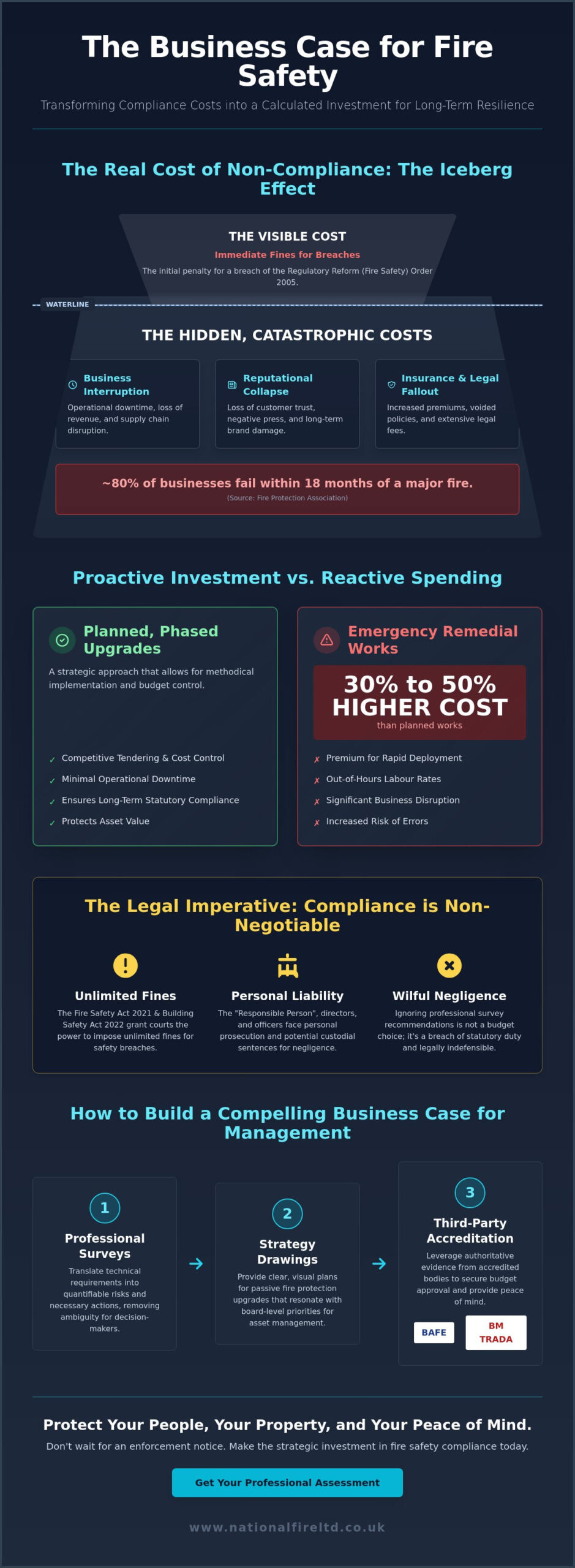
The financial impact of fire safety negligence is often compared to an iceberg. While the immediate fine for a breach of the Regulatory Reform (Fire Safety) Order 2005 is visible, the submerged costs of business interruption and reputational collapse represent the true threat to an organisation’s longevity. When justifying fire safety upgrade costs to management, it’s vital to present the full economic picture. Reactive spending is a poor substitute for strategic investment.
Emergency remedial works typically incur costs 30% to 50% higher than planned, phased upgrades. This premium is driven by the need for rapid deployment, out-of-hours labour, and the disruption of existing site operations. By contrast, a methodical approach allows for competitive tendering and minimal operational downtime. National Fire Ltd advocates for this disciplined foresight to protect both life and the balance sheet.
Legal and Financial Penalties in the UK
The UK legal framework has shifted toward more aggressive enforcement. Under the Fire Safety Act 2021 and Section 156 of the Building Safety Act 2022, courts now have the authority to impose unlimited fines for safety breaches. In 2023, several UK property management firms faced six-figure penalties for systemic failures in fire door maintenance and compartmentation. Personal liability is also a critical factor; directors and officers can face custodial sentences if negligence is proven. These statutory obligations make the cost of compliance a fixed necessity rather than a discretionary expense.
Business Continuity and Reputation Damage
The physical damage caused by fire is often secondary to the long-term commercial fallout. Industry data from the Fire Protection Association indicates that approximately 80% of businesses that suffer a major fire incident fail within 18 months. This high failure rate is usually linked to the loss of irreplaceable data, specialized equipment, and the immediate cessation of trade. A professional fire safety audit offers the clarity required to move from reactive repairs to a disciplined, planned maintenance schedule that ensures continuity.
- Compartmentation Failures: Without accredited fire stopping, a small localized fire can lead to total building loss.
- Brand Erosion: Public safety failures lead to a loss of stakeholder trust that no marketing budget can recover.
- Property Valuation: Non-compliant buildings suffer significant devaluation. Investors and insurers now require comprehensive evidence of safety before proceeding with leases or sales, particularly regarding EWS1 certifications and fire door logs.
Justifying fire safety upgrade costs to management requires shifting the focus from the initial price tag to the long-term mitigation of these catastrophic risks. A bespoke safety strategy doesn’t just satisfy the law; it secures the asset’s future value and provides essential peace of mind for all stakeholders.
The Strategic ROI of Passive Fire Protection
Passive fire protection isn’t just a compliance tick-box exercise; it’s a fundamental mechanism for asset preservation. When justifying fire safety upgrade costs to management, it’s vital to frame these expenditures as capital investments rather than sunk costs. Robust passive fire protection measures, such as high-specification fire doors and certified fire stopping, significantly extend the operational lifespan of a facility. They prevent minor incidents from escalating into catastrophic structural failures that could result in total loss. High-quality, accredited installations reduce the frequency of reactive repairs. Non-accredited fixes often fail within 12 to 24 months, leading to a cycle of expensive patch-up jobs. Professional installations provide a durable solution that lowers the total cost of ownership over a 10-year horizon.
Insurance Premium Mitigation and Insurability
The UK insurance market has tightened significantly since the 2017 Grenfell Tower tragedy. Insurers now demand granular evidence of compartmentation integrity before offering coverage. Buildings with documented gaps in fire stopping often face “uninsurable” status or see annual premiums surge by 30% to 50%. By presenting management with a portfolio of third-party accredited work, you provide the evidence needed to negotiate lower premiums. This transparency reduces the perceived risk for the underwriter, directly impacting the bottom line through reduced annual overheads. It’s a proactive strategy to maintain fiscal stability.
Asset Value and Tenant Retention
Modern commercial tenants, particularly those in the tech and legal sectors, prioritise buildings with transparent safety records. Effective fire compartmentation protects high-value server rooms and physical archives, ensuring business continuity. This level of protection increases the market value of the property and makes it a more attractive proposition for long-term leases. Additionally, investing in accredited installations now prevents the need for reactive, expensive remedial works when legislative standards inevitably evolve. It’s a method of future-proofing that simplifies justifying fire safety upgrade costs to management by demonstrating long-term responsibility.
To ensure maximum ROI, building managers should focus on three key areas:
- Accredited Installation: Ensuring all work is logged and certified to satisfy insurers.
- Durability: Selecting materials that withstand the rigours of high-traffic commercial environments.
- Comprehensive Documentation: Maintaining a digital golden thread of information for future safety audits.
By shifting the conversation from “cost” to “protection of value,” you align fire safety with the broader commercial goals of the organisation. This methodical approach demonstrates that safety and profitability aren’t mutually exclusive, but are instead deeply interdependent.
How to Build a Compelling Business Case for Management
Securing approval for fire safety investment requires moving beyond technical checklists. Management teams prioritise data, risk mitigation, and financial predictability. Successfully justifying fire safety upgrade costs to management involves presenting a disciplined strategy that aligns safety requirements with the organisation’s broader commercial objectives. We provide the technical clarity you need to transform a compliance obligation into a sound business decision.
Step 1: Evidence-Based Risk Assessment
A vague request for funding is rarely successful. You must present a prioritised remedial list backed by a professional fire door survey and detailed strategy drawings. High-resolution photographic evidence of non-compliance, such as excessive gaps or compromised intumescent seals, removes ambiguity and demonstrates the physical reality of the risk. To provide maximum clarity, categorise every identified issue into three distinct tiers:
- Immediate: Critical life safety failures that require rectification within 24 to 48 hours.
- Urgent: Statutory breaches that must be addressed in the current quarter to maintain compliance.
- Planned: Necessary lifecycle replacements that can be scheduled into the next financial year’s CapEx budget.
Step 2: Financial Modelling and Options Appraisal
Management needs to see the financial logic behind your proposal. Present a clear comparison between the cost of “Do Nothing,” “Phased Remedials,” and a “Full Upgrade.” While “doing nothing” has a £0 initial cost, it carries the risk of unlimited fines under the Regulatory Reform (Fire Safety) Order 2005 and potential business closure. Identifying “Quick Wins,” such as adjusting door closers or replacing missing signage, demonstrates immediate safety improvements while you secure larger sums for major works. Using specialist contractor quotes provides the budget certainty the board requires to approve expenditure without fear of hidden costs.
Step 3: The Executive Summary
The first paragraph of your summary must focus on liability, business continuity, and statutory compliance. Management’s primary concern is often the protection of the brand and the legal safety of the directors. You’re not just asking for a budget; you’re justifying fire safety upgrade costs to management as a method of protecting the company’s future. Provide a clear roadmap for the works that outlines how we will minimise operational disruption through out-of-hours working or phased installations. Your proposal should conclude with a direct Call to Action, stating exactly what decision is required and the deadline for approval to ensure the building remains within the law.
Secure your building’s compliance and protect your personnel by speaking with our experts. Contact National Fire Ltd today to schedule a comprehensive survey and build your business case.
Partnering with National Fire Ltd for Expert Compliance
Securing board-level approval for significant capital expenditure requires more than just a list of defects. It demands a business case built on forensic data and professional risk mitigation. National Fire Ltd provides the technical evidence required for justifying fire safety upgrade costs to management, transforming abstract safety requirements into a structured, prioritised investment plan. Our specialist surveys identify exactly where your building stands in relation to the Regulatory Reform (Fire Safety) Order 2005, providing the granular detail needed to defend budget requests.
Management teams often hesitate when faced with “hidden” costs. We remove this ambiguity through third-party accreditations, including BAFE and BM TRADA. These certifications aren’t merely badges; they’re a guarantee that our remedial works meet the highest UK statutory standards. When you present a proposal backed by an accredited partner, you’re demonstrating that the investment is a necessary step in fulfilling the building’s legal “Golden Thread” of information. This professional oversight reduces long-term liability and ensures that every pound spent contributes directly to life safety and asset protection.
From Survey to Strategy: Our Methodical Approach
We believe that clarity is the foundation of safety. Our team produces detailed fire strategy drawings that translate complex compartmentation issues into visual, easy-to-understand reports. This methodical approach is vital when addressing high-risk areas, such as the installation of cavity barriers to prevent hidden fire spread. By identifying these specific vulnerabilities during the survey phase, we prevent the “project creep” that often derails maintenance budgets.
Operating as a single-source contractor offers a distinct advantage for building managers. We handle everything from the initial intrusive survey to the final remedial installation. This continuity eliminates the friction between different trades and ensures that the original safety intent is never lost. It’s a streamlined process that makes justifying fire safety upgrade costs to management much simpler, as it provides a clear, fixed-cost pathway from non-compliance to total safety.
Delivering Peace of Mind Nationwide
Our national capability allows us to manage large-scale commercial portfolios with the same precision as a single-site project. We’ve developed a reputation for technical excellence by focusing on documented, compliant installations that stand up to the scrutiny of Fire and Rescue Service inspections. We don’t just fix problems; we provide the certification and digital records that prove the work was done correctly.
Building managers face a constant journey toward safety and compliance. National Fire Ltd acts as a steady, expert advisor throughout that process. We provide the stability and discipline required to manage fire risks in high-stakes environments. If you’re ready to move from reactive repairs to a strategic safety programme, contact National Fire Ltd today for a professional consultation on your remedial requirements. Let’s ensure your building remains a safe, compliant environment for every occupant.
Securing Your Building’s Future through Strategic Compliance
Transitioning from reactive maintenance to proactive investment is essential for meeting the stringent requirements of the Fire Safety Act 2021. By framing these upgrades as risk mitigation rather than mere expenses, you protect both lives and the long-term valuation of the asset. It’s a shift that replaces uncertainty with a structured path toward total regulatory alignment.
Successfully justifying fire safety upgrade costs to management requires a focus on the tangible ROI found in passive fire protection. Since 2018, National Fire Ltd has operated as a specialist in this field, providing the technical evidence needed to support your business case. Our status as BAFE and BM TRADA Accredited Installers ensures that every recommendation aligns with statutory standards. We provide comprehensive national UK coverage, delivering the methodical oversight required to eliminate ambiguity in your safety strategy.
Taking these steps today provides the peace of mind that your property remains fully compliant and protected against the unforeseen.
Frequently Asked Questions
Is it always necessary to replace fire doors, or can they be repaired?
Repairs are often a viable and cost-effective alternative if the structural integrity of the door leaf remains intact. Minor non-compliance issues, such as replacing damaged intumescent strips or adjusting self-closing devices, can be resolved to maintain safety standards. However, if the door core is breached or the gaps between the door and frame exceed 4mm, a full replacement is usually required to meet BS 8214 standards and ensure the safety of occupants.
Can management be held personally liable for fire safety budget cuts?
Yes, directors and senior managers can face personal prosecution under Article 37 of the Regulatory Reform (Fire Safety) Order 2005. If a fire incident occurs and it’s proven that a failure to allocate funds led to safety breaches, the “Responsible Person” can face unlimited fines or up to two years in prison. Maintaining a clear audit trail when justifying fire safety upgrade costs to management is essential to demonstrate due diligence and protect the leadership team from legal exposure.
How much should a commercial building budget for fire safety maintenance annually?
Industry benchmarks suggest budgeting between £1.50 and £3.00 per square metre annually for statutory fire safety maintenance in a standard UK office environment. This figure typically covers the routine testing of alarms, emergency lighting, and fire extinguishers. For older buildings or complex sites, we recommend adding a 20% contingency fund to address remedial works identified during annual surveys, providing the board with financial peace of mind.
What is the difference between active and passive fire protection in a budget?
Active fire protection includes systems that require a trigger to function, such as sprinklers or smoke detectors, which carry recurring costs for electronic testing and battery replacements. Passive fire protection refers to structural elements like fire-rated walls and floors that contain a fire at its source. While active systems often have lower initial costs, passive solutions are a long-term capital investment that requires less frequent maintenance over a 30-year building lifecycle.
How often should fire compartmentation surveys be conducted in the UK?
The Fire Safety (England) Regulations 2022 suggest that a comprehensive compartmentation survey should be conducted every three years for most commercial premises. However, high-rise residential buildings over 11 metres now require annual inspections of communal fire doors to remain compliant. Regular surveys are necessary because third-party contractors often breach fire walls during cable or pipe installations, which can compromise the entire building’s safety strategy.
What happens if our building fails a fire safety inspection by the local authority?
The Fire and Rescue Service can issue an Enforcement Notice, which legally mandates that you fix specific safety failures within a defined period, often 28 days. In extreme cases where life is at risk, they can issue a Prohibition Notice that closes the building immediately until the issues are resolved. These actions result in significant business interruption and are recorded on a public register, which can damage the organisation’s professional reputation.
Does a Fire Risk Assessment (FRA) cover everything needed for a budget proposal?
An FRA identifies general hazards and required actions, but it rarely provides the granular technical data or fixed costs needed for a capital expenditure request. You should supplement your FRA with specialist surveys, such as a fire door audit or a thermal imaging report, to obtain accurate quotes. This data-driven approach is vital when justifying fire safety upgrade costs to management, as it replaces vague estimates with concrete financial requirements.
How can I justify the cost of injectable cavity barriers to my finance team?
Injectable cavity barriers are a highly efficient investment because they don’t require the expensive removal of external brickwork or cladding. By choosing this accredited method, you can reduce labour costs by up to 60% compared to traditional manual barrier installation. This approach ensures the building meets modern safety standards while significantly reducing the downtime and disruption typically associated with major structural fire safety works.