


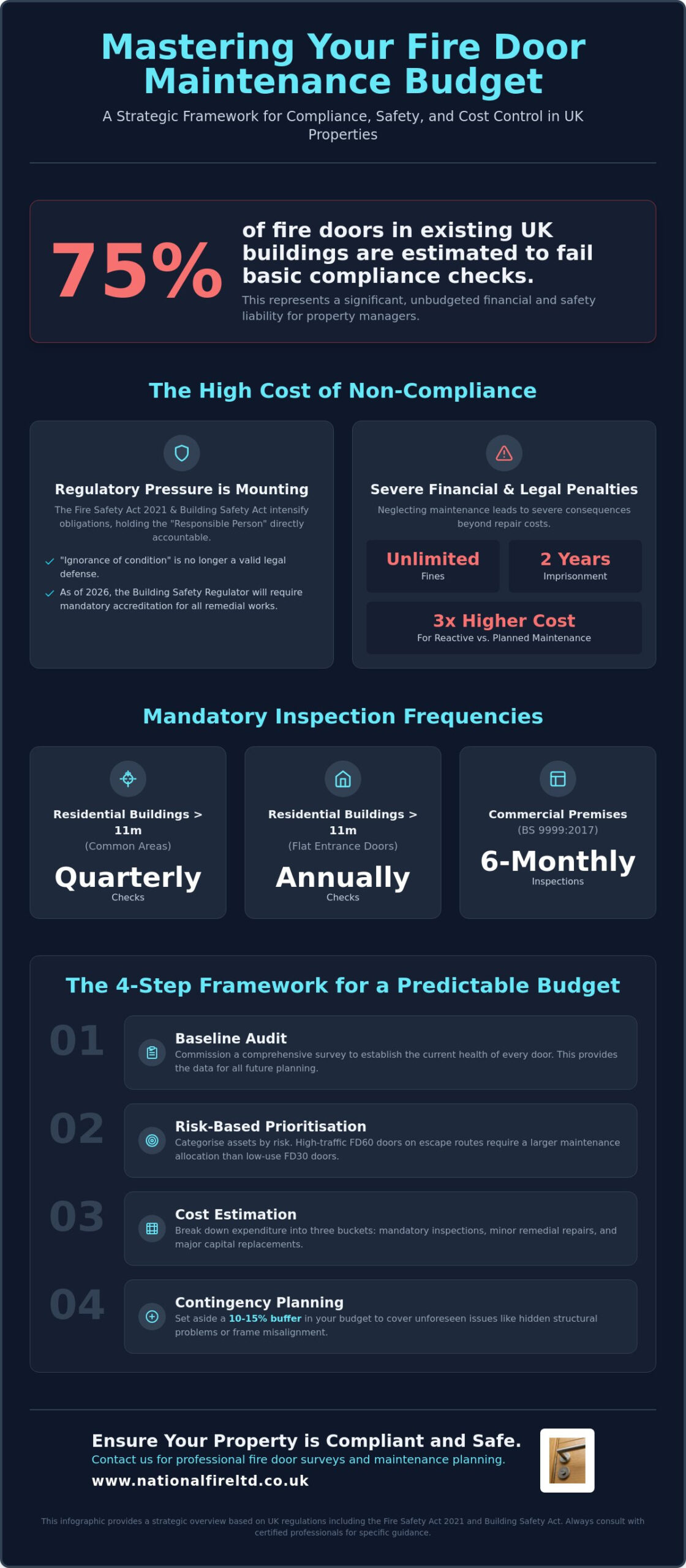
Did you know that an estimated 75% of fire doors in existing UK buildings currently fail basic compliance checks? This statistic represents more than just a safety risk; it’s a significant financial liability for property managers who haven’t mastered how to budget for fire door maintenance effectively. When a fire door survey reveals widespread failures, the resulting remedial costs often arrive as a shock, disrupting annual financial plans and creating tension between safety requirements and available capital.
We understand that meeting the requirements of the Building Safety Act and the Fire Safety Act 2021 can feel like a constant battle against shifting goalposts. You shouldn’t have to choose between fiscal responsibility and life safety. This guide provides a professional framework to help you forecast expenses with precision, allocate funds for remedial works, and manage the entire lifecycle of your assets. We’ll examine the implications of the January 2026 Building Safety Regulator independence and the transition to EN 1634-1 standards. By the end of this article, you’ll have a strategic roadmap to achieve a predictable annual maintenance budget and maintain full regulatory compliance.
Key Takeaways
- Navigate the heightened legal requirements of the Fire Safety Act 2021 and Building Safety Act to ensure your financial planning meets mandatory inspection frequencies.
- Master how to budget for fire door maintenance using a data-driven framework that prioritises assets based on fire risk and usage patterns.
- Determine the threshold of economic repair to make informed decisions between cost-effective remediation and full door replacement.
- Shift from reactive emergency repairs to a planned preventative maintenance cycle to extend asset lifespan and reduce total cost of ownership.
- Integrate door maintenance with wider fire compartmentation strategies to ensure the interface between frames and walls remains fully compliant.
The Regulatory Drivers of Fire Door Maintenance Expenditure
Building safety is no longer a matter of discretion. For property owners and managers, understanding how to budget for fire door maintenance is a fundamental requirement of the Regulatory Reform (Fire Safety) Order 2005. This legislation mandates that all fire safety equipment be maintained in efficient working order and in good repair. A fire door serves as a vital Passive fire protection system, and its failure compromises the entire building’s integrity. The introduction of the Fire Safety Act 2021 and the Building Safety Act has intensified these obligations, specifically regarding inspection frequencies and the accountability of the “Responsible Person.”
The financial risk of non-compliance is substantial. It includes not only the potential for unlimited fines but also the hidden costs of legal fees and significant hikes in insurance premiums. The “Responsible Person” must now lead the financial planning for safety, ensuring that every asset is accounted for in a transparent, audit-ready manner. This involves a methodical approach to risk management that prioritises long-term reliability over short-term savings.
The Legal Cost of Neglect
Under Regulation 10 of the Fire Safety (England) Regulations 2022, residential buildings over 11 metres require quarterly checks on fire doors in common areas and annual checks on entrance doors. For commercial premises, standards like BS 9999:2017 dictate six-monthly inspections. Failing to account for these cycles in your financial planning creates a dangerous gap. Industry data indicates that reactive maintenance, addressing failures only after they’re flagged in a survey, often leads to costs three times higher than a planned approach. This occurs because emergency call-outs and urgent parts procurement carry significant premiums. Crucially, the current legal environment means that “ignorance of condition” is no longer a valid defence. If a door fails during an incident, the financial penalties and potential two-year imprisonment for the Responsible Person are severe.
Insurance and Liability Implications
Liability concerns extend beyond the courtroom and into the insurance market. Most insurers now require documented proof of certified fire door maintenance to maintain policy validity. Without a digital audit trail, often referred to as the “Golden Thread,” insurers may refuse to pay out following a fire. This digital record must demonstrate that repairs were carried out by competent, accredited contractors. As of 2026, with the Building Safety Regulator operating as an independent body, there’s a decisive shift toward mandatory accreditation for all remedial fire protection works. Learning how to budget for fire door maintenance ensures that every component, from intumescent seals to overhead closers, is installed to the manufacturer’s original specification. By integrating these costs into a strategic budget, you protect your organisation from unbudgeted legal fees and the catastrophic impact of insurance claim denials.
A 4-Step Framework for Building a Fire Door Maintenance Budget
Establishing a reliable financial forecast for safety requires a structured, data-driven approach. You can’t rely on guesswork when life safety and legal compliance are at stake. When determining how to budget for fire door maintenance, the process must begin with an empirical baseline. We recommend a four-step framework designed to eliminate the shock of unbudgeted remedial costs and provide a clear path to total compliance.
- Step 1: Baseline Audit. Commission a comprehensive survey to establish the current health of every door in your portfolio. This identifies immediate failures and provides the data necessary for long-term planning.
- Step 2: Risk-Based Prioritisation. Categorise your assets. High-traffic FD60 doors in main escape routes require more frequent scrutiny and a larger maintenance allocation than low-use FD30 doors in secondary areas.
- Step 3: Cost Estimation. Break your expenditure into three distinct buckets: mandatory inspection fees, minor remedial repairs (such as replacing intumescent seals or overhead closers), and major capital replacements for doors beyond economic repair.
- Step 4: Contingency Planning. Always set aside a 10-15% buffer. Even the most thorough survey might not reveal hidden structural issues, such as frame misalignment within the wall cavity, until remedial works commence.
This structured approach clarifies how to budget for fire door maintenance by separating fixed inspection costs from variable remedial work. Our team of accredited professionals can help you establish a compliant maintenance schedule that aligns with your financial objectives.
Conducting the Initial Fire Door Survey
A professional fire door survey is the only legitimate starting point for any budget. A generic “handyman” check isn’t sufficient for the Building Safety Regulator’s standards. You should expect a report that provides clear pass or fail criteria for every component, from hinges to glazing. It’s vital to partner with a firm holding BM TRADA or similar third-party accreditation. This ensures the data driving your budget is technically sound and legally robust.
Forecasting Inspection Cycles
Your budget must differentiate between routine monthly visual checks and the mandatory six-monthly formal inspections required by BS 9999:2017. High-traffic areas, such as hospital corridors or school entrances, experience significantly higher wear and tear. These doors will naturally consume a larger portion of your maintenance budget than those in quiet plant rooms. Additionally, factor in the cost of technical documentation. Maintaining the “Golden Thread” requires professional floor plan generation and digital logging, which are essential for demonstrating compliance during a fire service audit.
Financial Allocation for Remedial Works vs. Full Door Replacement
A critical challenge in determining how to budget for fire door maintenance is identifying the “Threshold of Economic Repair.” This is the point where the cost of remediation no longer justifies the extension of the asset’s life. Generally, if remedial works exceed 50% of the cost of a new, certified fire door installation, replacement is the more fiscally responsible choice. Expert repairs typically cost between 20% and 25% of a full replacement, making them a highly effective way to manage limited budgets while ensuring safety.
Choosing non-certified repairs often leads to higher long-term costs. While a general contractor might offer a lower initial price, these repairs frequently fail subsequent surveys because they don’t use tested components or accredited methods. This results in “double spend,” where you pay for a repair that must eventually be removed and replaced by an accredited specialist to meet the Building Safety Regulator’s standards. A proactive, repairs-first strategy can reduce a fire door replacement budget by 30-40% when managed correctly.
Budgeting for Remedial Components
Ironmongery represents a significant portion of remedial expenditure. Fire-rated hinges and overhead closers are non-negotiable components that must match the door’s original test evidence. Intumescent seals and cold smoke strips are relatively low-cost items, yet they’re the most frequent points of failure in surveys. Neglecting these small components often leads to total door failure during an inspection. Glazing and vision panels require particular attention; remediating non-compliant glass is often expensive because the entire bead system must be replaced to maintain the fire rating.
Capital Expenditure for Full Replacements
When repairs are no longer viable, a multi-year replacement programme allows you to spread capital costs across several financial periods. This approach should be guided by your building’s fire strategy drawings to ensure you select the correct specification, whether it’s FD30, FD60, or FD120. A well-executed replacement programme ensures that the highest-risk areas are addressed first. The average lifespan of a commercial fire door is 15-20 years with professional maintenance. By understanding how to budget for fire door maintenance through this lifecycle lens, you can transition from reactive spending to a controlled, predictable capital expenditure model.
Strategic Cost Mitigation through Preventative Maintenance Cycles
Efficiency in safety expenditure is achieved through foresight, not reaction. Transitioning from a reactive “emergency” repair model to a planned preventative maintenance (PPM) framework is the most effective way to control long-term costs. When you understand how to budget for fire door maintenance as a continuous cycle rather than a series of isolated failures, you eliminate the premium prices associated with urgent call-outs and expedited parts delivery. This methodical approach addresses “Day 2” costs; those ongoing expenses that arise immediately after a building is commissioned or a new door is installed.
Strategic managers often find financial benefits in “bundling” these cycles with other passive fire protection tasks, such as fire stopping inspections or compartmentation surveys. By consolidating these services, you reduce the logistical overhead and site access fees that accumulate when contractors visit for single-issue repairs. Using historical survey data also allows you to negotiate more favourable Service Level Agreements (SLAs) with your providers, as you can present a clear, data-backed volume of work rather than an unpredictable series of tasks.
The ROI of Preventative Maintenance
The return on investment for a PPM model is mathematically clear. A minor remedial action, such as a £50 intumescent seal replacement, can prevent a full door replacement that might cost upwards of £1,500 when including labour, hardware, and certification. Beyond the direct hardware savings, planned works significantly reduce building downtime. For commercial tenants, a scheduled 30-minute hinge adjustment is far less disruptive than an emergency door replacement that closes an exit route for a full day. Disciplined ironmongery adjustment and regular lubrication extend the functional life of the door, ensuring it remains compliant for its full 15-20 year lifespan.
- Component Longevity: Regular lubrication prevents hinge wear and closer failure.
- Compliance Continuity: Small adjustments keep doors within the required 3mm gaps, avoiding survey failure.
- Budget Predictability: Fixed PPM fees replace volatile emergency repair invoices.
Data-Driven Budgeting
Modern compliance requires more than just physical repairs; it demands a digital record of every action taken. Utilising digital asset tags allows our team to track the specific repair history of every door in your facility. This level of detail identifies “problem doors” in high-traffic corridors that may require more frequent financial allocation due to accelerated wear. Digital data enables more accurate 5-year financial forecasting by highlighting trends in component wear and environmental impact. If you’re ready to move beyond reactive spending, you can request a strategic maintenance audit to establish your PPM baseline.
Integrating Fire Door Maintenance into Holistic Passive Fire Protection
A fire door is not an island of safety. It’s a critical component within a wider network of fire protection. When you determine how to budget for fire door maintenance, you must account for the integrity of the surrounding structure. A perfectly maintained door leaf is useless if fire can bypass the frame through unsealed gaps in the wall. This is why budgeting for fire door maintenance must be integrated into your broader fire compartmentation strategy. Ensuring that the interface between the door assembly and the partition is correctly fire-stopped is as vital as the door’s closing speed.
The most effective financial plans align maintenance spend with the building’s technical fire strategy drawings. These documents dictate where fire resistance is required and at what rating. If your maintenance budget doesn’t reflect these requirements, you risk overspending on low-risk areas or, more dangerously, underfunding critical escape routes. A methodical approach requires a single-source contractor who can handle surveys, drawings, and remedial works to ensure no detail is lost between different service providers.
Compartmentation and the Fire Door Interface
Budgeting for fire stopping around the door aperture ensures total system integrity. Hidden failures, such as a missing or poorly installed cavity barrier, can allow smoke and flames to circumvent a compliant fire door entirely. From a financial perspective, conducting compartmentation surveys and fire door surveys simultaneously is highly efficient. It provides a single, comprehensive view of the building’s safety status and reduces the time spent on site by multiple contractors. This holistic approach ensures that your remedial budget addresses the entire fire-rated partition, not just the moving parts. By identifying these issues during a single visit, you avoid the cost of mobilising separate teams for adjacent tasks.
Selecting a Professional Partner
The choice of a maintenance partner directly impacts your long-term financial stability. While a general contractor might offer the cheapest initial quote, they often lack the technical depth required for complex fire safety compliance. We’ve seen that the lowest bid frequently leads to the highest long-term cost because repairs often fail subsequent professional surveys. You should prioritise partners with recognised third-party accreditation, national coverage, and the technical capability to provide floor plan generation. A professional partner acts as a guardian of your property, ensuring that your financial allocation for safety produces a reliable, compliant, and audit-ready environment. This partnership provides the peace of mind that your building remains a secure environment for all occupants.
Securing Your Compliance Roadmap for 2026
Mastering how to budget for fire door maintenance is the cornerstone of a resilient building safety strategy. By transitioning from reactive emergency repairs to a disciplined, data-led preventative maintenance cycle, you ensure that your assets remain compliant for their full operational lifespan. We’ve established that effective financial planning requires a deep understanding of the interface between fire doors and broader compartmentation, supported by accurate technical strategy drawings and the “Golden Thread” of digital documentation.
Reliability in fire safety is achieved through meticulous attention to detail and a commitment to accredited standards. As specialists in technical fire strategy and compliance, we provide the expertise needed to navigate the complexities of the Building Safety Act with confidence. Our team offers comprehensive national UK coverage and the reassurance of being BM TRADA certified fire door installers.
Don’t leave your regulatory compliance to chance. Secure your building with a professional Fire Door Survey from National Fire Ltd to establish an accurate financial forecast and ensure the continued safety of your property and its occupants. We’re here to support your long-term safety objectives with unwavering professionalism and stability.
Frequently Asked Questions
How often should I budget for a professional fire door survey?
You should budget for a formal fire door survey at least every six months for commercial premises to comply with BS 9999:2017 standards. Residential buildings over 11 metres in height require quarterly checks of common area doors and annual checks of flat entrance doors under the Fire Safety (England) Regulations 2022. Aligning your financial planning with these mandatory cycles ensures you maintain the digital “Golden Thread” of information required by the Building Safety Regulator.
What is the average cost of fire door maintenance per door in the UK?
The cost of maintaining a fire door varies based on its current condition, usage frequency, and the specific components requiring attention. Factors such as the replacement of intumescent seals, smoke strips, or overhead closers are the primary drivers of remedial expenditure. When considering how to budget for fire door maintenance, it’s essential to account for both the fixed cost of professional inspections and the variable costs of accredited remedial works identified during the survey process.
Can I use my in-house maintenance team for fire door repairs?
You may use an in-house team only if they possess the necessary technical competency and recognised third-party accreditations. The Building Safety Act and Fire Safety Act 2021 place significant legal responsibility on the “Responsible Person” to ensure all works are carried out to the manufacturer’s original tested specification. Using uncertified staff for safety-critical repairs can invalidate your insurance and lead to failures during official surveys or fire service audits.
Is fire door maintenance tax-deductible for commercial properties?
Fire door maintenance is typically classified as revenue expenditure and is generally tax-deductible as a business expense for commercial properties. Repairs that restore a door to its original compliant state are usually deductible in the year they occur. However, full replacements or significant upgrades might be treated as capital expenditure. We recommend consulting with a qualified tax advisor to confirm how these safety investments apply to your specific financial structure.
How does the Building Safety Act affect my fire door budget for 2026?
The Building Safety Regulator became an independent body in January 2026, leading to more stringent oversight and a focus on accessible, up-to-date safety information. Your 2026 budget must account for the increased frequency of mandatory inspections and the requirement for detailed digital maintenance logs. Failure to demonstrate a proactive maintenance regime now carries a heightened risk of unlimited fines and potential imprisonment under the current enforcement framework.
What happens if I cannot afford all the remedial works identified in a survey?
If a survey identifies extensive remedial needs, you should adopt a risk-based prioritisation strategy. Focus your immediate financial allocation on doors in primary escape routes and high-risk areas, such as FD60 doors protecting stairwells. While all failures must eventually be addressed to achieve full compliance, categorising works allows you to manage cash flow while mitigating the most critical life-safety risks in a methodical and documented manner.
If you find that the required capital for these safety upgrades exceeds your current budget, exploring external financing can help you maintain compliance without delay; to explore your options and understand potential costs, discover I Need Cash.
Do FD30 and FD60 doors have different maintenance cost profiles?
FD60 doors generally have higher maintenance cost profiles than FD30 doors due to the increased specification of their components. The intumescent seals, glazing, and ironmongery for a 60-minute door are designed to withstand higher temperatures for longer durations, making them more costly to source and install. When determining how to budget for fire door maintenance, ensure your forecast reflects the specific fire ratings identified in your building’s technical fire strategy drawings.
How do I justify a fire door maintenance budget to a board of directors?
You can justify the maintenance budget by framing it as a critical risk-mitigation strategy rather than a simple cost centre. Highlight the legal exposure of the “Responsible Person” and the potential for unlimited fines or insurance claim denials in the event of non-compliance. Presenting a planned preventative maintenance model demonstrates professional competence and stability, showing that controlled annual spending prevents the catastrophic financial impact of emergency replacements or legal prosecutions.