

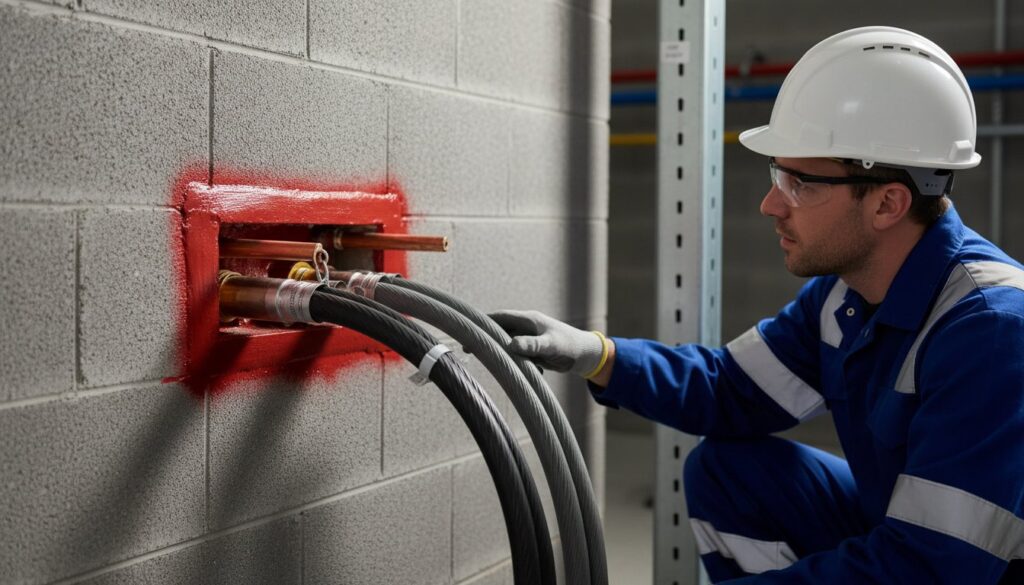
A single 2mm gap in a service penetration seal can allow enough toxic smoke to fill a standard office corridor in less than 180 seconds. While you recognise that maintaining building compartmentation is a critical statutory obligation, the vast array of fire stopping products available often leads to confusion during the specification stage. It’s common to feel a sense of unease when interpreting technical data sheets or matching intumescent wraps to specific masonry substrates. You’re responsible for the safety of every occupant; the fear of a non-compliance notice during a fire risk assessment is a burden we’re here to help you mitigate.
This guide will help you master the complexities of passive fire protection by providing the exact criteria needed to select and apply the correct seals for statutory compliance. We’ll provide a clear breakdown of product categories and demonstrate how to align your installation with Approved Document B standards. By the end of this article, you’ll have the technical knowledge to ensure your building’s integrity is intact and your legal duties are fully met, providing genuine peace of mind for your organisation.
Key Takeaways
- Understand the critical role of service penetration seals in maintaining compartmentation and ensuring your building meets all statutory fire safety requirements.
- Learn how to select the correct fire stopping products, such as intumescent sealants or fire batts, based on specific substrates and service types.
- Follow a methodical approach to professional installation, from pre-installation surveys to meticulous aperture preparation for maximum product adhesion.
- Mitigate legal liability and identify hidden safety risks by understanding the necessity of accredited fire compartmentation surveys over high-risk remedial works.
Understanding Fire Stopping Products and Passive Fire Protection
Fire stopping is the technical process of sealing apertures and joints within fire-rated walls and floors. When services such as pipes, cables, or ventilation ducts pass through these structures, they create breaches that compromise a building’s safety. National Fire Ltd utilises specialised fire stopping products to reinstate the original fire resistance of these compartments, ensuring that smoke, heat, and flames remain contained at their source. This methodical approach is a cornerstone of passive fire protection, providing the necessary time for evacuation and emergency service intervention.
Building owners must adhere to the legal requirements set out in Approved Document B of the Building Regulations and the Fire Safety Act 2021. A common error in the industry involves the use of generic fire-rated expanding foams. While these foams have limited applications, they’re rarely suitable for complex service penetrations. True fire stopping requires tested, accredited systems designed for specific substrates and service types. Using the wrong material doesn’t just fail a building inspection; it risks lives.
The Vital Importance of Compartmentation
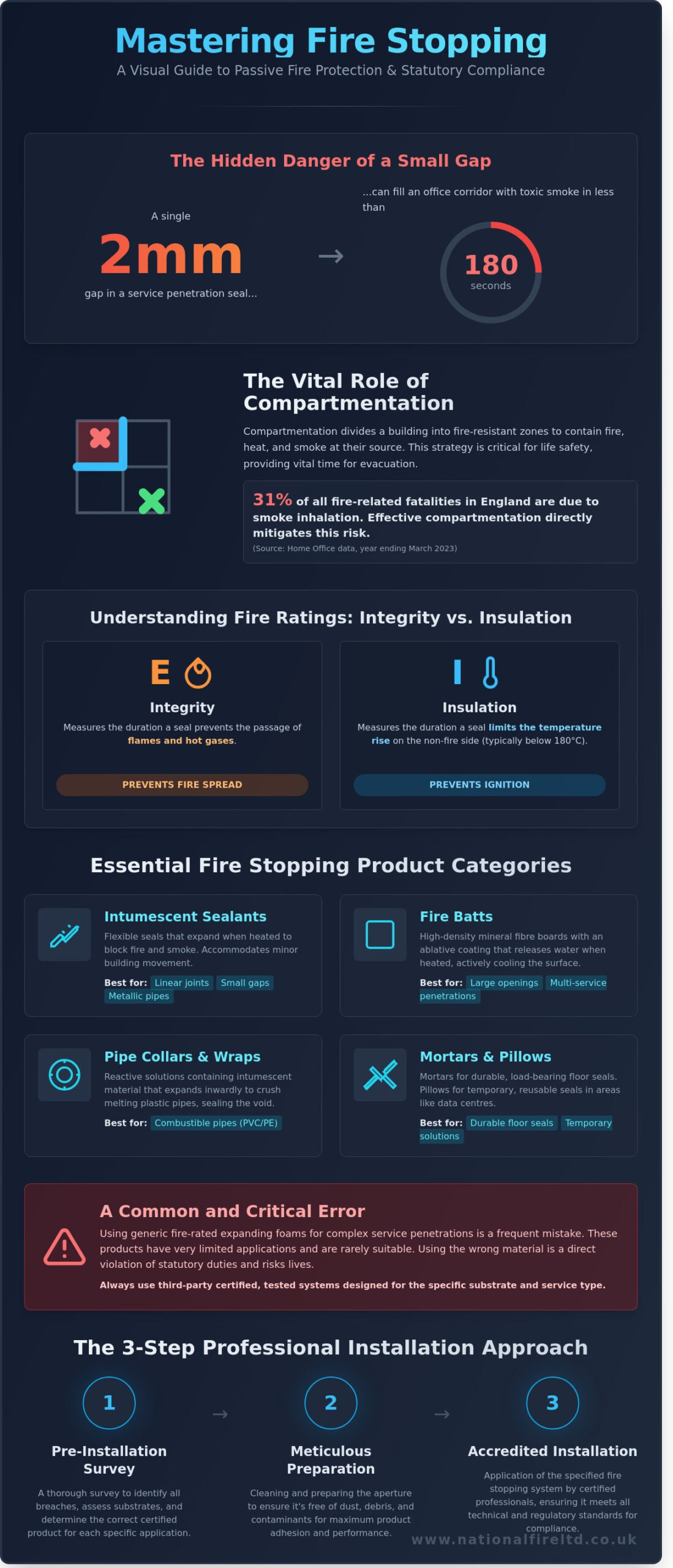
Compartmentation is the primary strategy for life safety in UK buildings. It divides a structure into manageable zones to prevent the rapid spread of fire. According to Home Office data for the year ending March 2023, smoke inhalation accounts for 31% of all fire-related fatalities in England; effective compartmentation directly mitigates this risk. By 2026, the “Golden Thread” of information mandated by the Building Safety Act 2022 requires a digital record of every product installed. This traceability ensures that every seal is documented, providing peace of mind that the building remains a safe environment for all occupants.
Regulatory Compliance and Statutory Obligations
Under the Regulatory Reform (Fire Safety) Order 2005, the designated Responsible Person holds a statutory duty to ensure all fire safety measures are fit for purpose. This includes the selection of fire stopping products that carry third-party certification from bodies like BAFE or IFC. When reviewing technical specifications, it’s vital to understand the difference between Integrity (E) and Insulation (I) ratings:
- Integrity (E): This measures the duration a seal prevents the passage of flames and hot gases.
- Insulation (I): This measures the duration a seal limits the temperature rise on the non-fire side, typically keeping it below 180°C above ambient levels to prevent spontaneous combustion of nearby materials.
National Fire Ltd ensures every installation meets these rigorous standards, providing a comprehensive solution that protects both assets and lives through disciplined, accredited workmanship.
Essential Categories of Fire Stopping Products for Service Penetrations
Selecting the correct fire stopping products is a statutory requirement under the Regulatory Reform (Fire Safety) Order 2005. Every service penetration creates a potential breach in a building’s compartmentation, making the choice of material critical for life safety. Professionals must match the product to the specific service type, substrate, and required fire rating, typically ranging from 30 to 240 minutes of integrity.
- Intumescent sealants: These are the primary choice for linear joints and small gaps around metallic pipes or cables. They provide a flexible seal that accommodates minor building movement while maintaining a robust barrier against flame and smoke.
- Fire batts: High-density mineral fibre boards, usually 140kg/m³ to 160kg/m³, serve as the foundation for sealing large multi-service openings. These are coated with an ablative sealant to enhance their thermal resistance.
- Pipe collars and wraps: Designed for combustible pipes like PVC or PE, these reactive solutions contain intumescent material that expands inwardly to crush the softening pipe and seal the void.
- Fire-rated mortars and pillows: Load-bearing mortars are used where floor penetrations require durability under foot traffic. Conversely, fire pillows provide a temporary, reusable solution for data centres where cabling is frequently updated.
Ablative Coated Batts and Sealants
Ablative systems function through an endothermic reaction. When exposed to heat, the coating releases chemically bound water, which actively cools the surface and slows the transfer of fire. In commercial plant rooms and riser cupboards, these boards provide a versatile barrier for complex cable trays. Combining batts with a perimeter of intumescent sealant creates a smoke-tight finish. This is vital, as toxic smoke inhalation causes approximately 60% of fire-related fatalities in the UK.
Intumescent Technology: How Reactive Products Work
Intumescence is a chemical process where a material expands when exposed to temperatures exceeding 150°C. Some graphite-based fire stopping products can expand up to 25 times their original volume, generating enough pressure to seal openings left by melted plastic pipes. While graphite versions handle high-pressure requirements, acrylic-based sealants offer superior adhesion for static joints. Beyond safety, these materials provide significant acoustic benefits, often achieving sound reduction ratings of up to 63dB. If you’re managing a complex refurbishment, our team can provide a bespoke fire stopping assessment to ensure every penetration meets current British Standards.
Selecting the Correct Fire Stop Based on Substrate and Service
Specifying the appropriate fire stopping products requires a methodical assessment of the installation environment. It’s not a one-size-fits-all process; the effectiveness of a seal depends entirely on its compatibility with the substrate and the service passing through it. Under the Regulatory Reform (Fire Safety) Order 2005, the responsibility for ensuring this compatibility falls on the building owner or designated responsible person. We categorise these requirements into four critical pillars:
- Substrate Material: Rigid substrates like 150mm thick masonry or concrete floors offer high stability. Conversely, flexible timber-stud or plasterboard partitions require products tested for their specific movement characteristics and lower density.
- Service Type: The physical properties of the penetration dictate the seal. Metallic pipes, plastic conduits, and electrical bundles each react differently to thermal stress.
- Required Fire Rating: Integrity and insulation ratings must match the compartment wall’s performance, typically 30, 60, or 120 minutes. These ratings are verified through BS EN 1366-3 testing.
- Environmental Conditions: High-moisture areas like plant rooms require water-resistant seals. Buildings prone to structural sway or vibration need fire stopping products with high elasticity to prevent cracking over time.
Fire Stopping for Metallic vs. Plastic Pipes
Metallic pipes, such as copper or steel, are excellent thermal conductors. During a fire, they transfer heat through the compartment wall, which can ignite materials on the protected side. To mitigate this, we use thermal insulation wraps alongside fire batt systems to maintain the “insulation” element of the fire rating. Plastic pipes present a different challenge as they melt and deform at temperatures as low as 150°C. For these services, intumescent pipe collars or wraps are essential. These devices contain graphite-based material that expands rapidly when heated, crushing the softening pipe to bridge the gap and prevent smoke spread. We also distinguish between “closed” systems, like heating pipes, and “open” systems, such as soil pipes, as the latter allows hot gases to move more freely, requiring more robust sealing solutions.
Electrical Penetrations and Cable Management
Electrical services often involve complex cable bundles or perforated trays that are difficult to seal individually. For single cables, fire-rated mastics are often sufficient to provide a 60-minute seal. However, for high-density cable management, we utilise fire-rated cable transit systems or bespoke cable baskets. These systems allow for the high-volume passage of data and power cables while maintaining a statutory fire barrier. In environments like data centres where service changes occur frequently, we recommend fire pillows. These are intumescent bags that can be easily removed and replaced, providing a flexible yet compliant solution for future-proofing. Using high-quality fire stopping products in these areas ensures that even as your infrastructure evolves, your life safety systems remain uncompromised.
A Step-by-Step Guide to Professional Fire Stopping Installation
The efficacy of fire stopping products depends entirely on the precision of their installation. Even the most advanced intumescent material will fail if a gap is left or a substrate is poorly prepared. At National Fire Ltd, we follow a rigorous, accredited process to ensure every seal meets the required fire resistance period, whether that is 30, 60, or 120 minutes. Failure to adhere to these standards can lead to catastrophic integrity loss during a thermal event.
This level of precision highlights why formal, accredited training is so critical for anyone working in construction. For those looking to gain the foundational skills needed for such safety-critical work, providers such as YTA Training offer intensive, hands-on courses.
Our methodology begins with a comprehensive pre-installation survey. In many commercial refurbishments, we find that up to 45% of existing service penetrations are either non-compliant or have been compromised by subsequent trades. We identify every breach in the fire-separating element before any work commences. This ensures the correct specification of materials for each unique service, from plastic pipes to complex cable tray bundles.
- Aperture Preparation: We remove all dust, mortar splashes, and loose debris. Contaminants prevent the chemical bond required for intumescent mastics to adhere.
- Primary Seal Fitting: Fire batts are cut to a precise friction fit. We ensure a tight seal against the substrate to prevent the passage of cold smoke.
- Secondary Sealing: All joints and service transitions are coated with fire-resistant ablative coating or intumescent mastic to provide a smoke-tight finish.
- Mechanical Fixings: Where required by the manufacturer’s test evidence, we install pigtail screws or steel brackets to maintain structural integrity under high heat.
Preparation and Surface Priming
Surface integrity is the foundation of fire safety. We conduct compatibility checks between the fire stopping products and the adjacent building materials to prevent adverse chemical reactions. For linear joint seals, our installers strictly follow the tested depth-to-width ratios. For example, a joint may require a specific 2:1 ratio to accommodate the thermal expansion of the building without the seal tearing away from the masonry. We prime porous surfaces where necessary to ensure the sealant maintains its grip for the entire lifecycle of the building.
Recording and Quality Assurance
The Building Safety Act 2022 has formalised the requirement for a “Golden Thread” of information. Every seal we install is tagged with a unique identification label. This label records the date of installation, the specific product used, and the individual installer’s credentials. We capture digital photographic evidence of every penetration before, during, and after the seal is applied. This documentation provides building owners with total transparency and forms a vital part of the statutory building safety manual. Our post-installation inspections verify that the integrity of the compartment remains uncompromised before we hand over the project.
To ensure your premises meet the latest compliance standards, you can book our professional fire stopping services for a full site audit and installation programme.
Navigating Remedial Works and Professional Fire Surveys
Attempting to install fire stopping products without specialist accreditation often results in catastrophic failure. Data from site audits suggests that 75% of DIY installations fail to meet the required fire-resistance period due to incorrect product selection or poor application. Under the Regulatory Reform (Fire Safety) Order 2005, the “Responsible Person” carries the full legal liability for these defects. Fines for non-compliance regularly exceed £200,000; in severe cases of negligence, custodial sentences are a reality. Professional intervention isn’t just a recommendation; it’s a statutory necessity for commercial safety.
Identifying Non-Compliant “Legacy” Fire Stopping
Historical buildings frequently hide dangerous “legacy” issues where previous contractors used unsuitable materials. One of the most persistent myths involves “pink foam.” While some expanding foams carry a fire rating, they’re often used in scenarios that exceed their tested scope, rendering them useless during a blaze. National Fire Ltd manages large-scale remedial projects by conducting a thorough fire compartmentation survey. We’ve identified over 1,500 non-compliant penetrations in a single 2023 project, replacing failed materials with tested, certified systems that restore the building’s integrity.
- System Mismatch: Using intumescent mastic where a fire batt is required.
- Inadequate Support: Failing to use high-temperature brackets for heavy pipework.
- The Foam Fallacy: Relying on standard gap filler instead of certified fire stopping products.
Professional Solutions for Total Peace of Mind
Engaging accredited passive fire protection contractors ensures every seal is logged, photographed, and GPS-tagged. We provide bespoke CAD drawings and floor plans that serve as a definitive record of compliance. This documentation is essential for meeting the “Golden Thread” requirements stipulated by the Building Safety Act 2022. It provides a clear audit trail for fire officers and insurers alike. Our methodical approach removes the guesswork from building safety, replacing uncertainty with verified protection.
Long-term safety relies on routine maintenance. Fire doors and service seals aren’t “fit and forget” items. They require bi-annual inspections to account for building movement or damage caused by third-party contractors. We offer comprehensive maintenance programmes that ensure your facility remains compliant 365 days a year. Don’t leave your legal obligations to chance. Secure your building today by scheduling an accredited compartmentation survey with our expert team. We provide the technical excellence required to protect both your assets and the lives within them.
Securing Your Building’s Future Through Rigorous Compliance
Ensuring the integrity of your fire compartments is a non-negotiable aspect of modern building management. The correct application of fire stopping products serves as the primary defence against the rapid spread of smoke and heat through service penetrations. Under the Building Safety Act 2022, maintaining a digital “Golden Thread” of information is a statutory requirement for buildings over 18 metres or seven storeys. National Fire Ltd specialises in delivering this level of meticulous detail across every project we undertake.
Our BAFE accredited specialists provide comprehensive nationwide coverage across all UK commercial sectors, from complex healthcare facilities to high-density industrial hubs. We focus on providing bespoke remedial works that align with the Regulatory Reform (Fire Safety) Order 2005, ensuring your property remains fully compliant and your occupants stay safe. Don’t leave your statutory obligations to chance. By partnering with a disciplined team, you gain the technical excellence required to mitigate risk effectively and maintain total peace of mind.
Book Your National Fire Compartmentation Survey Today and secure the long-term safety of your assets with a partner you can trust.
Frequently Asked Questions
What are the most common fire stopping products used in UK commercial buildings?
The most common fire stopping products used in UK commercial settings include ablative coated fire batts, intumescent mastics, fire collars, and pipe wraps. These solutions are engineered to maintain the integrity of fire-rated compartments where services pass through walls or floors. We specify products tested to BS EN 1366-3 standards to ensure they provide the necessary resistance. For instance, a 50mm fire batt often provides up to 240 minutes of fire protection in masonry structures.
Can I use standard expanding foam for fire stopping service penetrations?
You shouldn’t use standard expanding foam for fire stopping service penetrations as it lacks the necessary fire-resistant properties. Standard polyurethane foam is highly flammable and fails to prevent the spread of smoke or heat between compartments. For compliance with the Building Regulations 2010, you must use specific fire-rated gap fillers or intumescent foams. These specialised products are rigorously tested to withstand high temperatures for durations ranging from 30 to 120 minutes.
How do I know if a fire stopping product is compliant with UK regulations?
A fire stopping product is compliant if it carries a UKCA or CE mark and possesses a valid British Standard test report or European Technical Assessment. You’ll find this information on the product’s technical data sheet, which should reference BS EN 1366-3 or BS 476. We recommend using products with third-party certification from bodies like Warringtonfire or IFC. This ensures the 100% reliability required under the Regulatory Reform (Fire Safety) Order 2005.
What is the difference between an intumescent wrap and a fire collar?
An intumescent wrap is installed inside a wall or floor cavity around a pipe, whereas a fire collar is fixed externally to the surface of the substrate. Both products react to heat by expanding to crush softening plastic pipes, but their application depends on the specific site requirements. For example, a stainless steel fire collar is often preferred for 110mm PVC pipes where access to the internal void is restricted or unavailable during a retrofit.
How often should fire stopping seals be inspected for maintenance?
Fire stopping seals should be inspected at least once every 12 months to comply with the Regulatory Reform (Fire Safety) Order 2005. In high-risk environments or buildings with frequent maintenance activity, we suggest six-monthly inspections to mitigate risks from accidental damage. National Fire Ltd data shows that 25% of seals in active commercial buildings sustain some form of compromise within 2 years. Regular audits ensure your fire compartmentation remains robust and fully functional.
Does fire stopping also provide acoustic insulation between rooms?
Many fire stopping products provide significant acoustic insulation by sealing gaps that would otherwise allow sound to travel between rooms. Quality intumescent sealants and fire batts are often tested for their weighted sound reduction index, frequently achieving ratings of 50dB or higher. This dual-purpose functionality helps developers meet both Approved Document B for fire safety and Approved Document E for acoustic performance within a single, efficient installation process.
What happens if a building fails a fire compartmentation survey?
If a building fails a fire compartmentation survey, you’re legally obligated to undertake remedial works to address the identified breaches. Failure to act can lead to enforcement notices from the Fire and Rescue Service or prosecution under the Fire Safety Act 2021. We provide a comprehensive report detailing every non-compliant penetration and a bespoke plan to restore the building’s safety. Addressing these defects promptly ensures the continued protection of all occupants and maintains your statutory compliance.
Are fire stopping products required for both walls and floors?
Fire stopping products are required for any service penetration through both fire-rated walls and floors to maintain total compartmentation. Whether it’s a cable tray passing through a masonry wall or a soil pipe breaching a concrete floor slab, the seal must match the fire rating of the structure. We use specialised products for each scenario, ensuring that a 2-hour fire-rated floor maintains its full integrity for the required 120-minute duration without compromise.