

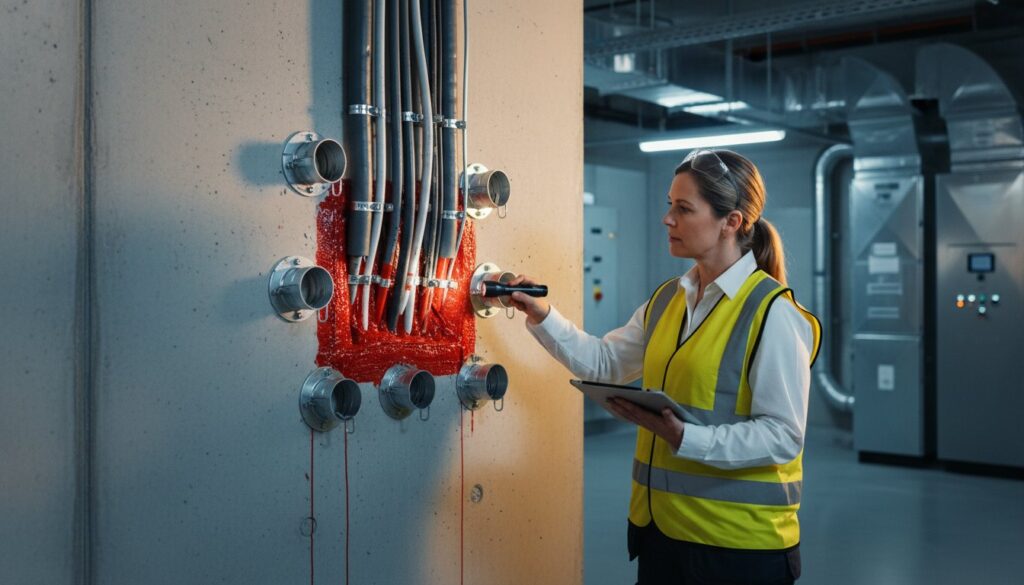
A single unsealed pipe or a mismatched sealant isn’t just a technical oversight. It’s a fundamental breach in a building’s primary defense that can nullify years of fire safety planning. As the UK completes its transition from BS 476 to the BS EN 13501 classification system in June 2026, the margin for error has vanished. Correctly implementing fire stopping for service penetrations through walls is no longer a matter of simple maintenance. It’s a high-stakes requirement for legal compliance and life safety.
It’s understandable if you feel a sense of unease during fire audits, particularly when managing legacy penetrations that don’t meet current expectations. This guide provides the technical clarity you need to master these requirements and ensure total building fire integrity. We’ll explore the latest amendments to Approved Document B, the testing rigour of BS EN 1366-3:2021, and a structured framework for selecting systems that meet the Building Regulations 2010/2026 standards.
Key Takeaways
- Navigate the regulatory transition to BS EN 13501 and understand how the latest updates to Building Regulations affect your statutory duties.
- Identify the distinct fire risks associated with combustible versus non-combustible penetrations, including the specific challenges posed by thermal conductivity in metallic services.
- Master a methodical framework for selecting fire stopping for service penetrations through walls that prioritises both integrity (E) and insulation (I) ratings across various wall substrates.
- Learn why a professional fire compartmentation survey is the indispensable first step in identifying and remediating legacy penetrations from previous contractors.
- Discover how technical fire strategy drawings provide the documented evidence required to satisfy fire audits and ensure long-term building safety.
Understanding Fire Stopping for Service Penetrations through Walls
Fire stopping is a specific requirement under the Building Regulations 2010, reinforced by the 2026 updates to ensure higher safety standards in complex buildings. It refers to the sealing of openings to prevent the passage of fire, smoke, and heat between different compartments. Effective fire stopping for service penetrations through walls ensures that the fire resistance of a compartment wall is maintained, even when breached by essential utilities. Without these measures, a fire-rated wall is merely a physical barrier rather than a life-saving safety system.
Fire compartmentation is the cornerstone of safety in commercial and industrial structures. It works by dividing a building into manageable zones designed to contain a fire at its source for a specified duration. Service penetrations, such as electrical cables, HVAC ducts, and plumbing pipes, create inherent vulnerabilities in these zones. It’s vital to distinguish between standard partitions, which are often non-load bearing and lack fire resistance, and fire-rated compartment walls. If gaps in fire-rated walls aren’t correctly sealed, they act as conduits for toxic gases, allowing a fire to bypass the structural safeguards designed to protect occupants and property.
The Legal Framework: Building Regulations and Compliance
Approved Document B provides the statutory guidance for meeting these safety requirements in England and Wales. It mandates that any opening for a service must be fire-stopped to maintain the wall’s original fire resistance rating. Compliance is now strictly measured against BS EN 1366-3:2021, which provides the rigorous testing criteria for penetration seals. Under UK safety legislation, an imperfection of fit is defined as any gap or opening remaining around a service penetration that compromises the integrity of a fire compartment wall. Meeting these standards is a legal necessity for building owners and managers during mandatory fire audits.
Why General Sealants Fail in Fire Scenarios
A common error in construction is the use of standard polyurethane expanding foam or general-purpose silicone. These materials aren’t fire-rated and will rapidly melt, ignite, or emit lethal toxic smoke when exposed to extreme heat. Understanding Firestop basics reveals that compliant systems must possess specific intumescent properties. These specialized materials expand significantly under thermal stress, creating a robust char that fills the void left by melting plastic pipes or shifting cables. Using non-compliant sealants doesn’t just risk a failed inspection; it removes the critical window of time needed for safe evacuation.
Common Types of Service Penetrations and Their Fire Risks
Identifying the specific nature of each service breach is the first step in maintaining structural fire integrity. Every utility that passes through a compartment wall presents a unique risk profile. We categorise these penetrations into two primary groups: combustible and non-combustible. While it’s a common misconception that non-combustible metallic pipes are inherently safe, they pose a significant threat through thermal conductivity. Heat can travel through the metal, reaching temperatures high enough to ignite materials on the protected side of the wall without the flame ever passing through the aperture.
Plastic services, conversely, fail through rapid melting. This creates an open “chimney” that allows smoke and toxic gases to bypass the fire-rated barrier. Managing these risks requires a methodical approach to fire stopping for service penetrations through walls, ensuring the selected system matches the specific physical properties of the service. Mixed service apertures, where pipes, cables, and ducts share a single opening, represent one of the most complex challenges in modern building safety. These scenarios require sophisticated, multi-tested systems to ensure that a sealant effective for a copper pipe does not fail when adjacent to a PVC duct or a bundle of data cables.
A failure to correctly identify these mixed openings often leads to significant non-compliance during a fire compartmentation survey, as standard single-service solutions are rarely sufficient for these combined breaches.
Combustible Pipes and the Need for Closure
Combustible pipes made from uPVC, HDPE, or ABS disappear almost instantly when exposed to fire. This leaves a significant void in the compartment wall. To counter this, we utilise fire collars or intumescent wraps. These devices contain high-pressure intumescent material that expands rapidly under heat. This expansion creates enough force to crush the softening pipe, sealing the void with a robust char. Precise installation is required, with specific attention paid to the pipe diameter and the wall thickness to ensure the closing mechanism activates correctly within the required timeframe.
Electrical and Data Cable Penetrations
Electrical and data cables introduce the risk of “wicking,” where fire spreads along the combustible plastic insulation of the cables themselves. In high-density environments like commercial server rooms, cable trays and ladders can act as conduits for fire spread. We implement fire-rated cable sleeves and transit systems to mitigate this. These solutions provide a permanent seal while allowing for the future addition or removal of cables. It is essential that these systems are installed to avoid cable overheating, as restricted airflow can lead to premature electrical failure or signal interference in sensitive data networks.

Selecting the Correct Fire Stopping Systems for Wall Penetrations
Selecting the appropriate fire stopping for service penetrations through walls requires a disciplined assessment of both the service and the substrate. A system that’s accredited for use in a solid masonry wall won’t necessarily provide the same level of protection in a flexible plasterboard partition. Testing data must specifically match the wall type to ensure the seal remains intact under the structural stresses of a fire. We always ensure that the chosen solution is supported by a primary test report that mirrors the actual site conditions.
Understanding fire performance ratings is equally critical for building safety. Integrity (E) measures the system’s ability to stop the passage of flames and hot gases. Insulation (I) measures the time it takes for the temperature on the non-fire side to rise to a level that could cause spontaneous ignition of nearby materials. For metallic pipes, which conduct heat rapidly as discussed in previous sections, achieving a high “I” rating is just as vital as the “E” rating. For smaller annular gaps and linear joints, intumescent mastics and sealants provide a versatile solution, expanding to fill minor voids and maintaining the compartment’s seal.
Fire Collars vs. Fire Wraps
The choice between fire collars and fire wraps often depends on the stage of construction and the available space. Surface-mounted fire collars are ideal for retrofitting or when a service passes through a finished wall. They’re bolted to the face of the substrate, making them easy to inspect and maintain. Conversely, fire wraps offer a more discreet finish as they’re installed within the wall cavity itself. It’s important to note that wraps require a solid construction for effective expansion, as they rely on the surrounding substrate to direct their expansive force inward to crush the pipe.
Ablative Coated Batts for Large Apertures
For large, irregular openings containing multiple service types, ablative coated batts are the industry standard. These high-density mineral wool boards are friction-fitted into the aperture and coated with an ablative sealant to prevent the passage of smoke. In scenarios requiring extended fire resistance, such as a 120-minute rating, double-layering the batts is often a mandatory requirement of the tested system. This methodical approach to sealing large breaches forms the backbone of robust passive fire protection, ensuring that complex utility clusters don’t become the weak link in your building’s safety strategy.
The Installation and Compliance Process: Ensuring Regulatory Adherence
Compliance is not achieved by chance. It’s the result of a disciplined, five-step workflow designed to eliminate risk and provide a verifiable audit trail. While the previous sections focused on the technical properties of materials, the installation process determines whether those materials will perform as intended during a fire. A methodical approach ensures that every breach is accounted for and every seal is backed by primary test data. This process transforms fire stopping for service penetrations through walls from a series of isolated repairs into a comprehensive building safety system.
- Step 1: A thorough fire compartmentation survey is conducted to identify every breach, including those hidden in ceiling voids or service risers.
- Step 2: We select a primary-tested system that specifically matches the service type and the wall substrate. This ensures the fire stopping for service penetrations through walls is legally compliant and technically sound.
- Step 3: Installation is carried out by accredited specialists. Third-party accreditation, such as FIRAS or BM TRADA, provides the necessary assurance that the work meets the high standards required by the Building Regulations.
- Step 4: Every seal is digitally recorded. This includes high-resolution photographs of the completed work, batch numbers of the materials used, and the unique ID of the installer.
- Step 5: All data is compiled into a final certification package. This information is then integrated into the building’s fire safety manual, providing a permanent record of compliance.
The Critical Role of Fire Compartmentation Surveys
Ceiling voids and floor plenums are frequently neglected areas where legacy penetrations from previous contractors often remain unsealed. A professional survey is the only reliable method to uncover these hidden risks. By documenting every breach before work begins, we provide building managers with a clear remedial strategy and a precise budget. This proactive identification prevents the “discovery of issues” during a formal fire audit, which can lead to significant delays and legal complications. If you’re unsure about the current state of your building’s defenses, it’s essential to book a fire compartmentation survey to establish a baseline of safety.
Evidence of Fire Stopping (The Golden Thread)
The “Golden Thread” of information is a legal requirement for higher-risk buildings, but it’s a best practice we apply to every project. Every fire stop must be clearly labeled with a permanent tag that corresponds to a digital floor plan. This level of transparency allows inspectors and fire risk assessors to verify the integrity of the compartmentation without invasive testing. Relying on uncertified “handyman” services for these life-critical installations is a significant risk. Without the documented evidence of a primary-tested system, a building’s fire integrity remains unproven, leaving owners personally liable for any safety failures.
Professional Fire Stopping Services: Maintaining Building Integrity with National Fire Ltd
National Fire Ltd operates as a guardian of life and property, providing authoritative reassurance in an industry where the stakes couldn’t be higher. We transform complex technical requirements into manageable, compliant systems that stand up to the most rigorous fire audits. Our expertise in fire stopping for service penetrations through walls is built on a foundation of technical excellence and a deep commitment to national safety standards. We don’t just seal breaches; we restore the structural integrity of your building’s fire compartments through a methodical, evidence-based approach.
We bridge the gap between physical installation and regulatory documentation through the generation of technical fire strategy drawings and precise floor plans. This digital integration ensures that every penetration is mapped and accounted for, fulfilling the “Golden Thread” requirement for modern building management. By providing this level of transparency, we offer a significant psychological benefit. Building owners and facility managers can operate with the confidence that their fire safety measures are documented, accredited, and fully compliant with the 2026 standards. This meticulous attention to detail prevents the confusion often associated with managing legacy penetrations left by previous contractors.
Our team provides specialised solutions for complex commercial and industrial environments, where high-density service clusters are common. We understand that a server room or an industrial plant requires a different technical approach than a standard office block. By selecting primary-tested systems that match these specific high-risk profiles, we ensure that your fire stopping measures are as robust as the walls they protect. This disciplined focus on reliability is what defines our role as a trusted expert advisor to property managers across the UK.
Why National Fire Ltd is the Strategic Choice
National Fire Ltd is a strategic partner for commercial property managers who prioritise standards over shortcuts. Our methodical installation process is always preceded by a thorough assessment, ensuring that our surveys integrate seamlessly with technical drawings for a complete safety overview. We provide national UK coverage, allowing us to manage large-scale commercial property portfolios with consistent quality and oversight. Our commitment to using only third-party accredited methods ensures that every project we undertake is a benchmark for compliance and safety.
Next Steps for Building Compliance
Achieving total building integrity requires a proactive approach to risk mitigation. A fire compartmentation survey is the essential first step in identifying existing vulnerabilities and planning a clear remedial strategy. Beyond initial remediation, we advocate for long-term maintenance partnerships that encompass both fire stopping and fire door integrity. This ensures that your building’s defences remain effective despite future service changes or building alterations. Secure your building’s integrity with our professional fire stopping services to ensure your facility meets every legal and safety benchmark for 2026 and beyond.
Securing Your Building’s Future Compliance
The safety of a building is determined by the weakest point in its compartmentation. Mastering fire stopping for service penetrations through walls requires moving beyond simple product selection toward a disciplined, system-led methodology. By prioritising accredited surveys and the digital recording of every seal, you ensure that your facility doesn’t just meet the 2026 standards but maintains them for the long term. This methodical approach is the only way to guarantee that your building’s fire integrity remains uncompromised.
National Fire Ltd provides the authoritative reassurance needed to manage complex commercial and industrial property portfolios across the UK. We act as your expert advisor, delivering detailed technical fire strategy drawings and professional installations that satisfy the most rigorous fire audits. Our status as accredited specialist contractors ensures that every remedial action we take is backed by the necessary quality management credentials and national coverage you require.
Ensure your building is compliant; book a professional fire compartmentation survey today.
Taking these steps today creates a secure environment for your occupants and provides the peace of mind that comes from total building integrity. We stand ready to support your compliance journey with the discipline and expertise your property deserves.
Frequently Asked Questions
What is the standard fire rating required for service penetrations in commercial walls?
The fire rating for any penetration seal must match or exceed the fire resistance of the compartment wall it breaches. If a wall is designed to provide 60 minutes of protection, the penetration seal must also provide 60 minutes of Integrity (E) and, in most cases, 60 minutes of Insulation (I). This ensures the utility breach doesn’t become the point of failure for the entire compartment.
Can I use fire-rated expanding foam for all service penetrations?
No, expanding foam isn’t a universal solution and is often unsuitable for larger apertures or combustible pipes. It’s typically restricted to very small linear gaps or specific substrate combinations defined by the manufacturer’s testing. For most fire stopping for service penetrations through walls, you’ll need primary-tested systems like ablative batts, collars, or wraps that provide the necessary intumescent pressure.
How often should fire stopping for service penetrations be inspected?
Inspections should occur at least annually as part of your building’s Fire Risk Assessment. It’s also vital to conduct an inspection immediately following any mechanical, electrical, or plumbing (M&E) works. This ensures that new service installations haven’t compromised existing compartmentation or left new penetrations unsealed, which is a common cause of non-compliance during fire audits.
What is the difference between a fire collar and a fire wrap?
The primary difference lies in the installation method and the available space. Fire collars are mechanical devices fixed to the surface of the wall, making them ideal for retrofitting. Fire wraps are flexible strips tucked into the wall thickness around the pipe. While both contain intumescent material, wraps require a solid construction to provide the resistance needed for the material to expand inward and crush the pipe.
Do I need to fire stop cables that are already inside a plastic conduit?
Yes, cables inside a plastic conduit require a compliant fire stop. The plastic conduit is a combustible material that’ll melt or be consumed during a fire, leaving a significant gap in the compartment wall. The fire stopping system must be tested to seal both the conduit and the internal cables to prevent the passage of smoke and flames through the remaining void.
Who is legally responsible for ensuring fire stopping is compliant in a commercial building?
Legal responsibility rests with the “Responsible Person” as defined by the Regulatory Reform (Fire Safety) Order 2005. This is typically the building owner, employer, or facilities manager. They’re held accountable for ensuring that all passive fire protection measures, including fire stopping for service penetrations through walls, are installed correctly and maintained to a compliant standard throughout the building’s life.
Can I install fire stopping myself or do I need a certified contractor?
You should always use a third-party accredited contractor to ensure technical and legal compliance. While the law focuses on the competency of the installer, using a certified specialist from an organisation like FIRAS or BM TRADA provides the documented evidence of that competency. This audit trail is essential for satisfying insurers and fire authorities during a mandatory safety inspection.
What happens if a fire stopping seal is breached during new M&E works?
Any breach made during new works must be immediately reinstated using a system that matches the original tested specification for that specific wall and service. Simply filling a hole with uncertified material doesn’t meet the Building Regulations. You must ensure the new seal is recorded, photographed, and added to the building’s fire safety manual to maintain the “Golden Thread” of information.