


A fire seal is only as reliable as the technical strategy that preceded its installation. For many commercial property managers, the search for fire stopping contractors manchester often begins after a failed audit, but true safety starts long before a single gap is filled. It’s a high-stakes environment where a single undocumented service penetration can lead to significant legal liability under the Building Safety Act 2022. You shouldn’t have to guess whether your passive fire protection measures will hold up during a fire or a rigorous safety inspection.
You understand that meeting the latest BS EN 13501 standards isn’t just about ticking boxes; it’s about the fundamental protection of life and assets. This article demonstrates how professional fire stopping and technical surveying provide the rigorous documentation required for total regulatory compliance and peace of mind. We’ll examine the importance of fire strategy drawings, the impact of Regulation 38 on handover responsibilities, and how a methodical approach to compartmentation ensures your building remains a secure environment. By focusing on the “golden thread” of information, you can transition from reactive repairs to a proactive, fully documented safety partnership.
Key Takeaways
- Understand the 2026 transition to BS EN 13501 standards and how these updated classifications impact your building’s legal compliance and safety documentation.
- Learn why a forensic fire compartmentation survey is a mandatory prerequisite for identifying hidden breaches and ensuring the integrity of fire-rated walls.
- Discover how professional fire stopping contractors manchester provide the technical strategy drawings necessary to maintain a building’s “golden thread” of information.
- Explore specialized passive fire protection solutions, including injectable cavity barriers and fire-rated balconies, designed for complex commercial and industrial facades.
- Identify the critical technical credentials and quality management standards required to select a competent partner for long-term fire safety maintenance.
The Critical Role of Fire Stopping Contractors in Manchester and the UK
Fire stopping is the fundamental practice of sealing service penetrations to maintain the integrity of a building’s compartmentation. While it’s often hidden behind walls and above ceilings, it acts as the building’s silent guardian. Unlike active systems, passive fire protection requires no power or external trigger; it’s a permanent structural safeguard. For commercial, industrial, and high-rise residential assets, understanding what fire stopping is becomes a matter of life safety and asset protection.
Leading fire stopping contractors manchester provide more than just remedial work. They deliver engineered solutions tailored to the specific fire-rating of a structure. There’s a significant difference between simply filling a gap with generic sealant and installing a tested, accredited fire stop. Professional contractors ensure that every pipe, cable, or duct passing through a fire-rated wall is sealed using methods that match the original fire-resistance period of the partition.
Why National Expertise Matters for Local Compliance
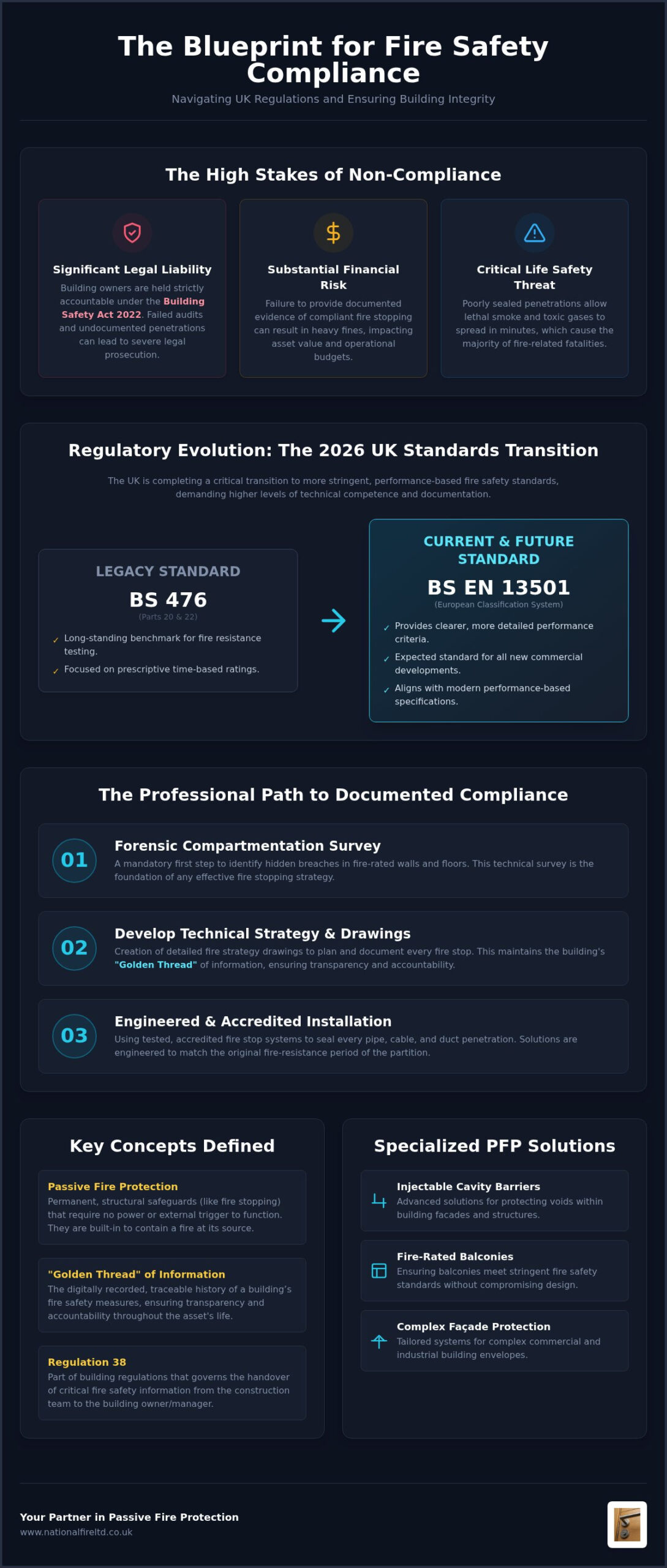
Local projects must adhere to a national framework of safety. As the UK completes its transition from BS 476 to the BS EN 13501 classification system in 2026, the technical requirements for materials have become more stringent. Engaging experienced fire stopping contractors manchester ensures that your local facility meets these rigorous national standards without compromise. A contractor with national reach brings a high level of oversight and a methodical approach to these shifting standards. They don’t just “fix holes.” They ensure that every installation is part of a broader compliance strategy. This level of discipline is essential for managing the complex service penetrations found in modern commercial buildings.
The Consequences of Non-Compliant Fire Stopping
The legal and financial risks of non-compliance are substantial. Under the Building Safety Act 2022, building owners and managers are held strictly accountable for the safety of their structures. Failing to provide documented evidence of compliant fire stopping can result in heavy fines or legal prosecution.
Beyond the legalities, the physical risk is the primary concern. Most fire-related fatalities are caused by the inhalation of smoke and toxic gases rather than direct heat. Poorly sealed penetrations allow these lethal elements to bypass fire walls and spread through a building in minutes. In 2026, the “Golden Thread” of information is defined as the digitally recorded, traceable history of a building’s fire safety measures that ensures transparency and accountability for the life of the asset.
Regulatory Framework: UK Standards and Compliance for 2026
Building Regulations Part B remains the cornerstone of fire safety in the United Kingdom. It mandates that buildings must be designed and constructed to inhibit the spread of fire within the structure. The Regulatory Framework: UK Standards and Compliance for 2026 places even greater emphasis on the accountability of the “Responsible Person.” This individual must ensure that all passive measures, particularly fire stopping, are installed to a standard that meets the latest legislative requirements. Failure to do so isn’t just a safety risk; it’s a significant legal liability.
In 2026, the industry is completing a critical transition from the older BS 476 standards to the European BS EN 13501 classification system. This change provides clearer, more detailed criteria for how materials perform under fire conditions. Competent fire stopping contractors manchester must understand these nuances to ensure every installation remains legally compliant. While BS 476 Parts 20 and 22 have long been the benchmarks for fire resistance testing, the shift toward performance-based specifications under BS EN 13501 is now the expected standard for new commercial developments.
Accreditation and Technical Competence
Third-party accreditation from bodies like IFC or BM TRADA is a non-negotiable requirement for modern contractors. These credentials verify that a company’s management systems and site performance are subject to regular, independent audits. In the field, technical proficiency is demonstrated through NVQ Level 2 and Level 3 qualified operatives. These specialists possess the specific skills required to manage complex service penetrations that general builders often overlook. For a deeper look into these technical requirements, you can consult our passive fire protection guide. Engaging accredited fire stopping contractors manchester ensures that your safety measures are installed by verified experts.
Documentation and the Golden Thread
The Building Safety Act 2022 introduced the “golden thread” of information, which requires a digital record of a building’s safety features throughout its entire lifecycle. Paper-based logs are no longer sufficient for modern safety cases. We’ve moved toward high-detail digital recording where every seal is logged with photographic evidence, geo-tagging, and precise location data. This process feeds directly into technical fire strategy drawings, providing building managers with a transparent, searchable history of their fire protection measures.
Updates to Regulation 38 in 2026 now place a greater responsibility on contractors to provide this detailed documentation at the point of handover. National Fire Ltd ensures that every penetration is documented to these exacting standards, facilitating seamless fire safety audits. If you’re concerned about your current level of documentation, you can contact our technical team for a professional review of your building’s compliance status.
Technical Surveying: The Foundation of Fire Compartmentation
A fire compartmentation survey represents a forensic analysis of a building’s structural fire walls and floors. It’s not a superficial inspection but a detailed investigation into the integrity of every barrier designed to contain fire and smoke. Qualified fire stopping contractors manchester recognize that remedial work without a preliminary survey is an incomplete solution. Without a comprehensive map of existing breaches, any subsequent sealing remains reactive rather than strategic.
The survey serves as the critical first step in the building safety lifecycle. It identifies the exact location, size, and type of every service penetration, from large HVAC ducts to individual data cables. By establishing this baseline, building managers can ensure that the correct, tested materials are specified for every unique opening. The Association for Specialist Fire Protection (ASFP) emphasizes the importance of technical competency when Selecting a Partner for Passive Fire Protection, as the quality of the initial survey dictates the effectiveness of the entire safety system.
Identifying Hidden Risks in Service Penetrations
Most critical breaches are located in areas that are difficult to access, such as ceiling voids, riser cupboards, and plant rooms. Common issues found during these surveys include incorrectly sealed HVAC runs, bundled electrical cables that exceed the tested capacity of the fire stop, and “legacy” breaches left behind during previous building renovations. These legacy openings are particularly dangerous because they’re often undocumented and forgotten. Our fire compartmentation guide provides a detailed breakdown of how these hidden risks are identified and categorized to ensure no breach is overlooked during the remediation phase.
Generating Accurate Fire Strategy Drawings
Strategy drawings provide a permanent roadmap for long-term building maintenance. National Fire Ltd utilizes floor plan generation to create high-precision technical documentation that marks every fire-rated partition and every documented seal. These digital drawings are vital for future-proofing a building against evolving regulations. They provide emergency services with immediate clarity on a building’s compartmentation and serve as an essential asset during insurance audits or safety case reviews.
A technical fire contractor doesn’t just provide a list of defects; they provide a structured data set. This methodology ensures that when new services are installed in the future, the “golden thread” of information remains intact. By maintaining a digital floor plan, building owners can track the lifecycle of every fire stop, ensuring that maintenance is proactive and that the building’s defensive layers are never compromised by undocumented changes. This disciplined approach to documentation is what distinguishes professional fire stopping contractors manchester from general maintenance providers.
Specialised Solutions: Beyond Standard Fire Stopping
While standard sealants and batts form the basis of many safety installations, modern commercial architecture often demands more sophisticated engineering. High-performance structures require a holistic approach that extends to the building’s exterior envelope and internal access points. Professional fire stopping contractors manchester must look beyond simple penetrations to secure the entire fire-resistance strategy of the asset. This includes managing the risks associated with external facades and the critical interface between fire walls and door sets.
The transition to more complex building designs has necessitated the development of niche solutions that address specific architectural challenges. These advanced measures ensure that compartmentation remains intact even in the most demanding environments. By utilizing specialized materials and installation techniques, we provide a level of protection that exceeds the capabilities of general maintenance providers.
Injectable Cavity Barriers and Facade Safety
Traditional cavity barriers are often impossible to install in existing buildings without significant structural disruption. Injectable cavity barriers provide a high-tech solution to this challenge. This technology allows for the creation of a fire-rated seal within inaccessible voids by injecting specialized materials through small, discreet access points. It’s a game-changer for remedial works in occupied commercial buildings, as it ensures compliance without requiring the removal of expensive cladding or internal finishes.
National Fire Ltd possesses deep expertise in this niche technical area. We understand that restoring compartmentation in a facade is essential for meeting the updated requirements for external wall safety in multi-occupancy buildings. This methodical approach to inaccessible cavities ensures that the building’s silent guardian remains effective across every square meter of the structure.
Fire Door Integrity and Maintenance
A fire wall is only as effective as the openings within it. Even the most meticulously installed fire stopping will fail to protect life if the adjacent fire door is non-compliant or poorly maintained. The link between wall stopping and door frame sealing is critical. If the gap between the wall and the door set isn’t correctly fire-stopped using tested materials, the entire compartment is compromised.
Commercial environments typically require FD30 or FD60 door sets, providing 30 or 60 minutes of fire resistance respectively. These installations must be certified and subject to regular maintenance schedules to ensure they remain functional under heat stress. Our experts provide comprehensive oversight, ensuring that both the door and the surrounding fire stopping work in unison to contain heat and smoke. For detailed technical specifications on these requirements, you can access the comprehensive guide to fire doors.
Beyond internal barriers, the safety of modern high-rises also depends on fire-rated balconies. These components are designed to prevent the vertical spread of fire up a building’s exterior, a risk that has come under intense regulatory scrutiny in recent years. By integrating these specialized solutions into a single safety strategy, we provide building managers with a robust defense against fire spread. To ensure your property meets these advanced safety standards, you can request a technical consultation with our specialist team today.
Selecting a Partner for Passive Fire Protection
The distinction between a “man with a mastic gun” and a technical fire contractor is often only realized during a high-stakes safety audit or a structural fire event. While many general builders offer basic sealing services, they frequently lack the specialized engineering knowledge required to maintain complex compartmentation. Selecting fire stopping contractors manchester involves more than comparing quotes; it requires a rigorous evaluation of a partner’s ability to provide technical strategy drawings and verified compliance data. A professional contractor acts as a guardian of your asset, ensuring that every installation is backed by a tested safety case.
When evaluating a potential partner for your commercial portfolio, use this checklist to ensure they meet national safety standards:
- Accreditations: Do they hold third-party certification from recognized bodies like IFC or BM TRADA?
- Technical Capabilities: Can they provide digital floor plan generation and precise fire strategy drawings?
- Insurance: Do they carry adequate Professional Indemnity insurance specifically for fire protection design?
- Proven Track Record: Can they demonstrate experience in high-rise residential, industrial, or complex commercial environments?
National scale provides the reliability and consistency needed for large-scale commercial tenders. Managing a portfolio across multiple regions requires a partner who can deliver a unified standard of work, regardless of location. National Fire Ltd brings this level of disciplined oversight to every project, combining local expertise with the robust infrastructure of a national specialist.
Reliability in logistics is equally important for property managers overseeing multi-regional portfolios. For those coordinating site visits or managing assets in the Ashford area, you can learn more about Noble Taxi for dependable 24-hour transport services.
The Value of a Comprehensive Passive Fire Strategy
Consolidating your fire stopping, compartmentation surveys, and fire door maintenance with a single technical partner significantly reduces administrative friction. Instead of managing multiple vendors with varying standards, you receive a unified digital report that covers every aspect of your passive fire protection. This integrated approach ensures that no gaps exist between different safety measures. To initiate a professional fire compartmentation audit, building managers should seek a partner capable of forensic analysis rather than just remedial repairs. This strategic oversight is the only way to ensure total regulatory compliance in 2026.
Ensuring Long-Term Building Compliance
Compliance isn’t a one-time event but a continuous commitment to the safety of a building’s occupants. Annual maintenance is a critical component of the Fire Safety Case, ensuring that new service penetrations or structural changes don’t compromise existing compartmentation. National Fire Ltd supports building managers in maintaining the “golden thread” of information by providing traceable, photographic records of every seal and survey. This methodical documentation ensures that your building remains a secure environment throughout its entire lifecycle.
The responsibility for life safety is a burden we share with our clients. Our commitment to technical excellence and meticulous documentation provides the peace of mind that your building meets all national safety standards. Don’t leave your regulatory compliance to chance. Contact National Fire Ltd for a technical consultation to secure your property’s future today.
Securing Your Building’s Future with Technical Excellence
The evolution of UK fire safety standards in 2026 demands a shift from reactive repairs to a disciplined, data-led strategy. True compliance relies on a robust “golden thread” of information. Every seal and survey must be digitally recorded for the life of the asset. By prioritizing forensic compartmentation surveys and technical strategy drawings, you ensure that your building remains a secure environment that meets all national legislative requirements. This methodical approach is the only way to mitigate legal liability and protect the structural integrity of your property.
Selecting the right fire stopping contractors manchester is a critical decision for any commercial or industrial property manager. National Fire Ltd provides the technical depth required for complex assets, offering national UK coverage and specialized expertise in injectable cavity barriers and fire-rated balconies. We don’t just fill gaps; we act as guardians of your property and the lives within it. Our experts are prepared to help you maintain a fully compliant safety case through every stage of the building lifecycle.
Secure your building with a technical fire compartmentation survey from National Fire Ltd and gain the peace of mind that comes from unwavering professional standards. We look forward to establishing a dependable partnership that keeps your environment safe and compliant for years to come.
Frequently Asked Questions
What is the primary difference between fire stopping and fire proofing?
Fire stopping refers to the sealing of service penetrations and joints within a fire-rated wall or floor to restore its original fire resistance. This practice is essential for maintaining compartmentation and preventing the spread of smoke and flame. In contrast, fire proofing involves applying protective coatings or materials to structural elements, such as steel beams, to prevent them from losing structural integrity during a fire. Both are critical components of a passive fire safety strategy.
How often should a commercial building undergo a fire compartmentation survey?
Commercial buildings should undergo a comprehensive fire compartmentation survey at least every twelve months as part of a robust maintenance schedule. However, a new survey is mandatory whenever significant structural changes, renovations, or new service installations occur. Regular inspections ensure that any breaches in fire walls are identified and remediated promptly. This proactive approach helps building managers maintain the “golden thread” of safety documentation required for regulatory audits and insurance reviews.
Can National Fire Ltd provide fire strategy drawings for existing buildings?
Yes, we specialize in generating technical fire strategy drawings and floor plans for existing commercial and industrial structures. Many older buildings lack accurate documentation of their original compartmentation strategy. Our technical team conducts forensic surveys to map existing fire barriers and penetrations, creating high-precision digital drawings. These documents are vital for future-proofing your asset and ensuring that emergency services have an accurate roadmap of the building’s safety features and defensive layers.
Is it a legal requirement to have photographic evidence of fire stopping work?
While the law doesn’t explicitly mandate a photograph for every seal, the 2026 updates to Regulation 38 and the Building Safety Act make detailed documentation virtually essential. Digital records, including photographic evidence and geo-tagging, provide the necessary proof of compliant installation for safety cases. Without this evidence, building owners may struggle to demonstrate that they’ve met their legal obligations during a fire safety audit. We provide this level of detail as standard for every project.
What are injectable cavity barriers and when are they used?
Injectable cavity barriers are specialized fire protection solutions designed for inaccessible voids within a building’s facade or internal structure. They are used when traditional barrier installation is impossible without significant structural disruption. By injecting fire-rated materials through small, discreet access points, we can restore compartmentation in occupied buildings. This technology is essential for remedial works, as it ensures compliance with external wall safety standards while minimizing impact on the building’s occupants and aesthetic finishes.
How do fire stopping contractors ensure compliance with Building Regulations Part B?
Professional fire stopping contractors manchester ensure compliance by installing systems that have been rigorously tested to BS EN 13501 or BS 476 standards. Every installation must match the specific fire-rating of the partition it penetrates. Contractors achieve this through meticulous planning, using third-party accredited materials, and employing qualified operatives who understand the technical requirements of compartmentation. This disciplined approach ensures that the building’s silent guardians remain effective and legally compliant under the current safety framework.
Does National Fire Ltd handle fire door maintenance as well as installation?
Yes, we provide comprehensive fire door installation and ongoing maintenance services for commercial and industrial clients. A fire door is a mechanical device that requires regular inspection to ensure it closes correctly and maintains its fire-rating. Our specialists verify that seals, hinges, and closers are fully functional and compliant with FD30 or FD60 standards. Consolidating door maintenance with your fire stopping needs ensures a unified and highly reliable approach to your building’s safety strategy.
What qualifications should I look for in a fire stopping operative?
You should look for operatives who hold a minimum of an NVQ Level 2 or Level 3 in Passive Fire Protection. These qualifications demonstrate that the individual has the technical skill and knowledge required for complex safety installations. Additionally, operatives should hold valid CSCS cards and work for a company with third-party accreditation from bodies like IFC or BM TRADA. Engaging qualified fire stopping contractors manchester guarantees that your safety measures are installed by verified experts.