


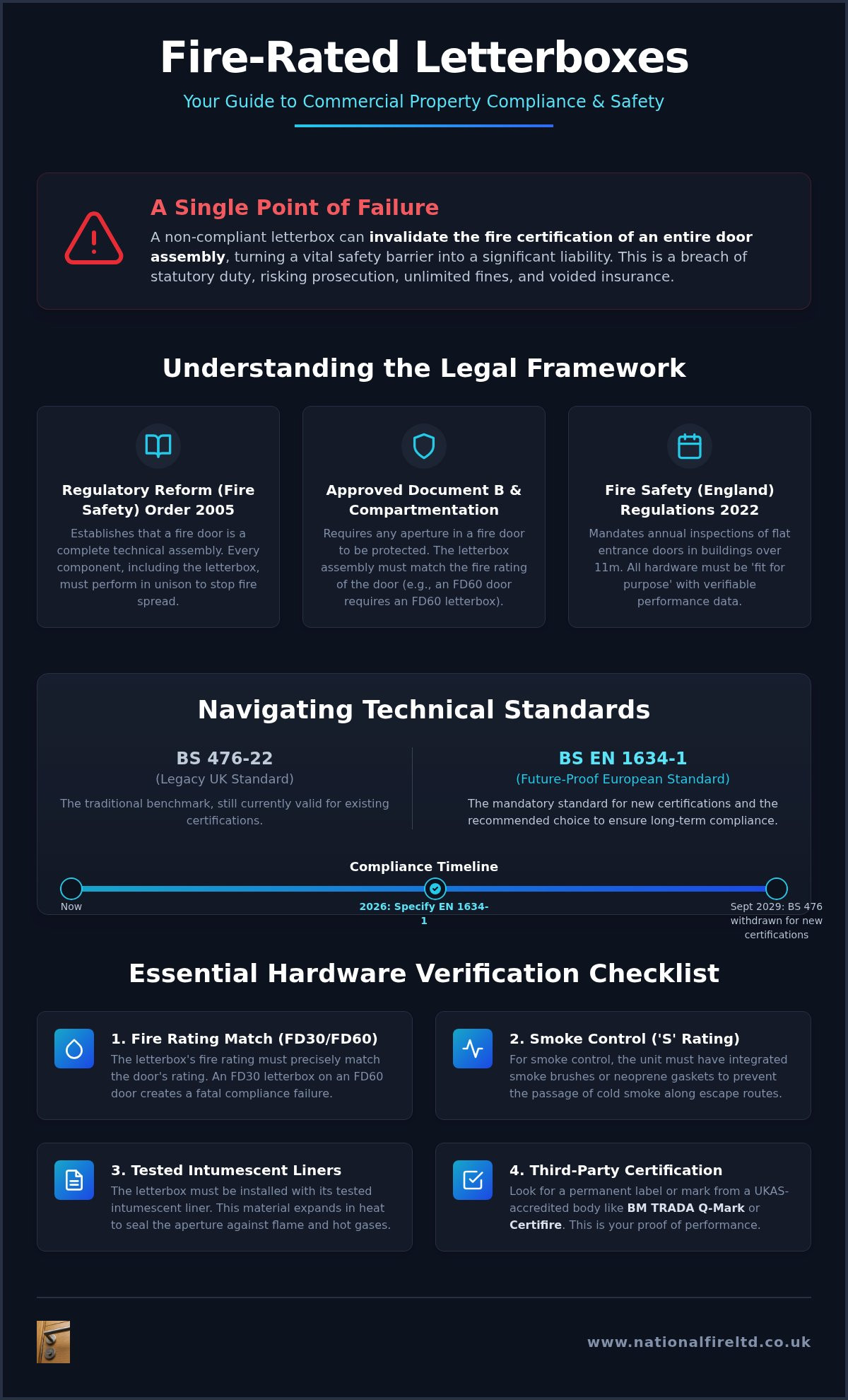
A single non-compliant letterbox can invalidate the fire certification of an entire commercial door assembly, turning a vital safety barrier into a significant liability. We understand that deciphering the transition between BS 476-22 and the newer BS EN 1634-1 standards often leads to more questions than answers. It’s difficult to maintain confidence in your hardware when fire safety audits feel like a looming threat rather than a routine check. You deserve the certainty that your property and its occupants are protected by fully accredited solutions.
Our team of specialists has developed this guide to help you master the essential fire rated letterbox requirements and technical specifications for 2026. By following our methodical approach, you’ll gain the clarity needed to verify existing installations and ensure all new hardware maintains the door’s integrity. We’ll walk through the current legal frameworks, the necessity of third-party certification from bodies like BM TRADA or Certifire, and provide a definitive checklist to keep your commercial property secure and compliant. This structured overview ensures you’re prepared for the upcoming regulatory shifts while maintaining the highest standards of passive fire protection today.
Key Takeaways
- Identify the critical distinctions between BS 476 Part 22 and BS EN 1634-1 to ensure hardware certifications remain valid through the 2026 regulatory landscape.
- Master the specific fire rated letterbox requirements for FD30 and FD60 assemblies to maintain the integrity of your building’s fire compartmentation.
- Recognise why correct installation using tested intumescent liners and mastic is essential for preventing the passage of smoke and flame through door apertures.
- Learn how professional fire door surveys provide a methodical framework for identifying non-compliant hardware before it leads to a failed safety audit.
- Access an actionable checklist for coordinating remedial works that restore the fire-stopping capabilities of compromised commercial door sets.
Understanding Fire Rated Letterbox Requirements and UK Regulations
The Regulatory Reform (Fire Safety) Order 2005 establishes a clear framework for life safety within commercial and multi-occupied buildings. Under this legislation, a fire door is viewed as a complete technical assembly rather than a simple piece of joinery. Every element, including Fire door components such as hinges, seals, and letterboxes, must perform in unison to prevent the spread of fire. We define a fire-rated letterbox as a critical fire-stopping component. Its purpose is to seal the aperture completely when exposed to high temperatures, ensuring the door’s integrity remains intact. Failing to meet fire rated letterbox requirements isn’t merely a minor defect; it’s a significant breach of statutory duty that can lead to prosecution, unlimited fines, or the invalidation of building insurance.
Building Regulations Part B and Compartmentation
Approved Document B (Fire Safety) dictates that any penetration in a fire-resisting structure must be protected to maintain the original level of fire resistance. When an aperture is cut into a door leaf for mail delivery, it creates a deliberate weakness in the fire barrier. Maintaining fire compartmentation requires that the letterbox assembly matches the fire rating of the host door exactly. If a door is rated for 60 minutes (FD60), the letterplate must also provide 60 minutes of protection. We often find that standard domestic hardware is mistakenly fitted to commercial doors, which immediately compromises the building’s fire strategy and allows smoke to bypass the door’s primary seals.
The Impact of the Fire Safety (England) Regulations
The Fire Safety (England) Regulations 2022 have introduced more rigorous oversight for multi-occupied buildings. For structures exceeding 11 metres in height, annual inspections of flat entrance doors are now a mandatory requirement. These audits specifically look for unauthorised modifications or the installation of non-compliant hardware. It’s essential that all components are ‘fit for purpose’, meaning they must possess verifiable evidence of performance through UKAS-accredited testing. The ‘responsible person’ is legally required to ensure that all door hardware is maintained in a state of readiness and continues to meet the technical standards established in the building’s fire risk assessment. Adhering to the correct fire rated letterbox requirements ensures that these mandatory inspections don’t result in costly remedial orders or legal enforcement action.
Essential Technical Standards for Fire Rated Letterplates
Compliance with fire rated letterbox requirements relies on rigorous laboratory testing that simulates real-world fire conditions. In the UK, two primary standards dictate the performance of these components: BS 476 Part 22 and BS EN 1634-1. While the former has been the traditional benchmark for decades, the latter represents the increasingly mandatory European equivalent. These tests don’t just evaluate the hardware in isolation; they assess the letterbox as part of a complete door assembly to ensure the aperture doesn’t become a point of failure. For any property manager, understanding these benchmarks is vital to fulfilling legal duties under the Regulatory Reform (Fire Safety) Order 2005.
Smoke control is equally critical to building safety. While fire resistance ratings like FD30 or FD60 focus on heat and flame, many commercial environments require an ‘S’ rating for smoke leakage. This necessitates fitting the letterbox with specialised smoke brushes or neoprene gaskets. These seals prevent cold smoke from infiltrating escape routes during the early stages of a fire, providing occupants with the clear visibility needed for a safe evacuation.
BS 476 vs. EN 1634: Which Standard Applies?
The UK government has confirmed that while BS 476 Part 22 remains currently valid, it’s scheduled for withdrawal regarding new certifications by September 2029. In 2026, we recommend specifying hardware tested to BS EN 1634-1 to future-proof your building’s compliance. You can identify compliant products by looking for third-party certification labels, such as the Certifire or BM TRADA Q-Mark, which are typically located on the internal flap or frame. Dual-certified hardware provides the highest level of assurance, as it confirms the component meets both British and European performance criteria under test conditions.
Intumescent Technology in Fire Stopping
The core of any fire-rated letterplate is its intumescent liner. These materials are designed to react chemically when exposed to extreme heat. Graphite-based liners are frequently used because they produce a high-pressure exfoliation that rapidly fills the aperture to block flames. Sodium silicate liners offer an alternative by creating a rigid, insulating char. Most fire-rated letterboxes feature an activation temperature between 120°C and 150°C, at which point the material expands to many times its original volume. If you’re unsure whether your current hardware features these essential liners, our specialist fire door surveys can provide a definitive assessment of your building’s safety status.
Selecting the Correct Letterbox for Commercial Fire Doors
Selecting a letterplate requires more than just aesthetic consideration; it’s a technical decision that must align perfectly with the door’s fire test evidence. A mismatched component is a primary reason for failed safety audits and compromised compartmentation. When we evaluate hardware, we prioritise the integrity period of the door, as a unit designed for a 30-minute rating will likely fail if installed on a 60-minute door. The physical dimensions of the aperture also play a critical role. Cutting an opening that exceeds the manufacturer’s tested specifications can lead to structural warping or premature failure of the door leaf during a fire event.
Material choice is another essential factor in maintaining safety standards. While aluminium and steel are the industry standard for durability and heat resistance, any fire-resistant plastics used must be specifically formulated to withstand high temperatures without contributing to toxic smoke yield. In many modern commercial developments, these components must also satisfy secondary building regulations, such as Part E for acoustic insulation and Part L for thermal performance. Ensuring your hardware meets these multi-faceted fire rated letterbox requirements prevents the need for expensive retrofitting later.
Hardware for FD30 and FD60 Doors
The technical requirements for FD60 doors are significantly more robust than those for FD30 equivalents. Because an FD60 door must withstand intense heat for an hour, the letterbox requires a higher volume of intumescent material to ensure a permanent seal. We must also consider door thickness; standard FD30 doors are typically 44mm thick, whereas FD60 doors are usually 54mm. Using a letterbox designed for a thinner door can leave internal timber exposed, which acts as a bridge for flames. It is vital to verify that any chosen hardware does not void the fire door certification by deviating from the original test parameters.
Security and Durability Standards
In commercial environments, fire safety must be balanced with physical security. The TS008 standard is the recognised benchmark for enhanced security letterplates, designed to prevent “fishing” and unauthorised access through the aperture. Many property managers now opt for anti-arson features, such as internal collection boxes that contain flammable liquids or items pushed through the flap. According to the official fire door guidance, all such additions must be part of a tested assembly. For external-facing doors, we also recommend specifying high-grade corrosion resistance to ensure the springs and flaps don’t seize, as a stuck-open letterplate completely bypasses all fire rated letterbox requirements and leaves the building vulnerable.
Compliance Checklist: Installation and Maintenance
Even a product that meets all fire rated letterbox requirements will fail if the installation process is flawed. We view the fitting stage as a critical transition where a hardware component becomes an integral part of the building’s passive fire protection. Precision is non-negotiable. Any deviation from the tested installation method can void the manufacturer’s warranty and, more importantly, compromise the door’s ability to resist fire. Our experts recommend a methodical approach to ensure that the hardware performs exactly as intended during a thermal event.
The Installation Checklist
- Precision cutting: Apertures must be cut using the manufacturer’s provided template to ensure a snug fit. Oversized holes create voids that intumescent materials may not be able to bridge effectively during expansion.
- Component verification: Ensure every supplied intumescent gasket and liner is utilised. These are not optional extras; they are the primary fire-stopping elements required to maintain the door’s integrity.
- Fixing integrity: Use only the screws and fixings provided with the kit. Substituting these for standard steel screws can lead to heat transfer directly through the door core, bypassing the protective liners.
- Flap alignment: The internal and external flaps must operate smoothly without catching. A flap that remains slightly ajar allows cold smoke to bypass the fire seals instantly, which is a common failure point in safety audits.
The ‘no-gap’ rule is a fundamental principle in fire stopping. If light can pass through the edges of the letterplate frame after installation, it indicates a path for smoke and heat. We recommend applying a thin bead of fire-rated intumescent mastic around the internal perimeter of the aperture before final fixing. This creates a secondary seal that activates alongside the primary liners, providing a robust barrier against fire spread and ensuring the installation remains airtight.
Routine Maintenance and Inspection
- Visual assessment: Regularly check for physical damage, corrosion, or signs of tampering. Ensure the intumescent liner is still present and has not been removed or damaged by mail delivery.
- Functional testing: Manually lift the flap to ensure the spring mechanism is functional and self-closes firmly against the frame.
- Seal inspection: Verify that smoke brushes or gaskets are intact and have not become brittle or detached over time.
- Logbook entry: Record every inspection date, the findings, and any remedial actions taken. This documentation is essential for demonstrating due diligence during a fire safety audit.
Facilities managers should integrate these checks into their quarterly fire door maintenance schedules to ensure long-term reliability. Maintaining a rigorous audit trail protects the building’s occupants and confirms that the responsible person is fulfilling their legal obligations under the latest safety regulations. If your internal team lacks the technical expertise to perform these detailed assessments, our specialists offer comprehensive Fire Door Maintenance services to ensure your hardware remains fully compliant and effective.
Ensuring Integrity: Professional Fire Door Surveys and Remedial Works
Maintaining building safety requires a holistic view of passive fire protection. While individual hardware choices are vital, their effectiveness is only guaranteed when they function as part of a certified assembly. A professional fire door survey is the most reliable method for verifying that every component, from intumescent seals to the letterplate, meets the necessary fire rated letterbox requirements. We treat these surveys as a technical audit, identifying where individual components might compromise the broader fire strategy of the premises.
In many commercial settings, we find that hardware has been retrofitted by contractors who lack specialist knowledge in fire stopping. These modifications often void the original door certification and can lead to the invalidation of building insurance. Our experts provide the technical oversight needed to identify these vulnerabilities before they result in a failed safety audit. By integrating hardware compliance into a total building fire strategy, we help you maintain a secure environment that prioritises life safety and property protection.
Why Professional Surveys are Non-Negotiable
Identifying non-compliant retrofitted hardware is a core objective of our inspection process. We often encounter “fire-rated” letterboxes that have been installed without the correct intumescent liners or with fixings that bridge the fire-resistant core. Our surveyors use fire strategy drawings and floor plan generation to document compliant apertures and ensure that every fire door in your portfolio is accurately mapped. This methodical documentation provides facilities managers with the evidence required to demonstrate national compliance across multiple sites. We don’t just find faults; we provide an accredited roadmap for maintaining the long-term integrity of your passive fire protection measures.
Coordinated Remedial Solutions
When a survey identifies a failure in compartmentation, immediate action is required to restore the building’s safety. Our remedial works are designed to address these vulnerabilities with precision. This process often involves the professional installation of injectable cavity barriers and fire stopping materials to reinforce the structure around the door frame. We ensure that all work is backed by technical fire strategy documentation, providing a clear audit trail for the “responsible person” and regulatory authorities. Our approach focuses on reliability and stability, ensuring that your building remains a safe environment regardless of the circumstances. Contact National Fire Ltd today for a comprehensive fire door assessment to secure your property’s future and ensure you meet all fire rated letterbox requirements.
Securing Your Compartmentation for 2026 and Beyond
Mastering fire rated letterbox requirements is a fundamental step in maintaining the integrity of your building’s passive fire protection. We’ve explored how matching hardware to specific door ratings and adhering to the latest technical standards, such as BS EN 1634-1, prevents critical failures during a fire event. It’s clear that even the highest quality components require precise installation and regular, documented maintenance to remain effective. By treating the letterbox as a vital fire-stopping seal rather than a simple accessory, you ensure your property remains compliant with the Regulatory Reform (Fire Safety) Order 2005.
As accredited passive fire protection specialists, we provide the technical expertise needed to identify hidden risks and implement robust solutions. Whether you require expert fire door and compartmentation surveyors or national UK coverage for commercial remedial works, our team is prepared to support your safety goals. Secure your building’s compliance with National Fire Ltd’s expert surveys to gain the peace of mind that comes with professional oversight. Taking proactive steps today ensures a safer, more resilient environment for every occupant in your care.
Frequently Asked Questions
Do all fire doors require a fire-rated letterbox?
No, fire doors only require a fire-rated letterbox if an aperture is cut into the door leaf for mail delivery. If a door remains solid, it maintains its integrity without additional hardware. However, if you choose to install a letterplate, it must match the door’s specific fire rating, such as FD30 or FD60. Many modern commercial developments now utilise communal mailboxes in central lobbies to avoid cutting into fire doors entirely.
Can I install a fire-rated letterbox on a standard non-fire door?
You can install a fire-rated version on a standard door for enhanced acoustic performance or security, but it won’t upgrade the door to a fire-rated status. A fire door is a complete assembly where every component works together. While the letterbox will resist heat and smoke at that specific point, the standard door leaf will fail rapidly during a fire event, rendering the hardware’s resistance ineffective.
What is the difference between an FD30 and an FD60 letterbox?
The primary distinction is the duration of fire resistance and the thickness of the hardware. An FD30 unit is tested to resist fire for 30 minutes, while an FD60 unit provides 60 minutes of protection. Because FD60 doors are typically 54mm thick compared to the 44mm thickness of FD30 doors, the letterbox must be physically compatible with these dimensions to ensure the intumescent material seals the aperture correctly.
How often should fire-rated letterboxes be inspected for compliance?
We recommend inspecting these components as part of your quarterly fire door maintenance schedule. For buildings over 11 metres in height, the Fire Safety (England) Regulations 2022 mandate quarterly checks of communal doors. During these inspections, you must verify the self-closing mechanism of the flap, the condition of the intumescent liners, and ensure no unauthorised modifications have compromised the unit’s ability to resist smoke and flames.
Does a fire-rated letterbox protect against arson attacks?
Yes, many fire-rated models are engineered with anti-arson features such as internal baffles or collection boxes. These elements are designed to contain flammable liquids or items pushed through the flap, preventing them from spreading fire into the building’s interior. While their primary function is to meet fire resistance standards, these security enhancements provide a vital secondary layer of protection for commercial properties and multi-occupied residential blocks.
Can I replace a standard letterbox with a fire-rated version myself?
Replacement should only be performed by a competent professional who understands fire rated letterbox requirements and the technical data of the door. Incorrect installation is a leading cause of non-compliance. A specialist installer ensures the aperture is cut to the exact manufacturer’s template and that all necessary intumescent gaskets are correctly seated. This precision is essential for maintaining the building’s passive fire protection integrity and insurance validity.
What markings should I look for to verify a letterbox is fire-rated?
Look for third-party certification marks such as the Certifire or BM TRADA Q-Mark, which are usually located on the internal flap or the frame. These labels confirm the product has undergone rigorous UKAS-accredited testing. You should also check for a CE or UKCA mark and consult the manufacturer’s technical data sheet to ensure the hardware’s fire rating specifically matches the FD30 or FD60 requirements of your fire door.
What happens if a fire door has a letterbox that isn’t fire-rated?
The entire fire door assembly will be deemed non-compliant, which typically results in a failed fire safety audit. During a fire, a non-rated letterbox will warp or melt, creating a direct path for flames and toxic smoke to bypass the door’s barrier. This breach compromises the building’s compartmentation, potentially leading to legal prosecution for the responsible person and the invalidation of your commercial property’s insurance policy in the event of a claim.