


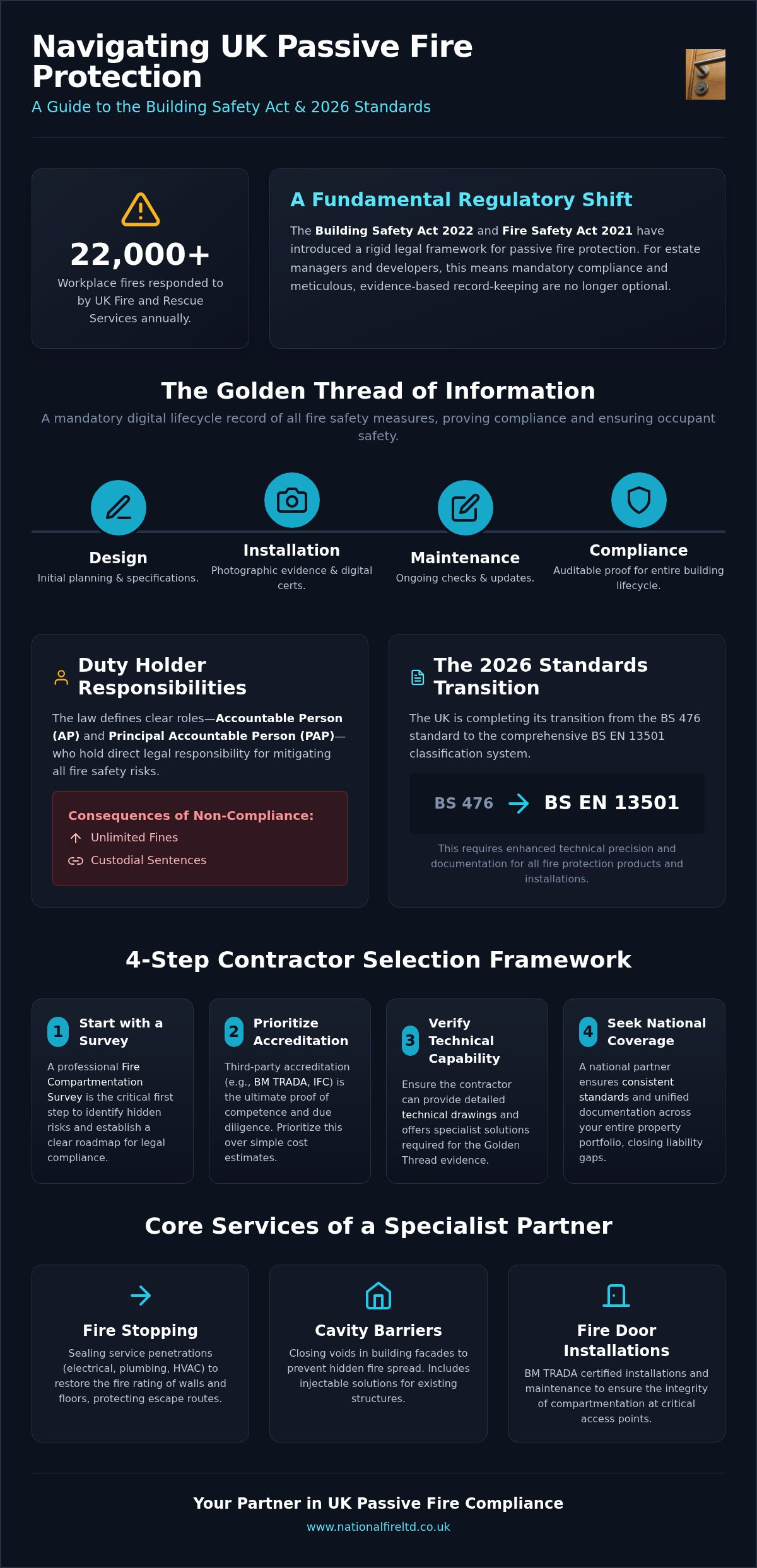
UK Fire and Rescue Services respond to over 22,000 workplace fires every year. This figure underscores the thin margin for error in passive fire protection. For estate managers and developers, the pressure of non-compliance under the Building Safety Act is a constant reality. Finding reliable commercial fire stopping contractors UK businesses can trust for national coverage and consistent standards is often a significant challenge. You understand that poor previous installations can hide risks that only become apparent when it is too late.
We recognise that your priority is the absolute safety of building occupants and the mitigation of legal liability. This guide provides a methodical framework to help you identify, vet, and partner with the UK’s leading passive fire protection specialists. You’ll learn how to ensure total building compliance through rigorous technical documentation and the latest 2026 standards, including the transition to BS EN 13501. We’ll examine how to maintain the Golden Thread of information, from initial fire compartmentation surveys to the final certification required for insurance and audit purposes.
Key Takeaways
- Understand how the Building Safety Act 2022 and the 2026 transition to BS EN 13501 standards dictate mandatory documentation and accountability for all commercial assets.
- Learn how to evaluate commercial fire stopping contractors UK wide by prioritising third-party accreditation and technical drawing capabilities over simple cost estimates.
- Recognise why a professional fire compartmentation survey is the critical first step in identifying hidden risks and establishing a clear roadmap for legal compliance.
- Discover how specialist solutions, such as injectable cavity barriers and BM TRADA certified fire door installations, provide the technical evidence required for the Golden Thread of information.
The Regulatory Landscape for Passive Fire Protection in 2026
Passive fire protection (PFP) consists of stationary components built into a structure to restrict the spread of fire and smoke. By 2026, the transition from BS 476 to the BS EN 13501 classification system is complete, making technical precision a non-negotiable requirement. The Building Safety Act 2022 and the Fire Safety Act 2021 have fundamentally reshaped how commercial assets are managed. Compliance is no longer a voluntary standard; it’s a rigid legal framework that requires meticulous evidence for every installation. Compliance is mandatory. Building managers must now prove that their properties meet these evolved standards to remain legally compliant.
A central pillar of this framework is the “Golden Thread” of information. This digital record must capture the design, installation, and maintenance history of all fire safety measures throughout a building’s lifecycle. For building managers, digital record-keeping is now essential. When you partner with commercial fire stopping contractors UK specialists, they must provide photographic evidence and digital certificates for every seal and barrier installed. This data doesn’t just satisfy an auditor; it provides the life safety assurance that occupants deserve. Data protects lives. Without this robust digital trail, a building cannot prove it’s safe for occupation or meet the requirements of a modern fire risk assessment.
The Building Safety Act and Duty Holder Responsibilities
The legislation introduces clear roles for the Accountable Person (AP) and the Principal Accountable Person (PAP). These individuals hold direct legal responsibility for the fire safety of the building and must ensure all risks are mitigated. Risks must be mitigated. Failure to maintain compliant compartmentation can lead to severe ramifications, including unlimited fines and custodial sentences. A Safety Case Report is a mandatory document for high-risk buildings that demonstrates how fire risks are managed through verified PFP data and accredited installation methods. This report serves as the foundation for building safety and relies heavily on the technical accuracy of your contractor’s work.
Standardising Compliance Across National Portfolios
Maintaining safety standards across a national portfolio presents unique logistical challenges. Disparate contractors often lead to inconsistent standards and fragmented documentation, which creates significant liability gaps. The complexities of managing multiple trades on a commercial site are significant, and resources from the Willmac Group can help estate managers navigate the hiring process for specialized construction subcontractors. This is why many industrial and commercial estates now prefer national commercial fire stopping contractors UK wide. A national partner ensures that every site, regardless of location, adheres to the same rigorous QA protocols and reporting formats. Third-party accreditation, such as BM TRADA or IFC certification, serves as the ultimate proof of professional due diligence. It provides the authoritative reassurance that the contractor possesses the technical competence to protect both life and property across your entire estate.
Core Services of Specialist Passive Fire Protection Contractors
Specialist commercial fire stopping contractors UK provide the technical expertise required to seal service penetrations and head-of-wall joints. These gaps, often created during the installation of electrical, plumbing, or HVAC services, are primary routes for the rapid spread of smoke and flame. By adhering strictly to Approved Document B (Fire Safety), contractors ensure that every penetration is restored to the original fire rating of the compartment wall or floor. This methodical approach is essential for maintaining the integrity of the building’s internal fire divisions and protecting escape routes.
Facade safety remains a critical concern for modern commercial developments. Cavity barriers are designed to close the voids between the building’s outer skin and its inner structure, preventing the hidden spread of fire within the building envelope. For existing structures where access is limited, injectable cavity barriers offer a sophisticated remedial solution. This method allows for the creation of robust fire seals without the need for a full, costly facade strip-down. It’s a precise engineering solution that provides immediate safety benefits while minimising operational downtime for building occupants.
Fire-rated balconies are another essential component for high-rise commercial buildings. These external attachments must be constructed from non-combustible materials to prevent fire from jumping between floor levels via the building’s exterior. Engineering these balconies requires a deep understanding of structural fire risks to ensure they don’t contribute to the fire load or compromise the building’s external fire spread strategy.
Fire Door Installation and Maintenance Standards
The installation of a fire door is a high-precision task that demands BM TRADA certification to guarantee performance under thermal stress. A door that’s poorly fitted, even by a few millimetres, will fail to contain smoke and heat. Regular maintenance is equally vital to prevent compliance drift caused by mechanical wear or unauthorised modifications. Integrating fire door surveys into your broader passive fire protection strategy ensures that every component of your escape route remains fully operational and legally compliant.
Specialised Facade and Structural Solutions
Injectable cavity barriers represent a significant technological shift in remedial fire safety. These systems are engineered to react to heat, expanding to fill the void and maintaining the building’s fire strategy. Similarly, fire-rated balconies must meet stringent engineering standards to ensure they remain structurally sound during a fire event. These specialised components must work in harmony with the building’s overall fire strategy to provide a robust, multi-layered defence. For organisations managing complex national portfolios, partnering with a specialist passive fire protection contractor ensures that these technical standards are consistently met across every site in your estate.
Vetting Commercial Fire Stopping Contractors: A Selection Framework
Evaluating commercial fire stopping contractors UK wide requires a shift from procurement based on cost to procurement based on technical competence. Under the Building Safety Act, the “Responsible Person” must demonstrate that they’ve selected a competent contractor to manage fire risks. Competence isn’t merely an internal claim; it’s validated through external oversight and rigorous technical standards. A common pitfall is assuming that because a product is fire-rated, the installation is automatically compliant. This is a dangerous misconception. While products must meet BS EN 13501 standards, their performance in a real-world fire depends entirely on the installation method. This is why third-party installer accreditation is essential. It ensures the contractor has been independently audited to prove they can install these complex systems correctly.
By 2026, compliance is a data-driven discipline. Professional contractors must offer more than physical labour; they must provide the technical intelligence required for the Golden Thread of information. A contractor’s ability to provide a comprehensive audit trail and digital O&M manuals is a key indicator of their reliability. These records provide the authoritative reassurance needed for insurance purposes and regulatory inspections, ensuring that your building’s safety data is accessible and accurate.
Third-Party Accreditation and Certifications
Accreditation from bodies like BM TRADA, IFC, or FIRAS is the benchmark for professional PFP contractors. These schemes involve random site inspections and office audits to verify that the contractor’s management systems and onsite workmanship meet the required safety standards. You should always verify a contractor’s credentials on the relevant national accreditation database before awarding a contract. The Association for Specialist Fire Protection (ASFP) provides extensive guidance on why using non-accredited installers for complex compartmentation works introduces unacceptable legal and safety risks to your building. Using an unverified contractor can invalidate your insurance and lead to significant remedial costs if the work fails a subsequent audit.
Technical and Drawing Capabilities
Technical drawing capabilities, specifically in AutoCAD or BIM, are now essential for 2026 compliance. Floor plan generation and fire strategy drawings are critical tools for building managers, providing a visual record of where every fire seal is located and its specific performance rating. As-built drawings are particularly valuable when demonstrating compliance to the Building Safety Regulator. They prove that the final installation matches the design intent and the fire strategy. Technical drawings bridge the gap between initial survey findings and the final installation, ensuring that every operative on site understands the exact requirements of the project. This methodical approach ensures that the safety of the building is documented with the precision required by modern legislation.
The Importance of Professional Fire Compartmentation Surveys
A fire compartmentation survey acts as the technical roadmap for a building’s safety strategy. It identifies the physical barriers designed to contain fire and smoke within a specific area for a set duration. Expert commercial fire stopping contractors UK wide use two primary methodologies: non-destructive and destructive surveys. Non-destructive surveys focus on visible elements, but they often miss risks hidden within the building fabric. Destructive surveys involve the temporary removal of ceiling tiles or wall panels to inspect hidden voids and service risers. This rigorous approach is essential for identifying common failures such as unsealed service penetrations, missing cavity barriers, or fire doors that have been compromised by improper hardware.
Once the survey is complete, the findings must be translated into a prioritised remedial work plan. This plan ensures that the most critical breaches, particularly those in high-risk areas or escape routes, are addressed first. It restores the building’s integrity in a structured, methodical manner that aligns with legal requirements. Don’t treat a survey as a one-off exercise; it’s the foundation of your ongoing compliance strategy.
The Survey Process: From Inspection to Report
The process begins with a systematic visual inspection of all accessible compartment lines, including walls, floors, and ceilings. Every identified breach or service penetration is recorded with precision using digital tools. Finally, the contractor generates a comprehensive report featuring photographic evidence and specific remedial recommendations. This document acts as the definitive record of the building’s current safety status. It provides the authoritative reassurance needed to prove that you’re managing fire risks with the required level of professional oversight.
Remedial Works and Restoring Integrity
Executing remedial works in live commercial environments requires careful coordination to minimise disruption while maintaining safety standards. It’s vital that commercial fire stopping contractors UK get the installation right the first time. Poorly executed repairs are not only dangerous but lead to significant costs when they inevitably fail future audits. Every remedial action must be documented digitally, ensuring that the repair is integrated into the building’s Golden Thread of information. This proactive approach guarantees that your safety data remains current and legally robust. If you need to establish a clear roadmap for your building’s safety, you should book a fire compartmentation survey with a specialist national provider.
National Fire Ltd: Your Partner in UK Passive Fire Compliance
National Fire Ltd operates as a specialist national contractor dedicated exclusively to the commercial and industrial sectors. We understand that managing fire safety across a large estate requires a partner with the scale and technical depth to deliver consistent results. As commercial fire stopping contractors UK businesses rely on, we provide a unified front of experts who act as guardians of your property and the lives within it. Our nationwide reach ensures that whether you manage a single industrial site or a diverse portfolio of commercial assets, the standards of installation and documentation remain identical. We take the high-stakes responsibility of passive fire protection seriously, providing the stability and competence required in an increasingly regulated environment.
Our organisation is built on a foundation of unwavering professionalism and authoritative reassurance. We don’t just install products; we provide a methodical, accredited approach to risk mitigation. By choosing a national specialist, you eliminate the inconsistencies often found when using multiple local contractors. We ensure that your entire portfolio adheres to the same rigorous safety protocols, providing a single, reliable point of accountability for your compliance needs.
Our Technical Approach to Fire Safety
Our methodology integrates surveying, technical drawing, and certified installation into a single, cohesive workflow. We provide professional floor plan generation and detailed fire strategy drawings that serve as the foundation for your building’s safety case. When addressing complex facade issues, we deploy specialised solutions such as injectable cavity barriers. This technology allows us to restore fire integrity without the disruption of a full facade strip-down, solving technical challenges that many standard contractors cannot address. By managing the entire process, we ensure a seamless journey from the initial compartmentation survey to the final certification. This approach guarantees that every seal and barrier is captured digitally, fulfilling the requirements of the Golden Thread of information and providing the technical evidence required for modern audits.
Why National Fire Ltd is the Professional Choice
We maintain an unwavering focus on commercial excellence, purposely excluding domestic services to ensure our expertise remains specialised. This commitment allows us to stay at the forefront of industrial safety standards and complex legislative changes. The personality of our brand is defined by meticulous discipline; we don’t just provide a service, we offer a long-term partnership built on constant availability and technical reliability. This provides building managers with the psychological benefit of safety, delivering total peace of mind that their assets are legally compliant and physically secure. Our technical certifications and quality management credentials are an inseparable part of our identity, reinforcing our position as a trusted expert advisor for commercial fire stopping contractors UK wide.
Contact National Fire Ltd for a comprehensive PFP consultation to discuss your specific requirements and ensure your building safety is managed by industry specialists.
Securing Your Assets and Ensuring Regulatory Compliance
Building safety in 2026 is defined by technical precision and the maintenance of the Golden Thread of information. You now have the framework to move beyond simple procurement and toward a partnership based on verified competence and rigorous documentation. Achieving full compliance isn’t just a legal requirement. It’s a fundamental responsibility to the occupants who rely on your building’s integrity.
Selecting professional commercial fire stopping contractors UK wide ensures that your national portfolio remains secure and your documentation is audit-ready. National Fire Ltd provides the authoritative reassurance of BM TRADA certified installers and technical fire strategy drawings across the commercial and industrial sectors. We provide a disciplined approach to risk mitigation. This safeguards both life and property through a dedicated national service.
Ensure your building is compliant; contact National Fire Ltd today to start your journey toward total safety. You can move forward with confidence, knowing your assets are protected by seasoned experts who prioritise reliability above all else.
Frequently Asked Questions
What is the difference between active and passive fire protection?
Active fire protection requires a specific trigger or action to function, such as sprinklers, extinguishers, or alarm systems. In contrast, passive fire protection consists of stationary components integrated into the building’s structure, such as fire stopping and cavity barriers. These elements work by containing fire and smoke within a specific compartment. This containment provides occupants with essential time for evacuation while protecting the structural integrity of the asset.
How often should fire compartmentation surveys be conducted in UK commercial buildings?
Best practice dictates that fire compartmentation surveys should be conducted annually or whenever significant structural changes occur. The Regulatory Reform (Fire Safety) Order 2005 mandates that the “Responsible Person” must review the fire risk assessment regularly. For large commercial assets, a yearly inspection by specialized commercial fire stopping contractors UK ensures that any new service penetrations or wear and tear don’t compromise the building’s fire strategy or legal compliance.
What are injectable cavity barriers and when are they used?
Injectable cavity barriers are advanced remedial solutions designed to restore fire integrity within building facades. They are primarily used in existing structures where traditional barrier installation would require a full facade strip-down. The specialized material is injected into the cavity, where it expands to create a robust fire seal. This methodical approach solves complex facade compliance issues without the high cost and operational disruption associated with major structural works.
Do fire stopping contractors need specific certifications in the UK?
While there is no single mandatory license, third-party accreditation is the industry benchmark for demonstrating competence. Professional contractors should hold certifications from bodies such as BM TRADA, IFC, or FIRAS. These schemes involve rigorous audits of management systems and random site inspections. Choosing an accredited contractor provides the authoritative reassurance that installations meet national safety standards and that the technical documentation provided is legally robust for insurance purposes.
Can National Fire Ltd provide fire strategy drawings for existing buildings?
Yes, National Fire Ltd provides comprehensive fire strategy drawings and floor plan generation for both new and existing commercial buildings. These technical drawings are essential for building managers to visualize compartment lines and identify the location of all passive fire protection measures. By documenting the as-built environment, we help you establish a clear compliance roadmap and maintain the Golden Thread of information required by the Building Safety Regulator.
Why is third-party accreditation like BM TRADA important for fire door installation?
BM TRADA accreditation ensures that fire door installation meets the exact manufacturer specifications required for life safety. A fire door is a high-precision component; even a minor gap can lead to total failure during a fire event. Using a certified installer guarantees that every frame, seal, and piece of hardware is fitted with the necessary accuracy. This certification provides the technical evidence needed to prove that your escape routes are fully compliant.
What documentation should I receive from a passive fire protection contractor?
You should receive a comprehensive digital audit trail for every installation. This includes photographic evidence of the seal before and after installation, technical data sheets for the products used, and a certificate of conformity. For large estates, your commercial fire stopping contractors UK should also provide updated fire strategy drawings and digital O&M manuals. This data is critical for maintaining the Golden Thread and demonstrating professional due diligence to auditors.
Does National Fire Ltd provide services for domestic residential properties?
National Fire Ltd focuses exclusively on the commercial and industrial sectors to ensure the highest level of specialized expertise. We don’t provide services for domestic residential properties. This unwavering commitment to commercial excellence allows our experts to address the complex engineering requirements and legislative frameworks unique to large-scale assets. By concentrating on these sectors, we provide building managers with the stability and reliability needed to protect complex national portfolios.