


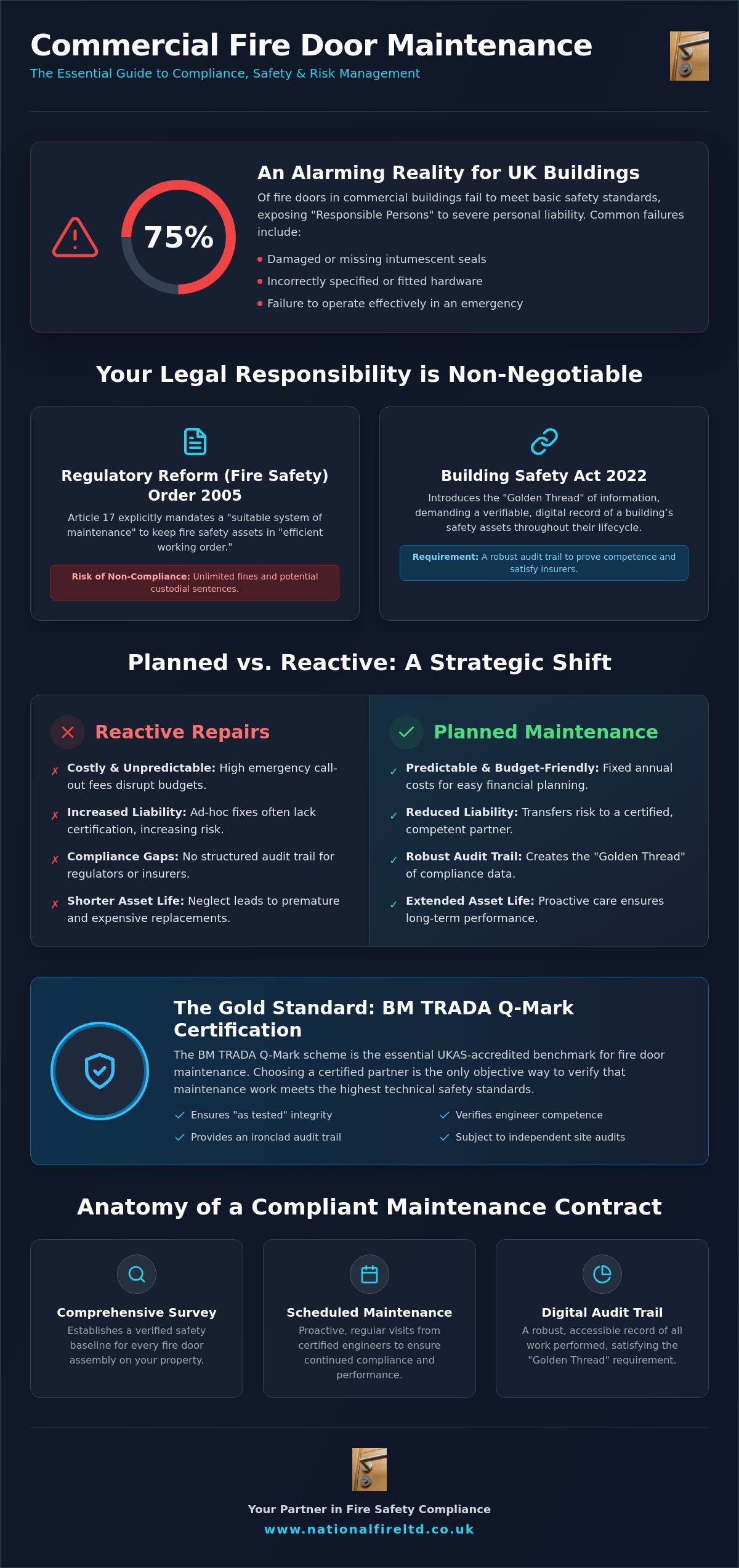
Did you know that 75% of fire doors in UK commercial buildings currently fail to meet basic safety standards due to damaged seals or incorrect hardware? It’s a sobering figure that places immense pressure on “Responsible Persons” who now face heightened personal liability under the Building Safety Act 2022. We understand the anxiety that comes with managing these risks, especially when faced with the rising costs of emergency repairs and the difficulty of finding accredited contractors for national estates.
Securing a BM TRADA certified commercial fire door maintenance contract is the most effective way to transfer this risk and ensure your life-safety assets remain “as tested” throughout their service life. By reading this article, you’ll learn how a structured maintenance regime protects your property from legal liability while ensuring the long-term performance of every door. We will examine how professional certification creates a robust audit trail for insurers, extends the lifespan of your assets, and finally brings predictability to your annual safety budgets through a methodical, compliant approach.
Key Takeaways
- Understand how the Regulatory Reform (Fire Safety) Order 2005 places the legal burden on you to ensure all fire doors remain in efficient working order.
- Discover why BM TRADA Q-Mark certification is the essential benchmark for verifying that maintenance work meets the highest technical safety standards.
- Learn how a proactive commercial fire door maintenance contract helps you transition from costly emergency repairs to a predictable, budget-friendly safety regime.
- Identify the critical components of a compliant maintenance agreement, starting with a comprehensive survey to establish a verified safety baseline for your property.
- See how a national partner provides the robust digital audit trail required to satisfy insurers and the Building Safety Regulator.
The Legal Necessity of Commercial Fire Door Maintenance Contracts
Fire doors are not static architectural features; they are precision-engineered life-safety systems. To fully grasp What is a Fire Door?, you must view it as a complete assembly where the frame, leaf, intumescent seals, and ironmongery work in unison to hold back smoke and flame. In high-stakes commercial environments, the failure of a single component can lead to catastrophic breaches in compartmentation. A structured commercial fire door maintenance contract is therefore much more than a service agreement. It’s a vital compliance tool that protects the “Responsible Person” from the significant legal exposure inherent in modern fire safety legislation.
Regulatory Reform (Fire Safety) Order 2005: Article 17
The Regulatory Reform (Fire Safety) Order 2005 (FSO) remains the cornerstone of UK fire safety law. Article 17 explicitly mandates that fire safety assets are subject to a “suitable system of maintenance” and kept in “efficient working order.” This isn’t a suggestion; it’s a statutory duty. Given that industry data from April 2026 suggests 75% of fire doors in existing UK buildings fail basic compliance checks, the risk of non-compliance is high. Ad-hoc repairs by non-specialist joiners often bypass critical standards like BS 8214:2026, leaving the building owner vulnerable. If an inspection by fire authorities reveals a lack of professional oversight, the “Responsible Person” can face unlimited fines and even custodial sentences.
The Building Safety Act and Traceability
The Building Safety Act 2022 has introduced a new era of accountability through the “Golden Thread” of information. This legislation demands a digital, transferable record of a building’s safety assets throughout their entire lifecycle. For facilities managers, this means the burden of proof has shifted. You must be able to produce a verified history of every adjustment, seal replacement, and hinge tightening performed on your fire doors. A commercial fire door maintenance contract with a third-party certified provider ensures this data is captured accurately. It provides the “competence” required by the Building Safety Regulator, offering a robust defence in court and ensuring that insurance providers remain satisfied that all risks are being methodically mitigated.
Understanding the BM TRADA Q-Mark Fire Door Maintenance Scheme
Third-party certification is the only objective way to verify that a commercial fire door maintenance contract actually delivers on its safety promises. The BM TRADA Q-Mark Fire Door Maintenance scheme is a UKAS-accredited programme designed to ensure that fire doors are maintained to their original “as tested” specification. Unlike a standard joinery contract, which focuses on functional operation, a certified agreement prioritises the integrity of the entire fire-resisting assembly. Every component, from the intumescent strip to the overhead closer, must be compatible with the door’s original test evidence. This level of technical oversight is essential for compliance with the Fire Safety (England) Regulations 2022, which demand that fire safety measures are kept in good repair.
A primary benefit of the Q-Mark scheme is how it bridges the “Golden Thread” gap identified in the Building Safety Act 2022. The legislation requires a permanent, digital record of safety information that is accessible throughout the building’s life. BM TRADA certified maintainers are subject to independent, third-party site audits where their work and documentation are scrutinized by experts. This ensures that the maintenance never degrades the original fire rating and provides “Responsible Persons” with an ironclad audit trail. To ensure your estate meets these rigorous standards, you should partner with a specialist like National Fire Ltd for your ongoing compliance needs.
Technical Competence and Ongoing Training
Engineers operating under this scheme aren’t merely skilled tradespeople; they undergo rigorous, scheme-specific training to interpret manufacturer test data and global assessments. They understand that fire doors are precision systems. If a component is replaced with an incompatible alternative, the entire certification of the door leaf is voided. Certified maintainers ensure every repair aligns with BS 8214:2026, maintaining the “as tested” state that is non-negotiable for life safety. This technical discipline prevents the common pitfall where ad-hoc repairs inadvertently compromise building compartmentation.
The Audit Trail: Plugs, Labels, and Documentation
The Q-Mark scheme utilizes a distinctive colour-coded plug system to identify doors that have been maintained by a certified professional. These plugs provide an immediate, visual confirmation of compliance for fire inspectors and insurers. Furthermore, the scheme requires a Documented Quality Management System (QMS). Every visit, adjustment, and part replacement is logged digitally. This data integrates seamlessly with your wider fire compartmentation records, creating a holistic view of your building’s passive fire protection status. This level of transparency is vital for satisfying the Building Safety Regulator and protecting against legal liability.
Strategic Benefits: Planned Preventative Maintenance (PPM) vs. Reactive Repairs
Adopting a proactive stance toward fire safety offers a significantly higher return on investment than a reactive “fix-on-fail” approach. A structured commercial fire door maintenance contract transforms fire doors from potential liabilities into reliable safety assets. While the initial cost of a contract is a planned annual expense, it prevents the unpredictable and often exorbitant costs associated with emergency remediation. For instance, while component-level repairs like replacing intumescent seals or overhead closers typically range from £50 to £200 per door, a total failure requiring full replacement can cost between £400 and £1,200 per assembly. By identifying minor mechanical wear before it compromises the door’s integrity, you extend the asset’s service life and ensure 24/7 operational readiness in high-traffic environments.
This strategic oversight also directly impacts your annual Fire Risk Assessment (FRA). Buildings managed under a certified maintenance regime experience a dramatically lower failure rate during these mandatory inspections. Instead of facing a long list of urgent non-compliances that disrupt business operations, managers benefit from a steady state of readiness. This methodical approach ensures that every door leaf, frame, and hardware set remains in peak condition, fulfilling its role within the building’s wider safety architecture.
Determining Your Inspection Frequency
The frequency of your maintenance visits must reflect the building’s specific risk profile. While standard guidance suggests professional inspections every six months for commercial properties, high-traffic or high-risk environments require more frequent oversight. Hospitals, schools, and large-scale residential buildings over 11 metres often necessitate quarterly reviews to account for the accelerated wear and tear on ironmongery and seals. Aligning your contract schedule with the technical requirements of BS 8214:2026 ensures that your maintenance frequency is both legally defensible and technically appropriate for the usage patterns of your estate.
Risk Mitigation and Insurance Validity
A BM TRADA certified contract serves as a powerful mechanism for liability transfer. By appointing a third-party accredited specialist, the “Responsible Person” demonstrates due diligence and professional competence. Insurers view this certification as a critical “de-risking” factor, as it provides verifiable proof that life-safety systems are being managed by experts rather than general contractors. This level of professional oversight is a fundamental pillar of a comprehensive passive fire protection strategy, ensuring that your insurance remains valid and your legal exposure is strictly controlled.
Key Components of a Compliant Fire Door Maintenance Agreement
A professional maintenance proposal should never be a vague or generalized document. It must be a precise technical specification that outlines exactly how your life-safety assets will be managed. Every compliant commercial fire door maintenance contract begins with a baseline assessment. You cannot maintain what hasn’t been properly inventoried. Therefore, a comprehensive initial fire door survey is a non-negotiable prerequisite. This survey identifies the location, fire rating, and current condition of every door set, establishing the starting point for the digital “Golden Thread” of information required by the Building Safety Act.
For managers of national portfolios, the agreement must define clear Service Level Agreements (SLAs) for remedial works. When a defect is identified, the timeline for correction is critical for maintaining building safety and insurance validity. To manage this effectively across multiple sites, a cloud-based reporting portal is essential. This digital platform provides a real-time view of your compliance status, offering a transferable audit trail that can be shared with fire authorities or insurers at a moment’s notice. It ensures that data isn’t trapped in paper logbooks but is instead a live, actionable asset. If you require a transparent, digitally-backed safety regime for your estate, contact our technical team today to discuss a tailored maintenance agreement.
The Scope of a Standard Maintenance Visit
A certified maintenance visit is exhaustive and methodical. Engineers must verify that leaf gaps remain within the mandatory 2mm to 4mm range and that threshold clearances don’t exceed the manufacturer’s tested limits. They test self-closing devices and hold-open systems to ensure the door latches reliably from any angle of opening. Every piece of ironmongery, from hinges to locks, is checked for compatibility with the door’s fire rating. This level of detail ensures the structural integrity of the frame remains uncompromised and the door performs exactly as intended during a fire event.
The Handover Pack: What Documentation You Must Receive
Upon the completion of maintenance cycles, you must receive a comprehensive handover pack. This documentation serves as your legal proof of “competence” and due diligence. It must include a Certificate of Maintenance for each door set and detailed defect reports supported by photographic evidence of all works performed. Critically, the pack should include updated fire strategy drawings that reflect the current “as maintained” status of your assets. This level of detail ensures you’re always prepared for a professional audit by the Building Safety Regulator or local fire services.
National Fire Ltd: Authoritative Maintenance and Compliance Solutions
National Fire Ltd operates as a dedicated partner in passive fire protection, offering a seamless integration of technical expertise and operational reliability. We provide a single point of accountability for both fire stopping and door safety, ensuring that your building’s compartmentation is never compromised by fragmented service delivery. By combining our specialised technical surveys with BM TRADA certified remedial works, we eliminate the gaps often left by generalist contractors. This unified approach allows building managers to achieve long-term compliance through a commercial fire door maintenance contract that is both rigorous and transparent. Our methodology ensures that every fire door remains a functional component of the building’s fire strategy, rather than just a piece of ironmongery.
We understand the psychological benefit of safety. Our experts don’t just tick boxes; we act as guardians of your life-safety assets. This commitment is reflected in our disciplined methodology, where every adjustment is measured against the original manufacturer’s test data. Our technical surveys feed directly into our maintenance programmes, creating a continuous loop of assessment and improvement. This ensures that the “as maintained” status of your building always aligns with the original safety design and the requirements of the Building Safety Regulator.
National Reach, Specialist Expertise
Managing a national estate requires a contractor with the scale and sophistication to maintain standards across diverse geographical locations. We manage large-scale commercial and industrial portfolios across the UK, ensuring that every site receives the same high level of expert oversight. Unlike general facilities firms, our engineers are specialists in passive fire protection. This focus allows us to maintain a robust digital “Golden Thread,” providing you with a permanent audit trail that is accessible whenever a regulator demands proof of competence. Our digital reporting systems are designed to satisfy the most stringent insurer audits, giving you peace of mind that your compliance data is secure and accurate.
Secure Your Building Today
Transitioning from a reactive repair model to a certified commercial fire door maintenance contract is a critical step in de-risking your operations. It moves your safety regime from a state of uncertainty to one of methodical control. We offer technical consultations to help you establish a baseline for your property, identifying immediate risks before they escalate into legal or financial liabilities. Our experts are available to review your current fire strategy drawings and floor plans to ensure your maintenance contract is perfectly specialised to your building’s specific needs.
Contact National Fire Ltd to discuss your commercial fire door maintenance contract.
Strengthening Your Fire Safety Architecture
Managing fire safety in the current regulatory environment requires more than occasional inspections; it demands a disciplined, technical approach to asset management. By establishing a commercial fire door maintenance contract, you fulfill your statutory duties under the Regulatory Reform (Fire Safety) Order 2005 and the Building Safety Act 2022. This proactive strategy ensures that every fire door remains in its “as tested” state, addressing the high failure rates observed across the UK industry. You move from a position of reactive risk to one of methodical control, backed by third-party accreditation.
National Fire Ltd provides the specialized expertise needed to protect large-scale commercial portfolios. As BM TRADA Q-Mark certified specialists, we offer full digital audit trails and national UK commercial coverage, ensuring your safety records are always regulator-ready. We invite you to Request a consultation for a BM TRADA certified maintenance contract and secure the long-term integrity of your property. Our team stands ready to assist you in building a safer, fully compliant environment for all occupants.
Frequently Asked Questions
Is a fire door maintenance contract a legal requirement for commercial buildings?
Yes, UK fire safety law mandates that all fire doors are kept in efficient working order through a suitable system of maintenance. Article 17 of the Regulatory Reform (Fire Safety) Order 2005 places this responsibility directly on the building’s “Responsible Person.” While the legislation doesn’t specify the format of the agreement, a formal commercial fire door maintenance contract provides the documented proof of compliance required by fire authorities during an audit.
How often should fire doors be inspected under a maintenance contract?
Commercial buildings typically require professional fire door inspections every six months to comply with standard BS 9999. In high-traffic environments like hospitals or busy educational campuses, quarterly reviews are often necessary to account for accelerated wear on hardware and seals. Your contract should be tailored to your building’s specific risk profile and usage patterns to ensure continuous operational readiness and compliance with BS 8214:2026.
What is the benefit of a BM TRADA certified maintenance contract?
BM TRADA certification ensures that all maintenance work preserves the door’s original “as tested” fire rating. This third-party accreditation involves rigorous training and independent site audits, providing a level of technical assurance that general contractors cannot match. It serves as a vital liability-transfer mechanism, demonstrating that you’ve appointed a competent specialist to manage high-stakes safety assets while providing a robust audit trail for regulators.
Can any joiner maintain a fire door, or do they need certification?
Fire doors are precision-engineered safety assemblies that should only be maintained by certified professionals. A standard joiner may lack the technical training to interpret manufacturer test data or select compatible components, which can inadvertently void the door’s certification. Using a non-certified contractor increases your legal exposure and can result in the failure of building compartmentation during a fire event, potentially leading to prosecution.
What documentation is provided at the end of a certified maintenance visit?
At the end of a certified visit, you receive a comprehensive handover pack containing Certificates of Maintenance and detailed digital reports. These records include photographic evidence of all remedial works and adjustments performed on each door set. This documentation is essential for building a robust audit trail that satisfies both the Building Safety Regulator and your insurance provider, ensuring you’re always prepared for a professional audit.
How do maintenance contracts affect my building insurance premiums?
Maintaining a certified maintenance regime is often a prerequisite for valid building insurance coverage and can help prevent premium increases. Insurers view third-party certified contracts as evidence of proactive risk mitigation and due diligence. Without a documented history of professional maintenance, you may find that claims are contested or denied following a fire incident due to a failure to maintain life-safety systems to national standards.
What is the “Golden Thread” and how does it relate to fire doors?
The “Golden Thread” is a mandatory digital record of a building’s safety information throughout its entire lifecycle. Under the Building Safety Act 2022, you must maintain a transferable and accessible history of all safety equipment, including fire doors. A structured maintenance contract ensures this data is captured digitally, providing a permanent record of every inspection and repair that remains accessible to future regulators, managers, or owners.
Can a maintenance contract cover both FD30 and FD60 fire doors?
A professional maintenance agreement covers the full spectrum of fire ratings, from standard FD30 doors to high-performance FD60 and FD120 assemblies. Certified maintainers are trained to identify the specific requirements for each rating, ensuring that intumescent seals and ironmongery remain compliant with the distinct test evidence for each door type. This holistic approach ensures uniform safety and technical excellence across your entire commercial estate.