


Could a decision made to enhance office privacy lead to a total failure during a 2024 building control inspection? Many project managers mistakenly assume that a high-performance seal designed to block sound will naturally resist heat and smoke. It’s a dangerous assumption that often leads to non-compliance with the Regulatory Reform (Fire Safety) Order 2005. We understand the frustration of trying to balance the stringent sound insulation requirements of Part E with the vital fire safety mandates of Part B. This guide details the critical technical differences between acoustic sealing and fire stopping to ensure your property remains both quiet and safe.
You’ll gain a clear framework for identifying when a seal must be fire-rated and how to select accredited, dual-purpose products that don’t compromise your budget. We provide the technical clarity needed to mitigate risk and achieve total peace of mind regarding your statutory obligations. We’ll examine the specific scenarios where these two disciplines overlap and how to maintain the integrity of your building’s compartmentation through methodical, compliant installations.
Key Takeaways
- Understand the fundamental distinctions between acoustic sealing and fire stopping to ensure your commercial property achieves both statutory safety and noise reduction standards.
- Learn how to correctly interpret product data sheets for integrity (E) and insulation (I) ratings to select materials that offer comprehensive protection.
- Discover the essential steps for specifying compliant seals by aligning partition decibel requirements with your site’s specific fire strategy drawings.
- Avoid common misconceptions regarding material performance to prevent compromising building compartmentation and legal compliance.
- Identify how professional, accredited surveys can mitigate risk and provide authoritative reassurance for your property’s long-term safety.
What is Acoustic Sealing in Commercial Buildings?
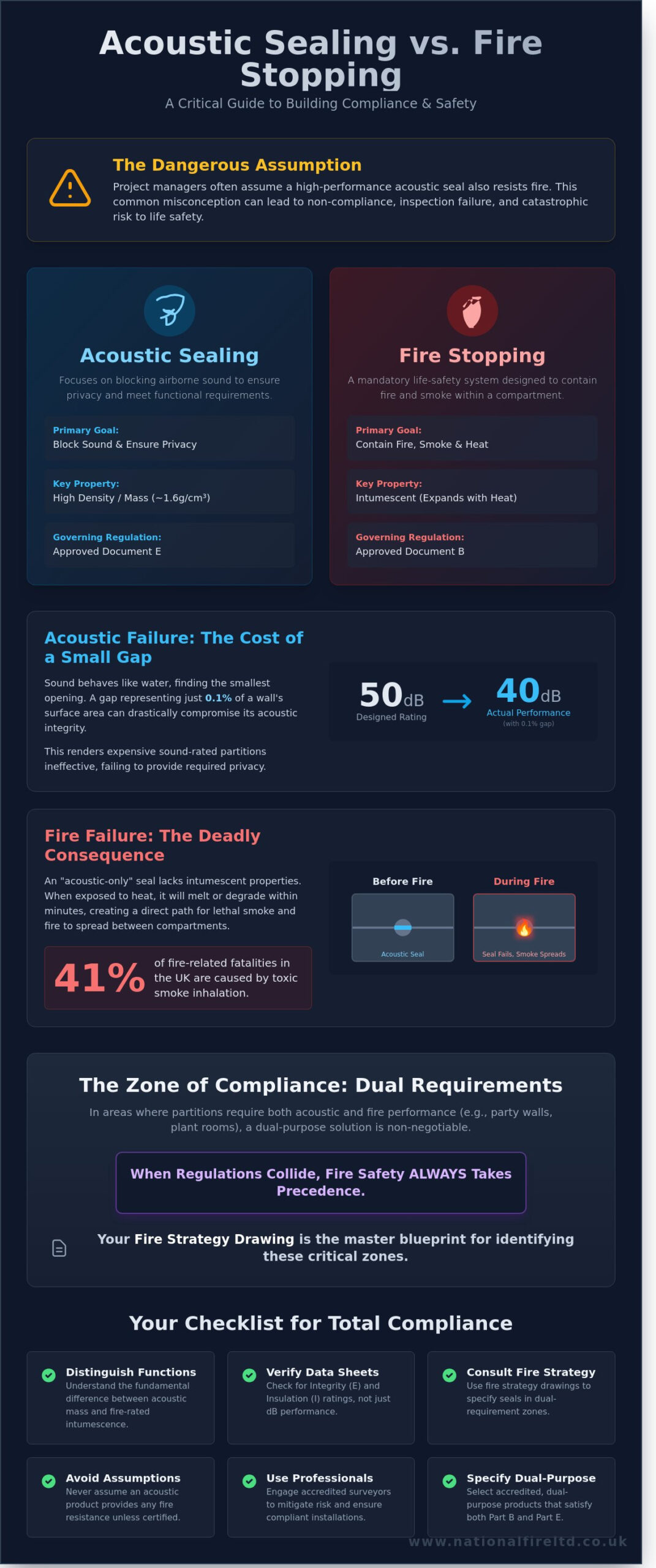
Acoustic sealing is the professional application of high-density materials to close apertures in a building’s fabric, preventing sound energy from bypassing a partition. In commercial environments, architects specify partitions with a specific Decibel (dB) rating to ensure privacy and focus. For instance, a boardroom wall might be designed to achieve a 50dB rating. If the perimeter isn’t sealed with precision, that rating can drop by 10dB or more, rendering the expensive acoustic partition ineffective.
Our technicians focus on several critical areas to maintain this performance:
- Service Penetrations: Gaps around electrical conduits, HVAC ductwork, and plumbing pipes.
- Floor and Ceiling Joints: The junctions where a partition wall meets the structural floor slab or the soffit.
- Head-of-Wall Details: The gap between the top of a partition and the underside of the floor above, which often fluctuates due to structural deflection.
Standard decorators’ caulk or general-purpose fillers fail in these applications because they lack the necessary mass. Specialist acoustic sealants typically offer a density of approximately 1.6g/cm³. This density provides the physical barrier required to block sound waves, whereas standard fillers often shrink or crack, creating new paths for noise leakage. Our methodical approach ensures every seal is airtight, providing the peace of mind that your commercial space is private and legally compliant.
The Science of Sound Transmission
Sound behaves like water; it finds the path of least resistance. Airborne sound includes voices and telephones, whereas impact sound refers to physical vibrations like footsteps on a floor slab. Research indicates that a gap representing just 0.1% of a wall’s surface area can reduce its sound insulation performance by up to 10dB. Acoustic sealing is a method of maintaining the integrity of sound-rated partitions.
Acoustic Sealing and UK Building Regulations
Approved Document E (Resistance to the passage of sound) governs these requirements in England and Wales. For residential conversions, partitions must achieve a minimum weighted standardised plant level difference of 43dB. In large-scale office projects, we must also mitigate flanking transmission. This occurs when sound travels through indirect structural paths, such as floor voids or continuous ductwork, rather than directly through the wall. Often, these penetrations require a dual-purpose solution. While a Firestop maintains the compartmentation for life safety, the acoustic seal ensures the building remains functional and compliant with statutory privacy standards.
The Critical Intersection: Acoustic Sealing vs. Fire Stopping
Fire stopping is a statutory requirement for passive fire protection. It ensures that walls and floors maintain their integrity during a blaze; this process is called compartmentation. A common error in commercial fit-outs involves assuming that acoustic sealing products automatically provide fire resistance. They don’t. While acoustic seals prevent sound flanking, they often lack the intumescent properties needed to expand and seal gaps when exposed to high temperatures. This distinction is vital for life safety.
Building regulations in the UK create a complex overlap. Approved Document B dictates fire safety standards, while Approved Document E governs resistance to the passage of sound. When these requirements collide, the fire safety specification must take precedence. Using a product that meets sound insulation targets but fails to withstand heat creates a literal hole in a building’s fire defence. The ICC G2-2010 Guideline for Acoustics provides a framework for these standards, yet it remains secondary to local statutory fire safety requirements in the UK. Building managers must prioritise the highest safety standard to ensure full compliance.
Regulatory Conflict or Synergy?
Fire compartmentation aims to contain heat and smoke. Acoustic insulation aims to dampen vibration and air-borne noise. These objectives meet in “dual-requirement” zones, such as party walls in residential blocks or plant room partitions. To identify these areas, managers must consult the fire strategy drawing. This document serves as the master blueprint for compliance. It highlights exactly where a seal must perform both roles simultaneously to satisfy building control officers.
The Risk of Non-Compliant Installations
An “acoustic-only” seal will typically melt or degrade within minutes of fire exposure. This failure allows toxic smoke to bypass compartmentation, which accounts for approximately 41% of fire-related fatalities in the UK according to Home Office data. Under the Regulatory Reform (Fire Safety) Order 2005, the “Responsible Person” faces unlimited fines or imprisonment if installations are found to be non-compliant. To mitigate this, we recommend accredited fire stopping services that carry third-party certification from bodies like BAFE or IFC. This ensures every seal is fit for purpose, provides peace of mind, and remains legally defensible during a safety audit.
Material Selection: Comparing Acoustic and Fire-Rated Seals
Selecting the correct medium for a commercial project requires a meticulous approach to ensure both life safety and acoustic privacy. We primarily utilise three material categories: mastics, intumescent sealants, and high-density mineral wool batts. While a basic mastic might offer the flexibility needed for acoustic sealing, it often lacks the chemical properties required to withstand temperatures exceeding 1,000°C during a fire. Intumescent variants are engineered to expand up to 25 times their original volume when exposed to heat, creating a robust carbonaceous char that blocks the passage of smoke and toxic gases.
Technical data sheets provide the statutory evidence required for building control approval. You must verify the ‘E’ (Integrity) rating, which measures the duration the seal prevents flame passage, and the ‘I’ (Insulation) rating, which limits the temperature rise on the non-fire side. High-specification sealants frequently achieve a Weighted Sound Reduction Index (Rw) of up to 52dB in a single 10mm joint. Referencing standards such as ASTM C919 ensures that these materials are applied correctly to maintain their laboratory-tested performance levels in real-world conditions.
Dual-purpose solutions frequently reduce labour costs by approximately 18% compared to installing separate fire and sound barriers. While a high-specification intumescent acoustic sealant may cost £6.80 per 310ml cartridge compared to £3.20 for a standard mastic, the reduction in statutory risk and the elimination of double-handling provide a clear financial advantage. We focus on these high-performance materials to provide a bespoke solution that guarantees peace of mind for the building’s lifetime.
Acoustic Mastics vs. Intumescent Sealants
Standard acoustic mastics remain permanently flexible to manage structural movement in buildings. However, in a fire scenario, they may melt or degrade. Intumescent sealants bridge this gap by providing the necessary acoustic sealing properties under normal conditions while activating a chemical expansion during a fire. For joints with high movement, we specify sealants with a 25% movement capability to prevent cracking that would otherwise allow sound flanking or smoke leakage.
Fire Batts and Large Service Openings
For openings larger than 100mm, we deploy high-density mineral wool batts, typically rated at 140kg/m³. These provide a formidable barrier against both fire and noise. It is vital to coat these batts with an ablative sealant to prevent air leakage, which can compromise decibel ratings. We ensure every system is tested as a complete assembly; mixing components from different manufacturers can void a 120-minute fire certification and lead to compliance failure.
Best Practices for Specifying and Installing Compliant Seals
Achieving statutory compliance requires a methodical five-step workflow to ensure safety systems perform as designed. National Fire Ltd follows a disciplined approach to bridge the gap between architectural intent and site reality. It’s vital to follow these steps to protect both life and property.
- Step 1: Consult the fire strategy drawings. These documents are the primary authority for identifying fire-rated compartments and must be the starting point for any remedial work.
- Step 2: Determine the required dB rating. Under Approved Document E of the Building Regulations, specific partitions require verified sound reduction levels. You can’t assume a fire seal provides adequate acoustic sealing without checking the decibel data.
- Step 3: Select a third-party tested product. We only specify materials with clear Certifire or ETA (European Technical Assessment) accreditation that verify performance for both fire and sound.
- Step 4: Meticulous surface preparation. Dust, grease, or moisture can reduce sealant adhesion by up to 60 per cent. Surfaces must be cleaned to BS 8000-16 standards to ensure a permanent bond.
- Step 5: Document the installation. A comprehensive photographic audit is now a requirement under Regulation 38. This creates a “golden thread” of safety information for the building’s lifecycle.
Common Installation Pitfalls to Avoid
Precision is the difference between safety and failure. Over-filling or under-filling gaps compromises the seal’s ability to expand during a fire. You must maintain the manufacturer’s specified depth-to-width ratio, which is typically 1:2 for intumescent joints. Using incompatible materials is another risk. Certain sealants react chemically with CPVC plastic piping, causing the pipe to become brittle and fail within 24 months of application. Our experts ensure every acoustic sealing solution is chemically compatible with the surrounding substrate.
The Importance of Professional Surveys
A professional fire compartmentation survey identifies hidden risks that standard maintenance checks miss. In a 2023 audit of UK commercial office spaces, 72 per cent of buildings were found to have compromised seals due to subsequent utility installations. Professional drawings provide a definitive map for long-term maintenance, allowing facility managers to track every penetration. When dealing with complex service clusters, bespoke solutions are often necessary. These tailored designs ensure that even the most congested service risers meet the strict criteria of the Regulatory Reform (Fire Safety) Order 2005.
Secure your building’s compliance and gain total peace of mind by contacting us for a professional fire compartmentation survey today.
National Fire Ltd: Your Partner for Integrated Compliance
National Fire Ltd provides the authoritative reassurance needed to manage complex commercial properties. We organise comprehensive surveys that mitigate risks across 100% of your building’s service penetrations. For building managers overseeing multi-site portfolios, our status as a national contractor ensures consistency across every location. Since the Regulatory Reform (Fire Safety) Order 2005, the legal burden on the Responsible Person has never been higher. Our meticulous approach provides lasting peace of mind by ensuring every compartment wall meets its intended safety rating.
Accredited Excellence in Passive Fire Protection
Our technical quality is anchored in our BAFE and FIA memberships. These certifications are markers of a disciplined, methodical approach to remedial fire stopping and acoustic sealing. We don’t just apply materials; we engineer solutions. Every installation is documented via technical drawings that form a vital part of your statutory compliance file. This level of detail is essential for the 85% of building managers who report that documentation is their primary concern during local authority inspections. We ensure that acoustic sealing measures never compromise the fire-resisting integrity of your partitions.
Secure Your Building Today
It’s easy to schedule a survey with our nationwide team of experts. We provide bespoke solutions tailored to your specific building fire strategy, whether you’re managing a single high-rise or a regional portfolio of 25 sites. Our experts identify hidden gaps that often compromise both safety and sound privacy. Secure your property now to ensure it’s both quiet and, more importantly, safe. Contact National Fire Ltd to speak with a specialist who understands the gravity of your compliance obligations and the importance of professional standards.
Securing Your Asset Through Integrated Safety Standards
Balancing sound insulation with fire safety is a mandatory requirement under UK building regulations. It’s vital to remember that acoustic sealing must never come at the expense of fire compartmentation integrity. Selecting materials that satisfy both BS EN 1366-3 standards and specific decibel reduction targets is the only way to ensure long-term statutory compliance. National Fire Ltd provides the disciplined oversight needed to navigate these complex technical specifications across all commercial sectors. We focus on the precision of every install to give you total peace of mind.
As BAFE Accredited Specialists, we deliver comprehensive technical fire strategy drawings and offer nationwide UK coverage to mitigate risk effectively. Our methodical approach ensures every seal is documented and compliant with the Regulatory Reform (Fire Safety) Order 2005. We’re ready to act as your trusted advisor to secure your building’s future. Our team is available 24/7 to ensure your safety measures remain robust and reliable.
Ensure your building is compliant: book a fire compartmentation survey with National Fire Ltd
Frequently Asked Questions
Is acoustic sealant the same as fire-rated sealant?
No, acoustic sealant and fire-rated sealant are distinct products, though hybrid solutions exist. Standard acoustic sealing focuses on mass and flexibility to dampen sound waves, whereas fire-rated sealants must withstand temperatures exceeding 1,000°C. Using a non-fire-rated acoustic product in a fire-rated partition violates Approved Document B. We recommend products tested to BS EN 1366-3 to ensure both 4-hour fire protection and 50dB sound reduction.
Can I use fire-rated foam for acoustic sealing in a commercial building?
You shouldn’t use standard fire-rated foam for acoustic sealing because its rigid, cellular structure often fails to block sound effectively. While it expands to fill gaps, it lacks the density required to meet the 45dB requirements set out in building regulations. Specialised acoustic foams or intumescent mastics are necessary to achieve the mass required for sound dampening. National Fire Ltd uses products with specific weighted sound reduction index ratings to ensure statutory compliance.
What are the UK regulations for acoustic sealing in offices?
Acoustic sealing in UK offices is governed by Approved Document E of the Building Regulations 2010. For new office builds, internal walls between rooms usually require a minimum sound insulation of 40dB to 45dB. Compliance is mandatory under the Building Act 1984. Failure to meet these standards can result in enforcement notices or the requirement for expensive retrospective remedial works. We ensure all installations align with these specific acoustic performance targets.
How long does a fire-rated acoustic seal last before it needs replacing?
A high-quality fire-rated acoustic seal typically lasts between 10 and 25 years under normal internal conditions. Environmental factors like high humidity or significant structural movement can reduce this lifespan by 30 percent. The Regulatory Reform (Fire Safety) Order 2005 requires regular inspections to ensure these seals remain functional. We provide comprehensive maintenance schedules to identify degradation, such as cracking or shrinkage, before the seal’s integrity is compromised.
Do I need a fire compartmentation survey if I only have acoustic concerns?
Yes, you should commission a fire compartmentation survey because acoustic leaks often indicate breaches in fire-rated barriers. Gaps as small as 2mm can allow both sound and toxic smoke to pass through a building’s structure. Under the Fire Safety Act 2021, building owners must manage the risk of fire spread. Identifying these gaps through a professional survey ensures that your acoustic sealing works also satisfy your legal fire safety obligations.
What is the difference between Approved Document B and Approved Document E?
Approved Document B focuses on fire safety and the prevention of fire spread, while Approved Document E regulates resistance to sound. While Document B mandates fire stopping to protect life for up to 120 minutes, Document E ensures privacy and acoustic comfort. Both are statutory requirements under the Building Regulations 2010. Our team integrates these standards to ensure a single installation meets the legal thresholds for both fire resistance and sound insulation.
Can National Fire Ltd provide bespoke drawings for acoustic and fire sealing?
We provide bespoke technical drawings for every complex acoustic and fire sealing project we undertake. These detailed schematics ensure that every penetration and joint is sealed according to BAFE standards and manufacturer specifications. Our drawings serve as a permanent record for your health and safety file, which is a requirement under the CDM Regulations 2015. This meticulous documentation gives you total peace of mind that your building is fully compliant.
Are intumescent strips required for acoustic fire doors?
Yes, intumescent strips are essential for acoustic fire doors to meet both safety and noise standards. These strips expand at temperatures around 150°C to seal the gap between the door and the frame. For acoustic performance, these are usually paired with separate cold smoke seals that provide the necessary 35dB sound reduction. We install combined seals tested to BS 476-22 to ensure your doorsets provide a robust barrier against both noise and fire.