


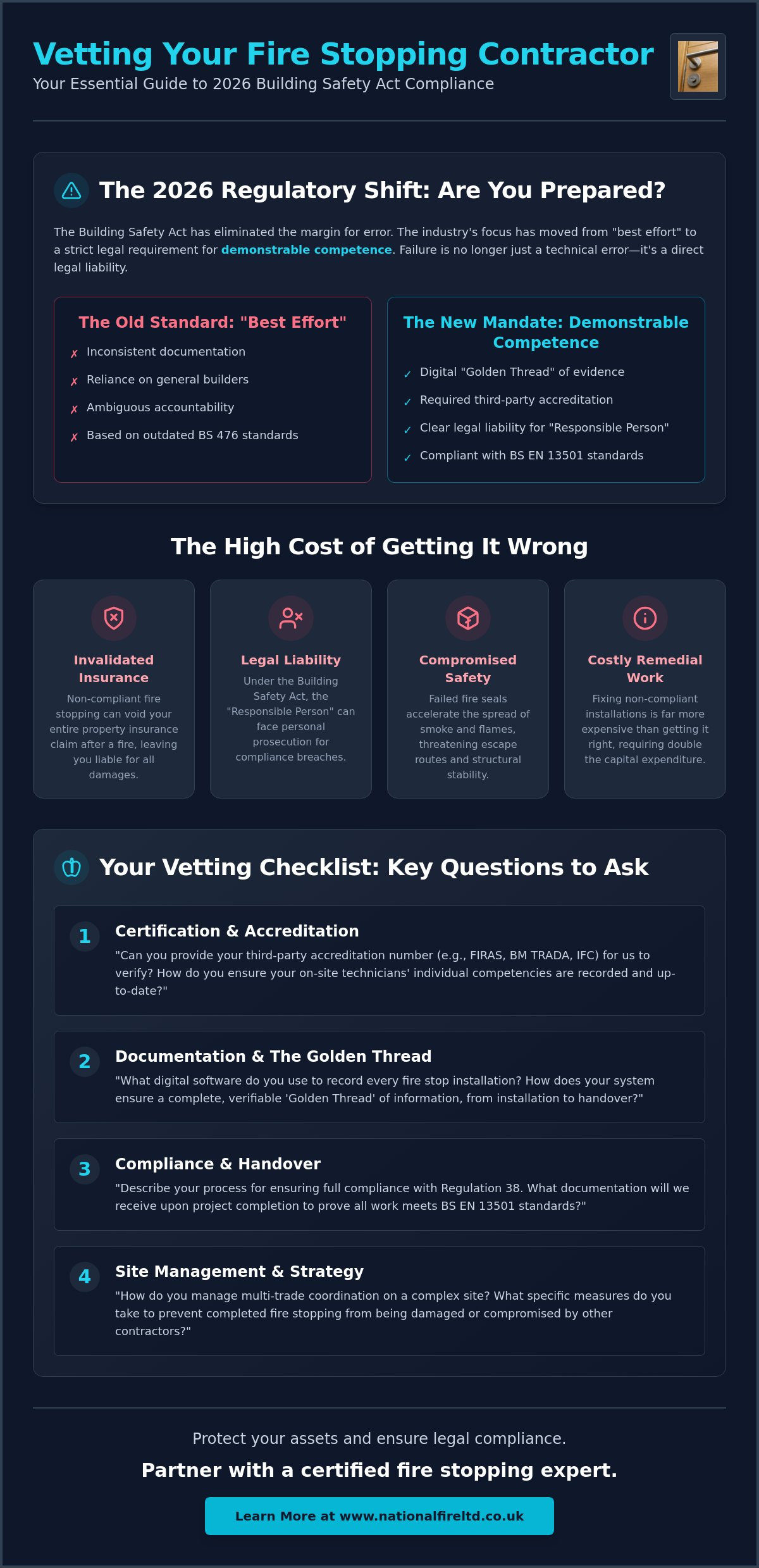
In 2026, a fire stopping failure is no longer just a technical error. It’s a direct legal liability under the Building Safety Act. With the transition from BS 476 to BS EN 13501 complete and new amendments to Approved Document B taking effect on September 30, the margin for error has vanished. Identifying the right partner requires more than a cursory glance at a brochure. You need a rigorous set of questions to ask a fire stopping contractor to ensure they can uphold the golden thread of information required for higher-risk buildings.
It’s understandable if the pressure to remain compliant while managing conflicting technical standards feels overwhelming. You carry a heavy responsibility to protect lives and property while keeping insurance premiums manageable through meticulous documentation. This guide provides an authoritative framework for your procurement process, helping you master the vetting steps necessary to secure your building’s future. We’ll examine how to verify third-party certifications, ensure Regulation 38 handover compliance, and confirm your contractor is fully prepared for the latest 2026 safety mandates.
Key Takeaways
- Understand the 2026 shift from “best effort” to demonstrable competence under the Building Safety Act to protect your insurance validity.
- Learn the essential questions to ask a fire stopping contractor regarding third-party accreditation and individual technician competency records.
- Identify the digital documentation requirements needed to maintain the “golden thread” of building safety and ensure Regulation 38 compliance.
- Master the vetting process for site management to ensure fire stopping installations remain undamaged during multi-trade coordination on complex projects.
The Stakes of Selection: Why Your Choice of Fire Stopping Contractor Matters
Selecting a contractor for passive fire protection is a decision that carries significant legal and financial weight. In the current regulatory environment, the industry has moved away from “best effort” installations toward a strict requirement for demonstrable competence. By 2026, building owners and managers must prove that every Firestop installation meets exact technical specifications. This shift is driven by the need for a “golden thread” of information, ensuring that every seal is documented and verified. If you aren’t prepared with the right questions to ask a fire stopping contractor, you risk hiring a firm that cannot provide this level of evidence.
The consequences of poor selection extend to your insurance coverage. Most commercial property insurance policies contain clauses requiring compliance with all statutory fire safety regulations. If a fire occurs and investigators find that non-compliant fire stopping contributed to the spread of flame or smoke, your insurer may invalidate the claim. This leaves the organization liable for the full cost of damages. Under the Regulatory Reform (Fire Safety) Order 2005, the “Responsible Person” is legally obligated to ensure all fire safety measures are fit for purpose. Relying on general builders for these specialized tasks often leads to failure, as they typically lack the specific accreditation and technical training required for complex compartmentation.
Understanding Regulatory Liability
The Building Safety Act 2022 has fundamentally changed procurement. It places a duty on those commissioning work to ensure the people they hire are competent. For facilities managers, this isn’t just a corporate risk; it can lead to personal liability and prosecution if a breach is discovered. Choosing the “cheapest quote” is a high-risk strategy. A low price often indicates a lack of third-party accreditation or a failure to use digital recording software, both of which are now essential for legal compliance. Using a structured list of questions to ask a fire stopping contractor ensures you prioritize competence over initial cost.
The Cost of Remedial Failure
Remedial work is far more expensive than getting it right the first time. Having to strip back ceilings or walls to redo non-compliant service penetrations disrupts operations and doubles your capital expenditure. Poorly executed fire stopping compromises the entire fire compartmentation strategy, allowing fire to bypass intended barriers. An integrity failure occurs when a fire seal develops cracks or gaps that allow the passage of flames and hot gases, rapidly accelerating smoke spread throughout the building. This failure directly threatens the safety of escape routes and the stability of the structure.
Verifying Technical Competence: Questions on Certification and Accreditation
Technical competence in fire stopping is non-negotiable. While many firms claim expertise, true proficiency is demonstrated through rigorous third-party validation and a deep understanding of evolving standards. When choosing a fire protection contractor, you aren’t just buying a service; you’re investing in a safety system that must perform under extreme conditions. The most critical questions to ask a fire stopping contractor revolve around their ability to prove that their work meets the specific fire resistance ratings required for your building’s design.
A contractor’s response to these queries reveals their commitment to the disciplined nature of life safety. It’s not enough for a company to hold a general trade membership. They must demonstrate that their supervisors are trained in the latest BS EN 13501 standards and that every operative on-site understands the specific “Scope of Application” for the materials they use. This level of detail ensures that your building remains compliant and that your insurance remains valid.
Decoding Third-Party Accreditations
Third-party accreditation schemes like FIRAS, BM TRADA, and IFC certification are the industry’s primary safeguards. These bodies conduct regular audits of a contractor’s office processes and on-site installations. You should ask for their registration number and verify it directly through the relevant accreditation database. Company-level status is essential, but it must be supported by individual competency records. Each technician should possess a valid CSCS card or equivalent training record that specifically lists fire stopping as a qualified skill. This ensures that the person actually applying the sealant or installing the batt has been assessed by an external expert.
Product and Material Knowledge
Every service penetration has a “tested solution” provided by the manufacturer. If a contractor uses a sealant in a way that wasn’t tested, the fire rating is void. Ask your contractor how they verify that products are used within their tested scope. They should be able to provide technical data sheets and primary test evidence for every seal type. It’s best practice to use single-manufacturer systems for compatibility. Mixing products from different brands in the same opening can lead to chemical reactions or performance failures. Our team at National Fire Ltd prioritizes these single-system solutions to ensure maximum reliability and compliance for every project.
Finally, inquire about their process for managing supervisors. A competent contractor will have a clear hierarchy where trained supervisors review work daily. This internal audit process mirrors the external scrutiny your building will face during a fire risk assessment or a Building Safety Regulator inspection. By asking these targeted questions, you move from hope-based procurement to a methodical, evidence-led selection process.
Ensuring Accountability: Questions Regarding Documentation and the Golden Thread
Accountability in the fire safety sector is no longer measured by the completion of a task, but by the quality of the data left behind. In 2026, the “golden thread” of building information is a mandatory requirement for higher-risk buildings, necessitating a seamless flow of digital evidence from installation through to handover. When assessing potential partners, the most critical questions to ask a fire stopping contractor involve their specific digital reporting capabilities. If a contractor cannot provide a granular, verifiable record of every seal, they aren’t just a safety risk; they’re a legal liability.
Our industry has moved past the era of paper checklists and vague summaries. Modern compliance requires a methodical approach to data collection that survives the lifetime of the building. This documentation serves as the primary evidence for fire risk assessments and insurance renewals. Without it, you cannot prove that hidden works meet the required standards once they are enclosed by ceilings or partitions. You must verify that your contractor has a robust process for handling non-conformance, ensuring that any installation errors are identified, corrected, and re-recorded before the project concludes.
Digital Record Keeping and Evidence
Photographic evidence is the only way to verify the integrity of fire stopping in concealed spaces. You should ask your contractor exactly what digital software they use to record their work. A professional firm will utilize platforms that allow for 3D tagging on digital floor plans, ensuring each penetration is mapped with precision. This data must include a unique ID number, “before and after” photographs, and the specific manufacturer data sheet for the product used. This level of detail is essential for future fire compartmentation surveys, allowing surveyors to verify the “as-built” condition without destructive testing.
Regulation 38 and Information Handover
Regulation 38 is a legal requirement under the Building Regulations that mandates the transfer of fire safety information from the person carrying out the work to the “Responsible Person” to ensure the building can be safely managed and maintained. This transfer isn’t a mere formality; it’s a critical component of the building’s legal compliance. You must ensure your contractor can provide a comprehensive handover package that includes updated fire strategy drawings reflecting the actual installations. This package must be accessible, accurate, and formatted to integrate with your building’s digital logbook. By securing this information at the point of completion, you protect the organization from the high costs of retrospective data collection and ensure a secure environment for all occupants.
Operational Vetting: Questions on Site Management and Strategy
Operational excellence is the bridge between a theoretical fire strategy and a safe building. Technical knowledge means little if site management is chaotic. When considering questions to ask a fire stopping contractor, you must focus on their ability to integrate with other site activities. Fire stopping is rarely a standalone task; it requires constant coordination with electrical and HVAC trades to ensure that once a seal is installed, it remains uncompromised. A contractor’s site strategy should be methodical, reflecting the disciplined nature of the life safety industry.
The “last trade in” problem is a primary cause of non-compliance in modern construction. Contractors often find their work breached by other trades installing additional services after the fire stopping is complete. A disciplined contractor will have a strategy for managing the sequence of works and educating other personnel on-site. They should be able to explain how they protect their installations and what steps they take if a breach occurs to ensure the building’s safety is never in doubt.
Trade Coordination and Protection
Preventing damage to fire seals is essential for maintaining fire compartmentation. You should ask how the contractor manages the sequence of works for service penetrations. A professional firm will establish clear handover points where they sign off an area as compliant, only for it to be protected from further trade interference. This level of oversight ensures that your investment in safety isn’t wasted by a single cable pull from an uninformed subcontractor.
Pre-Construction and Surveying
A professional installation starts long before the first sealant is applied. You must ask about their “pre-start” survey process. This initial assessment is vital for identifying existing non-compliance that might hinder new work. A comprehensive fire compartmentation survey uncovers hidden risks, such as improperly installed or missing cavity barriers. Understanding how a contractor handles these unforeseen issues is a key indicator of their reliability. They must have a clear procedure for reporting these risks to the building owner rather than simply working around them.
Working in occupied or sensitive environments, such as hospitals or care homes, requires a specialized level of operational discipline. You should ask about their protocols for dust suppression, noise management, and the maintenance of clear escape routes during the works. Health and safety protocols for working at height or within confined ceiling voids must be exhaustive and site-specific. A contractor’s ability to provide detailed RAMS (Risk Assessments and Method Statements) for these scenarios demonstrates their commitment to high-level risk mitigation. If you require a partner who prioritizes operational stability and safety, contact our technical team for a site strategy consultation.
Partnering for Compliance: How National Fire Ltd Exceeds Standard Vetting
National Fire Ltd positions itself not merely as a service provider, but as a steadfast guardian of life and property. When you evaluate the questions to ask a fire stopping contractor, our responses reflect a deep integration into the UK’s legal safety framework. We hold the highest tiers of third-party certification, ensuring that every project is underpinned by accredited expertise. Our commitment to compliance is absolute, providing you with the technical excellence required to navigate the complexities of modern building safety.
We utilize advanced digital reporting systems to secure the “golden thread” for your assets. Every installation we perform is documented with a unique ID, high-resolution photographic evidence, and a specific manufacturer data sheet. This methodical data collection ensures that your building remains compliant, insured, and ready for any regulatory audit. By choosing a partner with a national reach and a serious approach to risk mitigation, you ensure that safety is never compromised.
A Methodical Approach to Passive Fire Protection
Our process begins with comprehensive fire compartmentation surveys conducted by expert surveyors. These assessments identify existing vulnerabilities and form the basis for a robust remediation strategy. We don’t stop at installation; we provide specialized fire strategy drawings and floor plan generation to ensure your documentation is as precise as the physical seals. This holistic approach is essential in high-stakes commercial and industrial environments where complex service penetrations require disciplined oversight and technical precision.
Securing Your Professional Legacy
We understand the weight of responsibility carried by Responsible Persons and Facilities Managers. Our goal is to provide the authoritative reassurance you need to manage your properties with confidence. By focusing on long-term maintenance and high-standard passive fire protection, we help you avoid the pitfalls of remedial failure and insurance invalidation. Our experts are always prepared to provide the stability and competence required to protect your building’s future. To ensure your property meets the highest standards of safety and regulatory compliance, contact National Fire Ltd for a compliance-first consultation.
Securing Your Building’s Future through Rigorous Vetting
The regulatory landscape of 2026 demands a shift from passive observation to active, evidence-based procurement. You now have the framework to move beyond superficial checks. By prioritizing digital record-keeping and verifying individual competency, you ensure your building meets the stringent requirements of the Building Safety Act. These specific questions to ask a fire stopping contractor serve as your primary tool for mitigating risk and maintaining the golden thread of information.
National Fire Ltd stands ready to support your compliance journey as a BM TRADA Q-Mark Accredited partner. We’re specialists in Building Safety Act compliance and offer comprehensive national coverage across all commercial sectors. Our methodical approach provides the authoritative reassurance you need to manage your assets securely. We’re committed to long-term partnerships that prioritize life safety above all else. Every assessment we conduct and every seal we install is backed by our unified front of experts.
Ensure your building is compliant — Consult with our fire stopping experts today. Taking this step today creates a safer, more stable environment for everyone tomorrow.
Frequently Asked Questions
Is it a legal requirement to use a third-party accredited fire stopping contractor?
Third-party accreditation is the most robust way to demonstrate the “demonstrable competence” required by the Building Safety Act 2022. While the law doesn’t name specific schemes, it places the burden of proof on the Responsible Person to ensure all contractors are qualified. Using an accredited firm is a core part of the questions to ask a fire stopping contractor to ensure your procurement process stands up to legal scrutiny.
How do I check if a fire stopping product is compatible with the wall type?
Compatibility is verified by examining the manufacturer’s primary test evidence and technical data sheets. These documents define the “Scope of Application,” listing the specific wall types, such as blockwork or plasterboard, where the product is proven to perform. A disciplined contractor will always match the product to the substrate to ensure the fire resistance rating remains intact and compliant with national standards.
What is the “Golden Thread” and how does it affect fire stopping?
The “Golden Thread” is a digital repository of building safety information required for higher-risk buildings under the Building Safety Act. It mandates that all fire stopping installations are recorded with precision, including photographic evidence and technical specifications. This ensures that safety information is accessible and accurate for the entire life of the building, facilitating better maintenance and more reliable fire compartmentation surveys.
Can my regular maintenance team install fire stopping mastic?
Regular maintenance teams typically lack the specialized training and third-party accreditation necessary for compliant fire stopping. Installing mastic is not a simple cosmetic task; it requires an understanding of annular space, backing materials, and specific fire ratings. Incorrect application can lead to an integrity failure, allowing smoke to bypass the compartment. Entrusting this to non-specialists is a high-risk strategy that compromises building safety.
What documentation should I receive after a fire stopping project is completed?
Upon completion, you must receive a detailed handover package that satisfies Regulation 38 requirements. This package should include a digital register of every seal, unique identification tags, and “as-built” fire strategy drawings. Providing this level of documentation is a key requirement when formulating questions to ask a fire stopping contractor, as it ensures your building’s safety information is complete and verifiable for insurers and regulators.
How often should service penetrations and fire stopping be re-inspected?
Industry best practice suggests that fire compartmentation and service penetrations should be surveyed annually. This frequency aligns with the review of your fire risk assessment under the Regulatory Reform (Fire Safety) Order 2005. More frequent inspections are necessary in buildings with high turnover of tenants or frequent mechanical upgrades, where the risk of unauthorized breaches to fire seals is significantly higher.
What happens if a fire stopping seal is breached by a new cable installation?
A breached seal creates a direct path for smoke and flames, compromising the entire fire safety strategy. The breach must be remediated immediately by a qualified professional using a tested solution that is compatible with the existing seal and the new service. You should maintain a strict permit-to-work system to ensure that any trade breaching a compartment is held accountable for professional remediation by an accredited specialist.
Does fire stopping also provide acoustic insulation?
Many fire stopping materials are engineered to provide acoustic insulation alongside fire resistance. You should verify the specific Rw (Weighted Sound Reduction Index) on the product’s technical data sheet to ensure it meets your building’s acoustic requirements. While the primary function is life safety, high-quality fire stopping can effectively reduce noise transfer between rooms, contributing to a more controlled and professional environment for building occupants.