


While active systems like sprinklers often grab the headlines, the structural integrity of your building determines the ultimate outcome of a fire incident. The most effective safety measures are frequently the ones built into the very fabric of the walls and floors. You likely recognise that staying ahead of the Regulatory Reform (Fire Safety) Order 2005 is a rigorous, ongoing responsibility. It’s natural to feel concerned about hidden risks within service penetrations or the evolving requirements of the Building Safety Act 2022.
While these components focus on fire containment, the principle of passive protection extends to other vital building systems. For instance, securing plumbing infrastructure like backflow prevention devices is crucial for maintaining water safety and operational continuity. In these cases, physical protection like Standard Expanded Metal Enclosures serves a similar purpose, safeguarding critical assets from damage and ensuring they remain functional.
This guide provides a methodical path through the complex legislative landscape. You’ll discover how passive fire protection acts as the essential foundation of your safety strategy, ensuring statutory compliance and vital life-saving containment. We’ll examine accredited components like fire doors, compartmentation, and intumescent seals to give you total peace of mind that your property is structurally protected. By following this comprehensive framework, you can mitigate risks and ensure your building meets the highest standards of the British standard BS 9999.
Key Takeaways
- Understand how passive fire protection acts as a built-in shield to contain fire at its origin and protect structural integrity.
- Distinguish between active suppression and passive containment to develop a robust, multi-layered fire safety strategy for any building.
- Identify the vital roles of fire stopping and fire doors in maintaining compartmentation and meeting statutory UK safety standards.
- Navigate complex legal requirements, including the Building Safety Act 2022, to ensure your property meets current and future compliance mandates.
- Learn how professional technical strategy drawings establish the “Golden Thread” of information required for comprehensive building oversight and peace of mind.
What is Passive Fire Protection? The Invisible Shield
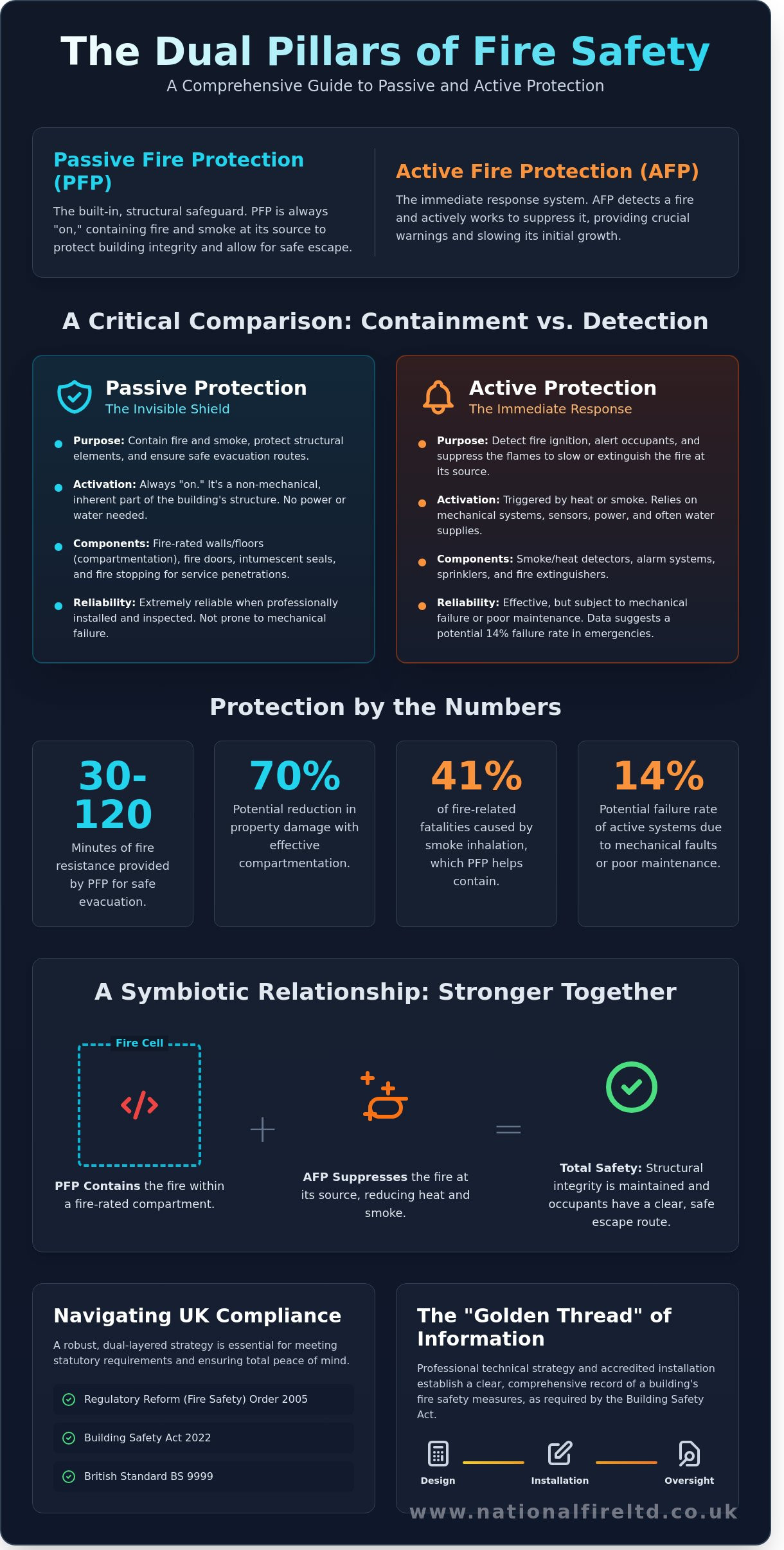
Passive fire protection (PFP) is a fundamental component of a building’s fabric, designed to remain dormant until the moment it’s required. Unlike active systems that react to heat or smoke, PFP is an inherent structural safeguard. It’s built into the walls, floors, and ceilings to ensure the building can withstand a thermal event without collapsing. This provides the essential stability needed for both occupants and emergency responders.
Passive fire protection is the structural safeguard that limits fire to its source.
By containing a fire at its origin, these measures prevent the rapid spread of flames and toxic gases. This containment protects the load-bearing elements of a structure, which is critical for maintaining stability. Under the Regulatory Reform (Fire Safety) Order 2005, providing a safe “window of time” for evacuation is a legal necessity. PFP typically offers between 30 and 120 minutes of fire resistance, allowing occupants to exit and emergency services to enter safely. This duration is verified through rigorous testing to BS 476 or EN 1366 standards.
The Core Principles of Fire Compartmentation
Compartmentation involves dividing a building into “fire cells” using fire-rated walls and floors. This strategy is a statutory requirement to prevent a localised fire from becoming a total loss. A 2023 industry report suggests that effective compartmentation can reduce property damage costs by up to 70%. However, a single unprotected pipe or cable tray can compromise this entire shield. National Fire Ltd ensures that every service penetration is sealed with accredited fire-stopping materials to maintain the integrity of the compartment.
The Importance of Built-In Safety
PFP is always “on” because it doesn’t require power, water, or mechanical activation. It provides a reliable baseline of safety that mitigates the risk of domino effects in high-density commercial settings. In industrial environments, where hazardous materials are often present, this constant readiness is essential for business continuity. Our bespoke solutions ensure that 100% of structural joints and gaps are addressed, providing the peace of mind that comes from a comprehensive, fail-safe safety strategy.
Passive vs Active Fire Protection: A Critical Comparison
Achieving statutory compliance requires a dual-layered approach to building safety. Active Fire Protection (AFP) focuses on the immediate response to an ignition event. This includes BAFE-accredited detection systems, sprinklers, and extinguishers that trigger to suppress flames. Conversely, passive fire protection is built into the fabric of the structure. It utilises fire doors, intumescent coatings, and fire stopping to contain the outbreak. AFP serves as the immediate response. PFP provides the structural integrity needed to prevent a localised incident from becoming a total loss.
The relationship between these two systems is symbiotic. An active system might fail if the structural containment is compromised. For instance, a sprinkler system designed for a small office cannot suppress a fire that has breached a non-compliant wall and entered a larger warehouse space. We ensure that every installation adheres to the highest standards, providing the peace of mind that comes from a comprehensive safety strategy.
The Detection vs. Containment Debate
An alarm system provides the necessary warning for evacuation. It does nothing to stop the spread of toxic gases. Research from the Building Research Establishment (BRE) indicates that smoke inhalation causes approximately 41% of fire-related fatalities in the UK. Passive fire protection mitigates this risk by sealing service penetrations and maintaining compartmentation. This ensures that while sprinklers control the seat of the fire, the heat and smoke remain trapped within the original zone. This provides occupants with a safe, clear means of escape. A balanced strategy integrates both pillars to meet the stringent requirements of the Regulatory Reform (Fire Safety) Order 2005.
Operational Reliability
Active systems are complex and mechanical. They rely on power supplies, water pressure, and sensors. Data suggests that 14% of active systems may fail during an emergency due to poor maintenance or mechanical fault. PFP offers a more permanent solution. It’s non-mechanical and always “on.” It doesn’t require a power source to function. However, its effectiveness depends on meticulous installation and regular technical surveys.
While AFP requires frequent mechanical testing, PFP demands expert visual inspections to ensure seals haven’t been breached during building works. To maintain your building’s safety, you should consult with accredited experts who understand these technical nuances. Investing in high-quality PFP reduces long-term lifecycle costs by providing 24/7 protection without the constant energy demands of active hardware. This disciplined approach ensures that your property remains a safe environment for all occupants.
The Essential Components of a PFP Strategy
A resilient passive fire protection strategy isn’t a collection of isolated products; it’s a holistic system designed to maintain building stability. Every component must perform under extreme thermal stress to provide the necessary time for evacuation. National Fire Ltd approaches this through four primary disciplines that ensure statutory compliance and structural endurance.
- Fire Stopping: We seal service penetrations where pipes, cables, or ductwork breach compartment walls. This restores the integrity of the fire-rated partition, preventing the passage of flame and toxic gases.
- Structural Steel Protection: Load-bearing steel begins to lose its structural integrity at approximately 550°C. We apply intumescent coatings or specialist boarding to ensure the building frame remains stable for up to 120 minutes during a fire event.
- Cavity Barriers: These are installed within the hidden voids of a building, such as those found in rainscreen cladding or timber frame constructions. They are vital for preventing the rapid spread of fire through the building’s “envelope.”
- Fire Doors: These serve as the primary means of escape while maintaining compartmentation. Because they’re the only moving part of a passive fire protection system, they require a rigorous inspection and maintenance regime.
Fire Doors as Life-Saving Assets
A certified fire door assembly is a precision-engineered safety device. It differs significantly from standard joinery by incorporating intumescent strips that expand at 150°C to seal the gap between the door and the frame. These assemblies also include cold smoke seals and mandatory self-closing devices to ensure the door remains shut when not in use. We advocate for BM TRADA Q-Mark certification as the industry benchmark. This third-party accreditation provides definitive proof that the door will perform as intended during a fire, offering stakeholders genuine peace of mind.
Advanced Solutions: Injectable Cavity Barriers
Modern building facades often create a “chimney effect,” where fire can travel vertically through wall cavities at alarming speeds. Injectable cavity barriers provide a sophisticated solution for remedial works in occupied buildings. This method allows our engineers to install fire-rated material into existing voids without the need for costly and disruptive cladding removal. These barriers are essential for ensuring buildings over 11 metres meet the stringent requirements of Approved Document B. By mitigating hidden fire spread, we protect the structural integrity of the facade and the safety of all occupants.
UK Compliance: Navigating Regulations and the Golden Thread
The Regulatory Reform (Fire Safety) Order 2005 serves as the primary statutory instrument for commercial safety in England and Wales. On 1 October 2023, Section 156 of the Building Safety Act 2022 came into force, significantly tightening the requirements for every “Responsible Person” in a commercial or multi-occupancy setting. These modern amendments remove previous exemptions for small businesses, meaning every fire risk assessment must now be recorded in full. Compliance is no longer a periodic check; it’s a continuous obligation that evolves with the building’s lifecycle.
Central to this new landscape is the “Golden Thread” of information. This is a digital record that tracks a building’s safety data from the initial design phase through to eventual demolition. By 2026, the government expects all high-risk buildings to have a fully operational digital audit trail. This ensures that the integrity of passive fire protection measures is never compromised by undocumented maintenance or structural changes. For the Responsible Person, the legal liability is absolute. Failure to provide this evidence of safety can result in unlimited fines or custodial sentences if a breach leads to a life-safety failure.
The Role of Fire Compartmentation Surveys
Professional surveys are essential for identifying “hidden” breaches in fire walls and floors. These gaps often occur above suspended ceilings where HVAC systems or data cables have been retrofitted without proper fire stopping. In approximately 70% of older commercial properties, these penetrations bypass original safety designs. A technical survey creates a prioritised remedial action plan. We use technical fire strategy drawings to map these compartments, ensuring the building’s layout supports long-term statutory compliance and provides a clear blueprint for future works. For a comprehensive understanding of how to identify and address these critical vulnerabilities, our fire compartmentation guide provides detailed insights into maintaining effective containment systems.
Third-Party Accreditation and Quality Assurance
Appointing BAFE or BM TRADA accredited contractors is a critical legal safeguard for any business owner. These bodies provide independent verification that an installer has the technical competence to execute complex passive fire protection tasks correctly. Every project we complete includes “As-Built” documentation and detailed fire stopping logs, which serve as a permanent record for the Golden Thread. Third-party accreditation provides the necessary evidence of due diligence. This documentation acts as your primary defence during local authority audits or insurance reviews.
Protect your property and ensure full regulatory compliance by booking a professional fire compartmentation survey with our accredited experts today.
Securing Your Property with National Fire Ltd
National Fire Ltd delivers a robust framework for passive fire protection through a disciplined, methodical approach. We don’t just install materials; we engineer safety. Our team specialises in technical fire strategy drawings and precise floor plan generation, ensuring every compartmentation line is documented with 100% accuracy. We operate across the UK, providing critical infrastructure support to the commercial, industrial, and high-rise sectors. Our promise is simple. We provide the authority and reliability required to meet statutory obligations, giving you total peace of mind. We currently manage safety protocols for over 500 high-rise residential blocks, ensuring they meet the stringent requirements of the Building Safety Act 2022.
Bespoke Remedial Solutions
Every building presents unique risks. We tailor our fire stopping and door maintenance programmes to your specific occupancy patterns. To ensure minimal disruption, we schedule works around your peak hours, often performing night shifts for 24-hour industrial facilities. Our 24/7 availability means we’re ready to address urgent compliance failures immediately. Whether it’s a single fire door or a complex industrial warehouse, our accredited engineers apply the same meticulous standards to every seal and joint. We utilise only BAFE-accredited products, ensuring that 100% of our remedial work meets current UK fire safety regulations and passive fire protection standards.
Start Your Compliance Journey Today
Compliance isn’t a one-time event; it’s a continuous commitment to life safety. The first step involves booking a professional fire compartmentation or door survey. Our expert team uses these audits to identify hidden breaches and mitigate risk through technical excellence. We’ve helped 98% of our clients achieve full compliance within their first 12 months of partnership. By prioritising high-risk areas first, we manage your budget while maximising safety. Ensure your building is compliant with National Fire Ltd and secure your property today.
Securing Your Statutory Compliance and Building Integrity
Maintaining a robust passive fire protection strategy isn’t just a safety preference; it’s a legal obligation under the Regulatory Reform (Fire Safety) Order 2005. Effective compartmentation and the implementation of the “golden thread” of information are essential to meeting the requirements of the Building Safety Act 2022. These measures ensure that fire is contained at its source, providing critical time for evacuation and protecting the structural stability of your property. For commercial property owners seeking comprehensive guidance on implementing these critical safety measures, our passive fire safety guide provides detailed technical insights and practical implementation strategies.
National Fire Ltd brings over 15 years of industry experience to every project. We’re BAFE Accredited for fire safety services and hold BM TRADA certification for fire door installations. Our team specialises in high-rise facade safety and the installation of cavity barriers to mitigate risks associated with modern construction. We provide the technical excellence required to keep your building safe and compliant at all times. When selecting contractors for your critical safety infrastructure, it’s essential to verify their credentials and expertise. Our comprehensive guide on passive fire protection companies provides a detailed checklist to help you evaluate potential partners and ensure they meet the rigorous standards required for 2026 compliance.
Don’t leave your property’s safety to chance. Take the first step toward total peace of mind by contacting our specialist team today. Request a Comprehensive Fire Compartmentation Survey to identify and rectify potential risks before they become critical failures. We’re ready to help you protect what matters most.
Frequently Asked Questions
What is the main difference between passive and active fire protection?
Passive fire protection contains a fire within its origin compartment, while active systems react to the presence of flames or smoke. Active measures like sprinklers or alarms require a specific trigger or power source to operate. In contrast, passive elements are built into the building’s fabric. They provide structural stability and limit smoke spread for up to 120 minutes without any human intervention or mechanical activation.
Is passive fire protection a legal requirement for UK businesses?
Yes, maintaining effective fire-stopping measures is a statutory requirement under the Regulatory Reform (Fire Safety) Order 2005. This legislation mandates that the Responsible Person ensures the building’s structure maintains its integrity during an emergency. Failure to comply often results in unlimited fines or prison sentences of up to 2 years. We provide the necessary accredited certifications to ensure your premises meet these rigorous British Standards.
How often should passive fire protection systems be inspected?
You should instruct a professional to inspect your passive fire protection systems at least every 6 to 12 months. While the 2005 Order doesn’t set a rigid timeframe, BS 9999 recommends 6-month intervals for fire doors in high-traffic areas. Our bespoke maintenance programmes ensure that 100% of your fire-stopping seals remain compliant. Regular audits mitigate the risk of material degradation and provide total peace of mind.
What are the most common failures in passive fire protection?
The most frequent failures involve poorly installed service penetrations and damaged fire doors. Data from the Fire Door Inspection Scheme shows that 76% of inspected fire doors fail to meet required safety standards. Often, external contractors compromise compartmentation by drilling holes for cables without reinstating the fire seal. These gaps allow smoke to bypass 60-minute barriers, which directly violates building regulations and endangers building occupants.
Can I install fire stopping products myself?
You shouldn’t install fire stopping products yourself unless you hold specific third-party accreditation. Incorrect installation accounts for 45% of passive fire system failures in UK commercial properties. Even a 2mm gap around a pipe penetration can render a fire barrier useless in a real emergency. Our BAFE-accredited engineers ensure every installation meets the precise manufacturer specifications required for statutory compliance and insurance validity.
What is a fire compartmentation survey and why do I need one?
A fire compartmentation survey is a comprehensive audit that assesses the integrity of walls, floors, and ceilings designed to contain fire. You need this survey to identify breaches in your building’s “fire boxes” that could allow a blaze to spread. These assessments are a vital component of your Fire Risk Assessment. We provide detailed reports with 100% photographic evidence to help you mitigate risks and ensure structural safety.
How do injectable cavity barriers work in existing buildings?
Injectable cavity barriers work by filling hidden voids in masonry or timber-frame walls with fire-rated materials. These substances expand when exposed to heat, sealing gaps that would otherwise allow fire to travel vertically through a structure. This bespoke solution is ideal for 1970s-era blocks where original fire stopping is often missing. It provides a non-disruptive way to achieve 60-minute fire resistance without the need to remove external cladding.
What is the “Golden Thread” in fire safety compliance?
The “Golden Thread” is a digital record of a building’s safety information that must be maintained throughout its entire lifecycle. Mandated by the Building Safety Act 2022, it ensures that accurate data regarding passive fire protection is accessible to owners and regulators. This transparency guarantees that every fire-stopping measure is documented from the initial installation to its most recent inspection. It’s a critical requirement for modern safety management.