


What if the strongest business case for a fire safety upgrade isn’t a promise of savings, but a clear record of risks addressed and responsibilities met? When calculating ROI for fire safety upgrades 2026, UK building owners and responsible persons need to weigh financial considerations alongside life-safety and compliance priorities that cannot be reduced to a payback figure.
It’s understandable to want a budget-ready comparison, especially when survey findings identify work across fire doors, compartmentation and firestopping. But a useful calculation needs more than an installation quote. It should show which costs are included, what benefits can be evidenced, what risks remain and how ongoing maintenance affects the investment over time.
This guide sets out a practical, auditable way to compare upgrade options without treating financial modelling as a substitute for fire safety duties. You’ll learn how to define a scope from survey evidence, account for project and maintenance costs, assess measurable benefits and uncertainties, and prioritise work against building risks and available budgets. Connecting surveys, fire-related design, installation and planned maintenance can turn individual findings into a coherent investment plan, with a clearer basis for decisions and records.
Key Takeaways
- Use ROI to compare defined project costs with measurable financial benefits over a stated period, not to decide whether essential safety work proceeds.
- When calculating ROI for fire safety upgrades 2026, include project-specific survey, design, installation, disruption and planned maintenance costs.
- Compare upgrade options using the same scope, time horizon and benefit assumptions, while recording evidence and non-financial safety considerations.
- Strengthen your business case by documenting assumptions, testing scenarios and setting review points for uncertain inputs.
- National Fire Ltd connects surveys, fire-related design, installation and maintenance. Its fire door maintenance service is authorised to offer fully certified maintenance service by the UK’s main Fire door certification body, BM Trada Q-Mark. The company is also accredited by Safe Contractor and Constructionline Gold.
Why calculate ROI for fire safety upgrades in 2026?
A return on investment (ROI) calculation gives decision-makers a structured way to compare an upgrade’s cost with its measurable financial benefits over a defined period. For organisations planning capital works, it can help explain budget requirements, compare proposals and show how assumptions affect the result. It is a planning tool, not a test of whether essential fire safety work should proceed.
Life safety, compliance and organisational responsibilities must remain distinct from financial returns. Don’t assign a cash value to lives protected or treat a positive ROI as the threshold for addressing a safety finding. The Fire safety principles and regulations overview offers useful background, but project priorities should be grounded in the building’s documented evidence and applicable duties. Generic industry averages can’t replace that evidence.
What does ROI mean for a fire safety project?
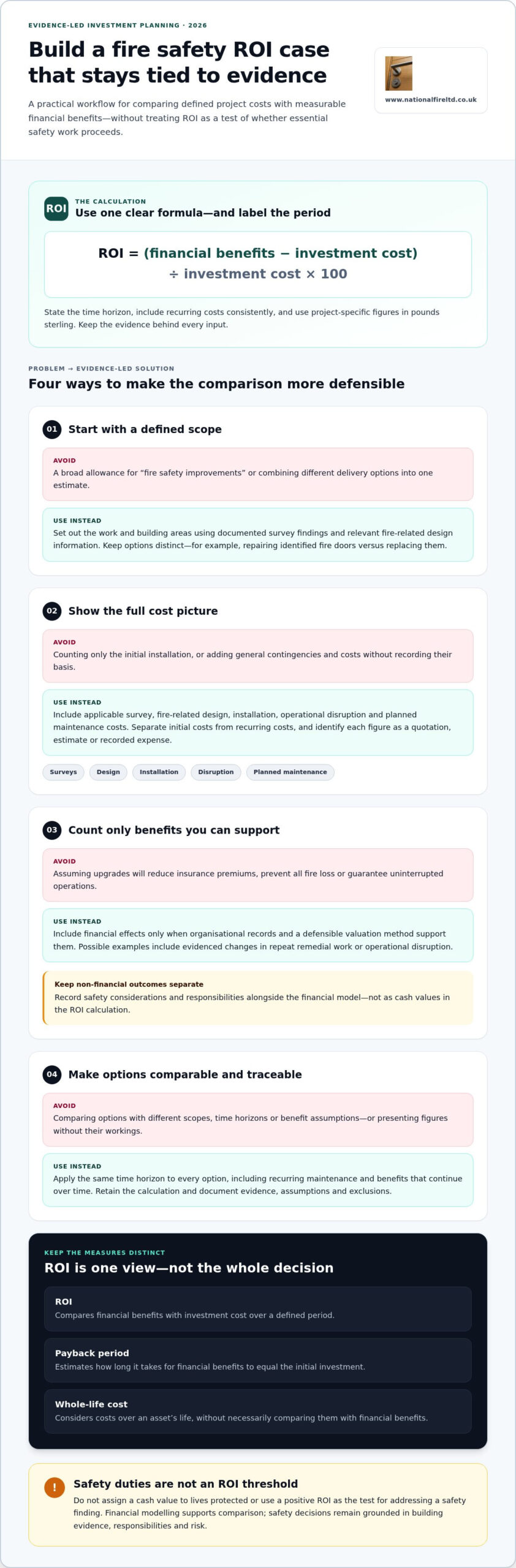
The basic formula is ROI = (financial benefits − investment cost) ÷ investment cost × 100. State the period covered and which costs recur within it. If planned maintenance is included, record it consistently rather than counting only the initial installation. Use project-specific figures in pounds sterling and identify the evidence behind each input.
ROI is not the same as payback period, which estimates how long it takes for financial benefits to equal the initial investment. Nor is it the same as whole-life cost, which considers costs over an asset’s life without necessarily comparing them with financial benefits. These measures answer different questions, so label each one clearly.
Which fire safety investments can be assessed?
ROI modelling can support decisions about passive fire protection work, such as firestopping, fire door installation or maintenance, and compartmentation remedial work. Define the scope from documented survey findings and relevant fire-related strategy, rather than from a generic list of improvements. Fire Compliance Surveys and fire door surveys can help establish the condition and location of issues that inform a project scope.
For a commercial, education, industrial or leisure property, a financial model might assess whether an evidenced reduction in repeat remedial work or operational disruption changes the project’s financial case. Include these benefits only when the organisation can support them with records and a reasonable calculation method. Don’t assume upgrades will reduce insurance premiums, prevent all fire loss or guarantee uninterrupted operations.
A calculation can clarify the financial consequences of different delivery options, but it can’t replace competent assessment or determine the building’s safety requirements. In practical terms, calculating ROI for fire safety upgrades 2026 means making the financial case transparent while keeping safety decisions tied to building evidence, responsibilities and risk.
How to calculate fire safety upgrade ROI: inputs and formula
A credible calculation starts with a defined scope, not a broad allowance for “fire safety improvements”. Use this workflow to make each input traceable and comparisons consistent. Keep a record of the evidence, assumptions and finance decisions behind the figures when calculating ROI for fire safety upgrades 2026.
- Define the scope. Set out the work being assessed, the relevant building areas and the findings or fire-related design information that support it. Keep distinct options separate, such as repairing identified fire doors versus replacing them.
- Set the time horizon. Choose a period that reflects the organisation’s investment assessment and state it clearly. Apply the same period to every option, including recurring maintenance and benefits that continue over time.
- Record project costs. Enter evidenced, project-specific amounts in pounds sterling. Separate initial costs from recurring costs, and note whether each figure is a quotation, estimate or recorded expense.
- Identify measurable benefits. Include only financial effects supported by organisational records and a defensible valuation method. Record non-financial outcomes separately.
- Calculate and document. Apply the formula consistently, retain the workings and list assumptions, exclusions and the date of the information used.
Which costs and benefits belong in the calculation?
Depending on the project, cost inputs may include surveys, fire-related design, installation, disruption to building operations and planned maintenance. Include each only where it applies to the defined scope. For example, record disruption as a financial cost only if the organisation can substantiate it, such as through documented temporary arrangements or lost operating time. Don’t add a general contingency or assumed saving without recording its basis.
Keep the initial works subtotal separate from recurring maintenance so decision-makers can see both. A fixed-cost maintenance service can support more predictable budget planning, but use only the project’s actual agreed figures. National Fire Ltd’s fire door maintenance service is authorised to offer fully certified maintenance service by the UK’s main Fire door certification body, BM Trada Q-Mark.
Potential benefits might include evidenced reductions in repeat remedial work or operational disruption. Don’t monetise life safety, compliance or assurance. Note those outcomes alongside the ROI instead. A financial model should support responsible prioritisation, not imply that a safety benefit has a cash equivalent.
How do you calculate ROI and payback consistently?
Use ROI = (documented financial benefits − relevant costs) ÷ total investment cost × 100. Include costs over the chosen period in the relevant-cost calculation, and define whether “total investment cost” includes recurring maintenance. Apply that definition consistently across options. If the organisation adjusts future cash flows for timing, state the approved discount rate and method; don’t mix adjusted and unadjusted figures.
Payback is the point at which cumulative documented cash benefits equal the investment. It may not be meaningful if benefits are uncertain or cannot be reliably timed. Ask the organisation’s finance team to validate discount rates, tax treatment and whether figures are nominal or adjusted for inflation. National Fire Ltd connects survey findings, fire-related design, installation and ongoing maintenance to support a defined scope and cost plan.
How to compare fire safety upgrade options without misleading ROI
A comparison is useful only if each option is assessed on the same basis. Set a common building boundary, time horizon and method for estimating financial effects. Then separate work needed to address documented safety or compliance findings from discretionary improvements that can be ranked by financial return. A higher projected ROI must not push an essential action below optional work simply because the latter appears more attractive financially.
Use a consistent comparison record for each option. Include the scope, evidence source, project-specific cost in pounds sterling, expected financial effect, assumptions and non-financial considerations. The structure below can be copied into a business case and completed using project evidence:
Option and scope: Describe the work and the building areas or elements it covers.
Evidence source: Identify the relevant survey finding, drawing or other project record.
Project-specific cost: Record the evidenced cost and clarify what it includes or excludes.
Expected financial effect: State the measurable benefit, its evidence and how it is valued.
Assumptions and non-financial considerations: Note uncertainties, safety and compliance needs, operational effects and dependencies.
Keep hypothetical avoided losses separate from guaranteed savings. A model may test a possible financial effect, but it should label it as an assumption, not a certain outcome. Safety, compliance and assurance belong in the decision record even where they cannot responsibly be expressed as a monetary value.
How should survey findings shape upgrade priorities?
Use Fire Compliance Survey and fire door survey findings to define the work, rather than starting from a preferred budget or ROI result. Group recorded items by location, building element, evidence and required action. Where compartmentation findings identify defects, they can inform remedial firestopping priorities. Keep the source and status of each item visible so decision-makers can trace the proposed scope back to building evidence.
Don’t create an unsupported numerical risk score to make unlike findings appear directly comparable. Prioritise according to the assessment and responsible decision-makers’ documented requirements. Once necessary work is identified, financial modelling can help distinguish between viable delivery approaches or additional discretionary improvements.
How can decision-makers compare scenarios fairly?
Compare a defined scope with a phased option only if both address the documented requirements. If phasing changes what is delivered, when it is completed or which areas are included, show those differences plainly. Record exclusions, dependencies and any interim arrangements so the comparison doesn’t imply that a partial scope provides the same outcome as full delivery.
Test how the result changes if uncertain costs, timing or benefits move within evidence-based bounds. Keep the same benefit assumptions across options unless there’s a recorded reason to change them. This makes calculating ROI for fire safety upgrades 2026 more transparent: the comparison shows which assumptions drive the result, while safety and compliance needs remain visible in their own right.
How to build a defensible 2026 ROI case and manage uncertainty
A sound ROI case should let another decision-maker trace how the conclusion was reached. Assign an owner to maintain the model and keep it aligned with the building evidence, approved scope and finance assumptions. This makes calculating ROI for fire safety upgrades 2026 a governed process rather than a single forecast presented as certain.
Use a repeatable sequence:
- Assign an accountable owner. Name who will gather inputs, maintain the record and coordinate updates.
- Collect the evidence. Bring together relevant survey findings, scope documents, project figures and records supporting any proposed financial effects.
- Document assumptions. For every estimate, state its source, date, owner and status as measured, estimated or assumed. Explain exclusions too.
- Model scenarios. Test how the result changes when uncertain inputs, such as timing or project costs, vary. Use plausible, evidence-based alternatives rather than presenting one outcome as guaranteed.
- Approve review points. Agree when the model will be revisited, such as after a survey update, a scope decision or receipt of revised project figures.
Keep calculations, survey findings, approvals and scope changes together in a controlled decision record. If a finding changes or an approved figure is updated, record what changed, who authorised it and how it affects the assessment. The record should distinguish changes to the financial model from decisions about safety and compliance.
How can you make the model auditable?
Use an input register with one line for each material figure or assumption. Record its value in pounds sterling where relevant, source, date, owner and classification as measured, estimated or assumed. Keep financial assumptions separate from evidence supporting safety and compliance decisions. Update the model when survey findings, project scope or approved figures change, and retain earlier versions so the decision trail remains clear.
What should a 2026 business case report?
Summarise the selected scope, alternatives considered, assessment period, principal assumptions and important exclusions. Present ROI or payback only when the financial inputs support those measures. Set out safety, compliance and assurance considerations alongside the financial results, not inside the return calculation. Have the organisation’s finance team review discount rates, tax treatment and other financial methods. Verify relevant legal and regulatory references for the building and jurisdiction before relying on them.
Survey and project records can make the evidence base clearer. National Fire Ltd connects Fire Compliance Surveys, fire-related design, installation and ongoing maintenance. Its Fire Door Planned Preventative Maintenance Service is fixed-cost and includes a client portal for viewing scheduled and completed maintenance visits and generating compliance reports. The maintenance service is authorised to offer fully certified maintenance service by the UK’s main Fire door certification body, BM Trada Q-Mark.
National Fire Ltd’s passive fire protection services connect survey findings, fire-related design, installation and maintenance.
How National Fire Ltd supports evidence-led fire safety investment
A credible investment plan depends on a clear line from building evidence to defined work and ongoing oversight. National Fire Ltd connects Fire Compliance Surveys, fire-related design, installation and maintenance, helping organisations shape a passive fire protection programme around project-specific findings. This gives decision-makers a structured basis for setting scope and recording costs, without promising a particular ROI or replacing the organisation’s safety responsibilities.
From survey findings to defined passive fire protection works
Fire Compliance Surveys and fire door surveys help identify and document issues that can inform a project scope. Findings may lead to firestopping, fire door installation or fire door maintenance, depending on the building and work required. Where design information is needed, fire strategy drawings and floor plan generation can support planning. The scope should make clear which findings each proposed action addresses.
For organisations calculating ROI for fire safety upgrades 2026, this evidence-led sequence helps distinguish the work being considered from assumptions used in the financial model. Survey findings can support a record of why certain work is prioritised, while financial analysis remains a separate tool for budgeting and comparing options.
National Fire Ltd is fully certified by BM Trada Q-Mark, the UK’s main fire-door certification body, and accredited by Safe Contractor and Constructionline Gold. To turn documented findings into a defined passive fire protection scope, discuss your project requirements with National Fire Ltd.
How maintenance supports financial planning
Installation is only one part of a managed approach. Planned maintenance brings recurring work into the investment picture and supports a more complete view of ongoing requirements. National Fire Ltd’s Fire Door Planned Preventative Maintenance Service is fixed-cost, which can help organisations plan maintenance expenditure without relying on an assumed saving or an unspecified price.
The service includes a client portal for viewing scheduled and completed maintenance visits and generating compliance reports. These records can support internal oversight and provide a clearer record of maintenance activity. The maintenance service is authorised to offer fully certified maintenance service by the UK’s main Fire door certification body, BM Trada Q-Mark.
Connecting survey findings, installation and maintenance can keep the original scope and subsequent work within one coherent investment plan. The financial case should still use the organisation’s actual project figures and clearly stated assumptions. Safety and compliance priorities remain central, whether or not a financial return can be calculated.
Turn your ROI model into a practical next step
A useful business case should lead to a decision process that remains clear after approval. Set a review point for when survey evidence, project scope or financial assumptions change, and keep the people responsible for building safety involved in decisions. This helps ensure that calculating ROI for fire safety upgrades 2026 supports planning without becoming a substitute for addressing identified safety needs.
Connect the evidence to a defined scope, then make the financial assumptions and ongoing responsibilities visible to everyone involved in approving the work. A considered plan gives your organisation a clearer basis for prioritisation and helps maintain confidence in how decisions are recorded.
Discuss your passive fire protection requirements with National Fire Ltd to take an evidence-led step towards planning the work your building needs.
Frequently Asked Questions
How do you calculate ROI for fire safety upgrades?
Calculate ROI by comparing evidenced financial benefits with the relevant investment over a stated period, then expressing the net benefit as a percentage of investment. For example, if a school is assessing fire door works, define the doors and activities included, then use recorded project costs and any substantiated operational benefit. When calculating ROI for fire safety upgrades 2026, keep safety outcomes visible but outside the financial calculation.
What costs should be included when calculating fire safety upgrade ROI?
Include costs that apply to the project and can be supported by project information. Depending on the scope, this might mean survey work, fire-related design, installation, operational disruption and planned maintenance. Check that costs haven’t been counted twice, such as where a combined project figure already includes design or access arrangements. Keep one-off works and recurring expenditure distinct so budget holders can see what drives each total.
Can fire safety compliance be included as a financial return?
Compliance should be reported as a safety and governance outcome, not automatically converted into a financial return. Avoid claiming that completing work guarantees a particular insurance outcome or prevents a future loss. If a business case identifies a measurable financial effect associated with the work, explain the evidence and calculation separately. This keeps the financial model honest while ensuring compliance needs remain visible in the decision record.
What is the difference between ROI and payback period for a fire safety project?
ROI expresses the net financial benefit relative to the investment over a chosen period. Payback period instead identifies when cumulative documented cash benefits equal the initial investment. For instance, a project may have a calculated ROI across its assessment period but no reliable payback date if its benefits are irregular or difficult to forecast. Report each measure only when project evidence supports it, and state the period used.
How do you compare fire safety upgrade options when costs are uncertain?
Use the same assessment period and scope boundary for each option, then test how results change under clearly labelled cost and timing assumptions. For example, compare the current project estimate with a higher estimate supported by known scope uncertainties. Keep the source and reason for each variation on record. Don’t describe a cautious scenario as a guaranteed maximum, and don’t rank options by ROI if they address different safety requirements.
Can fire door maintenance be included in a fire safety investment plan?
Yes. Include planned maintenance as a recurring cost where it applies to the investment period, and use the actual project-specific figure rather than an assumed saving. National Fire Ltd’s Fire Door Planned Preventative Maintenance Service is fixed-cost. Its client portal displays scheduled and completed visits and allows compliance report generation. The maintenance service is authorised to offer fully certified maintenance service by the UK’s main Fire door certification body, BM Trada Q-Mark.
What evidence do I need to justify a fire safety upgrade budget?
Build the budget case from records that connect the proposed work to the building’s condition and operational needs. Useful evidence may include survey findings, relevant fire strategy or floor plan information, a defined scope, project cost documentation and records supporting any claimed operational benefit. Include the approval trail and identify assumptions or exclusions. This helps reviewers understand why the work is proposed and which figures need updating before commitment.