

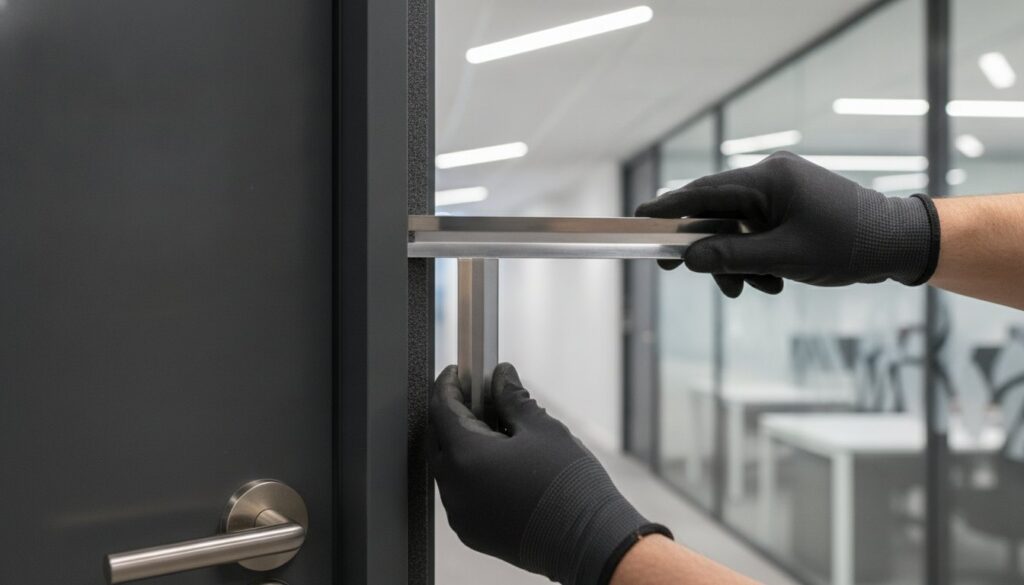
An alarming 75% of fire doors in the United Kingdom currently fail to meet mandatory safety standards, with missing or damaged seals often cited as a primary cause of failure. As a building manager or responsible person, you recognise that these components are vital for life safety, yet the technical specifics of replacing intumescent strips on fire doors often lead to more questions than answers. It’s a high-stakes responsibility where a single millimetre can be the difference between compliance and a significant legal liability under the Regulatory Reform (Fire Safety) Order 2005.
We understand the pressure of maintaining a secure environment while navigating complex gap tolerances and the nuances of FD30 versus FD60 requirements. This professional guide provides the technical clarity you need to identify non-compliant seals and ensure your property meets the rigorous BS EN 1634-1 testing standards. You’ll discover how intumescent strips function under heat, the critical differences between fire and smoke seals, and the methodical steps required to maintain the “Golden Thread” of safety documentation for your commercial building.
Key Takeaways
- Understand the chemical expansion process of intumescent material and how it provides a critical barrier against heat and flames during a fire event.
- Identify the physical differences between fire-only seals and combined smoke seals to ensure your escape routes provide adequate protection against toxic inhalation.
- Learn the exact specifications for replacing intumescent strips on fire doors to ensure your building adheres to the latest UK gapping tolerances and safety standards.
- Clarify your legal responsibilities under current fire safety legislation to ensure your commercial property remains fully compliant and avoids significant penalties.
- Recognise the value of professional remedial maintenance and surveys in mitigating risks and maintaining a robust “Golden Thread” of safety records.
What are Intumescent Strips and How Do They Function?
Intumescent strips are specialised passive fire protection components installed within the frame or leaf of a fire door. These strips remain dormant during normal daily operations but serve a life-critical function when they are exposed to extreme heat. Their primary role is to seal the perimeter of the door assembly, ensuring that the integrity of the fire-rated barrier is maintained. This process is essential for effective fire compartmentation, a strategy designed to contain fire and smoke within a specific zone of a building to allow for safe evacuation.
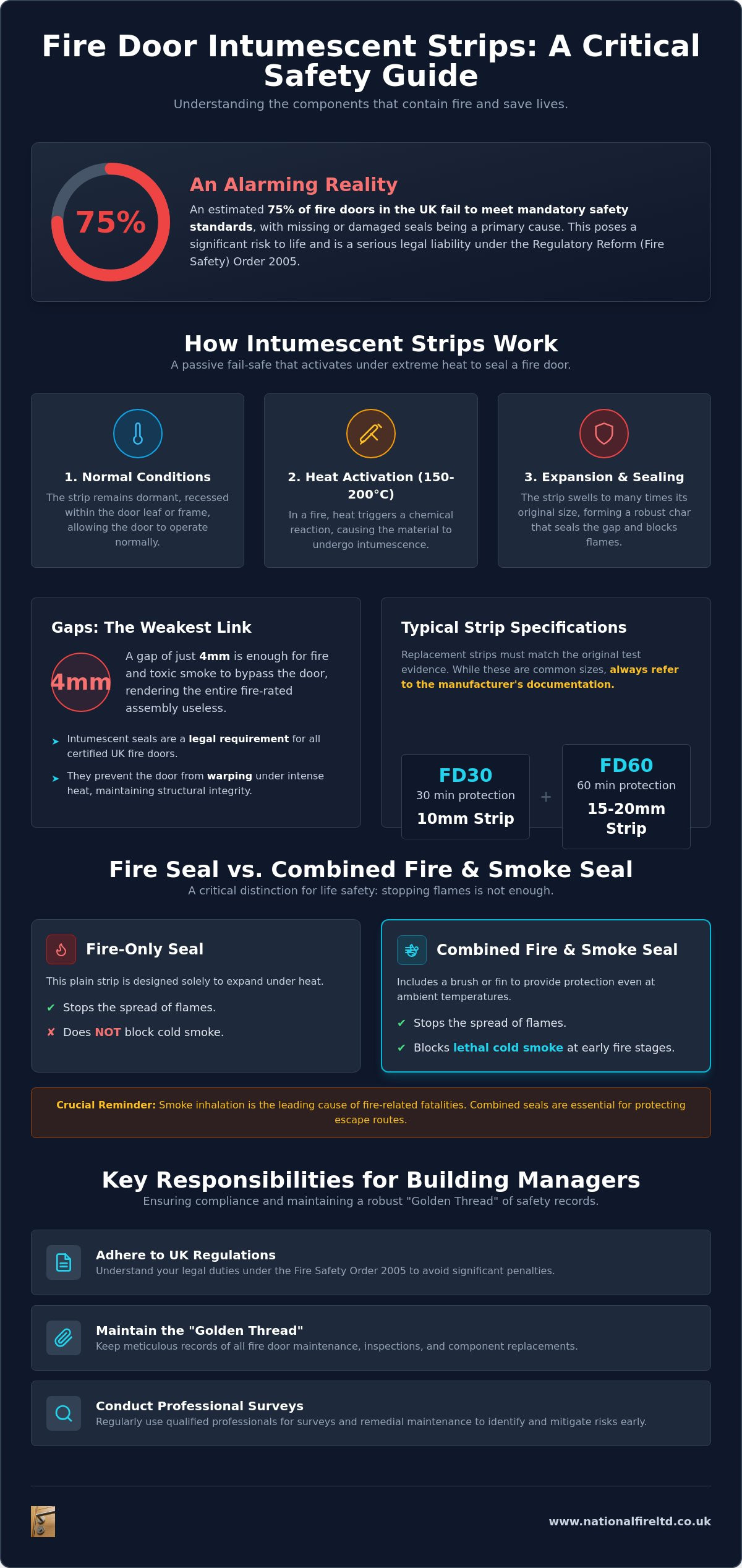
Intumescent materials rely on a chemical reaction triggered by thermal energy. When temperatures rise during a fire, the material undergoes a physical transformation known as intumescence, where it swells to many times its original volume. This rapid expansion fills the void between the door and the frame, creating a pressure seal that blocks the passage of flames. When building managers consider replacing intumescent strips on fire doors, they aren’t just performing a routine maintenance task; they are ensuring this chemical fail-safe remains functional and reliable.
The Science of Heat Activation
Most commercial intumescent strips are engineered to activate when temperatures reach approximately 150°C to 200°C. At this threshold, the material reacts to form a robust, carbonaceous char. This char acts as a poor conductor of heat, providing a thermal barrier that protects the door’s edges and prevents the frame from igniting. Depending on the specification of the door assembly, these strips are designed to provide either 30 or 60 minutes of protection. This duration is vital for maintaining the building’s structural fire strategy and protecting escape routes.
Why Gaps are the Weakest Link in Fire Safety
Precision is the foundation of fire safety. A fire door is only as effective as its seal. Research and testing demonstrate that even a 4mm gap is sufficient for fire and toxic gases to bypass the door entirely, rendering the entire assembly useless. Strips transform a standard timber or composite door into a certified fire-rated barrier by closing these tolerances under heat.
- Mandatory Requirement: Intumescent seals are a legal requirement for all certified fire door assemblies in the UK.
- Structural Integrity: They prevent the door from warping or moving excessively when exposed to high temperatures.
- Compliance: Neglecting the condition of these seals or delaying replacing intumescent strips on fire doors can lead to catastrophic failure during a fire door survey and an unacceptable risk to life.
By sealing the “weakest link” in the door assembly, these strips ensure that the fire remains contained within its room of origin, providing the stability and security necessary for emergency responders to operate effectively.
Choosing the Right Fire Door Strips: Types and Specifications
Selecting the correct component is not merely a matter of aesthetic preference; it’s a technical requirement based on the door’s original test evidence. When replacing intumescent strips on fire doors, the replacement must match the dimensions and chemical composition of the original component. Most strips are available in standard widths of 10mm, 15mm, and 20mm, with a typical depth of 4mm. Generally, 10mm strips are associated with FD30 doors, while 15mm or 20mm strips are required for FD60 doors. However, these are not universal rules. You must always refer to the manufacturer’s documentation to ensure the material choice aligns with the specific test results for that door assembly.
When you are tasked with replacing intumescent strips on fire doors, ensuring the seal is compatible with the door’s fire rating is the only way to guarantee the assembly will perform as intended. According to the latest UK government guidance, all fire doors must be maintained to their original standard. Using a strip that is too narrow for the groove or made of an incompatible material can result in the seal failing to activate correctly, leaving the building vulnerable.
Fire-Only vs. Combined Fire and Smoke Seals
The distinction between fire-only and combined seals is a critical safety factor. Fire-only strips are “plain” and solely designed to expand under heat. While they stop flames, they do not prevent the passage of cold smoke at the early stages of a fire. Statistics confirm that smoke inhalation is the leading cause of fire-related fatalities in the UK, making smoke seals essential in many commercial settings. Combined seals feature a physical barrier, such as a brush or a polymer fin, alongside the intumescent material. Brush seals, typically made of nylon, are effective at sealing gaps on uneven floors or older frames. Fin seals are often preferred in clinical or high-traffic environments because they are easier to sanitise and maintain.
Combined seals are mandatory in:
- Protected escape routes and stairwells
- Lobbies and corridors intended for evacuation
- Entrance doors to flats within residential blocks
Acoustic and Weather Sealing Benefits
Modern intumescent strips often provide multi-functional benefits beyond fire protection. In commercial office environments, twin fin seals are frequently specified because they provide superior acoustic performance, reducing noise transfer between rooms. This improves the working environment while maintaining strict safety standards. For external fire doors, weather-rated seals are necessary to prevent draughts and moisture ingress, which could otherwise degrade the door leaf and compromise its fire resistance over time.
Ensuring you have the correct specification is complex. If you’re uncertain about the specific requirements for your building, a professional fire door survey can identify exactly which components are needed for compliance.
UK Regulations and Compliance Standards for 2026
The legal framework governing fire safety in the United Kingdom places a significant burden of responsibility on building owners and facilities managers. Under the Regulatory Reform (Fire Safety) Order 2005 (RRO), a designated “Responsible Person” is legally required to ensure that all fire safety assets are fit for purpose and correctly maintained. Fire doors are not static fixtures; they are life-saving equipment that requires regular validation. Failing to address issues such as damaged seals or delaying the task of replacing intumescent strips on fire doors can lead to unlimited fines or even imprisonment if negligence is proven following a fire event.
Compliance is measured against specific testing standards. While older door sets were tested under BS 476-22, this standard has been withdrawn in favour of the more rigorous BS EN 1634-1. Current national fire safety guidance emphasises that any remedial work must preserve the door’s original fire-resistance rating. For deeper technical context on these obligations, our comprehensive guide to fire doors provides an exhaustive breakdown of the legislative landscape facing commercial building managers in 2026.
Understanding FD30 and FD60 Requirements
Fire ratings dictate the specific configuration of intumescent seals. An FD30 door is designed to provide 30 minutes of protection and typically utilises a single 10mm or 15mm strip. In contrast, FD60 doors, which provide 60 minutes of resistance, often require a more robust sealing strategy. This frequently involves wider 20mm strips or even twin 10mm strips installed in parallel. When replacing intumescent strips on fire doors, you must ensure the replacement matches the width and depth specified in the manufacturer’s certification. Deviating from these specifications, even by a few millimetres, can result in the door failing to meet the mandatory 3mm maximum gap tolerance, rendering the building non-compliant.
The Importance of Third-Party Certification
To guarantee reliability, we only recommend using products that carry third-party certification from recognised bodies such as BM TRADA or Certifire. These schemes provide independent assurance that the intumescent material will perform as claimed under fire conditions. Using generic, non-certified strips in a commercial environment introduces an unacceptable level of risk. In the event of a fire safety audit or a post-incident investigation, the “Golden Thread” of digital documentation must show that all components, including the seals, meet accredited standards. Keeping detailed records of maintenance and installation is now a mandatory requirement for residential buildings over 11 metres and is considered best practice for all commercial properties.
Common Installation and Maintenance Failures
Maintaining the integrity of a fire door assembly requires constant vigilance. In commercial environments, intumescent strips are subject to significant wear and tear, yet they’re frequently overlooked during routine building maintenance. The most common cause of failure is mechanical damage. In hospitals or warehouses, trolleys and heavy equipment often strike the door edges, causing strips to peel, crack, or become detached. When you’re replacing intumescent strips on fire doors, you must ensure the new material is flush and securely bonded; poor adhesion is a leading reason why DIY installations fail professional fire door surveys.
Building movement also plays a critical role in seal effectiveness. Over time, structures settle, which can shift door frames and increase gaps beyond the permitted 3mm tolerance. It’s common for a gap that was compliant during the initial installation to exceed the 4mm failure threshold within a few years. To maintain safety and legal compliance, building managers should perform a monthly visual inspection using this methodical checklist:
- Adhesion: Are the strips peeling or coming away from the groove?
- Visibility: Is the intumescent material clearly visible, or has it been obscured by paint or debris?
- Continuity: Are there any missing sections or breaks in the strip?
- Tolerance: Is the gap between the door and the frame consistently under 3mm at the top and sides?
The Dangers of Over-Painting and Damage
Refurbishment projects often lead to the catastrophic error of over-painting. Applying standard gloss or emulsion over intumescent material creates a hard shell that can prevent the chemical expansion process during a fire. This renders the strip useless. If your strips are painted, they must be removed and replaced immediately to restore safety. Mechanical damage is equally dangerous. Even a small missing section of a strip compromises the entire door’s fire rating, as it provides a path for thermal energy to breach the compartment.
Addressing Oversized Gaps: Remedial Solutions
While the 3mm gap is the industry standard, many older buildings suffer from warped frames where gaps reach 5mm or 6mm. A gap of just 4mm is considered a failure in professional audits. In these specific instances, high-expansion intumescent seals may provide a remedial solution for gaps up to 10mm, provided this application is supported by the door’s original test evidence. However, if the structural integrity of the frame is compromised or the door leaf is warped, simply replacing intumescent strips on fire doors won’t suffice. You should consult fire door installation experts to determine if a full replacement is necessary.
If you’ve identified damaged or painted seals in your facility, contact our team today to schedule a comprehensive fire door survey and ensure your property meets UK safety standards.
Professional Fire Door Surveys and Remedial Maintenance
While visual inspections are a necessary component of building management, they cannot replace the technical depth of a professional fire door survey. Relying on internal staff to assess complex safety systems often leads to overlooked defects that only become apparent during a fire or a rigorous regulatory audit. Professional surveys provide the only definitive guarantee that your building remains compliant with the Regulatory Reform (Fire Safety) Order 2005. At National Fire Ltd, our surveyors conduct exhaustive assessments that go beyond surface-level checks, focusing on the precision required to maintain a certified fire barrier.
A National Fire Ltd fire door survey involves a methodical examination of every component within the door assembly. We use calibrated equipment to verify gap measurements against the mandatory 3mm tolerance, assess the chemical integrity of intumescent material, and check that all hardware is functioning correctly. This includes testing self-closing devices and ensuring hinges are free from oil leakage or wear. When our experts identify that replacing intumescent strips on fire doors is necessary, it is recorded as a specific remedial action within a comprehensive digital report, providing you with a clear roadmap to compliance.
The Role of Accredited Contractors
The competency of the individual performing remedial works is a critical factor in building safety. Entrusting your property to accredited passive fire protection contractors ensures that every repair is carried out to the manufacturer’s original specification. Third-party accreditations, such as BM TRADA, serve as a hallmark of technical excellence and reliability. These certifications demonstrate that we operate under a strict quality management system, ensuring that when we are replacing intumescent strips on fire doors, the work restores the full fire integrity of the compartment. Following the completion of remedial works, we provide detailed documentation that forms a vital part of your building’s safety record.
Ensuring Long-Term Building Compliance
Compliance is an ongoing commitment rather than a one-time event. In high-traffic commercial environments, the physical condition of fire doors can degrade rapidly. We recommend a planned maintenance programme that includes professional inspections every six months, as outlined in BS 9999. This proactive approach allows building managers to address minor issues before they escalate into major non-compliances or safety risks. By utilising digital asset management, we help you track the maintenance history of every door, ensuring the “Golden Thread” of information remains intact and accessible for future fire safety audits.
Protecting life and property requires a disciplined approach to maintenance. Don’t leave your building’s safety to chance. Book a professional fire door survey with National Fire Ltd today to ensure your environment remains secure and fully compliant with UK national standards.
Maintaining Long-Term Integrity and Legal Compliance
Fire door safety is a continuous commitment to precision and technical excellence. By understanding the chemical activation of intumescent materials and the strict 3mm gap tolerances required by British Standards, you’re better equipped to manage your building’s risk profile. Replacing intumescent strips on fire doors is a critical remedial task that must be executed with absolute accuracy to ensure the door performs as intended during a fire event. Neglecting these small components can lead to catastrophic failure of the entire fire compartmentation strategy.
National Fire Ltd stands as a unified front of experts, providing national coverage and accredited remedial work across the United Kingdom. As specialist passive fire protection contractors, we offer the comprehensive oversight needed to bridge the gap between regulatory requirements and operational reality. Our expert fire door maintenance and compliance surveys provide the detailed digital documentation necessary to uphold the “Golden Thread” of safety records for your commercial property.
Secure Your Building with a Professional Fire Door Survey and take the first step towards total compliance. We are here to help you navigate these complex safety standards, ensuring your commercial property remains a secure and reliable environment for years to come.
Frequently Asked Questions
Do intumescent strips need to be replaced after a certain number of years?
Intumescent strips don’t have a fixed expiry date, but they must be replaced immediately if they show any signs of physical degradation or loss of adhesion. While many high-quality seals are designed to last for up to 15 years, their lifespan is heavily influenced by environmental factors and the level of footfall in your building. Regular professional inspections are the only reliable way to determine if the material’s chemical properties remain viable for fire protection.
Can I paint over intumescent strips if they don’t match the door colour?
You should never paint over intumescent strips as this can prevent the material from expanding correctly during a fire. A layer of paint creates a hard crust that restricts the chemical reaction, potentially delaying the seal and allowing flames to breach the compartment. If you are replacing intumescent strips on fire doors and require a specific aesthetic, you should purchase strips with coloured plastic casings that match your door’s finish rather than applying paint to existing seals.
What is the difference between a fire seal and a smoke seal?
A fire seal is designed solely to expand under extreme heat to block the passage of flames, whereas a smoke seal provides a physical barrier against cold smoke at the early stages of a fire. Smoke seals usually feature a brush or a polymer fin that maintains contact with the frame even when the door is closed. Because smoke inhalation is a primary cause of fire-related fatalities, combined fire and smoke seals are mandatory on most commercial escape routes.
Is it a legal requirement to have intumescent strips on all commercial doors?
Intumescent strips are a legal requirement for all doors designated as fire doors under the Regulatory Reform (Fire Safety) Order 2005. They are not required for standard non-fire-rated internal doors. If a door is part of a fire compartmentation strategy, it must be fitted with the specific seals detailed in its manufacturer’s test evidence to ensure it provides the rated 30 or 60 minutes of protection required by UK law.
What should I do if the gap between my fire door and the frame is more than 4mm?
A gap exceeding 4mm is a critical failure point that renders the fire door non-compliant with BS 8214 standards. You must take immediate remedial action to reduce this gap to the permitted 3mm tolerance. While replacing intumescent strips on fire doors with high-expansion versions can sometimes resolve minor issues, persistent oversized gaps often indicate a warped door leaf or a shifting frame. In these instances, a professional survey is required to determine if the door needs structural repair or full replacement.
How often should fire door intumescent strips be inspected?
Commercial fire doors should be inspected every six months to comply with BS 9999 guidelines. In high-traffic environments, such as schools or hospitals, these checks should be performed more frequently, often every three months. These inspections focus on identifying mechanical damage, ensuring the strips are securely bonded, and verifying that no sections are missing. Routine checks are a fundamental responsibility of the building’s designated Responsible Person to ensure ongoing life safety.
Can I install intumescent strips myself in a commercial building?
UK regulations require that all fire safety work be carried out by a competent person with the necessary technical knowledge. While the physical task might seem simple, DIY installation in commercial settings often leads to non-compliance due to incorrect material selection or poor adhesion. Using an accredited contractor ensures that the work is performed to the door’s original test evidence, protecting you from the significant legal liabilities associated with improper fire door maintenance.
Are there different types of intumescent strips for timber and steel doors?
Yes, intumescent strips are engineered with different chemical compositions, such as graphite or sodium silicate, to suit specific door materials. Timber doors and steel doors react differently to thermal stress, meaning the expansion rate and pressure of the strip must be matched to the door type. You must always consult the manufacturer’s certification or a professional surveyor to ensure the replacement strips are compatible with the specific construction of your fire door assembly.