


A stronger fire safety profile can influence a commercial property’s risk assessment, but it does not guarantee a set reduction in premiums. The impact of fire safety ratings on commercial insurance premiums depends on how insurers assess the building’s construction, use, location, fire protection and operational risks.
It is reasonable to expect effective fire safety measures to feature in an insurance assessment. Insurers may consider passive protection, such as compartmentation and fire doors, alongside active systems and the building’s exposure to external hazards. A higher assessed risk can mean higher premiums, while effective protection may support a more favourable assessment.
This article explains how building characteristics shape insurers’ decisions, how passive fire protection may influence the risk profile, and why fire safety systems can matter at renewal. It also clarifies why improvements should be considered as part of the whole building assessment, rather than as a guaranteed discount.
Key Takeaways
- Understand how construction, occupancy, location and previous claims can shape an insurer’s view of a commercial property’s fire risk.
- See how compartmentation, fire doors and other passive measures can contribute to a stronger risk profile when properly maintained.
- Learn why fire safety systems and clear compliance records may influence an insurer’s assessment at renewal.
- Identify where fire stopping, fire door installation, maintenance or cavity barriers can address weaknesses in a building’s passive protection.
Building characteristics affecting insurance premiums
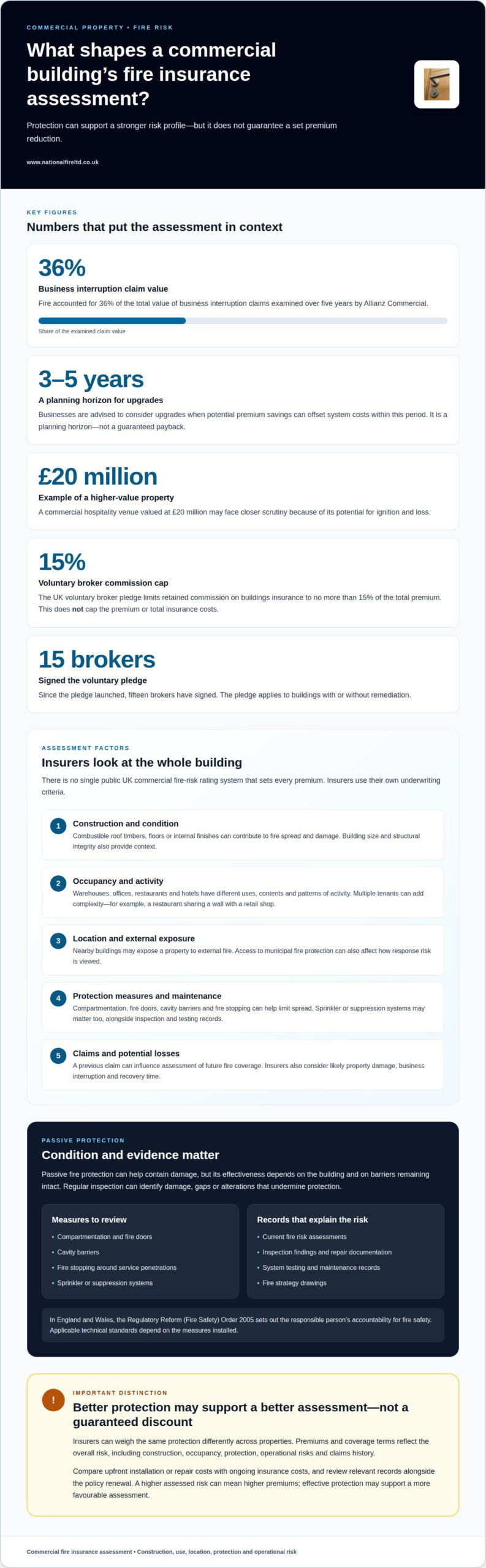
Insurance companies assess a building’s fire risk alongside its value, use and potential losses. Construction materials matter: combustible roof timbers, floors or internal finishes can contribute to fire spread and damage. A commercial hospitality venue valued at £20 million may face closer scrutiny because of its potential for ignition and loss. Higher potential damage can affect both property coverage and business interruption cover.
Occupancy affects exposure. A warehouse, office, restaurant and hotel have different activities, contents and patterns of use, so insurers assess each against its particular risks rather than applying one rate to every building type. Multiple tenants can add complexity, especially when their activities differ. For example, a restaurant sharing a wall with a retail shop can affect assessment of the whole building because cooking introduces a distinct fire hazard.
Location and surrounding properties also inform an assessment. Nearby buildings can expose a property to external fire, while access to municipal fire protection may affect how insurers view response risk. The building’s size, structural integrity and passive protection provide further context. Sprinkler or suppression systems may matter too, alongside inspection and testing records. A previous claim can influence how insurers assess future fire coverage.
Insurance costs can include broker commission, but commission and premium are separate amounts. A UK voluntary broker pledge limits retained commission on buildings insurance to no more than 15% of the total premium, for buildings with or without remediation. Since the pledge launched, fifteen brokers have signed. That cap does not cap the premium or total insurance costs charged to leaseholders, whose costs may reflect the policy and building arrangements.
In England and Wales, the Regulatory Reform (Fire Safety) Order 2005 sets out the responsible person’s accountability for fire safety, according to UK Parliament. Clear records of fire risks and protective measures help explain how building conditions are managed. Insurers use this context to consider likely damage, interruption and the overall risk profile.
How passive fire protection may affect commercial insurance premiums
Passive fire protection can limit fire spread and help contain damage within a building. In England and Wales, the Regulatory Reform (Fire Safety) Order 2005 sets out the responsible person’s accountability for fire safety, according to UK Parliament; applicable technical standards depend on the measures installed.
Upfront Protection Costs and Ongoing Insurance Costs
Upfront protection costs cover installation or repair, while insurance costs continue across policy periods. The comparison matters because an upgrade may reduce exposure and support a stronger risk assessment, but savings depend on the insurer’s assessment. Businesses are advised to consider upgrades when potential premium savings can offset system costs within 3 to 5 years. This is a planning horizon, not a guaranteed payback.
Passive measures include compartmentation, cavity barriers and fire stopping around service penetrations. Their effectiveness depends on the building and on barriers remaining intact. Regular inspection can identify damage, gaps or alterations that may undermine protection. Repairing defects and keeping inspection records helps show the building’s current condition, rather than relying only on original installation documents.
Insurer Rating Systems
UK commercial insurers assess fire risk using their own underwriting criteria. There is no single public rating system that sets every commercial premium. Assessments may consider construction, occupancy, protection measures, operational risks and claims history. The same protection can be weighed differently across properties, and a rating does not bring an automatic, standard discount.
To document improvements, keep current risk assessment records, inspection findings and repair documentation together. Fire strategy drawings can help explain how the building is intended to limit fire spread. Reviewing this information alongside the policy renewal gives insurers relevant details when reassessing risk and coverage.
Fire protection also affects business interruption exposure: damage can delay recovery even after flames are controlled. Fire accounted for 36% of the total value of business interruption claims examined over five years by Allianz Commercial. Environmental considerations matter too. Targeted repairs can avoid replacing sound materials unnecessarily, while suitable protection helps limit damage and associated waste.
Fire safety systems and potential premium reductions
Fire protection can influence insurers’ assessment of potential losses, damage and recovery time. Its value depends on how the measures function within the building’s construction and overall fire risk.
Ratings and Insurance Premiums
A fire safety rating reflects an insurer’s assessment of the measures protecting a property and the risks affecting it. It matters because insurers use that assessment when setting premiums and coverage terms.
Fire risk assessments help identify hazards, protection gaps and changes in occupancy or operations. Insurers may consider those findings alongside system design, maintenance records and claims history. A sprinkler system, for example, can help control fire spread, while testing records show whether it has been maintained. No single system guarantees a particular premium reduction; the insurer weighs the property’s overall risk.
Poor Ratings and Coverage Restrictions
A poor rating indicates concerns about a property’s fire risk, which can influence the terms insurers are prepared to offer. This matters because commercial insurers may decline coverage when they consider a business too high-risk.
Assessment findings can also inform discussions about excesses and exclusions, depending on the policy and identified exposure. Gaps in protection, overdue maintenance or incomplete testing records can make it harder to demonstrate that risks are controlled. Clear records of corrective work give insurers evidence to consider, but do not determine policy terms.
System selection should reflect the building’s use and hazards. Sprinklers, fire alarms and other automatic protection address different aspects of fire prevention, detection and control. They complement passive measures, rather than replacing compartmentation or sound construction. Insurers consider how these measures work together to reduce potential losses.
Inspection and testing records make system condition visible during underwriting or renewal. A building more than 36 months overdue for sprinkler inspection is rated as unsprinklered under one inspection-rating schedule. That example shows why missed maintenance can affect an assessment, even where equipment remains installed.
Insurers may reassess risk when businesses provide updated assessments, maintenance records and details of completed improvements. Sharing that information at renewal helps the insurer consider the protection currently in place. The resulting premium reflects the property’s risk profile, not one system in isolation.
How fire safety ratings affect UK commercial insurance
In the UK, a fire safety rating helps an insurer assess a commercial property’s likelihood of fire loss. That assessment influences the premium, coverage terms and any policy conditions. Construction, occupancy, protective measures and inspection records all contribute. A rating is not a universal tariff: insurers weigh these factors against the specific building and its operating risks.
One inspection-rating schedule demonstrates how maintenance affects the calculation. A building up to 12 months overdue for inspection receives a 5% increase above its sprinklered insurance rate. At 12 to 24 months overdue, the increase is 20%; at 24 to 36 months overdue, it is 60%. These figures apply to that schedule, not every UK insurer’s policy.
The example shows why inspection dates and supporting records matter at renewal. An overdue inspection can affect how a building is classified, even if equipment remains installed. Insurers consider current protection alongside the property’s other risks. Businesses can provide assessment findings, maintenance records and evidence of completed remedial work to explain the measures in place.
Ratings can affect policy terms as well as premiums. Commercial insurers may decline coverage if they consider a business too high-risk. Identified weaknesses can influence excesses or exclusions, depending on the insurer’s assessment and policy terms. Reviewing protection before renewal gives the insurer current information, rather than outdated records or unresolved findings.
For example, a business addressing compartmentation defects can document the work and its completion alongside updated fire safety records. This creates a clearer account of how the building’s fire risk is managed. The insurer still assesses the entire property, including occupancy and claims history, rather than treating one improvement as a fixed discount. Contact National Fire Ltd about fire safety to support a clearer view of your building’s protection.
National Fire Ltd
National Fire Ltd helps commercial property teams address passive fire protection issues that may affect an insurer’s view of building risk. Where a review identifies gaps in compartmentation, damaged doors or vulnerable façade cavities, Fire Stopping, Fire Door Installation, Injectable Cavity Barriers and Fire Door Maintenance can support the necessary remedial work.
These measures do not set an insurance premium, but they can strengthen building protection and help document improvements. Appropriate work depends on the building’s construction, layout and identified defects. Consider National Fire Ltd when survey findings identify passive protection work that needs attention, particularly before policy renewal, so updated information can reflect completed improvements.
Contact National Fire Ltd to discuss fire protection needs at your commercial property.
Make fire risk management part of your next decision
The impact of fire safety ratings on commercial insurance premiums is one reason to treat building protection as an ongoing management priority, not a task that ends after renewal. Changes to a property’s layout, use or condition can alter its risk profile. Connecting fire safety planning with property management helps keep protection relevant as the building evolves.
Where passive protection needs attention, National Fire provides Fire Stopping, Fire Door Installation and Injectable Cavity Barriers. These services address building-specific protection needs and support considered fire risk management. Any changes should be understood in the context of the property and its wider safety arrangements. Insurance outcomes depend on the insurer’s assessment, so improvements should manage risk, not be treated as a promised premium reduction.
Take a practical next step by discussing your building’s fire safety requirements with Contact National Fire Ltd about fire safety. A clear plan can help you move forward with confidence.
Frequently Asked Questions
How Are Commercial Property Insurance Rates Determined?
Insurers set rates by assessing a property’s likely losses and the cost of providing coverage. They consider construction, size, location, occupancy, protection measures, operational risks and claims history. For example, a property with several different businesses may present a more complex risk than one with a single, consistent use. The impact of fire safety ratings on commercial insurance premiums is part of this broader assessment.
What are the first questions insurers ask?
Insurers typically need details about a building’s use, construction and fire protection. They may ask what activities take place, whether different tenants occupy the premises, what materials form the structure, and which fire measures are installed and maintained. For example, a change from office use to food preparation changes the activity profile insurers assess. Clear answers help describe the property’s actual risk.
What fire safety measures do insurance companies value most?
Insurers consider measures that limit fire spread, protect structural integrity and reduce the chance of extensive loss. Compartmentation, fire-resistant materials and secure fire doors can form part of the picture, alongside suitable sprinkler or alarm systems. Their relevance depends on the building’s hazards and layout. A measure is more useful in an assessment when its condition and maintenance are clearly documented.
How do sprinklers, alarms, fire doors and fire-resistant construction affect premiums?
These measures address different parts of fire risk. Sprinklers can control a fire, alarms can support detection, fire doors can help protect escape routes, and fire-resistant construction can slow fire spread. Insurers assess them as part of the building’s overall protection, not as interchangeable features. For instance, a system’s inspection history helps demonstrate its condition, while construction details inform how fire may travel.
How much can fire safety improvements reduce commercial property insurance premiums?
There is no single reduction that applies to every commercial property. The insurer weighs the improvement against the building’s use, construction, other protection measures, claims history and current exposure. A documented upgrade may support reassessment, but its effect depends on how it changes the overall risk profile. Businesses can present evidence of completed improvements at renewal for consideration within the policy assessment.
How do insurers assess fire risk for different commercial building types and uses?
Insurers consider both what a building contains and how people use it. A warehouse may have different stored materials and operational exposures from an office, while a restaurant involves cooking activity. Multi-tenant premises add complexity because tenants can have different activities and protection arrangements. Insurers also consider size, nearby hazards, construction and the potential effect of a fire on operations.