


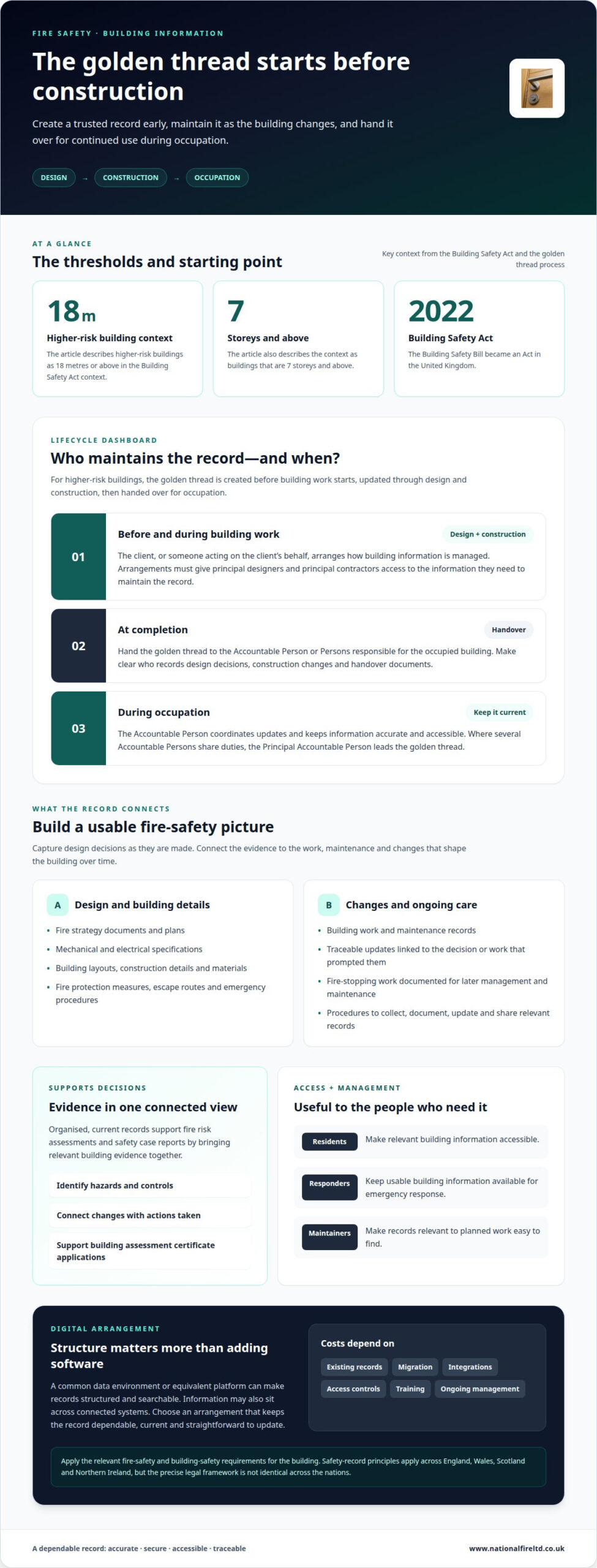
Fire safety information must be ready before occupation, not pieced together after a building is in use. For a higher-risk building, the golden thread must be created before building work starts, updated throughout design and construction, and handed to the Accountable Person or Persons when work is complete. Implementing a golden thread of information for fire safety therefore starts before construction and continues into occupation.
A dependable record is more than a digital filing system. It brings together information about building work and maintenance, along with the processes that keep records accurate, secure and accessible to the people who need them. This article explains when the golden thread begins, how to capture and maintain fire safety information as a building changes, and how to keep it useful during occupation. Clear ownership and straightforward access allow building information to support informed safety decisions over time.
Key Takeaways
- Build a reliable record by managing both the safety information and the processes that keep it accurate, secure and usable over time.
- Make relevant information accessible to residents and emergency responders, as well as the people responsible for maintaining the building.
- Connect fire safety records with design and construction details, then keep them current as work and building conditions change.
- Use clear ownership, consistent records and structured reviews to support informed fire-safety decisions throughout occupation.
Keeping building information accurate and accessible over time
A golden thread combines safety records with processes that keep them accurate, secure and usable. For building safety, this means maintaining information as work, occupancy and risks change.
Golden thread principles and safety documentation
The golden thread is a trusted, accessible record of building information and the steps used to manage it. According to UK Parliament, the Building Safety Bill became an Act in the United Kingdom in 2022, calling for implementation of the golden thread of information. Its records should give authorised users a clear account of building work, maintenance and changes, with updates traceable to the decisions or work that prompted them. This supports safer decisions throughout a building’s life.
According to UK Parliament, higher-risk buildings in the Building Safety Act context are buildings that are 18 metres or 7 stories and above. The golden thread helps identify, understand, manage and mitigate fire-spread and structural-collapse risks in these buildings. Across England, Wales, Scotland and Northern Ireland, use the safety-record principles alongside the requirements applying where the building is located; the precise legal framework is not identical across the nations.
Implementation costs and software options
A golden-thread information system is a digital arrangement for storing, organising and sharing building safety information. A common data environment or equivalent platform can make records structured and searchable, while information may also sit across connected systems. Costs depend on existing records, migration, integrations, access controls, training and ongoing management. Choose an arrangement that provides a dependable, current record, rather than adding software that leaves information fragmented or difficult to update.
The Fire Safety Regulations and Building Safety Act should guide which records are relevant to each building. Clear procedures should govern how teams collect, document, update and share information. This makes it easier to identify changes, assess their effect on fire spread and record the action taken.
Supporting safety cases and fire risk assessments
Golden-thread records support safety case reports and fire risk assessments by bringing relevant building evidence together. Plans, construction details, materials, fire protection measures and maintenance records can help explain how risks are identified and managed. Accountable Persons can use organised, current information to support building assessment certificate applications and demonstrate ongoing compliance. For an assessment, clear dates, change records and accessible supporting documents help connect identified hazards with the controls and decisions in place.
When does the golden thread start?
For higher-risk buildings, the golden thread must be created before building work starts and updated throughout design and construction. During this phase, the client, or someone acting on the client’s behalf, is responsible for arranging the management of building information. These arrangements must give principal designers and principal contractors access to the information they need to maintain the record.
Responsibilities change when construction is complete. The golden thread must be handed to the Accountable Person or Persons responsible for the occupied building. During occupation, the Accountable Person coordinates the information and keeps it updated, accurate and accessible. Where several Accountable Persons share duties, the Principal Accountable Person leads the golden thread.
Clear allocation prevents information from falling between teams. Identify who records design decisions, construction changes, handover documents and later maintenance. Set out who updates each record and how changes are passed to the person responsible for the occupied building. Assigning a named role to each task makes accountability easier to follow when staff or contractors change.
- During design and construction: the client’s arrangements support principal designers and principal contractors in maintaining the information.
- At completion: hand over the record to the Accountable Person or Persons for the occupied building.
- During occupation: the Accountable Person coordinates updates and keeps information accessible.
Access matters beyond the management team. Information should be available to residents, emergency responders and people who need it to work on or maintain the building. Use clear naming and organised records so relevant plans or safety details can be found easily. For example, emergency responders need usable building information, while a maintenance team needs records relevant to its planned work.
Documenting fire-stopping work is one practical part of keeping building information useful. Fire stopping work should be recorded in a way that supports later building management and maintenance.
Information capture from design through occupation
Capture fire safety information as design decisions are made, rather than reconstructing them after construction. The record should connect fire strategy documents and plans with mechanical and electrical specifications. Include building layouts, construction details, materials, fire protection measures, escape routes and emergency procedures. Together, these details help responsible people assess how the design addresses fire spread and how later work may affect that approach.
Check fire strategy documents against plans and specifications during design. Confirm that compartment walls and floors, escape routes and fire protection measures are represented consistently. Identify services and insulation passing through compartment boundaries, then establish the space needed to install and fire stop them. These checks help teams spot coordination issues before installation makes access more difficult.
For service penetrations, follow a considered design process and document the intended seal, location and supporting evidence. Involve firestopping manufacturers and specialist installers early so proposed details can be coordinated with the construction design. Where possible, use one manufacturer for a project. Do not mix products from different manufacturers in one opening without clear supporting test evidence. Record the installed arrangement and relevant evidence for future maintenance.
During the work, use a structured inspection plan and retain photographic evidence as installation progresses. Photographs, for example, can show a penetration before it is concealed, while records identify its location and the work completed. This makes information more accessible to people assessing later alterations, maintenance or fire safety concerns.
Dame Judith Hackitt’s final report recommended improvements to transparency, accountability and information flow across the UK construction industry. Treating accurate records as part of the work helps design teams, contractors and building safety duty-holders preserve decisions beyond handover. Residents and those maintaining the building can then use information that reflects the actual design and construction, rather than relying on assumptions.
Golden Thread guidance for fire safety
For fire safety, useful guidance turns records into a dependable way to understand and manage building risks. The practical focus is what information to retain, how to keep it current and how to make it usable.
Fire safety information for the golden thread
The golden thread brings together fire safety information and the processes used to maintain it. It should cover the building’s design, construction materials, fire protection systems, escape routes and emergency procedures. Include records of building work and later changes so the information reflects the building as it stands, not just its original design. This helps responsible people assess fire-spread risks and understand how safety measures relate to the building.
For higher-risk buildings, information should show that completed buildings and later work meet applicable building regulations. The Building (Higher-Risk Buildings) Procedures Regulations 2023 and Higher-Risk Buildings (Management of Safety Risks) Regulations 2023 set relevant requirements. Records should be digitally stored, secure, accessible and shareable, with changes accounted for. This lets people use a reliable record instead of relying on disconnected documents or outdated plans.
Steps for implementing the fire safety golden thread
Implementing a golden thread of information for fire safety means organising evidence and the processes that keep it reliable throughout a building’s life. Start by identifying existing records and gaps, then set out who collects, updates and shares each type of information. Use consistent terminology and a structured digital system so contractors and building managers can find relevant records and understand what they describe.
For organisations, the core steps are to:
- Bring together available design, construction, fire-safety and maintenance records.
- Record changes with supporting information, including relevant plans or photographs.
- Assign responsibility for updates, access and regular reviews.
- Use current information to assess fire-spread and structural risks, then document decisions.
For existing buildings, Accountable Persons need to make reasonable enquiries to find information for assessing and managing fire-spread and structural-stability risks. A structured review can identify missing or outdated records, while a controlled change process helps prevent future gaps. These practices support building safety and make information more useful during occupation.
Review your building’s fire-safety information as part of maintaining a clear, usable record.
National Fire: Fire Stopping
National Fire provides Fire Stopping for projects where passive fire protection forms part of the building’s safety measures. This work can be relevant when fire-stopping requirements identified during design need to be carried through installation and reflected in building records. Clear records help those responsible for occupation understand what work was completed and where it is located in the building.
National Fire also provides Fire Door Installation and Fire Door Maintenance for buildings where door work forms part of the fire safety scope. Injectable Cavity Barriers are another offering for building projects. The appropriate work depends on the building’s fire safety requirements and the project scope. Keep records aligned with the work undertaken so the information remains useful for future management and maintenance.
For fire protection work that needs to connect with your building’s safety arrangements, contact National Fire to discuss your project.
Make your next fire-safety decision count
Use the golden thread as a working reference when planning building changes, maintenance or further fire safety work. Implementing a golden thread of information for fire safety is more practical when each project decision connects to the building’s current records. This helps those responsible understand what is changing and which information needs updating.
For work involving passive fire protection, National Fire offers Fire Stopping, Fire Door Installation and Injectable Cavity Barriers. These services can form part of a project’s fire safety scope, with relevant information recorded alongside the work. Clear documentation gives building teams a useful basis for future management.
For a practical next step, identify the part of your building’s fire-safety scope that needs attention, then discuss how the work fits your building’s records. Contact National Fire for support with your project. A considered approach can help you move forward with clarity and confidence.
Frequently Asked Questions
What is the golden thread of information for fire safety in UK buildings?
The golden thread is the information and management processes needed to understand a building and keep it and its people safe. For fire safety, this means records that help explain how the building’s design, materials, fire protection and later work affect fire-spread risks. For example, an alteration record should help users understand what changed and where supporting details are held.
Which buildings must comply with golden thread requirements under the Building Safety Act 2022?
In the Building Safety Act context, UK Parliament describes higher-risk buildings as buildings that are 18 metres or 7 stories and above. UK Parliament also says a building must have at least two residential units to be within the Act’s scope. These points help identify potential coverage; the relevant building type and legal duties determine which requirements apply.
Who is responsible for creating, maintaining and handing over golden thread information?
During design and construction, the client, or someone acting for the client, must arrange for building information to be managed. The information is handed to the Accountable Person or Persons when work is complete. During occupation, the Accountable Person coordinates updates and access. If several Accountable Persons share responsibility, the Principal Accountable Person leads the golden thread.
What are the golden thread requirements for higher-risk buildings in England?
For higher-risk buildings, create the golden thread before building work starts and update it through design and construction. It must show that the completed building and later building work meet applicable building regulations. The Building (Higher-Risk Buildings) Procedures Regulations 2023 and Higher-Risk Buildings (Management of Safety Risks) Regulations 2023 set relevant requirements for information management and sharing.
How should building owners store, manage and share golden thread information digitally?
Keep information digitally in a secure, usable arrangement. It can be held across multiple systems, provided users can locate and share the records they need. A common data environment or equivalent platform can organise information in a searchable structure. Use consistent terminology and controlled access, then record changes so users can distinguish current information from superseded plans or documents.
What are the deadlines and enforcement penalties for failing to meet golden thread requirements?
For higher-risk buildings, create the golden thread before building work starts, update it throughout design and construction, and hand it over when work is complete. There is no single deadline for every record or update. Accountable Persons use the information to apply for building assessment certificates and demonstrate ongoing compliance. Enforcement consequences depend on the applicable duty and breach.