

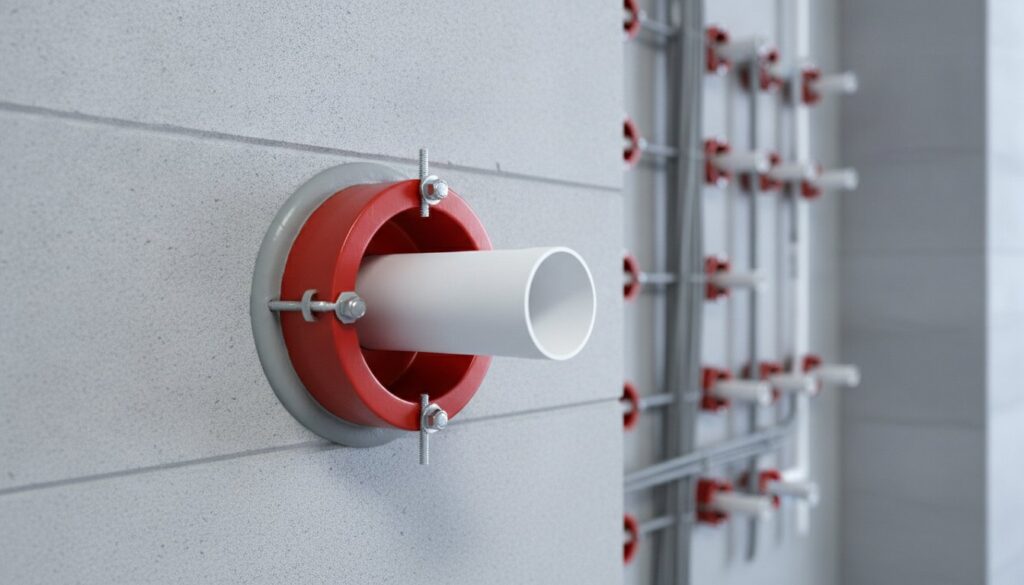
A single non-compliant seal can invalidate an entire building’s fire strategy and put lives at risk. Effective fire stopping for pipe penetrations is never a matter of applying a patchwork of products; it’s a disciplined engineering requirement that must meet rigorous 2026 regulatory standards. We recognize the technical burden placed on estate managers and contractors who face the complexity of managing multiple services within a single wall. It’s natural to feel concerned about failing a fire compartmentation survey when the distinction between pipe materials and substrates seems so narrow.
This guide is designed to provide you with the technical certainty required to achieve 100% compliance with BS EN 1366-3. You’ll master the critical differences between integrity and insulation ratings and learn how to select tested systems that satisfy the Building Safety Act 2022. We’ll preview the essential steps for maintaining the “Golden Thread” of information and explain why professional remedial work is vital for long-term legal security. By the end of this article, you’ll have a clear roadmap for ensuring every penetration in your facility serves as a reliable barrier against fire and smoke.
Key Takeaways
- Understand the critical engineering principles of fire stopping for pipe penetrations to prevent the “chimney effect” and maintain compartmentation integrity.
- Identify the technical differences between combustible and non-combustible pipes to ensure the correct application of intumescent collars or wraps.
- Learn to select tested fire stopping systems based on specific substrates, such as masonry or drywall, to satisfy 2026 regulatory standards.
- Master the “Golden Thread” of information by implementing meticulous photo documentation and ID tagging for every service penetration.
- Discover how professional fire compartmentation surveys mitigate legal risk by identifying hidden breaches before they lead to inspection failure.
The Critical Role of Fire Stopping for Pipe Penetrations in Compartmentation
Fire stopping for pipe penetrations is the technical process of sealing openings where services pass through fire-rated walls or floors. It’s a critical component of a building’s overall safety infrastructure. Without these seals, a fire-rated barrier is merely a wall with a hole in it. A Firestop system ensures that the fire-resistance rating of the assembly remains intact, preventing the passage of flames and toxic gases between zones. This process is essential for maintaining the life-saving potential of any commercial structure.
In commercial environments, service penetrations are frequently the most common point of failure during fire safety audits. This usually happens because contractors prioritize service installation over the integrity of the barrier. Ensuring correct fire stopping for pipe penetrations is not just a best practice; it’s a mandatory requirement for building handover and ongoing occupancy. It forms a core element of passive fire protection, acting as a static defense that requires no manual activation to save lives.
Understanding the Chimney Effect in Vertical Services
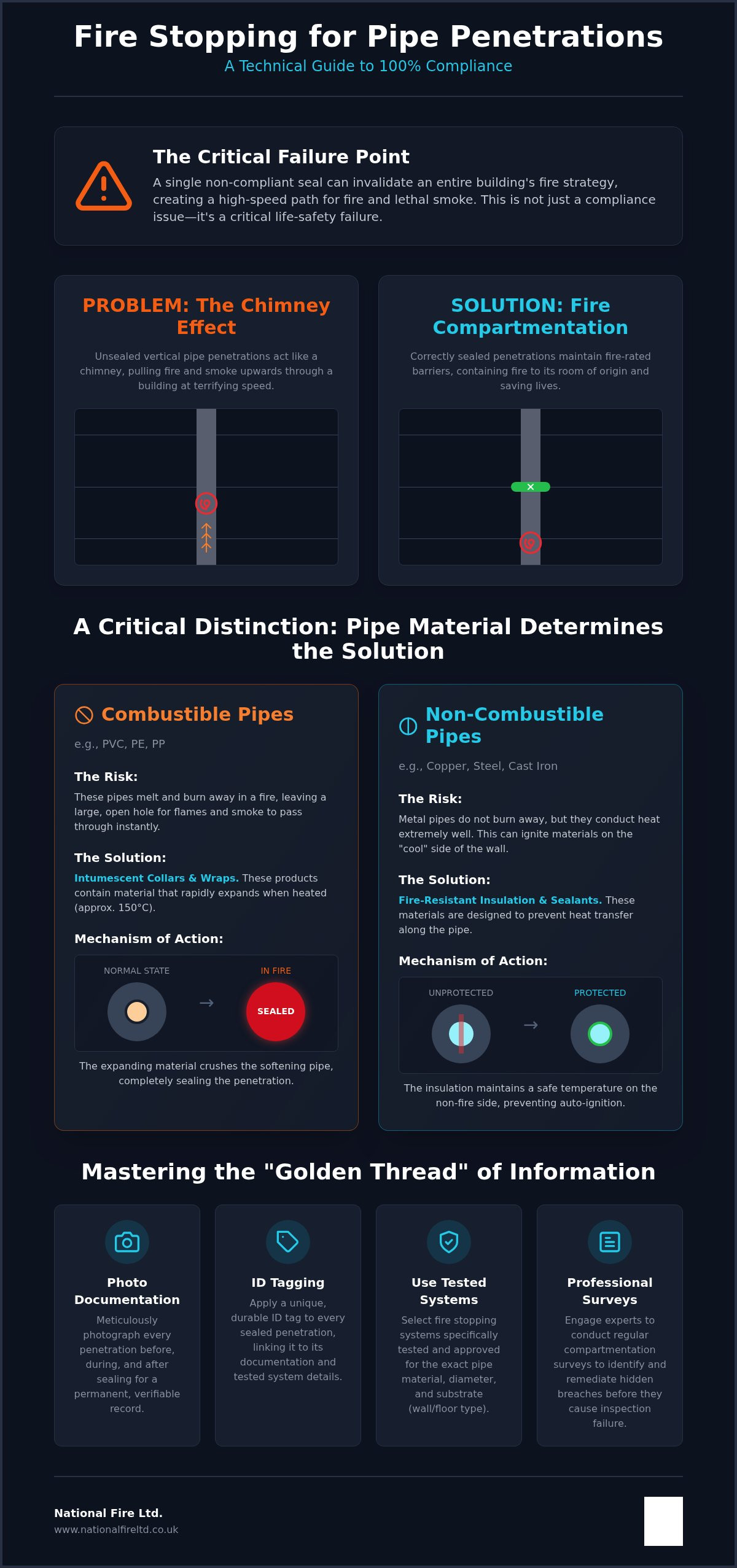
Vertically oriented pipework presents a unique set of risks due to the fundamental laws of thermodynamics. When a fire occurs, heat naturally rises through any available void. Unsealed penetrations create a pressure differential, essentially a vacuum that pulls flames and hot gases upward with terrifying speed. This movement isn’t just about the fire itself; it’s about the smoke. Smoke inhalation remains the primary cause of death in commercial building fires, and vertical voids act as high-speed conduits for these lethal fumes. The chimney effect is a primary driver of rapid vertical fire spread. We’ve seen cases where smoke bypassed three floors in minutes because of a single missing seal in a service riser.
Maintaining Fire Compartmentation Integrity
A robust fire compartmentation strategy relies on the principle that fire should be contained within its room of origin. Even a single unsealed 110mm pipe can completely invalidate this strategy by allowing fire to leapfrog from one zone to another. Building managers have a strict legal obligation to maintain these barriers under current safety legislation, and ignorance of a breach is not a valid defense. There’s a fundamental difference between a simple “hole in the wall” and a compliant service penetration. A compliant penetration is an engineered solution, tested and certified to withstand heat and pressure for a specific duration, typically 30 to 120 minutes. It requires meticulous documentation to prove its performance during a legal audit or post-incident investigation.
Understanding Penetration Types: Combustible vs. Non-Combustible Pipes
The selection of a system for fire stopping for pipe penetrations is dictated by the thermal properties of the pipe material. We categorise these into combustible and non-combustible types. Each requires a different mechanical response to heat. Misidentifying a pipe material is a frequent cause of non-compliance. It’s essential to match the product to the specific pipe diameter and wall thickness used in the installation. If you’re unsure about the materials currently installed, professional fire compartmentation surveys can provide the necessary technical clarity.
Combustible Pipes (PVC, PE, PP)
Plastic pipes like PVC, PE, and PP present a unique risk because they melt and burn away when exposed to fire. This leaves a clear path for flames and smoke to penetrate the compartment. We address this using intumescent collars or wraps. These devices contain a reactive material that expands rapidly when temperatures reach approximately 150°C. The expansion generates significant pressure, enough to crush the softening pipe and seal the aperture. While intumescent sealants are useful for small gaps, they’re often insufficient for large-diameter pipes. For these, a mechanical collar is the standard for achieving ratings from E30 up to EI120. Proper fire stopping for pipe penetrations ensures that even as materials change state under heat, the compartment remains secure.
Non-Combustible Pipes (Copper, Steel, Cast Iron)
Metal pipes won’t disappear in a fire, but they pose a different threat: thermal conductivity. Copper and steel can transfer enough heat to the “cool” side of a wall to cause auto-ignition of nearby combustible materials. This is why we focus on the “I” or insulation rating in an EI system. A compliant seal must manage the heat transfer through the pipe wall itself. This often involves using specialised mineral wool or coated batts that provide a thermal break. Metal pipes also expand and contract during normal building operation. The chosen sealant must remain flexible enough to accommodate this movement without cracking or losing adhesion. Standards such as the International Building Code (IBC) provide clear frameworks for these through-penetration systems. They emphasise that the insulation rating is just as critical as the integrity rating to prevent fire spread via conduction. Using a generic sealant on a large copper main often leads to failure during a professional audit because it doesn’t account for these thermal dynamics.
Selecting the Correct Fire Stopping System: Collars, Wraps, and Sealants
Selecting the correct system for fire stopping for pipe penetrations requires a methodical assessment of both the service and the substrate. A solution that works for a masonry wall may fail entirely when applied to a flexible drywall partition. We don’t believe in “one size fits all” approaches; such shortcuts are a primary source of liability in commercial fire safety. Every product must be part of a tested system that matches the specific configuration of your building. This includes verifying that all components carry reputable third-party certifications from bodies like UL, IFC, or BM TRADA. These credentials provide the technical assurance that a seal will perform as expected under extreme thermal stress.
Fire Collars vs. Fire Wraps
The choice between a fire collar and a fire wrap often depends on the stage of construction and the available access to the penetration. Both serve the same fundamental purpose for combustible pipes, but their application methods differ significantly. We’ve outlined the primary distinctions below to assist in your selection process.
- Fire Collars: These are surface-mounted mechanical devices. They’re the preferred choice for remedial works because they can be installed around existing pipes without dismantling the service. They’re typically bolted or screwed into the wall or floor.
- Fire Wraps: These are flexible strips installed within the wall or floor thickness. They’re often used in new builds because they’re cast into the concrete or tucked into the partition, providing a space-saving and aesthetically clean finish.
While wraps are excellent for tight clusters of services, collars provide a robust, visible solution that is easier to inspect during a fire compartmentation survey. We recommend collars for any high-traffic commercial area where the integrity of the seal must be verified at a glance.
Intumescent Sealants and Fire Batts
When dealing with oversized apertures or multi-service openings, a simple collar isn’t enough. We utilize high-density mineral wool fire batts to bridge large gaps. These batts are coated with an ablative substance that resists fire and prevents smoke leakage. For smaller annular gaps, intumescent sealants provide the necessary smoke-tight finish. It’s vital to avoid the common trap of using standard polyurethane (PU) “fire foam.” While some foams claim fire resistance, they’re rarely part of a tested and compliant system for permanent service penetrations in commercial settings. Relying on foam instead of engineered batts and sealants is a frequent cause of failed building handovers. We ensure that every large opening is treated as a bespoke engineering challenge, maintaining the “Golden Thread” of safety from installation to final audit.
Best Practices for Compliant Installation and Maintenance
Even the most advanced fire stopping for pipe penetrations will fail if the installation lacks technical discipline. We frequently observe non-compliance caused by basic execution errors, such as over-packing apertures with combustible materials or under-filling seals to save on product costs. Using unapproved backing materials, like standard polyurethane foam or household insulation, is a critical failure that voids the system’s fire rating. Correct installation is an engineered process that requires precision to ensure the safety of the building and its occupants.
The Installation Workflow
A compliant installation follows a structured, three-step sequence. First, the substrate must be thoroughly cleaned. Dust, grease, and loose debris prevent sealants from bonding correctly to the wall or pipe surface. Second, the primary fire-stopping element, such as a collar or wrap, must be positioned flush against the substrate. Any gaps between the device and the wall can allow smoke to bypass the seal. Finally, we apply a secondary smoke seal and affix a unique identification tag to the penetration. This tag corresponds to the fire safety logbook, providing an immediate reference for future audits. Compliance isn’t optional. This methodical approach ensures that every seal is a verified barrier rather than a legal liability.
Documentation and the Building Safety Act
The Building Safety Act 2022 has fundamentally changed how we manage fire stopping for pipe penetrations. It’s no longer enough to perform the work; you must prove it was done to the required standard. This “Golden Thread” of information demands digital evidence for every single seal. We use high-resolution photography to document the penetration before, during, and after the seal is applied. This creates a permanent, tamper-proof record of compliance that protects building owners from future litigation.
Our technical team utilizes fire strategy drawings and floor plan generation to track the location of every service penetration across a facility. These documents act as a live map for facilities managers, making annual inspections efficient and exhaustive. High-risk commercial buildings require these regular reviews to identify damage caused by subsequent trades or building movement. Maintaining this level of oversight is the only way to guarantee long-term compartmentation integrity. If you require a detailed audit of your existing seals, we recommend commissioning professional fire stopping services to secure your building’s compliance status.
Ensuring Regulatory Compliance with Professional Fire Stopping Services
Achieving compliant fire stopping for pipe penetrations isn’t merely about purchasing a rated product; it’s about the technical execution of a safety system. While many contractors can apply a sealant, only a specialist can guarantee that the installation meets the specific requirements of the tested system and the building’s fire strategy. There’s a significant risk in treating fire stopping as a secondary task. Professional fire compartmentation surveys go beyond surface-level inspections to identify hidden breaches where services pass through inaccessible voids or behind false ceilings. These surveys provide the technical evidence required to prove that your building remains a secure environment for its occupants.
Technical fire strategy drawings and floor plan generation are essential tools for demonstrating due diligence to insurers and regulatory bodies. They provide a clear, auditable trail of where every penetration is located and how it’s protected. National Fire Ltd is the preferred partner for complex remedial fire stopping projects across the UK because we prioritize this level of meticulous oversight. We don’t just install products; we manage the entire lifecycle of compartmentation to ensure you’re always prepared for legal scrutiny.
The Value of a Specialist Contractor
Engaging a specialist contractor helps building managers avoid the “split liability” trap. In many commercial projects, M&E contractors install the pipework but lack the specific accreditation to certify the fire stopping. This creates a dangerous gap in responsibility. By appointing accredited professionals with national coverage, you ensure that every seal is backed by a certificate of conformity. National Fire Ltd provides a unified solution from initial survey to certified remedial work. This disciplined approach eliminates ambiguity and ensures that your passive fire protection strategy is robust and fully documented.
Preparing for Your Next Fire Safety Audit
Consolidating your fire stopping records into a compliant safety file is a critical step for any facilities manager. This file should contain your strategy drawings, installation photos, and unique ID tags for every service. Having this information readily available provides authoritative reassurance during a fire safety audit, demonstrating that you’ve taken every necessary step to protect life and property. The peace of mind provided by professional oversight cannot be overstated; it’s the difference between hoping for compliance and knowing you’ve achieved it. Contact National Fire Ltd for a comprehensive survey of your building’s service penetrations to secure your 2026 compliance status.
Securing Your Building’s Future with Technical Excellence
Establishing compliant fire stopping for pipe penetrations is an engineering discipline that demands unwavering precision. We’ve highlighted the necessity of matching tested systems to specific pipe materials and the critical importance of the “Golden Thread” for legal compliance. By moving away from patchwork solutions and adopting a methodical approach to documentation, you protect both your property and the lives within it. Meticulous oversight is the only way to ensure that your building’s compartmentation remains an impenetrable barrier against heat and smoke.
National Fire Ltd serves as a trusted advisor, offering nationwide UK coverage for commercial sectors. Our team consists of accredited passive fire protection experts who specialize in technical fire strategy drawings and floor plan generation. We provide the stability and reliability required to manage complex remedial projects from initial survey to final certification. You can rely on our methodical approach to deliver the security your building requires.
Secure your building today with a professional fire stopping survey from National Fire Ltd and gain the technical certainty that your safety systems are fully compliant.
Frequently Asked Questions
Is fire stopping for pipe penetrations a legal requirement in the UK?
Yes, it’s a mandatory requirement under UK Building Regulations, specifically Approved Document B, and the Regulatory Reform (Fire Safety) Order 2005. The Building Safety Act 2022 further mandates the maintenance of the “Golden Thread” for high-risk buildings. Failure to ensure compliant fire stopping for pipe penetrations can result in prosecution, unlimited fines, or the invalidation of building insurance. It’s a critical component of a building’s legal safety framework that requires professional certification.
What is the difference between a fire collar and a fire wrap?
Fire collars are mechanical, surface-mounted devices typically used for remedial works or where access to the wall interior is limited. They’re bolted directly to the substrate around the pipe. Fire wraps are flexible intumescent strips installed within the wall or floor thickness during the construction phase. While both products expand to seal melting plastic pipes, collars provide a visible solution that’s often easier to verify during a professional fire compartmentation survey.
Can I use standard expanding foam for fire stopping around pipes?
No, standard polyurethane expanding foam isn’t a compliant solution for fire stopping. While some foams are marketed as “fire-rated,” they’re rarely part of a tested and certified system for permanent service penetrations in commercial buildings. Compliant fire stopping requires engineered products like intumescent sealants or mineral wool batts that have been tested to BS EN 1366-3. Using unapproved foam is a common point of failure during professional audits and surveys.
How often should fire stopping for service penetrations be inspected?
Commercial building managers should commission an inspection of fire stopping at least annually. High-risk environments or buildings undergoing frequent maintenance work may require more frequent reviews. These inspections identify damage caused by building movement or subsequent trades who may have breached existing seals. Regular oversight ensures that the strategy for fire stopping for pipe penetrations remains robust and that all documentation stays current for the safety logbook and legal compliance.
What does an “EI” rating mean in fire stopping?
An “EI” rating describes two distinct performance criteria: Integrity (E) and Insulation (I). Integrity refers to the system’s ability to stop the passage of flames and hot gases through the penetration. Insulation measures how long the system prevents the non-fire side of the penetration from reaching a specific temperature. In many commercial settings, achieving an “I” rating is vital to prevent the auto-ignition of materials on the protected side of the fire-rated wall.
Do I need to fire stop metal pipes if they are non-combustible?
Yes, metal pipes require fire stopping because they act as thermal conductors. Even though the pipe won’t melt, it can transfer enough heat through a wall to ignite combustible materials on the other side. A compliant seal for metal pipes must accommodate thermal expansion and manage heat transfer to meet required insulation ratings. Ignoring non-combustible penetrations is a major risk to a building’s overall fire compartmentation strategy and often leads to survey failure.
How do I document fire stopping for the Building Safety Act?
Documentation must follow the “Golden Thread” principle by creating a digital, auditable record for every seal. This involves taking high-resolution photographs of the penetration before, during, and after the work is completed. Each seal should be assigned a unique ID tag that corresponds to a digital fire safety logbook and technical fire strategy drawings. This evidence proves that the installation was performed by experts using tested systems and approved materials for total compliance.
Can fire stopping be done after the pipes are already installed?
Yes, remedial fire stopping is a standard procedure for existing buildings. While some products like fire wraps are easier to install during construction, fire collars are specifically designed for surface-mounting around pipes that are already in place. Our team specializes in these complex remedial works, ensuring that even legacy penetrations are brought up to current BS EN 1366-3 standards. We use technical drawings and surveys to map and seal every identified breach effectively.