


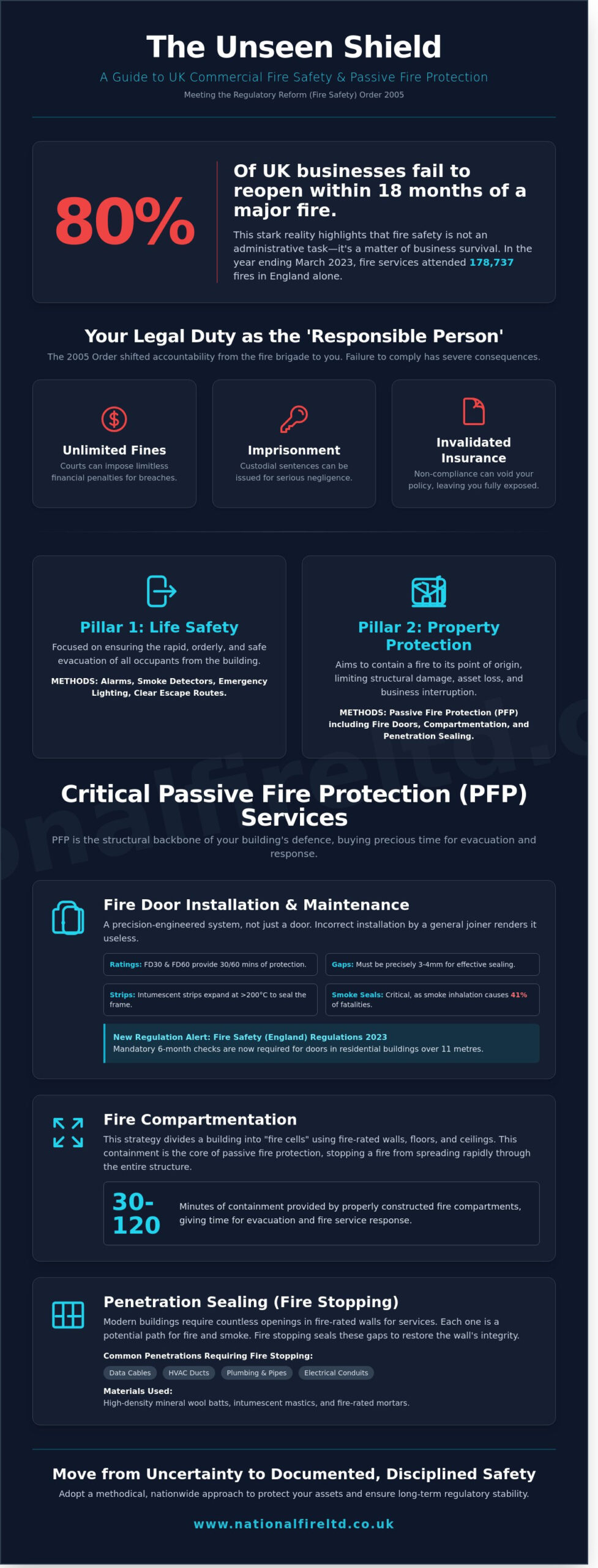
Did you know that 80% of UK businesses that experience a major fire fail to reopen or go out of business within 18 months of the incident? It’s a sobering reality that underscores why you view compliance as a serious responsibility rather than a simple administrative task. You likely recognise that the shifting requirements of the Regulatory Reform (Fire Safety) Order 2005 create significant pressure, especially when you’re searching for reliable fire safety services that can guarantee a standard of excellence across your entire estate.
This guide provides an authoritative breakdown of the essential provisions required to protect your commercial assets and deliver the peace of mind that comes from total regulatory alignment. We’ll explore the specific BAFE-accredited methods used to mitigate risk, protect your building’s structural integrity, and ensure your 2026 safety strategy is both robust and legally sound. We’re here to help you move from the uncertainty of an upcoming inspection to a position of documented, disciplined safety that safeguards both your people and your property.
Key Takeaways
- Understand the critical distinction between life safety and property protection to ensure your building’s containment strategy is both robust and compliant.
- Learn how to verify professional accreditations to mitigate the severe legal and safety risks associated with non-compliant remedial work.
- Discover why general risk assessments often miss structural vulnerabilities and how professional compartmentation surveys identify these hidden dangers.
- Streamline your facilities management by implementing integrated fire safety services designed to meet the latest UK statutory standards for 2026.
- Gain peace of mind by adopting a methodical, nationwide approach to protecting complex commercial assets and ensuring long-term regulatory stability.
Essential Fire Safety Services for UK Commercial Buildings
Modern fire safety services in the UK commercial sector extend far beyond the simple installation of extinguishers. They represent an integrated framework designed to manage two distinct but related objectives: life safety and property protection. Life safety systems ensure the rapid, orderly evacuation of occupants. Property protection measures aim to contain a blaze to its origin, limiting structural damage and financial loss. National Fire Ltd treats these as non-negotiable pillars of a robust safety strategy.
Building managers act as the primary guardians of these standards. A compliance-first approach is the only reliable method to mitigate the legal and financial risks associated with fire incidents. Home Office data for the year ending March 2023 showed that fire and rescue services attended 178,737 fires in England alone. Failing to meet statutory requirements leads to unlimited fines or imprisonment under current UK law. We provide the technical expertise to ensure your facility remains a safe environment for every occupant.
Beyond Alarms: The Foundation of Passive Fire Protection
Detection systems provide the warning, but structural measures provide the time needed to act. Fire stopping is just as critical as smoke detection because it prevents the invisible spread of toxic gases through service penetrations. Passive fire protection (PFP) provides the necessary window for safe evacuation by maintaining the integrity of fire-rated walls and floors. Passive fire safety acts as the structural defence in depth against fire spread. These services ensure that a 30-minute fire door actually provides 30 minutes of protection when it matters most.
Statutory Compliance and the Regulatory Reform Order
The Regulatory Reform (Fire Safety) Order 2005 places a clear legal burden on the Responsible Person to ensure suitable and sufficient fire precautions. This legislation shifted the responsibility from the fire brigade to the building owner or manager. You’re legally required to maintain fire compartmentation and ensure all fire doors are fit for purpose. Neglecting these fire safety services doesn’t just risk lives; it invalidates insurance policies and invites prosecution. Our accredited teams focus on meticulous record-keeping to prove your compliance during any audit or inspection.
A Roundup of Critical Passive Fire Protection Services
Passive fire protection forms the structural backbone of a building’s defence. By integrating these fire safety services into a single, cohesive strategy, facilities managers can significantly reduce the administrative burden of coordinating multiple vendors. Managing a national portfolio of 50 or 100 properties requires a unified approach to ensure every site adheres to the same rigorous standards. This consistency is vital for meeting your legal responsibilities for fire safety under the Regulatory Reform (Fire Safety) Order 2005. Using a single accredited contractor ensures that every service penetration and fire door across your estate meets the required FD30 or FD60 rating, providing essential peace of mind for stakeholders.
Specialist Fire Door Installation and Maintenance
Installing a fire door isn’t a task for a general joiner. It’s a precision engineering exercise where every gap must be measured to within 3mm to 4mm to ensure the door functions as intended during a thermal event. We focus on the installation of FD30 and FD60 rated sets, incorporating intumescent strips that expand at temperatures exceeding 200°C to seal the frame. Cold smoke seals are equally critical; smoke inhalation causes 41% of fire-related fatalities in the UK. Under the Fire Safety (England) Regulations 2023, doors in residential commercial buildings over 11 metres now require mandatory checks at 6-month intervals to remain compliant and functional.
Fire Compartmentation and Penetration Sealing
Fire compartmentation works by dividing a building into “cells” to contain fire at its source for 30 to 120 minutes. Modern commercial buildings are riddled with service penetrations for data cables, HVAC ducts, and plumbing. If these aren’t sealed with fire-rated batts, mastics, or mortars, the wall’s integrity is compromised in seconds. We utilise high-density mineral wool batts and intumescent sealants to restore these barriers to their original fire rating. For modern facades, injectable cavity barriers are essential to prevent the “chimney effect” in concealed spaces. Maintaining these barriers is a statutory requirement that ensures the safety of your occupants. If you’re unsure about your current level of protection, you might consider a comprehensive compartmentation survey to identify hidden risks. These fire safety services are not merely optional extras; they’re the disciplined foundation of life safety in the built environment.
Evaluating Service Providers: Accreditations and Competence
Selecting the right partner for your fire safety services is a statutory obligation that carries significant weight. Using uncertified contractors for remedial works often leads to non-compliance, which compromises the integrity of your building’s fire strategy. In 2023, UK fire and rescue services attended approximately 185,000 incidents. If your fire doors or detection systems fail due to substandard installation, the legal and financial repercussions are severe. You must verify a provider’s credentials on the BAFE or BM TRADA registers before commissioning any work. This due diligence ensures that every pound spent contributes to a robust safety framework rather than a future liability. When evaluating passive fire protection companies, it’s essential to follow a rigorous checklist that verifies their technical competence and statutory compliance credentials.
Why BM TRADA and BAFE Certifications Are Non-Negotiable
Third-party certification provides the only objective proof of technical competence in the UK fire industry. The BM TRADA Q-Mark scheme is essential for fire door installers, as it requires rigorous, ongoing audits of their installation processes. Similarly, BAFE accreditation ensures that a provider has been independently assessed for specific fire safety modules. We believe that peace of mind is built on a foundation of evidence. Every completed project must result in a Certificate of Conformity. This document serves as your primary defence during a Fire Authority inspection, proving that the work meets the required British Standards. Without this certificate, your insurance may be voided in the event of a claim.
Technical Fire Strategy Drawings and Documentation
Modern fire safety management relies on precision and clarity. Accurate floor plans and fire strategy drawings are now a critical requirement under The Fire Safety (England) Regulations 2022 for specific building types, but they remain a gold standard for all commercial properties. These drawings provide emergency services with vital information regarding your site’s layout and fire-fighting equipment. Digitising these records is a logical step for any responsible person. It simplifies compliance tracking and ensures that your audit trail is always accessible. Benefits of digital documentation include:
- Instant access to maintenance logs during surprise inspections.
- Automated reminders for upcoming statutory testing dates.
- Secure storage of bespoke fire strategy drawings and asset registers.
- Real-time updates when remedial works are completed by accredited technicians.
Relying on paper logbooks is a risk you don’t need to take. A digital approach ensures your fire safety services are organised, transparent, and fully compliant with current UK law.
Identifying Hidden Risks: The Importance of Professional Surveys
Standard Fire Risk Assessments are a statutory requirement, yet they’re typically non-intrusive. They often fail to detect structural fire protection failures hidden deep within the building fabric. A specialist survey provides the technical depth required to mitigate these risks. Our methodology involves a systematic inspection of the building’s fire-resisting elements to ensure they meet the Regulatory Reform (Fire Safety) Order 2005. We transform these findings into a prioritised remedial work plan, categorising risks from ‘Immediate’ to ‘Planned’ to help you manage budgets effectively. This disciplined approach ensures that 100% of identified vulnerabilities are addressed according to their severity.
Fire Door Surveys: Ensuring Integrity at Every Opening
Technical surveys go beyond a simple visual check. Our accredited surveyors examine the leaf, frame, and hardware against BS 8214 standards. We measure gaps precisely; a gap exceeding 4mm can lead to catastrophic failure during a fire. We inspect hinges, self-closing devices, and fire-rated glazing to ensure every component functions as a unified system. Each door is tagged and logged in a digital fire safety logbook, providing a statutory audit trail for your premises. This level of detail is a core part of our fire safety services, ensuring your exits remain viable when they’re needed most.
Compartmentation Surveys: Finding Hidden Vulnerabilities
Complex commercial structures rely on fire-rated walls and floors to contain a blaze. We map these barriers to identify breaches above suspended ceilings and under raised floors where services like cables and pipes pass through. A compartmentation survey is the only way to guarantee the ‘box-in-a-box’ safety principle. This principle ensures that fire and smoke remain trapped within the room of origin for a specified period. Statistics from UK fire services indicate that 60% of fire-related deaths are caused by smoke inhalation; maintaining these barriers is critical for life safety. Our team uses invasive and non-invasive techniques to ensure your fire safety services strategy covers every square metre of the property.
Secure your building against invisible threats by booking a comprehensive compartmentation survey with our expert team.
National Fire Ltd: Your Partner in Nationwide Fire Safety
National Fire Ltd delivers accredited passive fire protection across the United Kingdom. We operate from three key hubs in Warwick, London, and Great Yarmouth, providing a truly nationwide response for commercial property owners. This infrastructure is essential for clients managing multi-site portfolios or complex, large-scale safety projects that require consistent standards across different regions. We focus on restoring fire integrity through a disciplined, methodical approach. Our specialists ensure every building meets the strict criteria of the Regulatory Reform (Fire Safety) Order 2005, providing the peace of mind that comes from total statutory compliance.
- Warwick: Our central base facilitates rapid deployment across the Midlands and Northern England.
- London: This office manages high-density residential and commercial projects within the capital’s unique regulatory environment.
- Great Yarmouth: Our Eastern hub provides specialist support for industrial and commercial sectors along the coast.
Specialist Solutions: Injectable Cavity Barriers and Fire-Rated Balconies
Modern construction requires specific, high-tech interventions to mitigate risk. We provide bespoke fire safety services such as injectable cavity barriers to solve fire spread issues in existing facades. These barriers are vital for buildings where original construction failed to include adequate fire stops. By injecting specialist materials into these hidden voids, we eliminate the “chimney effect” that allows fire to bypass floor slabs. We also focus on balcony safety, replacing combustible components with fire-rated materials. Since the 2018 amendment to Building Regulations, 100% of materials in external wall systems for buildings over 11 metres must meet strict non-combustibility standards, typically requiring A1 or A2-s1, d0 rated components.
Ensuring Peace of Mind Through Comprehensive Maintenance
Safety systems only work if they’re maintained with absolute precision. Our 24/7 commitment ensures we’re always available to support our clients’ needs, regardless of the hour. We build long-term partnerships based on technical excellence and reliability. Our team doesn’t just provide a service; we act as a guardian for your property and its occupants. We follow a clear, logical progression from risk identification to accredited remediation, ensuring every project is documented for your golden thread of information. Contact our expert team today to organise your compliance survey and secure your building’s future.
Protecting Your Commercial Portfolio Through 2026
Managing commercial compliance in 2026 requires a methodical approach to statutory obligations. Under the Building Safety Act 2022, the responsibility for maintaining structural integrity and life safety systems has never been more critical. You’ve identified the necessity of thorough professional surveys to mitigate hidden risks within your building’s fabric. Addressing these issues through specialist passive fire safety remedials ensures your property remains compliant with the Regulatory Reform (Fire Safety) Order 2005. This isn’t just a legal checkbox; it’s a fundamental commitment to life safety.
National Fire Ltd provides the technical excellence required to navigate these complex regulations with absolute certainty. As BM TRADA Certified Installers, we deliver accredited solutions across our entire nationwide UK coverage. We don’t just provide fire safety services; we act as your disciplined partner in safeguarding occupants and assets. Our team focuses on meticulous standards to provide the peace of mind your organisation demands. We’re ready to help you maintain a robust safety profile regardless of your building’s scale or location.
Secure your building’s compliance with National Fire Ltd and ensure your commercial portfolio is protected by seasoned professionals. Your commitment to safety today builds a more resilient future for everyone.
Frequently Asked Questions
What are fire safety services in a commercial context?
Our comprehensive fire safety services encompass the technical and administrative measures required to protect a commercial property from fire risks. These include statutory risk assessments, the installation of passive fire protection, and the maintenance of active systems like alarms or sprinklers. Under the Regulatory Reform (Fire Safety) Order 2005, every UK business must appoint a Responsible Person to oversee these essential safety protocols, ensuring total compliance and peace of mind.
Is fire door maintenance a legal requirement for UK businesses?
Yes, fire door maintenance is a statutory obligation under the Fire Safety (England) Regulations 2022, which mandate specific inspection intervals. For buildings over 11 metres in height, the law requires quarterly checks on fire doors in common parts and annual checks on flat entrance doors. We provide accredited inspections to ensure every door remains a certified barrier against heat and smoke, protecting both your assets and your personnel.
How often should a fire compartmentation survey be conducted?
A fire compartmentation survey should be conducted every 12 to 36 months, depending on your building’s risk profile and usage. High-risk environments or buildings with high footfall often require annual reviews to ensure the integrity of fire-rated walls and floors. Our BAFE-accredited team identifies breaches in these barriers to prevent the rapid spread of fire through hidden voids or service penetrations, maintaining the building’s structural safety.
What is the difference between active and passive fire protection?
Active fire protection requires a trigger or action to function, while passive fire protection is built into the structure to contain fire at its source. Examples of active systems include smoke detectors and sprinklers that respond to heat or smoke. Passive measures, such as fire doors and intumescent seals, remain stationary and provide a minimum of 30 or 60 minutes of protection without any external activation or power source.
Can any builder install a fire door in a commercial building?
While any builder can physically hang a door, only a competent person with specific accreditation should install fire doors in commercial settings. Incorrect installation can reduce a door’s effectiveness by 100% in a fire event. We ensure all installations meet BS 8214:2016 standards, using certified components to guarantee the door performs exactly as intended during an emergency, which is vital for legal compliance and safety.
What are injectable cavity barriers and why are they used?
Injectable cavity barriers are specialised fire-stopping materials used to seal concealed gaps in external wall systems or masonry. They’re often used in remediation projects where traditional barriers are missing or inaccessible. These barriers expand when exposed to heat, sealing the cavity and preventing the chimney effect that can accelerate fire spread through a building’s facade by 5 to 10 times the normal rate, providing a robust safety solution.
How do I know if my building is compliant with fire safety regulations?
Compliance is verified through a valid Fire Risk Assessment (FRA) and a comprehensive audit of your existing fire safety services. If your FRA was conducted more than 12 months ago or your building has undergone structural changes, your compliance status is likely outdated. We provide detailed reports that cross-reference your current safety measures against the Regulatory Reform (Fire Safety) Order 2005 to identify any necessary remedial actions for your property.
What information should be included in a fire strategy drawing?
A fire strategy drawing must include the location of fire-resisting walls, escape routes, fire-fighting equipment, and assembly points. It should also detail the fire rating of specific compartments, such as FD30 or FD60 zones. These drawings are vital for both building management and the fire service, ensuring that 100% of the building’s safety features are mapped and maintained according to the original design intent and British standards.