


Installing a fire and acoustic sealant is often treated as a final, minor detail, yet it’s frequently the primary point of failure during a professional fire compartmentation survey. When a single overlooked gap can compromise an entire building’s safety, the margin for error is non-existent. You likely recognise the pressure of ensuring every service penetration meets the rigid demands of Approved Document B while simultaneously managing the complex acoustic requirements of a modern commercial space.
We understand that the distinction between intumescent integrity and acoustic insulation can be confusing, especially with the Building Safety Act 2022 now mandating a rigorous ‘Golden Thread’ of information for high-rise developments. This guide provides the technical clarity you need to specify and apply these essential materials with total confidence. We’ll examine the critical differences between sealant types, the latest 2025 and 2026 regulatory updates, and the methodical steps required to achieve a fully compliant seal that protects both life and property. By following these accredited methods, you can ensure your building remains a secure environment that meets the highest safety standards.
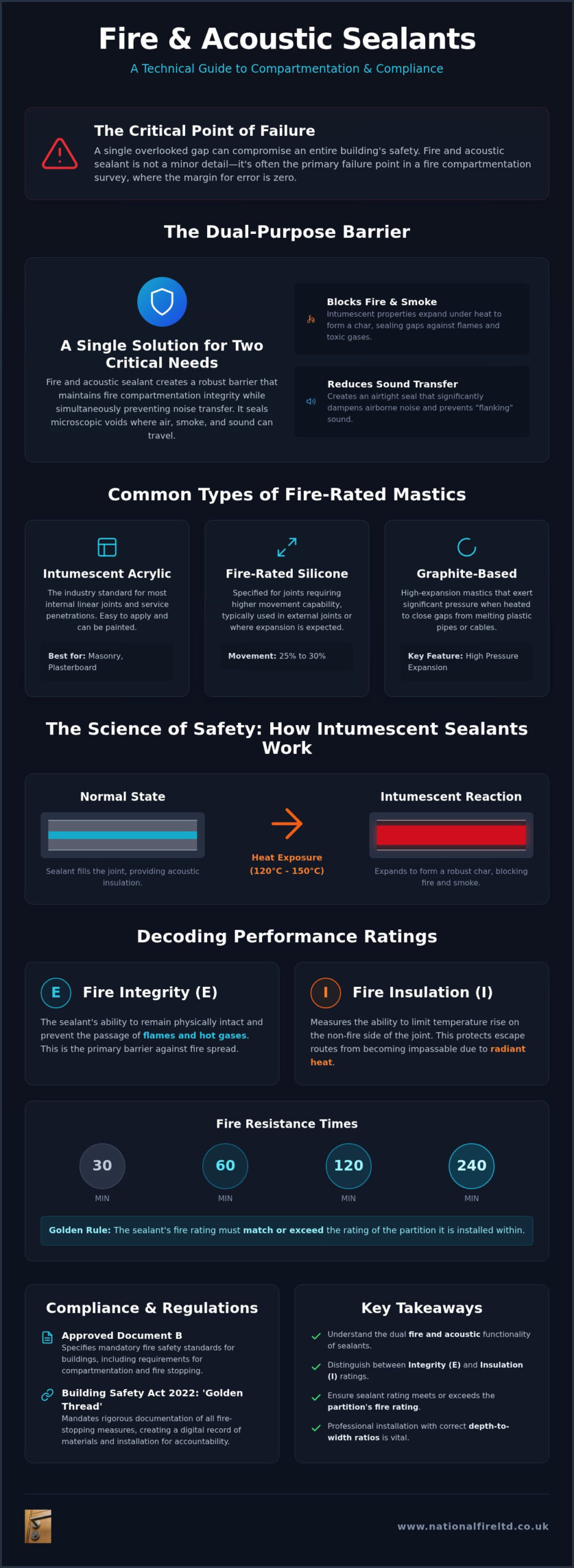
Key Takeaways
- Understand the dual functionality of fire and acoustic sealant in maintaining compartmentation while preventing noise transfer between commercial zones.
- Distinguish between Fire Integrity (E) and Fire Insulation (I) ratings to ensure your specification aligns with the building’s specific fire strategy.
- Identify critical application areas, including linear joints and service penetrations, where precise sealing is required to meet Approved Document B standards.
- Learn why professional installation and correct depth-to-width ratios are vital for the sealant to function effectively under thermal stress.
- Gain clarity on how the Building Safety Act 2022 and the ‘Golden Thread’ mandate rigorous documentation of all fire stopping measures.
What is Fire and Acoustic Sealant?
A fire and acoustic sealant is far more than a standard construction mastic; it’s a precision-engineered safety component designed to maintain the integrity of fire-rated walls and floors. These specialised mastics act as a barrier against the passage of flames, toxic smoke, and airborne sound. To understand the broader context of What is a Firestop?, one must look at how individual components like sealants function within a larger passive fire protection system. The product serves a dual role by ensuring that the fire compartmentation remains intact while providing the acoustic decoupling necessary to prevent noise transfer between commercial zones.
Fire vs. Acoustic: Why the Combination Matters
Fire-rated partitions often fail acoustic performance tests because of “flanking” noise. This happens when sound travels through structural elements or leaks through microscopic voids that are invisible to the naked eye. If air can pass through a gap, sound and smoke will follow. A fire and acoustic sealant fills these voids to create an airtight seal. This significantly reduces decibel transfer between rooms. Flexibility is vital in this application. The sealant must remain elastic enough to accommodate minor structural shifts without cracking. Any breach in the seal, no matter how small, compromises both the acoustic rating and the fire-stopping capability of the entire partition.
Common Types of Fire-Rated Mastics
Different environments and substrates require specific chemical formulations to ensure long-term compliance. Choosing the wrong material can lead to failure during a fire compartmentation survey. We typically categorise these into three primary types:
- Intumescent Acrylic: This is the industry standard for most internal linear joints and service penetrations. It’s easy to apply, can be painted, and provides excellent adhesion to masonry and plasterboard.
- Fire-Rated Silicone: We specify silicone-based mastics for joints that require higher movement capability, often between 25% and 30%. These are typically used in external joints or areas where structural expansion is expected.
- Graphite-Based Sealants: These are high-expansion mastics. When exposed to heat, they exert significant pressure. This is essential for closing the gaps left behind by melting plastic pipes or combustible cable insulation.
The intumescent properties of these sealants are their most critical safety feature. When temperatures reach approximately 120°C to 150°C, the material undergoes a chemical reaction. It expands to several times its original volume. This expansion creates a robust, carbonaceous char that blocks the path of fire and hot gases. In a real-world fire scenario, this rapid reaction is what preserves the life-saving compartmentation of a commercial building. It buys valuable time for evacuation and protects the building’s structural framework.
Understanding Fire and Acoustic Performance Ratings
Selecting a fire and acoustic sealant involves more than checking a single fire rating. It requires a methodical evaluation of how the product performs under extreme thermal stress and its ability to dampen vibration. Building managers often overlook the distinction between integrity and insulation, yet this technical detail is the cornerstone of legal compliance. In high-stakes commercial environments, relying on a product without understanding its specific performance metrics can lead to catastrophic failure during a real-world event.
Fire Integrity (E) represents the sealant’s capacity to remain physically intact and prevent the passage of flames or hot gases. Fire Insulation (I) measures the product’s ability to limit temperature rise on the non-fire side of the joint. Simply put, integrity is the barrier against flame and insulation is the barrier against heat. Failure to specify a product that meets both criteria can lead to a breach of UK Building Regulations Approved Document B, particularly in escape routes where heat radiation must be strictly controlled to allow safe passage.
Decoding Fire Resistance Times
Standard fire resistance durations are classified as 30, 60, 120, or 240 minutes. It’s a fundamental rule of fire stopping that the sealant’s rating must match or exceed the fire rating of the partition it’s installed within. If a wall is rated for 120 minutes, using a 60-minute sealant invalidates the entire compartmentation strategy. We ensure that every specification aligns with the building’s fire strategy drawings to maintain a seamless line of protection.
Acoustic Performance in Commercial Partitions
The acoustic role of these mastics is equally vital. A gap as small as 1mm can reduce the weighted sound reduction (Rw) of a high-performance wall by as much as 10dB. This represents a significant loss in soundproofing quality. Professional sealants are designed to meet Building Regulations Part E, which governs the resistance to sound in UK buildings. Unlike standard construction mastics, these specialised sealants maintain their density and mass, ensuring they don’t shrink or pull away from the substrate over time.
Buildings are dynamic structures. They experience thermal expansion, wind loading, and mechanical vibration. Static sealants often fail in these environments because they cannot accommodate structural movement. If you’re unsure which rating your project requires, our team can provide a comprehensive fire compartmentation survey to identify specific risks. We ensure that every seal accounts for both the required fire resistance and the necessary movement capability to prevent future failure.
Key Application Areas in Commercial Buildings
Commercial buildings present a labyrinth of voids and junctions that can facilitate the rapid spread of fire and noise if left unmanaged. Identifying these critical areas is the first step in maintaining a robust safety strategy. While many installers focus solely on large openings, the smallest linear gaps and service penetrations often present the greatest risk to building compliance. We ensure that every seal is mapped and documented to provide a clear audit trail of protection.
Linear Gap Sealing and Movement Joints
Linear joints occur at the junction between different structural elements, such as the gap between the top of a fire-rated wall and the concrete soffit. These joints are particularly challenging because they often involve dissimilar materials, like concrete and steel, which expand and contract at different rates. To manage this structural movement, we use backer rods to control the depth of the fire and acoustic sealant. This ensures a “two-point” bond, where the sealant adheres only to the sides of the joint, allowing it to stretch without tearing as the building settles. Standards established by the International Firestop Council emphasise that correct depth-to-width ratios aren’t optional; they’re a technical necessity for maintaining the integrity of the seal over time.
Service Penetrations and Compartmentation
Service penetrations are the most common breach in a building’s fire compartmentation. Every cable, metal pipe, or plastic conduit that passes through a fire-rated wall creates a potential pathway for smoke and flames. In these scenarios, a fire and acoustic sealant often works in conjunction with other systems like fire batts or intumescent collars. For instance, when a plastic pipe melts in a fire, the intumescent properties of the sealant must expand rapidly to block the resulting hole. Ensuring smoke-tightness in plenum ceilings and riser cupboards is also vital to prevent the “chimney effect,” where toxic gases are drawn upward through the building’s vertical voids, endangering occupants on higher floors.
Fire Door Frames and Socket Boxes
The junction between a fire door frame and the structural opening is another critical application area where sealants are vital. A compliant installation requires a specific volume of sealant to prevent fire from bypassing the door assembly. Similarly, electrical socket boxes in partition walls can compromise both fire and acoustic ratings. We use specialised acoustic pads and sealant to wrap these boxes, ensuring the partition’s weighted sound reduction (Rw) is maintained. If you’re unsure where these gaps exist in your property, a professional fire compartmentation survey is the most reliable method to identify and rectify missing seals before they lead to a compliance failure.
UK Regulations and Compliance Standards
The regulatory framework for fire safety in the UK is stringent, placing the legal burden on building managers to ensure all passive fire protection measures are fit for purpose. Approved Document B provides the primary guidance for fire stopping in England and Wales, detailing the specific requirements for maintaining compartmentation. Under the Regulatory Reform (Fire Safety) Order 2005, the designated ‘Responsible Person’ must ensure that every fire and acoustic sealant application is verified against tested configurations. Failure to provide this evidence can lead to significant legal repercussions, including heavy fines or prosecution if a breach is discovered during a routine inspection.
Technical compliance is measured against BS EN 1366-3, the rigorous European standard for fire resistance tests for service installations. This standard ensures that the sealant can withstand extreme temperatures while preventing the passage of smoke and flames. We prioritise products that carry third-party certification from accredited bodies. This certification provides an extra layer of assurance that the material will perform as expected in a real-world fire event. It’s not enough to simply buy a fire-rated product; it must be the specific product tested for that exact substrate and penetration type.
The Role of Fire Compartmentation Surveys
Professional surveys are the only reliable way to identify where seals have degraded, been damaged by subsequent trades, or were never correctly installed. A thorough fire compartmentation survey maps every penetration and joint within a building to ensure no gaps exist in the safety shell. These surveys are now a critical component of the ‘Golden Thread’ of information required by the Building Safety Act 2022. Documented evidence of every seal is essential for insurance purposes and provides building owners with a clear audit trail of their safety investments.
Passing a Fire Safety Audit
Fire inspectors and auditors look for specific indicators of professional installation. Using standard decorators caulk in place of a certified fire and acoustic sealant is a major red flag that often triggers a full building audit. Inspectors require documented evidence of the specific product used, including its batch number and technical data sheet. We ensure that every installation is recorded in the health and safety file to simplify the audit process. Non-compliance doesn’t just risk safety; it can invalidate your building insurance, leaving the organisation financially exposed in the event of a fire.
If you have concerns about the current state of your building’s fire stopping measures, we can provide a comprehensive fire compartmentation survey to bring your property into full alignment with UK standards. Our experts help you identify specific risks and implement remedial actions that meet all legislative requirements.
Why Professional Fire Stopping Installation is Critical
The assumption that a tube of high-performance fire and acoustic sealant is a universal solution is a dangerous misconception in the construction industry. This ‘magic tube’ myth leads many to believe that simply applying the material into a gap guarantees safety. In reality, the efficacy of any fire stopping measure is entirely dependent on the precision of its application and its adherence to specific tested details. A sealant is not a standalone product; it’s a component within a complex safety system that must be installed exactly as it was tested in a laboratory.
Technical precision is paramount, particularly regarding depth-to-width ratios. If a sealant is applied too shallowly, it won’t possess the mass required to withstand thermal expansion or maintain its char during a fire. Conversely, if it’s too deep, it may not cure properly or could tear during structural movement. Professional installers also consider chemical compatibility. Certain mastics can react negatively with PVC cable sheaths or specific types of pipe insulation, leading to the degradation of both the sealant and the service it’s meant to protect. National Fire Ltd acts as a specialist partner for fire stopping projects, ensuring every technical nuance is addressed to maintain total compliance.
Common Installation Errors to Avoid
Even the most expensive materials fail when applied incorrectly. We frequently identify several recurring errors during our remedial works:
- Over-thinning: Some contractors ‘tool’ the sealant too thin to reduce material costs. This causes excessive shrinkage and eventual cracking, leaving the compartmentation compromised.
- Poor Substrate Preparation: Dust, grease, and moisture prevent the sealant from bonding correctly. Without a perfect bond, the seal will fail under the pressure of a fire’s hot gases.
- Ignoring Tested Details: Every manufacturer provides a specific ‘Tested Detail’ for their product. If the installation doesn’t mirror the configuration used in the laboratory test, the fire rating is legally void.
Ensuring Long-Term Reliability
Compliance isn’t a one-time event; it’s an ongoing commitment to safety. Buildings are dynamic structures that settle over time, and services are frequently modified by different trades. These changes can easily damage existing fire and acoustic seals. Regular inspections are essential to identify these breaches before they become a liability. Upon completion of any remedial work, professional contractors provide a ‘Certificate of Conformity’. This document serves as a formal guarantee that the work meets all relevant standards and is a vital part of your building’s safety records.
Protecting your building requires meticulous attention to detail and a deep understanding of current legislation. Contact National Fire Ltd for a professional fire stopping assessment to ensure your property remains fully compliant and your occupants stay safe.
Securing Your Building’s Compliance and Safety
Achieving a fully compliant fire compartmentation strategy depends on the methodical application of high-performance materials. You’ve seen that a fire and acoustic sealant is not a simple commodity; it’s a technical component that requires precise depth-to-width ratios and substrate preparation to function effectively during a fire. Relying on unverified installations or incorrect products risks failing safety audits and potentially invalidating insurance policies.
As UK-wide specialist fire stopping contractors, we provide fully accredited passive fire protection services tailored to commercial and industrial requirements. Our experts specialise in complex remedial works and ensuring long-term compliance through rigorous documentation and the maintenance of the Golden Thread. We act as your trusted advisors, providing the technical excellence needed to safeguard life and property.
The first step toward a secure environment is identifying existing gaps in your protection. Request a Fire Compartmentation Survey from National Fire Ltd today to ensure your building meets every legal standard. We’re here to help you manage your safety obligations with complete confidence.
Frequently Asked Questions
Can I use fire sealant instead of acoustic sealant?
While some fire sealants possess sound-dampening properties, they aren’t interchangeable unless specifically tested for both functions. A dedicated fire and acoustic sealant is engineered to provide the high density required for weighted sound reduction (Rw) while maintaining intumescent properties for fire safety. You must verify that the product’s technical data sheet confirms compliance with both Approved Document B and Building Regulations Part E before installation.
How long does fire and acoustic sealant take to cure?
Curing times depend on ambient temperature and humidity, but most professional mastics form a surface skin within 15 to 30 minutes. A full cure typically requires 24 to 48 hours for a standard bead. It’s critical that the seal remains undisturbed during this period. Any premature movement can cause internal fractures that compromise the fire integrity and acoustic performance of the joint.
What is the maximum gap size for a fire-rated sealant?
Maximum gap sizes are dictated by the manufacturer’s tested details, usually capped at 25mm to 50mm for linear joints. If an opening exceeds the tested width, the sealant must be used as part of a system involving fire batts or mineral wool. Attempting to bridge excessive gaps with sealant alone is a common cause of failure during a professional fire compartmentation survey.
Is fire sealant waterproof once it has cured?
Standard acrylic-based fire sealants are water-resistant but not fully waterproof. They perform reliably in high-humidity environments but shouldn’t be used where standing water or constant saturation is expected. For external applications or damp zones, we specify fire-rated silicone sealants. These provide the necessary weatherproofing and movement capability while ensuring the building’s fire-stopping integrity remains intact under all conditions.
Do I need a backer rod when applying fire mastic?
A backer rod is essential for achieving a compliant seal in most linear joints. It controls the depth of the sealant and prevents “three-point bonding,” which can lead to the material tearing during structural movement. By using a non-combustible backing material, you ensure the sealant adheres only to the joint sides. This allows for the necessary flexibility required to maintain a durable fire and acoustic seal.
Can fire and acoustic sealant be painted over?
Acrylic formulations can generally be painted once they have achieved a full cure, typically after 48 hours. Silicone-based fire mastics are not paintable. If you intend to paint the seal, you must ensure the coating is compatible and won’t inhibit the sealant’s ability to expand during a fire. Always refer to the manufacturer’s documentation to ensure painting doesn’t invalidate the product’s third-party certification.
What is the difference between intumescent and fire-rated sealant?
“Fire-rated” is a broad classification for any material that resists fire, whereas “intumescent” refers to a specific chemical reaction. An intumescent sealant expands significantly when exposed to heat, creating a char that fills voids left by melting pipes or cables. While most modern fire mastics are intumescent, some fire-rated products rely solely on their density to block flames and gases without expanding.
How often should fire seals be inspected in a commercial building?
Fire seals should be inspected at least annually as part of a formal fire risk assessment. In buildings with high maintenance activity or frequent service upgrades, more regular checks are advisable. Any time new cabling or pipework is installed, a survey is necessary to confirm that the fire and acoustic sealant hasn’t been damaged or removed, ensuring the building’s compartmentation remains fully compliant.