


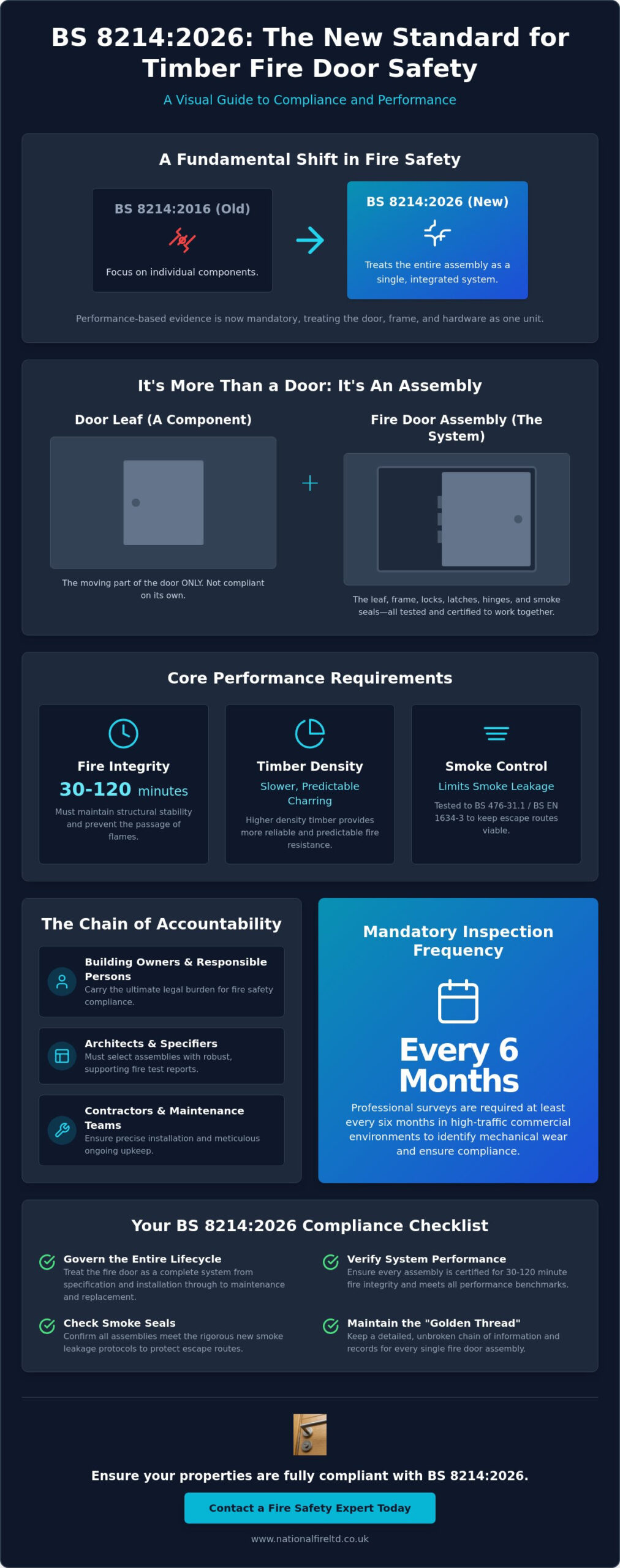
Your previous fire door compliance records might be legally insufficient under the new standards published on March 20, 2026. The transition from BS 8214:2016 to the updated BS 8214:2026 represents a fundamental shift in how the industry approaches life safety, making understanding bs 8214 for timber fire doors a top priority for duty holders. It’s no longer enough to simply install a door; you must now provide performance-based evidence that treats the entire assembly as a single, integrated system. We understand that managing maintenance for large timber door inventories while keeping up with shifting regulations like the Building Safety Act 2022 can feel overwhelming.
This guide simplifies the process so you can master the latest British Standards and maintain an impeccable safety record. You’ll gain a clear understanding of the 2026 updates, including how UKCA marking and smoke control requirements impact your specific assets. We’ve structured this overview to provide a practical roadmap for compliance, covering everything from initial installation to the rigorous maintenance schedules required for insurance and legal verification. By the end of this article, you’ll have the technical insight needed to act as a disciplined guardian of your building’s fire compartmentation strategy.
Key Takeaways
- BS 8214:2026 governs the entire lifecycle of timber fire door assemblies, providing a comprehensive framework for design, specification, and installation.
- Timber fire doors must maintain integrity for 30 to 120 minutes, with fire resistance performance fundamentally linked to timber density and system components.
- Developing a thorough understanding bs 8214 for timber fire doors is essential for maintaining the “Golden Thread” of information and meeting rigorous new smoke leakage protocols.
- Professional fire door surveys should be conducted at least every six months to identify mechanical wear and ensure ongoing compliance in high-traffic commercial environments.
- Full regulatory alignment requires expert oversight to verify that installed door systems meet the latest 2026 performance benchmarks and legal requirements.
What is BS 8214:2026 and Why Does it Govern Timber Fire Doors?
BS 8214:2026 serves as the definitive British Standard Code of Practice for timber-based fire door assemblies. Released on March 20, 2026, this updated standard supersedes the 2016 version, reflecting a more rigorous approach to building safety and risk mitigation. It provides a structured framework for the design, specification, installation, and maintenance of pedestrian doorsets. By strictly adhering to these guidelines, duty holders ensure that their Fire Doors perform as intended during a fire event, maintaining integrity and controlling smoke leakage to protect both life and property.
The transition to the 2026 standard is not merely a technical update; it is a legal necessity. Compliance is a core requirement for meeting the obligations set out in the Building Safety Act 2022 and the Fire Safety Act 2021. Understanding bs 8214 for timber fire doors allows professionals to bridge the gap between architectural intent and operational safety. It ensures that every component, from the timber core to the smallest hinge, contributes to a certified level of fire resistance. This methodical approach provides the stability and reliability required in high-stakes commercial environments.
The Scope of Timber-Based Assemblies
A critical aspect of the standard is the distinction between a “door leaf” and a complete “fire door assembly”. A door leaf is simply the moving part of the door, whereas an assembly encompasses the leaf, the frame, and all essential hardware such as locks, latches, and hinges. Timber remains the primary material for internal commercial fire doors because it offers a unique combination of structural integrity and design flexibility. For those looking to source high-quality timber components from experienced suppliers, you can learn more about Arborfield Joinery and their heritage in crafting doors and joinery since 1953. BS 8214:2026 applies to all timber-based installations in 2026, covering everything from large-scale new builds to remedial refurbishments of existing inventories. It demands that every installation matches the tested specimen exactly to guarantee performance.
Who Must Adhere to BS 8214 Standards?
Accountability is a central theme of the 2026 update. Building owners and designated “Responsible Persons” carry the ultimate legal burden for fire safety. They must ensure that every timber door within their premises is fit for purpose and compliant with the 2026 code. Architects and specifiers must use the standard to guide the selection of assemblies, ensuring that chosen products are supported by robust fire test reports. Contractors and maintenance teams rely on these standards to perform their duties with precision. Understanding bs 8214 for timber fire doors enables these professionals to maintain a clear chain of accountability. This collaborative adherence ensures that the high-level safety principles established during the design phase are maintained throughout the building’s operational life.
Performance Requirements for Timber Fire Door Assemblies
Performance in timber fire door assemblies is measured primarily by their integrity. These assemblies must maintain structural stability and prevent the passage of flames or hot gases for specific durations, typically ranging from 30 to 120 minutes. Achieving these ratings depends heavily on the inherent properties of the timber used. Understanding bs 8214 for timber fire doors involves recognizing that timber density is a primary factor in fire resistance. Higher density timber generally burns at a slower, more predictable charring rate, which provides the stability required for commercial safety protocols.
Beyond fire resistance, timber assemblies must address smoke control as specified in the BS 8214:2026 standard. Performance is evaluated against BS 476-31.1 or BS EN 1634-3 to ensure that smoke leakage remains within permissible limits. This is vital because smoke inhalation remains a leading cause of mortality in building fires. A methodical approach to specifying these assemblies ensures that escape routes remain viable during an evacuation. For those managing large inventories, a professional fire door survey is the most reliable method for verifying that existing installations meet these specific performance criteria.
Intumescent Seals and Smoke Strips
Intumescent seals are the active component of a fire door’s performance. These strips must be specified precisely based on the door leaf thickness and the required fire rating. When temperatures reach approximately 200°C, intumescent materials expand to many times their original volume to seal the gaps between the door leaf and the frame. Smoke strips, often combined with these intumescent seals, prevent the passage of cold smoke before the heat is sufficient to trigger the intumescent expansion. This dual-action protection is essential for safeguarding corridors and stairwells.
Glazing and Essential Hardware
Any vision panel integrated into a timber door must use fire-rated glass that matches the door’s integrity rating. The standard requires that the glazing system, including beads and liners, is tested as part of the complete assembly. Similarly, hardware compatibility is non-negotiable. Using non-compliant hinges, latches, or overhead closers will invalidate the BS 8214 certification. Every component must be tested as a unified assembly to ensure the door doesn’t warp or fail prematurely under thermal stress. Meticulous attention to these technical details is what separates a compliant safety system from a potential liability.
Key Changes in BS 8214:2026 vs. the 2016 Standard
The transition from the 2016 standard to the 2026 edition introduces a level of technical scrutiny previously unseen in timber door management. Understanding bs 8214 for timber fire doors now requires a focus on the more rigorous testing protocols for smoke leakage. This alignment with the latest BS 8214:2026 Code of Practice ensures that timber assemblies meet the performance benchmarks established by BS EN 1634-1. These changes reflect an industry-wide move toward performance-based evidence, replacing the more prescriptive guidance of the past decade. Every assessment must now be backed by verifiable fire test reports or accredited technical assessments.
Maintenance protocols for older timber door stock have also been significantly updated. The 2026 code provides a methodical framework for assessing whether existing doorsets can be brought up to modern standards or if they require full replacement. This decision-making process is now heavily influenced by the “Golden Thread” of information. Building owners are responsible for ensuring that every fire door assembly has a documented pedigree that proves its fire resistance capabilities. This focus on data integrity aims to close the gaps in accountability that were identified in recent legislative reviews. Understanding bs 8214 for timber fire doors is the only way to ensure these legacy assets don’t become a legal or safety liability.
The Move Toward Digital Record Keeping
Digital record keeping is now a central pillar of compliance. The 2026 standard mandates the documentation of every inspection, adjustment, and repair to create a transparent audit trail. Many organisations are adopting digital tags, such as QR codes or RFID chips, to track the lifecycle of each timber door. These tags allow surveyors to access fire test data and maintenance history instantly on-site. Your fire safety manuals must be updated to reflect these digital workflows, ensuring that critical safety data remains accessible throughout the building’s lifespan. This shift from paper-based logs to digital systems provides the reliability needed for high-stakes regulatory audits.
Updated Installation Tolerances
Installation tolerances have been refined to reduce the risk of failure during a fire event. While 3mm remains the “gold standard” for gaps between the door leaf and the frame, the 2026 update provides stricter guidance on how these measurements are verified across the entire perimeter. It also places greater emphasis on threshold requirements and the specific use of drop seals for smoke control. These physical parameters are non-negotiable. Even a slight deviation from these tolerances can lead to non-compliance during a professional fire door survey. Precision in installation is now as important as the fire rating of the door itself.
Maintenance and Inspection: Ensuring Ongoing Compliance
A fire door is a dynamic safety system that requires constant vigilance. Understanding bs 8214 for timber fire doors means acknowledging that installation is only the first step in a long-term safety commitment. In high-traffic commercial environments, mechanical wear can compromise a door’s integrity within months. For this reason, professional fire door surveys should be conducted every six months at a minimum. This frequency ensures that minor defects are identified before they escalate into significant life-safety risks or legal liabilities. Regular oversight is the only way to maintain the reliability of your building’s fire compartmentation strategy.
The inspection process must be methodical and exhaustive. It involves verifying that intumescent seals are intact and have not been painted over, as excessive paint layers can prevent the material from expanding correctly during a fire. Additionally, the self-closing device must be tested to ensure it effectively returns the door to the rebate from any angle of opening. If a door fails to latch securely, its fire-resistance rating is essentially void. To maintain these standards, duty holders often rely on professional fire door maintenance programs to ensure every component remains in peak operational condition.
A Facility Manager’s 5-Point Inspection Checklist
- Step 1: Verify the certification label or plug on the top or hinge edge of the door to confirm its fire rating.
- Step 2: Use a taper gauge to measure gaps around the door leaf; they must consistently meet the 3mm standard.
- Step 3: Inspect all intumescent and smoke seals for signs of physical damage, peeling, or missing sections.
- Step 4: Test the closing mechanism from various angles to ensure the door overcomes the latch and seals the opening.
- Step 5: Check all hardware, including hinges and handles, for loose screws or signs of heat-induced warping.
Common Non-Compliance Issues in Timber Doors
The “paint problem” is a frequent finding during professional audits. Over time, repeated decorating can lead to paint buildup that interferes with the closing speed or prevents intumescent strips from activating. Another critical issue involves incorrectly fitted locks. If a mortice lock is installed without the required intumescent gasket, it creates a “burn-through” point that compromises the timber core. Finally, physical damage to the timber rebate from heavy equipment or trolleys is common in healthcare and retail settings. This damage often destroys the bed where seals are seated, making understanding bs 8214 for timber fire doors essential for identifying when a repair is no longer sufficient and a full replacement is required.
Achieving BS 8214 Compliance with National Fire Ltd
Compliance is a continuous obligation, not a one-time event. National Fire Ltd provides the technical oversight required to navigate the complexities of the updated 2026 code. We offer comprehensive fire door surveys that identify non-compliance with surgical precision. Our team applies a methodical approach to understanding bs 8214 for timber fire doors, ensuring that every leaf, frame, and seal meets the specific performance requirements of the March 20, 2026 update. We don’t just identify problems; we provide the accredited solutions needed to rectify them with minimal disruption to your operations.
Our expert installation services ensure that new timber fire door assemblies are fitted to the exact tolerances required for certification. For existing properties, we perform bespoke remedial works to bring older timber doors up to current standards. This often involves replacing non-compliant hardware or installing new intumescent systems that match the door’s original test evidence. We view every door as a critical component of a wider fire compartmentation strategy. This integrated perspective ensures that your building’s fire-stopping measures work in unison to protect life and property.
Professional Surveys and Strategy Drawings
Managing compliance across large estates requires more than just physical inspections; it demands disciplined data management. Our technical drawings and floor plan generation services assist facility managers in tracking door compliance and maintenance history with ease. This visual data is an essential part of a building’s passive fire protection framework. By documenting every assembly, we create a clear audit trail that satisfies the requirements of both regulators and insurers. This transparency provides the “Golden Thread” of information necessary for modern building safety management, ensuring that technical data is always accessible for future risk assessments.
Secure Your Premises for 2026
Reliability in fire safety is built on third-party accreditation. National Fire Ltd holds BM TRADA Q-Mark certification, which serves as a guarantee of our technical excellence and commitment to standards. We provide national coverage for commercial fire door maintenance and installation, ensuring that professional help is always available regardless of your location. Our experts are prepared to help you master the latest requirements for timber assemblies. Understanding bs 8214 for timber fire doors is the foundation of our service delivery. Contact National Fire Ltd today for a professional compliance assessment and ensure your premises are fully secured for 2026.
Future-Proofing Your Fire Safety Compliance
The transition to BS 8214:2026 marks a definitive shift toward a lifecycle-performance model for timber fire doors. Maintaining compliance now requires more than just high-quality installation; it demands a disciplined approach to ongoing maintenance and meticulous digital record-keeping. By prioritizing the “Golden Thread” of information and adhering to rigorous six-monthly inspection cycles, you protect both your building’s occupants and your legal standing. Understanding bs 8214 for timber fire doors is the essential foundation for any professional responsible for fire compartmentation in 2026.
National Fire Ltd has served as a specialist in passive fire protection since 2018, providing the technical expertise needed to navigate these regulatory updates. Our BM TRADA certified installers and surveyors offer comprehensive national coverage, ensuring your assets meet the most rigorous safety standards. We act as a dedicated guardian of your property, delivering the reliability and stability required in high-stakes safety environments. You can move forward with confidence, knowing your compliance is managed by seasoned experts who are always prepared.
Ensure your building is compliant — Book a Fire Door Survey with National Fire Ltd
Frequently Asked Questions
What is the main difference between BS 8214 and BS EN 1634-1?
BS 8214 is a comprehensive Code of Practice that governs the entire lifecycle of a timber doorset, including its design, specification, installation, and ongoing maintenance. In contrast, BS EN 1634-1 is a specific laboratory testing standard used to determine the fire resistance rating of a particular door design. While the test provides the performance data, the Code of Practice ensures that this data is applied correctly in a real-world building environment.
How often do timber fire doors need to be inspected under BS 8214:2026?
Timber fire doors require professional inspection at least every six months to remain compliant with the latest standards. This frequency is a core recommendation of the 2026 update to address the inevitable mechanical wear and tear found in commercial settings. High-traffic environments, such as hospitals or schools, often necessitate more frequent audits to ensure that self-closing devices and seals remain fully operational at all times.
Can I repair a timber fire door myself and remain compliant?
Compliance requires that all remedial works are performed by accredited professionals using components that match the original fire test evidence. Understanding bs 8214 for timber fire doors reveals that unauthorized or amateur repairs can immediately invalidate the certification of the entire assembly. This creates significant legal and safety risks for the building’s Responsible Person, who must provide an audit trail of professional maintenance.
Does BS 8214 apply to domestic residential properties?
BS 8214:2026 is designed for non-domestic buildings and the communal areas of multi-occupied residential blocks, such as flat entrance doors and corridor partitions. It doesn’t typically apply to the interior doors within private houses. It remains the governing standard for any timber door protecting a shared escape route in commercial, industrial, or public sector premises.
What are the gap requirements for timber fire doors according to BS 8214?
The standard gap tolerance between the door leaf and the frame is 3mm, with a common permissible range between 2mm and 4mm. Threshold gaps at the bottom of the door are typically restricted to 8mm or 10mm, depending on whether the assembly is also rated for smoke control. Precision in these measurements is non-negotiable for passing a professional fire door survey and ensuring the door performs as intended during a fire.
Is it mandatory to use intumescent seals on all timber fire doors?
Intumescent seals are mandatory for any timber fire door assembly that relies on them to achieve its fire resistance rating, such as FD30 or FD60 doors. These seals expand under heat to fill the gaps between the leaf and the frame, preventing the passage of flames. Without correctly fitted and maintained seals, the assembly will fail to meet the integrity requirements established during its initial fire testing.
What happens if my building does not meet BS 8214 standards?
Non-compliance exposes duty holders to severe legal penalties under the Fire Safety Act 2021 and the Building Safety Act 2022. Insurers may also refuse to honor claims in the event of a fire if the timber doorsets are found to be poorly maintained or incorrectly installed. Understanding bs 8214 for timber fire doors is the only reliable way to mitigate these professional risks and ensure a secure environment for all occupants.
Can a timber fire door be painted without affecting its rating?
Timber fire doors can be decorated, but intumescent seals and smoke strips must remain entirely free of paint to function correctly. Excessive buildup of paint on the door leaf or frame can also interfere with the closing speed or prevent the door from seating correctly into the rebate. It’s essential to follow the manufacturer’s specific instructions regarding compatible finishes to avoid compromising the door’s fire-resistance properties.