


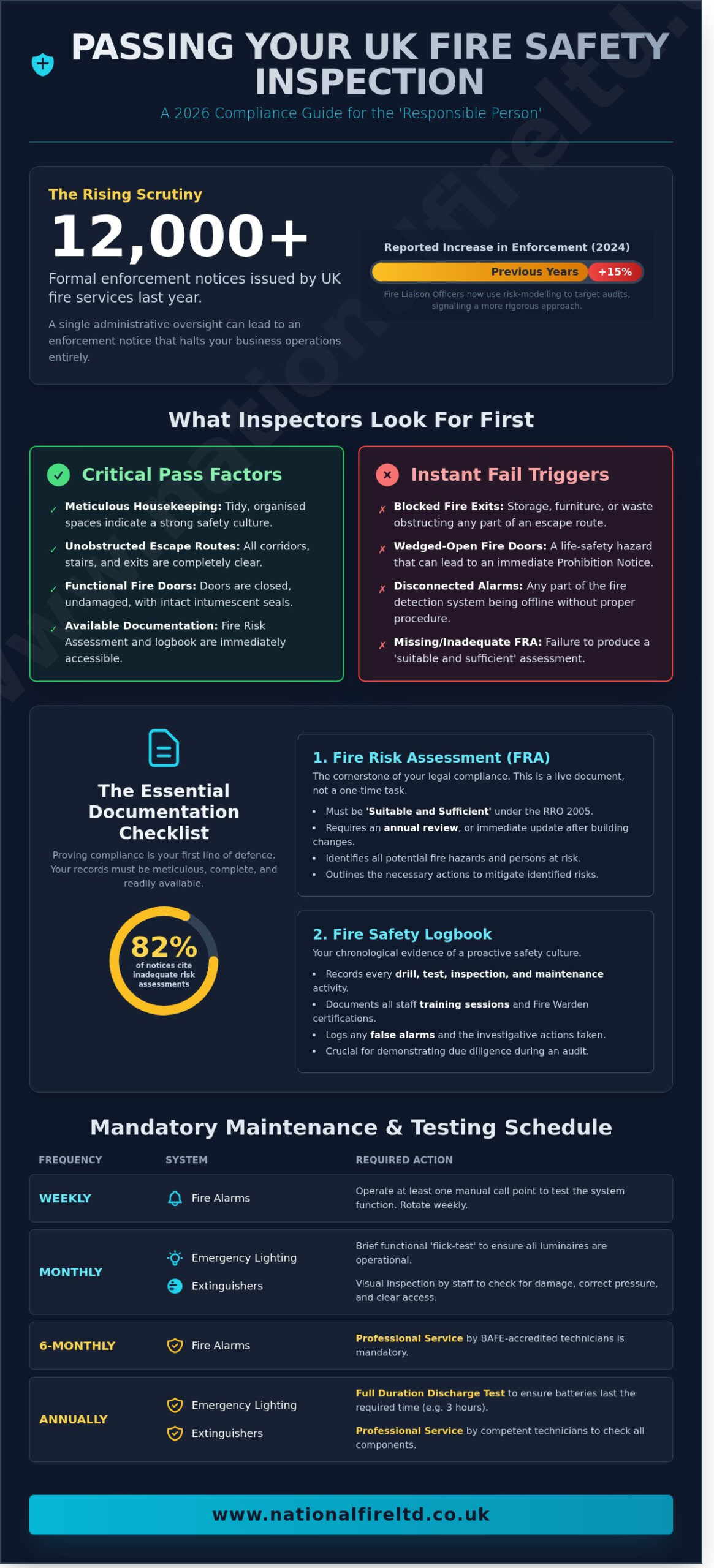
A single administrative oversight in your fire logbook can now lead to an enforcement notice that halts your business operations entirely. You likely feel the weight of responsibility that comes with managing commercial premises, especially as the 2026 regulatory landscape introduces more rigorous oversight. Knowing how to pass a fire safety inspection uk is no longer just about basic safety; it’s about navigating a complex legal framework where UK fire services issued over 12,000 formal enforcement notices last year alone. It’s natural to worry about hidden structural risks or missing a specific piece of statutory documentation that could trigger a heavy fine.
This guide provides a disciplined, methodical strategy to satisfy every requirement of the Fire Service. You’ll master the essential steps and accredited documentation needed to ensure your premises remain fully compliant and your people stay protected. We’ll examine the mandatory 2026 checklist, covering everything from BAFE-accredited equipment servicing to the precise evidence required to secure your peace of mind. By following this structured approach, you can move from uncertainty to total confidence in your building’s safety standards.
Key Takeaways
- Understand the evolving regulatory landscape to ensure the ‘Responsible Person’ complies with the latest statutory requirements of the Building Safety Act 2022.
- Discover exactly how to pass a fire safety inspection uk by maintaining a ‘suitable and sufficient’ Fire Risk Assessment alongside a meticulously detailed fire safety logbook.
- Identify the critical maintenance standards for passive and active systems, ensuring escape routes and fire doors meet the highest standards for total peace of mind.
- Establish a robust safety culture by implementing comprehensive staff training programmes and maintaining the correct ratios of certified Fire Wardens.
- Learn to navigate post-inspection outcomes by effectively prioritising remedial works to mitigate risks and satisfy Fire Service enforcement deadlines.
Understanding the UK Fire Safety Inspection Process in 2026
Compliance in 2026 requires more than a cursory glance at your extinguishers. The legislative environment has tightened since the Fire Safety Act 2021 and the Building Safety Act 2022 became fully operational. Knowing how to pass a fire safety inspection uk requires a deep dive into the Regulatory Reform (Fire Safety) Order 2005, which remains the cornerstone of your legal obligations. This order places the statutory burden on the ‘Responsible Person’ (RP). Usually, this is the employer, building owner, or the person in control of the premises.
Fire Liaison Officers now utilise sophisticated risk-modelling to decide which buildings to audit. While standard inspections occur periodically, targeted audits focus on buildings over 11 metres or those with complex occupancy profiles. In 2024, the Home Office reported a 15% increase in enforcement notices, signalling a more rigorous approach by local authorities. Officers have the legal right to inspect any part of the premises, demand maintenance logs, and interview staff. They aren’t just looking for equipment; they’re looking for a comprehensive culture of safety and evidence of regular BAFE-accredited servicing.
The Legal Framework: Your Statutory Duties
The Fire Safety (England) Regulations 2022 mandate specific actions for RPs in multi-occupied buildings. In multi-tenanted commercial hubs, the RP is often the managing agent or the head of the residents’ management company. You’re legally required to provide residents and employees with clear safety instructions. Failure to maintain these standards results in severe penalties. Enforcement notices are a matter of public record, and prosecution can lead to unlimited fines or custodial sentences. Our team provides the expert guidance needed to ensure your bespoke safety strategy mitigates these risks, offering you total peace of mind.
What Inspectors Look for First
First impressions dictate the tone of the entire audit. Inspectors assess housekeeping, looking for obstructed escape routes or wedged-open fire doors the moment they arrive. They’ll immediately ask for your Fire Risk Assessment (FRA). This isn’t a static document; it must be a live record that reflects your 2026 operations. If an officer finds a blocked fire exit or a disconnected alarm system, they’ll likely issue a Prohibition Notice. This effectively shuts down your business until the life-safety hazard is resolved. Understanding how to pass a fire safety inspection uk means prioritising these foundational elements through disciplined, daily checks.
The Essential Documentation Checklist: Proving Compliance
Proving compliance is the foundation of learning how to pass a fire safety inspection uk. An inspector’s first request is almost always the Fire Risk Assessment (FRA). This document must be ‘suitable and sufficient’ as defined by the Regulatory Reform (Fire Safety) Order 2005. It isn’t a static file; it requires an annual review or an immediate update if your building’s layout or occupancy changes. Following the Official UK Government Fire Safety Guidance ensures the ‘responsible person’ understands their statutory duties. Data suggests that 82% of enforcement notices cite inadequate risk assessments as a primary failure.
Your fire safety logbook serves as the chronological proof of your safety culture. It must record every drill, staff training session, and false alarm. By 2026, the ‘Golden Thread’ standard will require digital records for higher-risk buildings to ensure a transparent safety trail. Maintaining these files provides the peace of mind that your facility is prepared for any external audit. We ensure all documentation is meticulous, as clear records are often the difference between a pass and a costly remediation order.
Maintenance and Testing Records
Consistency is vital for statutory compliance. Your logbook must evidence weekly fire alarm tests and six-monthly professional servicing by BAFE-accredited technicians. Emergency lighting requires monthly functional ‘flick-tests’ and an annual full-duration discharge test to ensure the batteries last the required three hours. For extinguishers, you need records of annual professional servicing alongside your own monthly visual inspections. If you’re unsure about your current record-keeping standards, our team provides bespoke compliance support to bridge any gaps.
Structural Safety Evidence
Inspectors look beyond the hardware to the building’s fabric. You must provide fire compartmentation survey reports that prove the integrity of fire-rated walls and floors. Fire door inspection schedules are equally critical; commercial properties require documented checks every six months. In 2023, data from the Fire Door Inspection Scheme showed that 61% of fire doors inspected failed to meet the required standard. Technical drawings and clear fire strategy documents must also be available to show designated evacuation routes and the precise location of all life-safety systems.
Physical Site Readiness: Prioritising Passive and Active Systems
Passing a statutory visit requires more than just organised paperwork; it demands a rigorous physical audit of your premises. To understand how to pass a fire safety inspection uk, you must first ensure that your passive and active fire protection systems are fully integrated and functional. Start by verifying that every escape route is entirely unobstructed. These paths must lead to a place of ultimate safety, such as an external assembly point, and remain well-lit via emergency lighting that’s tested monthly. Inspectors will check that exit signs are visible from all angles and that no combustible materials are stored in protected corridors.
The Fire Door Audit
A fire door is a life-saving device, not just a piece of joinery. Every door must display a BM TRADA Q-Mark or equivalent certification label to prove its fire-resistance rating, typically FD30 or FD60. We often see doors propped open with fire extinguishers or wedges in high-traffic areas, which is a critical failure that compromises compartmentation. To remain compliant, the gap between the door leaf and the frame must be between 2mm and 4mm. Ensure that intumescent seals are intact and that self-closing devices fully engage the latch from any angle without manual assistance.
Hidden Hazards: Fire Stopping and Cavity Barriers
Inspectors will look beyond what’s visible at eye level. They frequently examine service risers and plant rooms for unsealed pipe or cable penetrations. These gaps allow smoke and flames to bypass compartmentation, which is a leading cause of rapid fire spread in commercial buildings. Standard ‘expanding foam’ from a DIY shop is rarely an acceptable fire stopping solution for inspectors because it often lacks the required 30-to-120-minute fire rating. Instead, use accredited intumescent pillows, batts, or mastics. Proper cavity barriers within facades are also vital, as they prevent the chimney effect within wall voids that can lead to total building loss.
Active systems like smoke detectors and sprinklers must be unobstructed by stock or partitions. If a sprinkler head is blocked by a pallet, it can’t deploy effectively. While physical hardware is vital, it must be supported by competent staff. Following the Fire Safety Training Requirements set out by the London Fire Brigade ensures your team knows how to operate this equipment during an emergency. This holistic approach is essential for any business learning how to pass a fire safety inspection uk while maintaining total peace of mind and legal compliance.
The Human Element: Staff Training and Emergency Procedures
Fire safety hardware is only half the battle. To understand how to pass a fire safety inspection uk, you must demonstrate that your team is prepared for a crisis. Inspectors require documented evidence of staff inductions and annual refresher training for 100% of your workforce. This isn’t a suggestion; it’s a statutory requirement under the Regulatory Reform (Fire Safety) Order 2005. If a staff member can’t explain the basic evacuation route during an inspection, it signals a failure in your safety management system.
Your Fire Warden ratios must reflect the specific risks of your premises. In a standard low-risk office, one warden for every 20 employees is typically sufficient. However, high-risk industrial sites or care homes often require a ratio of one warden for every 8 occupants to ensure a safe exit. These individuals must hold valid training certifications from accredited bodies like BAFE or the FIA. You must also account for the 14% of the UK workforce who may require a Personal Emergency Evacuation Plan (PEEP) due to permanent or temporary mobility issues.
- Induction Training: Must be completed on day one for all new starters.
- Refresher Training: A mandatory annual programme to maintain safety awareness.
- PEEPs: Bespoke plans for any occupant who cannot exit the building unaided.
- Logbook Records: Clear dates, names, and signatures for every training session held.
Fire Drill Best Practices
An inspector will scrutinise your fire logbook for a drill recorded within the last 12 months. To meet the requirement for realism, vary the exit routes used to simulate a blocked corridor or a compromised stairwell. Document the evacuation time precisely; a successful office evacuation typically concludes in under 2 minutes 30 seconds. Recording ‘lessons learned’ after each drill proves a proactive safety culture. It shows you’re actively looking to mitigate risks rather than just ticking a box.
The Warden’s Role During an Inspection
Expect the inspector to interview your staff directly. They’ll test whether your wardens can locate the fire panel and explain the assembly point procedures. Wardens should be able to identify the correct fire-fighting equipment for specific risks, such as using CO2 extinguishers for electrical fires. This level of preparedness is a core component of how to pass a fire safety inspection uk. It transforms your safety policy from a stagnant document into a living, breathing practice that provides genuine peace of mind.
Post-Inspection Outcomes: Remediation and Next Steps
Once the Fire and Rescue Service completes their visit, you’ll receive a formal report detailing their findings. Understanding the distinction between a Notice of Deficiencies and an Enforcement Notice is vital for your response strategy. A Notice of Deficiencies usually lists minor breaches that don’t pose an immediate threat to life; it’s an advisory warning to improve standards. An Enforcement Notice is a statutory document issued under Article 31 of the Regulatory Reform (Fire Safety) Order 2005. It carries a legal obligation to complete specific works within a set timeframe, often 28 days, to avoid potential prosecution or heavy fines. In 2023, UK fire services issued over 2,500 such notices, highlighting the rigour of modern inspections.
You must prioritise remedial works based on the level of risk identified by the inspector. High-risk items, such as faulty alarm systems or blocked fire exits, require action within 24 to 48 hours. Once you’ve addressed the items listed, you must provide the Fire Service with documented evidence, such as certificates of conformity or photographic proof, to close the loop on the inspection. Understanding how to pass a fire safety inspection uk requires a commitment to this final administrative stage to ensure your building remains legally compliant.
Managing Remedial Fire Stopping and Door Works
Complex remedial projects often require bespoke fire strategy drawings to ensure every penetration and door assembly meets current building standards. It’s insufficient to simply patch holes; you need a system-based approach that considers the fire rating of the entire wall or floor. Selecting BAFE or BM TRADA accredited installers is the only way to guarantee that materials and methods are compliant with the Building Regulations 2010. National Fire Ltd supports building managers by providing comprehensive remedial work that meets these rigorous third-party standards, ensuring your safety measures are fit for purpose.
Ongoing Compliance: Moving Beyond the Audit
The most effective strategy for how to pass a fire safety inspection uk is to maintain a state of permanent readiness. Implementing a rolling maintenance schedule ensures that fire doors, emergency lighting, and extinguishers are checked at 6 or 12-month intervals. Regular fire compartmentation surveys are essential for long-term safety, as they identify hidden breaches in walls and floors that standard risk assessments might miss. Contact National Fire Ltd for a comprehensive compartmentation survey to secure your building’s future and provide total peace of mind for all occupants.
Achieving Long-Term Compliance and Safety Resilience
Navigating the 2026 Building Safety Act requires more than a cursory check of your premises. It demands a rigorous, disciplined commitment to both statutory documentation and the physical integrity of your building. You’ve seen that success lies in the meticulous management of your digital safety records and the professional maintenance of passive fire systems. Understanding how to pass a fire safety inspection uk in this stricter regulatory climate is about moving from reactive fixes to a proactive culture of guardianship.
National Fire Ltd provides the technical excellence required to meet these evolving standards. As BAFE Accredited Fire Stopping experts and BM TRADA Certified Fire Door Installers, we specialise in 2026 Building Safety Act compliance. We ensure your compartmentation is robust and your legal obligations under the Regulatory Reform (Fire Safety) Order 2005 are fully met. It’s vital to remember that professional verification is the only way to secure total peace of mind for your staff and residents.
Book a Professional Fire Compartmentation Survey Today
Taking these steps today ensures your building remains a safe, compliant, and protected environment for years to come.
Frequently Asked Questions
Can a fire inspector shut down my business immediately?
Yes, a fire inspector has the legal power to issue a Prohibition Notice that shuts down your premises instantly if they identify a risk to life. Under Article 31 of the Regulatory Reform (Fire Safety) Order 2005, this action is taken when hazards like blocked fire exits or faulty alarm systems are deemed too severe to ignore. We provide comprehensive audits to help you mitigate these risks and ensure your operations remain uninterrupted and compliant.
How often should a fire risk assessment be updated in the UK?
You must review your Fire Risk Assessment at least once every 12 months or whenever a significant change occurs to the building’s layout or purpose. The 2023 updates to the Fire Safety (England) Regulations emphasise that these documents must be kept “suitable and sufficient” at all times. For high-risk environments, such as those storing flammable chemicals, a 6-month review cycle is the industry standard for maintaining peace of mind and statutory safety.
What is the most common reason for failing a fire safety inspection?
Poor fire door maintenance and obstructed escape routes account for 65% of failed inspections in the UK. Inspectors often find fire doors propped open or with damaged intumescent seals that compromise the building’s compartmentalisation. Learning how to pass a fire safety inspection uk involves implementing a weekly check of all fire-resisting doors. Our BAFE-accredited team can formalise these inspections to ensure your hardware meets the necessary British Standards.
Do I need a fire certificate for my commercial building in 2026?
No, fire certificates were officially abolished in 2006 and there are no plans to reintroduce them in 2026. The legal responsibility now rests with the “Responsible Person” to maintain a valid Fire Risk Assessment under the current statutory framework. Failure to produce this documentation during an inspection can result in unlimited fines or a prison sentence of up to 2 years, so keeping digital records is a vital part of modern compliance.
How much notice does the Fire Service give before an inspection?
Fire inspectors typically provide 24 to 48 hours of notice for a scheduled audit, but they have the statutory right to enter any business premises unannounced. If a complaint is lodged by an employee or a member of the public, an inspector will likely arrive without warning to see the building in its usual state. Understanding how to pass a fire safety inspection uk requires constant readiness, which is why we recommend daily checks of your alarm panels and exit routes.
Is it a legal requirement to have fire door maintenance records?
Yes, Regulation 10 of the Fire Safety (England) Regulations 2022 makes it a legal requirement for many building owners to maintain detailed inspection records. For residential buildings over 11 metres in height, you must check fire doors in communal areas every 3 months. In commercial settings, Article 17 of the Fire Safety Order requires a “suitable system of maintenance.” We provide bespoke logbooks that offer a clear audit trail for any visiting inspector.
What happens if I cannot find my original fire strategy drawings?
If your original fire strategy drawings are missing, you must commission a retrospective fire strategy to document how the building’s safety features function. This is a critical requirement under the Building Safety Act 2022, which demands a “golden thread” of information for high-rise buildings. National Fire Ltd can perform a full site survey to recreate these drawings, ensuring your fire stopping and evacuation plans are based on 100% accurate structural data.
Can I carry out fire stopping repairs myself?
You should only perform fire stopping repairs if you are a competent person with the specific technical training and accreditation required for the task. Incorrectly installed fire batts or sealants fail in 80% of DIY cases during professional integrity tests. To ensure total compliance and peace of mind, repairs should be handled by third-party accredited contractors. We provide a certificate of conformity for every penetration we seal, proving the work meets national safety standards.